


惯性聚合 高效追踪和阅读你感兴趣的博客、新闻、科技资讯
阅读原文 在惯性聚合中打开

推荐订阅源

Cisco Talos Blog
Cisco Talos Blog
K
Kaspersky official blog
T
The Exploit Database - CXSecurity.com
NISL@THU
NISL@THU
AWS News Blog
AWS News Blog
V2EX - 技术
V2EX - 技术
Google DeepMind News
OSCHINA 社区最新新闻
OSCHINA 社区最新新闻
S
Security @ Cisco Blogs
让小产品的独立变现更简单 - ezindie.com
Recent Commits to openclaw:main
J
Java Code Geeks
Microsoft Azure Blog
Attack and Defense Labs
Jina AI
Jina AI
The Last Watchdog
The Last Watchdog
W
WeLiveSecurity
H
Help Net Security
V
Visual Studio Blog
宝玉的分享
宝玉的分享
C
Cybersecurity and Infrastructure Security Agency CISA
T
Threat Research - Cisco Blogs
IT之家
IT之家
Hugging Face - Blog
Hugging Face - Blog
Latest news
Latest news
T
Tor Project blog
I
Intezer
美团技术团队
GbyAI
GbyAI
T
Tailwind CSS Blog
Last Week in AI
Last Week in AI
博客园 - 三生石上(FineUI控件)
Google DeepMind News
Scott Helme
Scott Helme
Y
Y Combinator Blog
博客园 - 司徒正美
T
Tenable Blog
O
OpenAI News
N
News and Events Feed by Topic
cs.CL updates on arXiv.org
V
Vulnerabilities – Threatpost
P
Palo Alto Networks Blog
博客园 - 聂微东
酷 壳 – CoolShell
酷 壳 – CoolShell
D
Darknet – Hacking Tools, Hacker News & Cyber Security
T
Threatpost
Google Online Security Blog
Apple Machine Learning Research
云风的 BLOG
云风的 BLOG
Help Net Security
Help Net Security

Health

New research shows how AMIE, our medical AI, could help manage health conditions. Google.org and the Johnson & Johnson Foundation are launching a $10 million initiative to train rural U.S. healthcare workers in AI. An update on our mental health work The latest AI news we announced in March 2026 Announcing the winners of the MedGemma Impact Challenge A more personal digital health experience for people in Europe The Check Up with Google 2026 How Google is using AI to improve health for everyone How Google Earth AI’s planetary intelligence is supporting global public health How AI is helping improve heart health in rural Australia How AI can improve breast cancer detection in the UK How Google and Taiwan are building an AI blueprint for public health We’re announcing new health AI funding, while a new report signals a turning point for health in Europe. DeepSomatic, an open-source AI model, is speeding up genetic analysis for cancer research. How a Gemma model helped discover a new potential cancer therapy pathway Meet 25 startups using AI to improve public services Stephen Curry is bringing his elite athlete insights to Google products Google France hosted a hackathon to tackle healthcare's biggest challenges New AI tools for mental health research and treatment The latest AI news we announced in June Using AI to tackle Type 2 diabetes in Taiwan
Building the future of global health, together
Fred Hersch · 2026-07-09 · via Health

Your browser does not support the audio element.

Listen to article

This content is generated by Google AI. Generative AI is experimental

[[duration]] minutes

An estimated 4.6 billion people worldwide lack access to essential health services. While mobile and AI have tremendous potential to help bridge the gaps, the reality is that global digital health infrastructure is fragmented, which limits the potential of these technologies to improve health outcomes, especially in low-resource environments.

That’s why in 2023, Google Research collaborated with the World Health Organization (WHO) to launch Open Health Stack, a suite of open-source tools to help developers build next-gen digital health solutions. Today, we're announcing the next step. Google is transferring the Open Health Stack code and assets to the Linux Foundation which will launch the Open Health Stack Software Foundation (OHS-SF), to provide a community-led home for the project.

Accelerating local, community-led innovation

The OHS-SF will provide a vendor-neutral, community-governed future for the essential building blocks for global digital health. Organizations who have expressed initial support alongside Google include the WHO, Anthropic, Microsoft, Endless Health, PATH and regional health networks in Asia and Africa. In addition, Google.org is providing a $3 million grant to support the long-term growth of the project.

The foundation is also introducing a program that will allow local startups, small businesses and developers from around the world to participate directly in its governance without financial barriers.

Building on global open standards

OHS-SF will give developers the building blocks to power AI-enabled digital health solutions to help close health equity gaps. The work is organized into three pillars: FHIR foundations which includes the original OHS libraries and extends these to make it easier to work with modern standards for healthcare data; a multi-platform toolkit for reducing time to deployment; and AI commons for collaborating on projects to advance safe, effective AI. Each pillar offers a different way for developers to engage, and all are grounded in global open standards for health and AI.
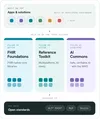
The there pillars: FHIR Foundations, Reference Toolkit, and AI Commons

Supporting healthcare developers worldwide

Over the last three years, an incredible global ecosystem of technical partners — like Argusoft, Ona, IntelliSOFT, IPRD Solutions, KushiBaby, Living Goods and many more — have deployed OHS-powered solutions in countries across Sub-Saharan Africa, South Asia and Southeast Asia for a range of different use cases. Together with the broader ecosystem, we have hosted workshops to build capacity and stimulate local, standards-based innovation.

By transitioning the complete Open Health Stack to the global community under the Linux Foundation’s leadership, we are ensuring these critical building blocks are available to everyone and can act as the foundation for the next generation of health innovation.

Get more stories from Google in your inbox.

Done. Just one step more.

Check your inbox to confirm your subscription.

You are already subscribed to our newsletter.

You can also subscribe with a