





惯性聚合 高效追踪和阅读你感兴趣的博客、新闻、科技资讯
阅读原文 在惯性聚合中打开

推荐订阅源

The GitHub Blog
The GitHub Blog
L
Lohrmann on Cybersecurity
T
Threatpost
T
Threat Research - Cisco Blogs
C
Cybersecurity and Infrastructure Security Agency CISA
S
Schneier on Security
Engineering at Meta
Engineering at Meta
Scott Helme
Scott Helme
博客园 - 三生石上(FineUI控件)
Threat Intelligence Blog | Flashpoint
V
Visual Studio Blog
I
Intezer
L
LangChain Blog
Apple Machine Learning Research
S
Securelist
C
Cyber Attacks, Cyber Crime and Cyber Security
B
Blog RSS Feed
M
MIT News - Artificial intelligence
V
Vulnerabilities – Threatpost
T
The Exploit Database - CXSecurity.com
NISL@THU
NISL@THU
Cisco Talos Blog
Cisco Talos Blog
C
CXSECURITY Database RSS Feed - CXSecurity.com
Know Your Adversary
Know Your Adversary
H
Hackread – Cybersecurity News, Data Breaches, AI and More
阮一峰的网络日志
阮一峰的网络日志
CTFtime.org: upcoming CTF events
The Cloudflare Blog
奇客Solidot–传递最新科技情报
奇客Solidot–传递最新科技情报
Vercel News
Vercel News
Stack Overflow Blog
Stack Overflow Blog
The Hacker News
The Hacker News
钛媒体:引领未来商业与生活新知
钛媒体:引领未来商业与生活新知
The Register - Security
Simon Willison's Weblog
Security Latest
Security Latest
C
Cisco Blogs
量子位
Cyber Security Advisories - MS-ISAC
P
Proofpoint News Feed
Cyberwarzone
Cyberwarzone
Y
Y Combinator Blog
C
CERT Recently Published Vulnerability Notes
T
Tenable Blog
让小产品的独立变现更简单 - ezindie.com
AWS News Blog
AWS News Blog
Project Zero
Project Zero
D
Darknet – Hacking Tools, Hacker News & Cyber Security
A
Arctic Wolf
K
Kaspersky official blog

Quantum computing

The latest AI news we announced in May 2026 Our new initiative to apply quantum science and AI to the life sciences Answering your trending questions on World Quantum Day Quantum frontiers may be closer than they appear Building superconducting and neutral atom quantum computers The quantum era is coming. Are we ready to secure it? The 7 finalists in the XPRIZE Quantum Applications competition Our Quantum Echoes algorithm is a big step toward real-world applications for quantum computing Our quantum hardware: the engine for verifiable quantum advantage We’re scaling quantum computing even faster with Atlantic Quantum. 3 real-world problems that quantum computers could help solve Quantum computing education for global policy leaders Meet Willow, our state-of-the-art quantum chip A quantum computing partnership with the University of Chicago and the University of Tokyo How Google is celebrating World Quantum Day Our progress toward quantum error correction Our new Quantum Virtual Machine will accelerate research and help people learn quantum computing World Quantum Day: Meet our researchers and play The Qubit Game 2021 Year in Review: Google Quantum AI Ask a Techspert: What exactly is a time crystal?
Computing takes a quantum leap forward
Hartmut Neven · 2019-10-23 · via Quantum computing

Article's hero media

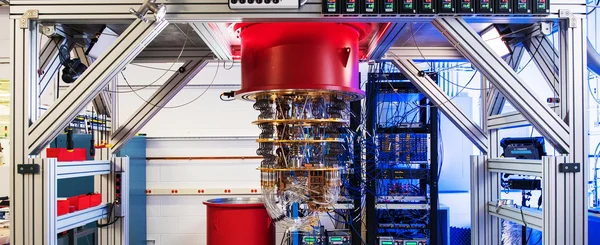
Quantum computing: It sounds futuristic because until recently, it was. But today we’re marking a major milestone in quantum computing research that opens up new possibilities for this technology.

Unlike classical computing, which runs everything from your cell phone to a supercomputer, quantum computing is based on the properties of quantum mechanics. As a result, quantum computers could potentially solve problems that would be too difficult or even impossible for classical computers—like designing better batteries, figuring out what molecules might make effective medicines or minimizing emissions from the creation of fertilizer. They could also help improve existing advanced technologies like machine learning. 

Today, the scientific journal Nature has published the results of Google’s efforts to build a quantum computer that can perform a task no classical computer can; this is known in the field as “quantum supremacy.” In practical terms, our chip, which we call Sycamore, performed a computation in 200 seconds that would take the world’s fastest supercomputer 10,000 years.

This achievement is the result of years of research and the dedication of many people. It’s also the beginning of a new journey: figuring out how to put this technology to work. We’re working with the research community and have open sourced tools to enable others to work alongside us to identify new applications. Learn more about the technical details behind this milestone on our AI blog.
Perspective's hero media

Related stories