
惯性聚合 高效追踪和阅读你感兴趣的博客、新闻、科技资讯
阅读原文 在惯性聚合中打开

推荐订阅源

cs.CV updates on arXiv.org
云风的 BLOG
云风的 BLOG
aimingoo的专栏
aimingoo的专栏
Vercel News
Vercel News
T
The Blog of Author Tim Ferriss
F
Full Disclosure
A
About on SuperTechFans
C
Check Point Blog
让小产品的独立变现更简单 - ezindie.com
量子位
Know Your Adversary
Know Your Adversary
K
Kaspersky official blog
L
LINUX DO - 热门话题
Recorded Future
Recorded Future
C
Cisco Blogs
M
MIT News - Artificial intelligence
T
Tenable Blog
G
GRAHAM CLULEY
月光博客
月光博客
Recent Announcements
V
Visual Studio Blog
IT之家
IT之家
T
The Exploit Database - CXSecurity.com
The GitHub Blog
The GitHub Blog
T
Threat Research - Cisco Blogs
D
DataBreaches.Net
P
Privacy International News Feed
P
Proofpoint News Feed
I
Intezer
博客园 - 叶小钗
C
CXSECURITY Database RSS Feed - CXSecurity.com
The Hacker News
The Hacker News
Cyber Security Advisories - MS-ISAC
博客园 - Franky
SecWiki News
SecWiki News
宝玉的分享
宝玉的分享
P
Palo Alto Networks Blog
Last Week in AI
Last Week in AI
小众软件
小众软件
Hacker News - Newest:
Hacker News - Newest: "LLM"
O
OpenAI News
N
News and Events Feed by Topic
Microsoft Security Blog
Security Archives - TechRepublic
N
News and Events Feed by Topic
The Cloudflare Blog
Spread Privacy
Spread Privacy
酷 壳 – CoolShell
酷 壳 – CoolShell
Exploit-DB.com RSS Feed
B
Blog RSS Feed

Latent.Space

[AINews] Claude Opus 5: Fable-level performance at Opus price (half Fable) [AINews] Black Forest Labs FLUX 3 - Multimodal Flow Models that beat Seedance 2.0, Gemini Omni and Grok Imagine, and FLUX-mimic video-action robotics model [AINews] "Laguna S 2.1 Released: Cheaper than Deepseek v4 Flash, Better than V4 Pro" Inside the Model Factory — Eiso Kant, Poolside AI [AINews] AI Cybersecurity becomes top of mind 🔬Causal Models Need Causal Data - Xaira’s X-Cell model for Drug Discovery (Bo Wang & Ci Chu, Chief Discovery Officer & Chief AI Scientist) [AINews] not much happened today [AINews] not much happened today [AINews] Kimi K3 2.8T-A50B: the largest open model ever released; Opus 4.8-class at Sonnet 5 pricing 🔬 The Lab of the Future Should Feel Like a Data Center — Andy Beam & Rafa Gómez-Bombarelli, Lila Sciences [AINews] Thinky's Inkling: 975B-A41B multimodal, new best American Apache 2.0 open model (with Inkling-Small, 276B-A12B) [AINews] not much happened today 5 Trends That Defined AI Engineering at World’s Fair 2026 [AINews] Codex usage up >10x in 6 months to 7M users, +1M in the past ~day; did Codex overtake Claude Code?? [AINews] not much happened today [AINews] OpenAI launches GPT 5.6 Sol/Terra/Luna, Codex becomes ChatGPT superapp [AINews] SpaceXAI launches Grok 4.5, first Opus-class model post Cursor acquisition Why AI Infrastructure must evolve for Agent Experience — Akshat Bubna, Modal CTO [AINews] Lilian Weng summarizes 35 papers on Harness Engineering for RSI [AINews] The Field Guide to Fable AIEWF Daily Dispatch: The great loops debate and the state of AI engineering Vercel's Andrew Qu on why agents are a new kind of software Skill engineering and the case against one-shot AI design [AINews] not much happened today AIEWF Daily Dispatch: Autoresearch and the tension between AI and human agency Autoresearch: The feedback loop behind self-improving agents How Cursor deploys AI inside the enterprise 🔬 The Coolest Diffusion Research Isn't in LLMs — Evan Feinberg & Sergey Edunov, Genesis Molecular AI Warp CEO Zach Lloyd on why software factories are the next phase of coding AIEWF Daily Dispatch: Loops, Software Factories & Forward Deployed Engineers [AINews] Sonnet 5 today, and Fable 5 tomorrow Forward Deployed Engineers and the future of software engineering Ahmad Osman on why local AI is catching up [AINews] not much happened today [AINews] OpenAI GPT-5.6 Sol / Terra / Luna — restricted to trusted partners [AINews] OpenAI reports median internal Codex output tokens grew 56x in Research, 32x in Customer Support, 27x in Engineering, and 13x in Legal since November 2025. [AINews] It's Meta-Harness Summer Why the Frontier Ecosystem must be Open — Matei Zaharia and Reynold Xin, Databricks [AINews] Claude Tag: Multiplayer, Proactive, Persistent Agents in Slack [AINews] SpaceX is already a $28B/yr Neocloud Red-Teaming after Mythos — Zico Kolter & Matt Fredrikson, Gray Swan How to AIE Good [AINews] not much happened today [AINews] GLM-5.2 is the real deal; Z.ai forecasts Open Fable by EOY The Professor of Outputmaxxing — Anjney Midha, AMP [AINews] Midjourney Medical: scan your organs like you step on a scale 🔬 The Self-Driving Lab — Joseph Krause, Radical AI [AINews] GLM-5.2: the top Frontend Coding model in the world, IndexShare for Speculative Decoding [AINews] Satya on Loopcraft: Building Frontier Ecosystems [AINews] Fable and Mythos officially too dangerous to release [AINews] Loopcraft: The Art of Stacking Loops [AINews] Loopcraft: The Art of Stacking Loops [AINews] Open Models, Model Labs vs Agent Labs, and What's Untrainable — Sarah Guo [AINews] Anthropic Claude Fable 5 — Mythos but Safe, with Controversial Terms [AINews] FrontierCode: Benchmarking for Code Quality over Slop [AINews] not much happened today How to Stop Shipping Low-Quality RL Environments (with Examples) [AINews] not much happened today Reality: The Final Eval — Lukas Petersson and Axel Backlund of Andon Labs [AINews] Reve 2 and Ideogram 4: Layouts in Imagegen 🔬Scaling Past Informal AI - Carina Hong, Axiom Math ⚡️Satya Nadella: No Priors x Latent Space Crossover Special at Microsoft Build [AINews] Microsoft Build: MAI-Thinking-1 and MAI Family models GitHub's plan for Agents — Kyle Daigle, GitHub [AINews] NVIDIA Cosmos 3, Nemotron 3 Ultra, and RTX Spark Why Video Agent models are next — Ethan He, xAI Grok Imagine [AINews] Founders and Forward Deployed Engineers [AINews] Anthropic raises $965B Series H, releases Opus 4.8 and Dynamic Workflows/ultracode The Age of Async Agents — Cognition's Walden Yan & OpenInspect's Cole Murray [AINews] Cognition raises $1B in $26B Series D 🔬 ESMFold2: The Bitter Lesson is Coming for Proteins - Alex Rives, BioHub [AINews] New AI Infra decacorns: Fireworks, Baseten (with OpenRouter on the way) [AINews] All Model Labs are now Agent Labs [AINews] New AI Infra unicorns: Exa, Modal, TurboPuffer Giving Agents Computers — Ivan Burazin, Daytona [AINews] OpenAI GPT-next disproves 80 year old Erdős planar unit distance problem for under $1000 Railway: The Agent-Native Cloud — Jake Cooper [AINews] Google I/O 2026: Gemini 3.5 Flash, Omni (NanoBanana for Video), Spark (background agents), and Antigravity 2.0 [AINews] How to land a job at a frontier lab (on Pretraining) The Autonomous Drone Tech Stack & Economics of Drones — Yaroslav Azhnyuk, The Fourth Law & Guest Host Noah Smith, Noahpinion [AINews] Cerebras' $60B IPO: Slowly, then All at Once [AINews] Everything is Conductor AI-Native Healthcare: 100M Doctor Visits, 10–20 Hours Saved, Prior Auth in Minutes — Janie Lee & Chai Asawa, Abridge [AINews] Codex Rises, Claude Meters Programmatic Usage [AINews] The End of Finetuning [AINews] Thinking Machines' Native Interaction Models - TML-Interaction-Small 276B-A12B - advances SOTA Realtime Voice and kills standard VAD
The website of the future may assemble itself for every visitor
Richard MacManus · 2026-07-03 · via Latent.Space
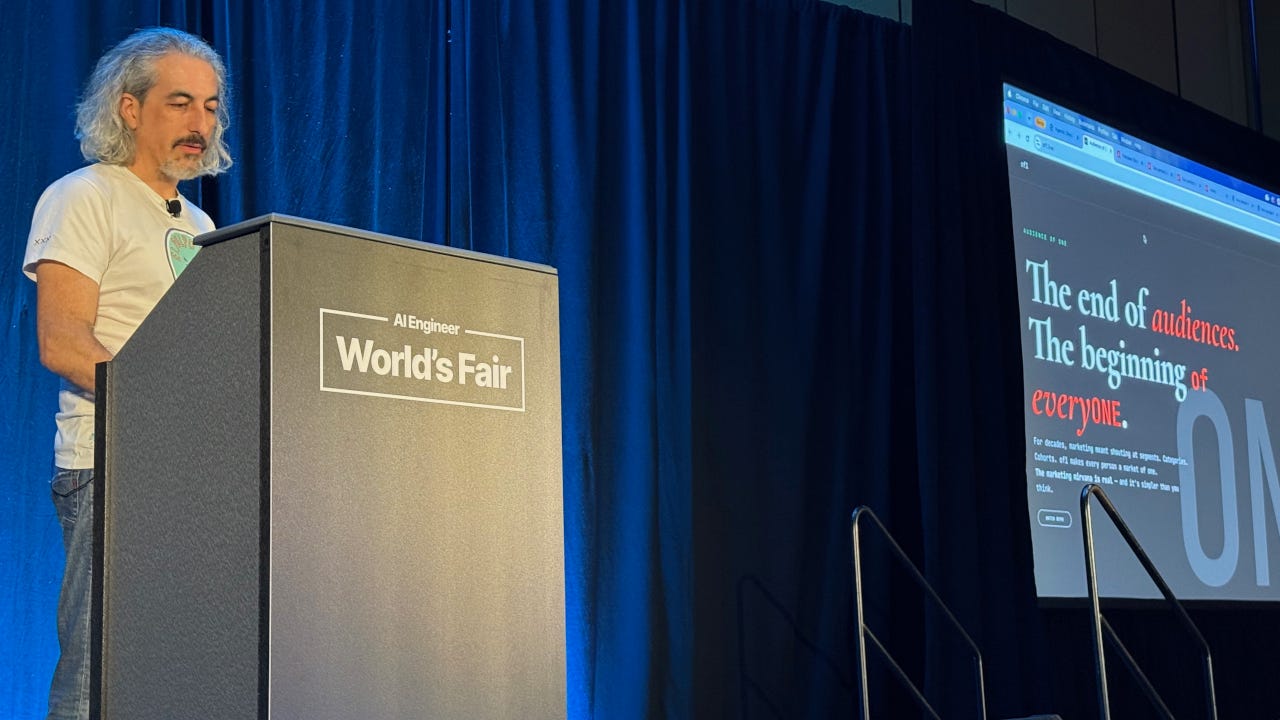
Adobe Principal Scientist Carlos Sanchez at AIEWF.

For as long as I can remember (and I managed websites in the dot-com period), “personalization” has been a holy grail for websites. But up till now, that’s typically meant selecting from a predefined set of options. A retailer might recommend an item based on a previous purchase, or place a visitor into one of several audience segments — that’s been the extent of personalization.

Adobe Principal Scientist Carlos Sanchez is exploring a more radical possibility: what if the website itself could be assembled around the needs of each visitor?

At the AI Engineer World’s Fair in San Francisco, Sanchez demonstrated what Adobe calls an “agentic site” — a web experience that interprets a visitor’s intent, retrieves relevant material from the company’s existing content, and composes a personalized page in real time.

Adobe calls this approach an “audience of one.” Sanchez’s larger point was that the technology is no longer hypothetical.

“Many people don’t even think it’s possible to generate a web page on the fly,” he told Latent Space after his session. “People think it is future-looking. No, you can do this. It’s not the future, it’s the present now.”

During his presentation, Sanchez demonstrated a site that used the visitor’s browsing behavior and search queries as signals. The system grouped those signals into an intent category — such as exploring, researching or preparing to purchase — and then used an LLM to assemble a page suited to that intent.

In one example, a visitor interested in camping received a version of a coffee-machine site whose copy, product selection and supporting content had been reorganized around making coffee outdoors.

Sanchez also showed a more open-ended interface in which someone could enter a query such as “Europe AI conferences” and receive a page composed specifically around that request.

“We call this ‘audience of one,’ because the idea is to personalize the site in real time based on the user accessing it and what the user is doing,” Sanchez said.

The idea is that the site’s existing content is the grounding corpus. Adobe’s system retrieves from that material rather than asking an LLM model to invent an entire experience from scratch.

For AI engineers, one potential constraint is latency. In his session, Sanchez said that Adobe evaluates models not only for accuracy, but also for speed: “We don’t want the site generation to take more than one or two seconds.”

Sanchez says the economics are already becoming plausible. He estimated the current inference cost at “one to two cents per page.”

“But our point is also this is only going to get cheaper,” he said. “This is where we are today. In six months, who knows where we’re going to be.”

Adobe has not yet broadly deployed these experiences on production customer sites. Sanchez said the company is presenting the concept to customers and looking for organizations willing to experiment.

Commerce is an obvious initial use case, because personalization can be connected directly to conversion. But the opportunity is not necessarily limited to retail. “It could work for other things — anything that needs more conversion and has a big matrix of user types or personas,” he told me.

Still, Sanchez acknowledged that he’s unsure if agentic sites will become a widespread reality.

“With AI, it’s very easy to build things, but it’s hard to know what to build,” he said. “We build things and then we find the customers.”

It’s not just Adobe feeling the uncertainty around its ‘audience of one’ concept. Website owners are currently evaluating all kinds of AI functionality: chat interfaces, structured content (like WebMCP), generative UI, personal agents, and more. Not to mention trying to find ways to bring users in from third-party AI platforms.

“I think it’s a combination of all these crazy different ways,” Sanchez said. “You are in a chat, I want to show UI, I want to get you to buy something. Then you’re in a site, I want to steer you this other way. Maybe you’re in an OpenAI chat and I want to bring you into my site. Everybody’s trying to figure this out on the marketing side.”

Of course, websites in 2026 and beyond won’t just be personalized for human visitors.

As personal agents become more capable, a user may delegate some purchases or research tasks entirely. The agent could arrive carrying a much richer expression of the user’s preferences than the destination site could infer from cookies or recent browsing behavior.

Sanchez expects websites to evolve for both kinds of visitor. “Whether it’s going to be two versions [of a website] or not, that may be blurry,” he said. “But obviously, you’re going to have to target both.”

Also, not every transaction will work the same way. A personal agent might autonomously reorder toilet paper, while a person buying a jacket may still want to inspect the product and make the final choice through a visual interface.

That means websites will need to support different levels of delegation and involvement, rather than treating “agentic commerce” as a single interaction pattern.

Technologies such as WebMCP could allow a site to expose structured tools directly to an agent, while MCP Apps and other generative interfaces could bring interactive product experiences into the user’s chat environment. An A2A backend might allow agents to interact without traversing the conventional visual site at all.

It might end up being one site with both visual components and agent-accessible tools — two distinct experiences — or perhaps a human-facing website paired with an agent-to-agent service.

“That’s still what everybody’s trying to figure out,” Sanchez said. “But there’s going to be agentic targeting, for sure.”

Whether websites survive the AI era at all is another big question we’re all grappling with.

What I gleaned from Sanchez at AIEWF was that the traditional website is unlikely to disappear completely, but its role will surely change.

Rather than being a fixed collection of pages that every visitor navigates, a “website” could become a governed content and interaction system that assembles an appropriate interface on demand. At least, that’s the future that Adobe is actively exploring.