





I think you should vibe code your app. At least at first.
LLMs have made it incredibly cheap to turn an idea into something you can use. That’s especially exciting for ideas that would have never survived the old cost of software development. Every company has things that might be useful to build someday, but probably aren’t worth putting six people on for three months just to find out.
Now you can find out for virtually nothing.
Where companies get into trouble is assuming that because AI made it cheap to discover a product, it also made it cheap to build that product well. Those are two very different problems.
My advice is to vibe code while you’re figuring out what to build. Once you know you’ve found something valuable, it’s time to decide whether the code you wrote to answer the question is really the code you want to build the answer on.
One of the most expensive parts of software development has always been getting far enough into an idea to discover whether it’s any good. A new internal tool might save hundreds of hours a year, but is it worth taking developers off the core roadmap to find out? A new customer experience might open another revenue stream, but how much should you invest before a customer has actually seen it?
AI has dramatically reduced the cost of answering those questions. Someone who understands the problem can make something surprisingly sophisticated, put it in front of people, and learn from what happens. That’s not half-baked software development. That’s a better way to prototype.
I’ve written before that a prototype is not a product, it’s a conversation. Vibe coding lets a lot more people join that conversation.
A bad prototype is easy to throw away. A good prototype can be much more dangerous.
It looks like software. It smells like software. It even behaves like software. People like it. And maybe someone has already started depending on it to do their job. Suddenly, throwing anything away feels wasteful. Beware of confirmation bias. People will be more likely to give you positive feedback on your idea which can create an illusion that there is more buy in or value in the prototype. We use shaping sprints to help us combat this and ensure what we build is actually what people want and need.
But a prototype is optimized for learning quickly. A production application has a different job. It needs to be secure, reliable, maintainable, accessible, observable, and able to change as the business changes. Software has always had an iceberg problem. AI just got remarkably good at generating the part above the water.
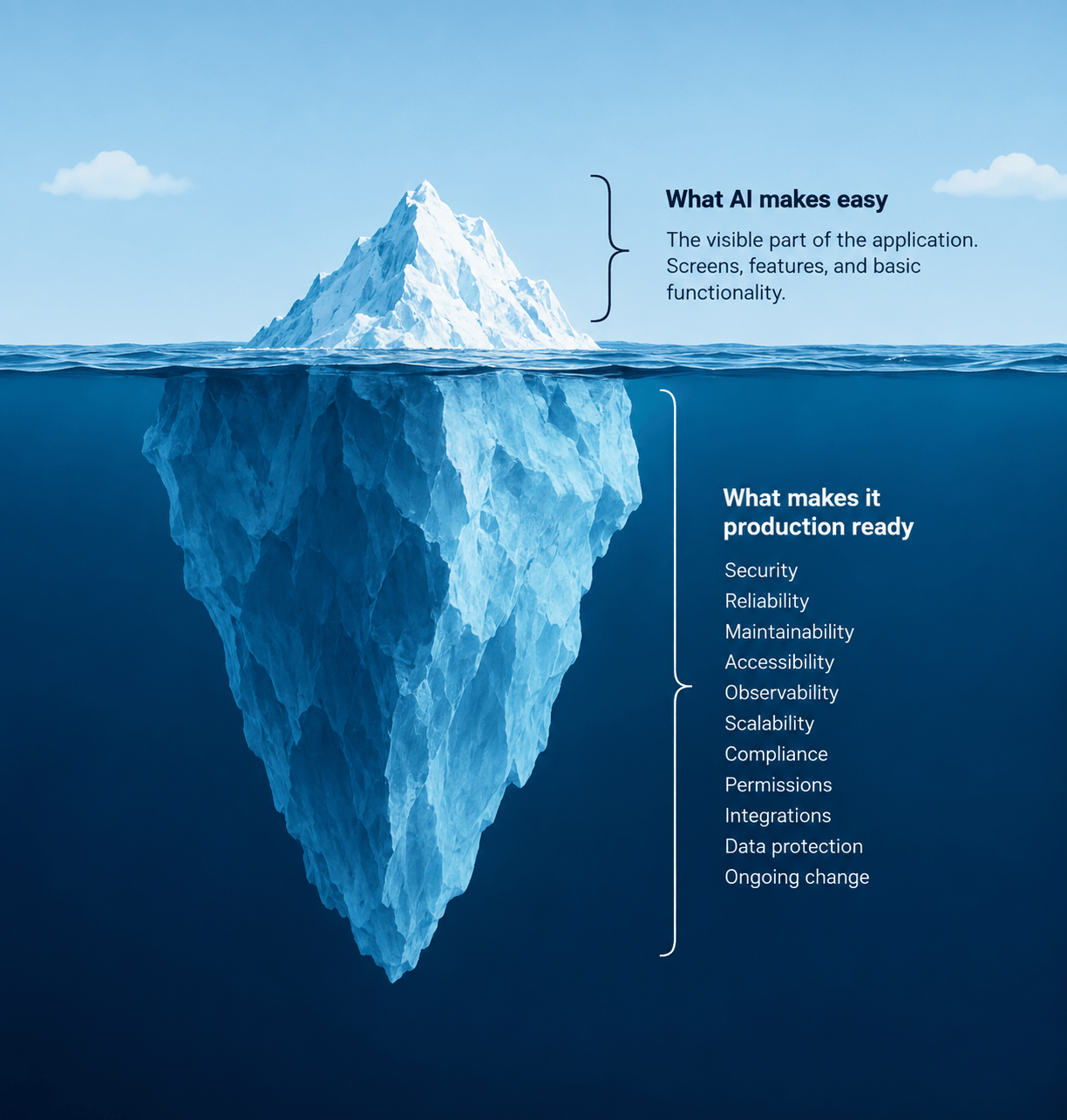
This is part of what I meant when I wrote don’t hire thoughtbot to write code. Code is becoming cheaper to produce. The judgment surrounding that code is becoming more valuable.
Vibe code aggressively when the biggest risk is that the idea is wrong.
If you don’t know whether customers want something, whether an internal workflow makes sense, or whether a new product deserves funding, make the cheap version. Change it. Put it in front of people again. Learn what you were wrong about.
This is particularly interesting for established companies. There are probably people inside your company who understand a customer or operational problem incredibly well but have never been able to get their idea onto an engineering roadmap. Now they can make the idea tangible before asking the company to make a major investment.
Vibe coding doesn’t just make software cheaper to build. It also makes software cheaper to say no to.
Start spending real money on professional product development when you have evidence that the idea deserves a real investment, but not a minute before.
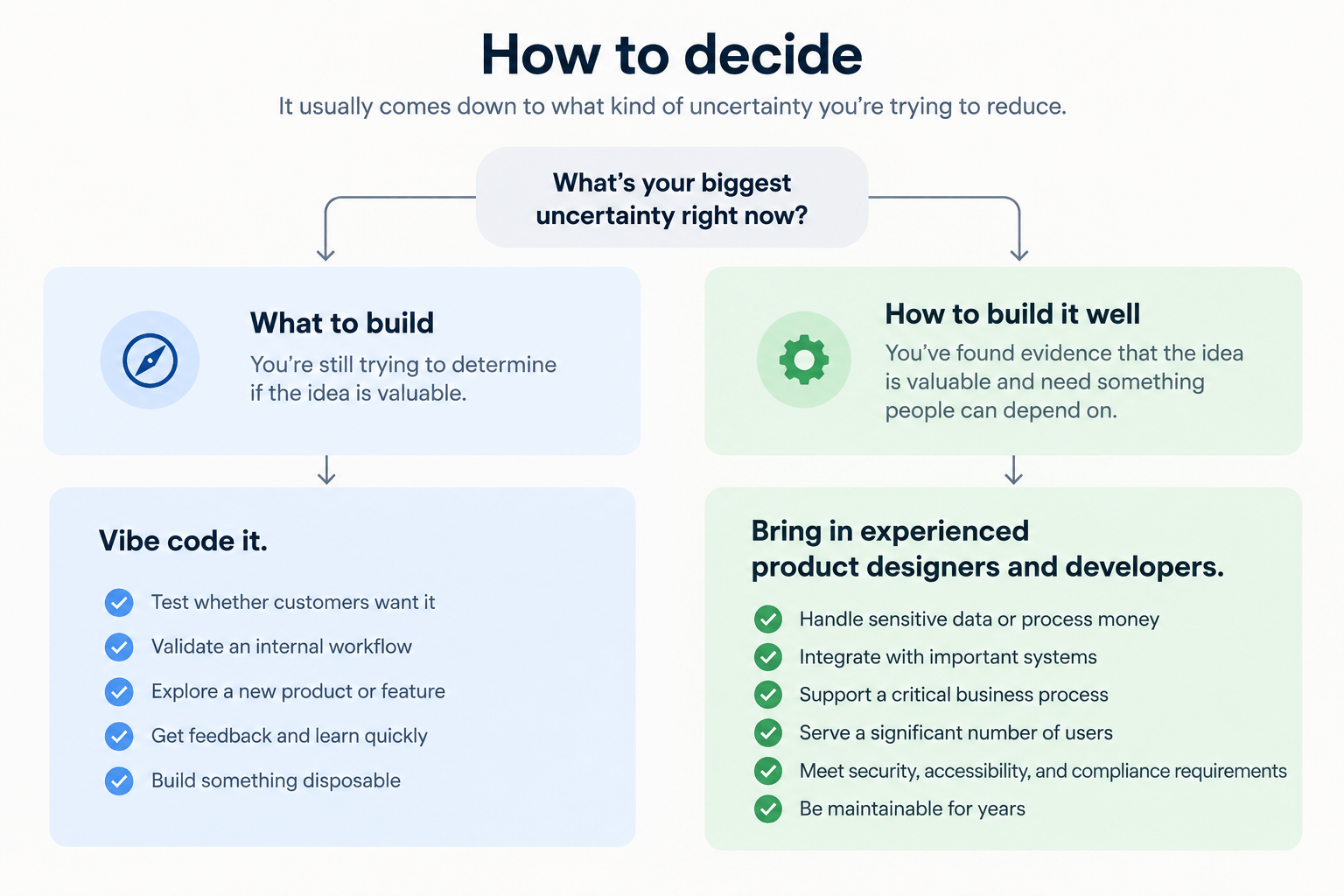
That point comes sooner when the application handles sensitive data, processes money, integrates with important systems, supports a critical business process, or will be used by a significant number of customers or employees.
It comes much sooner in regulated industries. A vibe-coded healthcare prototype can be a fantastic way to test a patient experience. That doesn’t mean I want the same prototype storing protected health information next week.
Security, privacy, accessibility, auditability, permissions, and compliance aren’t things you sprinkle onto an application once people like the demo. They should influence how the application should be built in the first place.
I’ve written more about this in AI makes creating software faster, but in regulated industries, judgment matters more.
Over the last couple of years, we’ve been asked to evaluate a number of substantially vibe-coded applications. Some of these have been exceptionally well-written, but most have had serious gaps. So far, particularly in regulated industries, we haven’t seen a single one where fixing the existing application was clearly less work than rebuilding it properly.
That will change as the tools improve. But I also think we’re asking the wrong question.
If you spent \$15,000 building a prototype that saved you from spending \$200,000 building the wrong product, that was money well spent even if we throw away every line of code. The return on a prototype should be measured in what you learned, not how many lines of code you managed to keep.
A good vibe-coded application might clarify the workflows, expose bad assumptions, prove demand, or secure funding. By the time a professional team gets involved, you may know far more about what should be built than if you’d hired them on day one.
The prototype wasn’t the first version of the product. It was the research that made the first version better.
When you’re uncertain about the idea, optimize for learning and vibe code it. Once you know the idea is valuable and the uncertainty shifts to how to make it secure, scalable, maintainable, and ready to become part of a real business, bring in experienced product designers and developers.
There is an exception if you genuinely want to become the long-term developer of the application yourself. If so, keep going and keep learning.
But if your actual job is going to be running the business, leading a product organization, practicing medicine, selling insurance, or doing anything other than becoming the developer of this application, don’t accidentally give yourself a second career because the prototype was fun and easy to make.
I want companies to vibe code more, not less. There are good ideas sitting inside companies right now that would have been irresponsible to spend \$150,000 exploring a few years ago. We should explore them now.
Just don’t assume there needs to be a continuous line of code between the thing that helped you decide what to build and the thing your business ultimately depends on.
此内容由惯性聚合(RSS阅读器)自动聚合整理,仅供阅读参考。 原文来自 — 版权归原作者所有。