



惯性聚合 高效追踪和阅读你感兴趣的博客、新闻、科技资讯
阅读原文 在惯性聚合中打开

推荐订阅源

Threat Intelligence Blog | Flashpoint
爱范儿
爱范儿
H
Help Net Security
Last Week in AI
Last Week in AI
The Cloudflare Blog
博客园 - 三生石上(FineUI控件)
小众软件
小众软件
IT之家
IT之家
aimingoo的专栏
aimingoo的专栏
大猫的无限游戏
大猫的无限游戏
Jina AI
Jina AI
Google DeepMind News
B
Blog
C
Check Point Blog
T
Tailwind CSS Blog
云风的 BLOG
云风的 BLOG
D
Docker
Recent Announcements
Vercel News
Vercel News
博客园 - 聂微东
阮一峰的网络日志
阮一峰的网络日志
MyScale Blog
MyScale Blog
The GitHub Blog
The GitHub Blog
Stack Overflow Blog
Stack Overflow Blog
雷峰网
雷峰网
人人都是产品经理
人人都是产品经理
月光博客
月光博客
F
Fortinet All Blogs
Blog — PlanetScale
Blog — PlanetScale
B
Blog RSS Feed
The Register - Security
V
Visual Studio Blog
F
Full Disclosure
Hugging Face - Blog
Hugging Face - Blog
T
Threat Research - Cisco Blogs
Latest news
Latest news
PCI Perspectives
PCI Perspectives
Cisco Talos Blog
Cisco Talos Blog
博客园 - Franky
D
DataBreaches.Net
A
Arctic Wolf
OSCHINA 社区最新新闻
OSCHINA 社区最新新闻
奇客Solidot–传递最新科技情报
奇客Solidot–传递最新科技情报
G
Google Developers Blog
P
Palo Alto Networks Blog
Engineering at Meta
Engineering at Meta
Microsoft Azure Blog
T
Tenable Blog
L
LINUX DO - 热门话题
Spread Privacy
Spread Privacy

Hacker News

Introducing Claude Opus 4.7 Qwen Studio The Future of Everything is Lies, I Guess: Where Do We Go From Here? GitHub - SeanFDZ/macmind: Single-layer transformer in HyperTalk for the classic Macintosh Show HN: Agent-cache – Multi-tier LLM/tool/session caching for Valkey and Redis Moving a large-scale metrics pipeline from StatsD to OpenTelemetry / Prometheus GitHub - Nightmare-Eclipse/RedSun: The Red Sun vulnerability repository GitHub - SethPyle376/hiraeth: Local AWS emulator focused on fast integration testing, with SQS support, SQLite-backed state, and a debug-friendly web UI. GitHub - macOS26/Agent: Any AI, replaces Claude Code, Cursor, OpenClaw. Over 18 LLM providers (Claude, OpenAI, Gemini, Ollama, Zai, HF, Qwen) wired into a native Mac app that writes code, builds Xcode projects, bumps versions, manages git, automates Safari, use AppleScript, JS or Accessibility, extend Agent! w/ MCP Servers, run tasks from your iPhone via Messages. YouTube now lets you turn off Shorts I Made a Terminal Pager Burgers | マクドナルド公式 Commands — HackerNews CLI documentation ChatGPT for Excel PiCore - Raspberry Pi Port of Tiny Core Linux Live Nation illegally monopolized ticketing market, jury finds Google Broke Its Promise to Me. Now ICE Has My Data. Founding Engineer at Adaptional | Y Combinator CRISPR takes important step toward silencing Down syndrome’s extra chromosome GitHub - saffron-health/libretto: The AI toolkit for building reliable browser automations US v. Heppner (S.D.N.Y. 2026) no attorney-client privilege for AI chats [pdf] Unexpected €54k billing spike in 13 hours: Firebase browser key without API restrictions used for Gemini requests Retrofitting JIT Compilers into C Interpreters IPv6 – Google The Accursèd Alphabetical Clock Cybersecurity Looks Like Proof of Work Now Fragments: April 14 Cal.com Goes Closed Source: Why AI Security Is Forcing Our Decision | Cal.com - Scheduling Software for Online Bookings Laravel raised money and now injects ads directly into your agent When moving fast, talking is the first thing to break Too much Discussion of the XOR swap trick – Heather Cafe Introduction to Spherical Harmonics for Graphics Programmers The Grand Line Building a Z-Machine in the worst possible language High-Level Rust: Getting 80% of the Benefits with 20% of the Pain GitHub - duguyue100/midnight-captain: Inspired by Midnight Commander, tailored to my taste. How to build a `git diff` driver · Jamie Tanna | Software Engineer Center for Responsible, Decentralized Intelligence at Berkeley The Local Universe’s Expansion Rate Is Clearer Than Ever, but Still Doesn’t Add Up - A new synthesis of astronomical measurements confirms a persistent mismatch that could point to physics beyond current models The air throughout our homes is infused with microplastics. But there are things you can do to breathe less of them The disturbing white paper Red Hat is trying to erase from the internet – OSnews The Future of Everything is Lies, I Guess: Annoyances ‘Abhorrent’: the inside story of the Polymarket gamblers betting millions on war Productive procrastination — Max van IJsselmuiden maps, territory and LMs 447 Terabytes per Square Centimetre at Zero Retention Energy: Non-Volatile Memory at the Atomic Scale on Fluorographane Show HN: Pardonned.com – A searchable database of US Pardons 20 Years on AWS and Never Not My Job The Seasons are Wrong Artemis II crew splashes down near San Diego after historic moon mission We gave an AI a 3 year retail lease in SF and asked it to make a profit | Andon Labs How a dancer with ALS used brainwaves to perform live On filing the corners off my MacBooks Installing every* Firefox extension OpenClaw’s memory is unreliable, and you don’t know when it will break Steve Blank Nowhere Is Safe Chimpanzees in Uganda locked in vicious 'civil war', say researchers watgo - a WebAssembly Toolkit for Go linux/Documentation/process/coding-assistants.rst at master · torvalds/linux GitHub - callumlocke/json-formatter: Makes JSON easy to read. Founding Product Engineer at Bild AI | Y Combinator A compelling title that is cryptic enough to get you to take action on it GitHub - Keychron/Keychron-Keyboards-Hardware-Design: Industrial design files for Keychron keyboards and mice. 100+ models with CAD assets in STEP, DXF, DWG, and PDF. Source-available, with commercial use allowed for original compatible accessories within the license terms. [ANNOUNCE] WireGuardNT v0.11 and WireGuard for Windows v0.6 Released 1D-Chess Helium Is Hard to Replace Cooperative Vectors Introduction | Evolve Keeping a Postgres queue healthy — PlanetScale Our response to the Axios developer tool compromise Do Americans read print books, e-books or audiobooks more? The Zettelkasten Method in Obsidian: A Practical Setup Guide Artemis II Is Competency Porn and We Are Starving For It WeakC4 Flight Viz — Cockpit View A Mexican surveillance giant you’ve never heard of is now watching the U.S. border Surelock: Deadlock-Free Mutexes for Rust RISC-V 101 – what is it and what does it mean for Canonical? | Ubuntu The Problem That Built an Industry How Much Linear Memory Access Is Enough? | Solidean Investigating Split Locks on x86-64 Simplest hash functions Sybilproof reputation mechanisms (2005) [pdf] What is a property? How Complex is my Code? Static code analysis in Kotlin — tools overview Toffoli gates are all you need PGLite evangelism dcmake: a new CMake debugger UI Clojure on Fennel part one: Persistent Data Structures Fragments: April 2 Python Release Python install manager 26.1 The Life and Death of the Book Review - Liberties Introducing Database Traffic Control — PlanetScale Bitcoin miners are losing $19,000 on every BTC produced as difficulty drops 7.8% God sleeps in the minerals Building slogbox Apple Silicon and Virtual Machines: Beating the 2 VM Limit Who was “Not Even Wrong” first? Pokemon Evolution Vs Darwinian Evolution The APL Programming Language Source Code
Magma
mgunlogson · 2026-06-09 · via Hacker News

Magma

Vertical reinforcement infill for FDM 3D printing. A fork of OrcaSlicer that injects molten plastic into sealed lattice channels during printing — for continuous solid Z-axis reinforcement, with no hardware modifications.

⚠️ Experimental. The slicer pipeline works end-to-end. Mechanical print results are still being characterized. Do not report bugs to the official OrcaSlicer repo. This is a research release; help is welcome.


What it does

FDM-printed parts are notoriously weak in the Z-axis because layers only bond at their thin interfaces. Magma changes the infill geometry so that the print contains sealed vertical channels, then it injects molten plastic into those channels during the print itself. The injection comes from the printer’s existing extruder — no new hardware required.

The result, when it works: continuous interlocking solid columns running vertically through the part, mechanically locked into the layer-printed walls.

One paired cell pair, vertical cross-section:

   Before injection:        After injection:

     ┌───┬───┐                ┌───┬───┐
     │   │   │                │███│███│
     │   │   │                │███│███│
     │   │   │      →         │███│███│
     │   │   │                │███│███│
     │   │   │                │███│███│
     │       │                │███████│   ← continuous through window
     └───────┘                └───────┘

  Two adjacent triangle      Injection fills both
  cells sharing a wall,      cells in a continuous
  with a "window" gap at     U-shape, mechanically
  the bottom.                interlocking with the
                             surrounding lattice.
Injection in progress

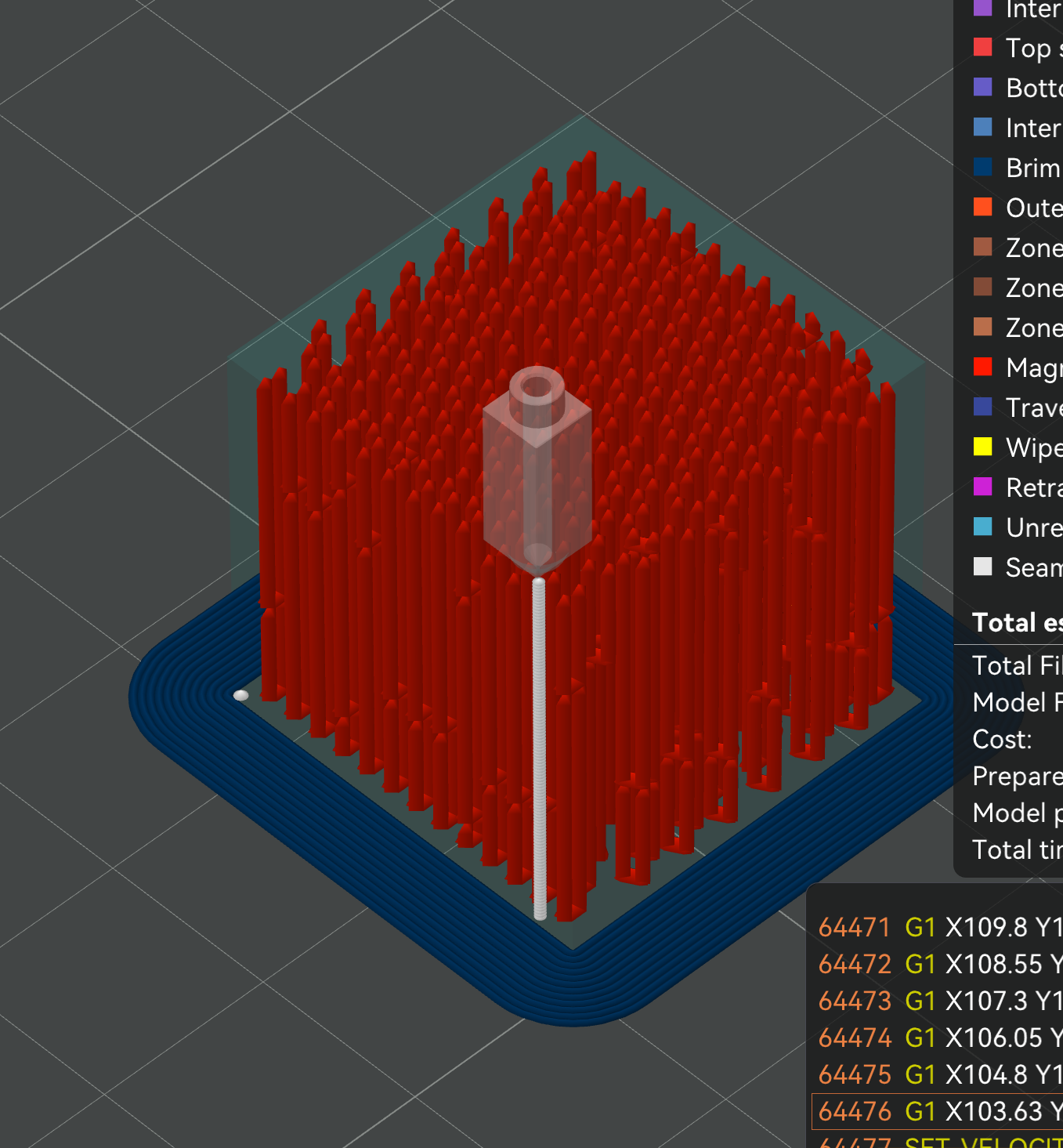
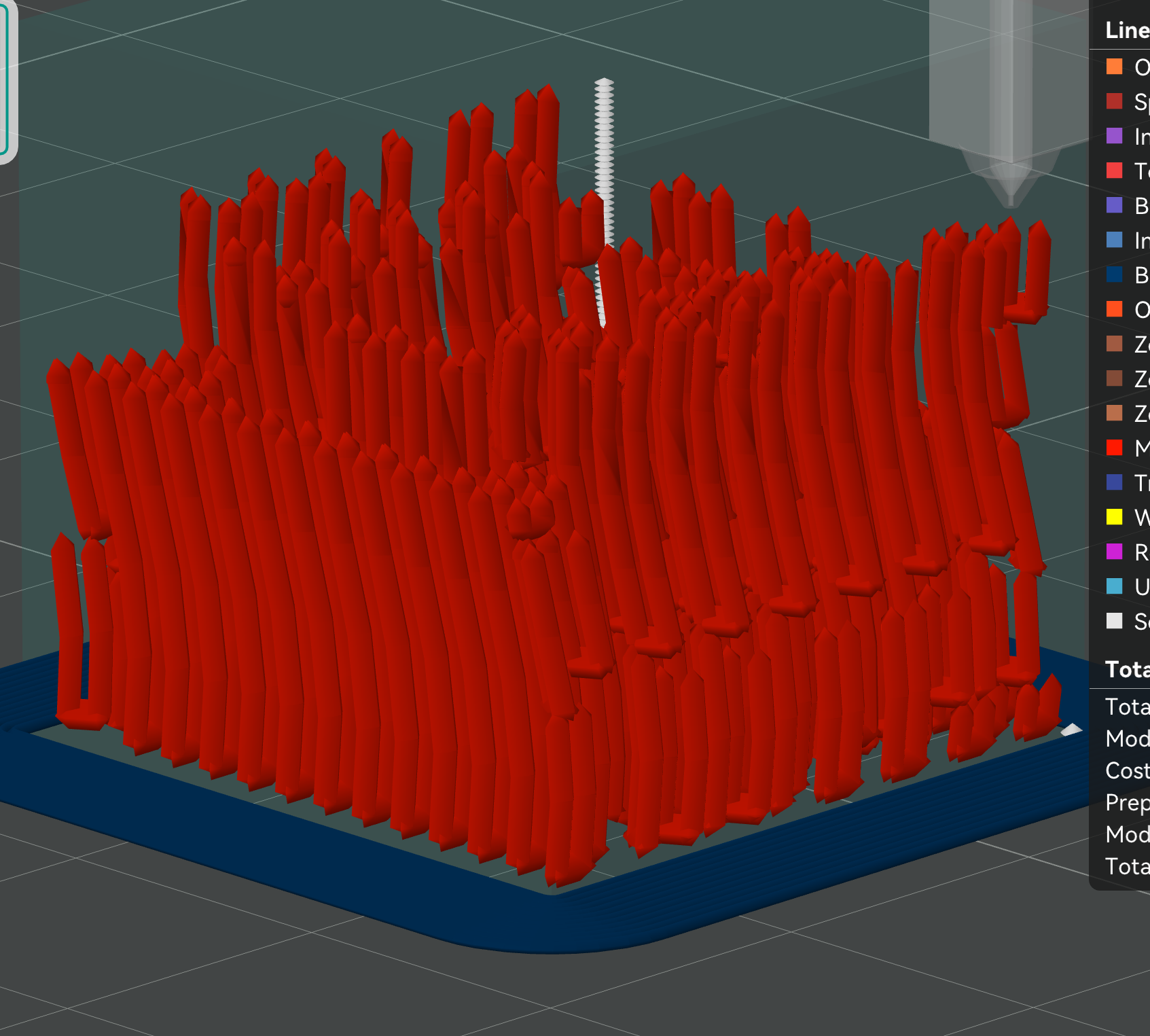
Mid-print injection in GCode preview: the nozzle (white marker) drops into a vertical channel, extrudes a column of molten plastic, lifts, and moves to the next one. Every red column is one of these injection events. They’re what turn an otherwise hollow lattice into solid vertical reinforcement.
Triangle infill with windows

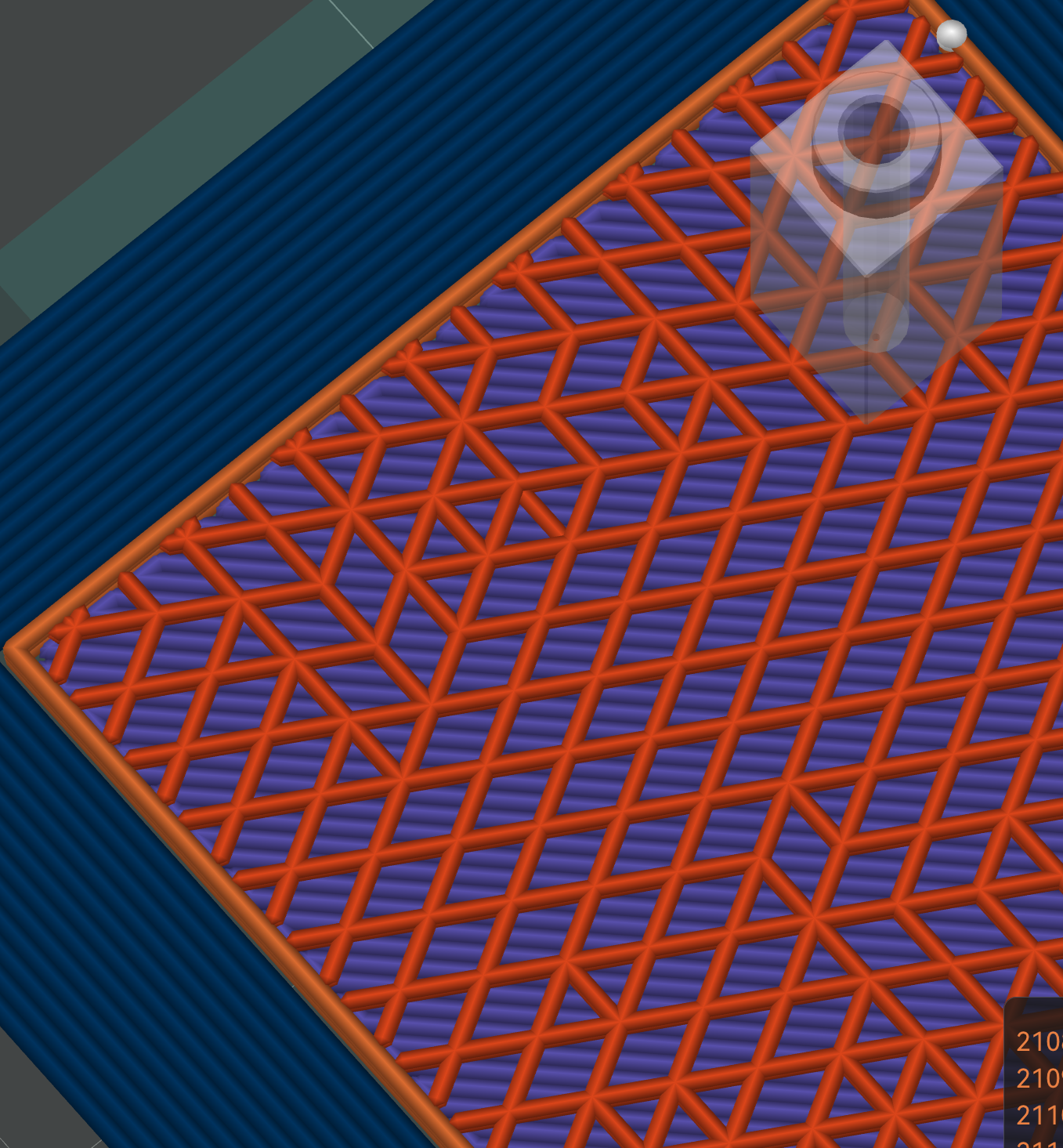
The lattice the injections fill: top-down view of a single printed layer. The orange triangular grid is the outer Magma zone — hollow channels at this stage. The hexagonal gaps in the lattice are windows, where pairs of channels are connected so plastic can flow from one tube into its partner during injection.


Status: works in software, not yet in physical print

I want to be upfront about this. The slicer pipeline is fully functional:

  • Triangle lattice generation with optional spiral interlock
  • Dual-zone infill (Magma outer + configurable inner)
  • Two-stage tube assignment solver (greedy + CP-SAT)
  • Injection G-code with Z-slam sealing, multi-material support
  • Full GCode preview with tube and injection visualization
  • 40+ configurable settings exposed in the UI

What’s NOT yet working: the physical print. On my Ender, same-material plastic injected into freshly-printed cells melts the cell walls before they can seal. The math says this should work; the materials science is the open question.

I’m publishing the software now so people with better setups can experiment.


What you can try (please)

I’ve done the first three. They didn’t work for me, but might for you with better hardware:

  • Lower-melt injection material — PCL (60°C melt), TPU, sugar/wax for lost-wax style applications
  • Dual extruder — print cells in PETG/ABS, inject with PLA
  • Higher injection temperatures — way above print temp, fast injection before damage propagates

Things I haven’t tried that might work:

  • CHT or Volcano nozzles — much higher flow before pressure drop, faster injection before the cell walls heat-soak
  • Redesigned injection nozzles — triangle-shaped with flat sealing faces (a lathe project for someone)
  • Silicone gaskets on the nozzle tip for sealing
  • PTFE or other non-stick coatings to prevent injected plastic from sticking to the nozzle
  • Thermal breaks around the injection nozzle so it doesn’t conduct heat to cell tops
  • Slow injection with long dwell — let the heat soak rather than melt-and-go
  • Larger nozzle bore — more volume per second at lower pressure
  • Post-print annealing — fuse the interfaces after cooling
  • Different injection volumetric flow ratios — current default is 0.5; testing across 0.3-0.9 needed
  • Different z-slam depths — currently default 0.05mm, testing up to 3.5mm might help sealing
  • Variable cell sizes — current default ~5x nozzle diameter; smaller cells would print faster but require finer nozzles

If you find a combination that works, please open an issue or contact me. The community can solve this faster than I can alone.


Multi-material / multi-extruder

I attempted to wire Magma through OrcaSlicer’s multi-material and multi-extruder infrastructure:

  • magma_injection_filament — pick a dedicated filament/extruder for tube injection (so you can print walls in PETG and inject with PLA, for example)
  • dual_infill_outer_filament — pick a different filament for the outer Magma zone
  • Tool-ordering, temperature management, and filament switching are all wired through

I have not been able to test any of this — I only have a single-extruder Ender. The code path exists and slices without errors in my testing, but real multi-material printing might surface bugs I can’t see. If you have a dual-extruder or IDEX setup, please try this and report what breaks.


Get the beta

Source: MGunlogson/OrcaSlicer (magma-infill branch)

Pre-built binaries: Releases page

These are my current best guesses. None have produced a successful print yet — they’re a starting point for experimentation.

Setting Value
Sparse infill pattern Magma Triangle
dual_infill_enabled on
dual_infill_outer_width 5.0 mm
Inner zone infill (sparse_infill_pattern for the inner region) Lightning — strength isn’t the goal here; the inner zone just needs to support the top of the part. Lightning uses the least material.
magma_tube_height 6 mm (max ~6mm seems to work in preview)
magma_nozzle_outer_diameter 3.5 mm (or 2.5 mm for finer cells)
magma_injection_z_slam 0.5–1.0 mm
magma_injection_speed 8 mm³/s
magma_tube_fill_factor 0.5–0.9 (start higher)
magma_tube_solver_mode Basic — the CP-SAT (Refined) solver is much slower and only really helps on complex geometry
magma_spiral_interlock off — see notes below

Full configuration reference: RELEASE.md

How it works (high level)

  1. Slice with Magma Triangle infill. The slicer generates a triangular lattice. Adjacent cells are paired and connected by “windows” (gaps in the shared wall) at the bottom of each tube pair.
  2. Print normally. The printer prints each layer’s walls, perimeters, and infill — including the cell walls that form sealed tubes.
  3. Inject during print. At configured points in the print, the printer pauses motion, drops the nozzle to the top of a tube, extrudes molten plastic to fill the tube + its U-tube partner, lifts, and continues.
  4. Result. As the print finishes, every tube pair is a continuous solid column of injected plastic, mechanically interlocking with the surrounding lattice.

Tube structure with windows

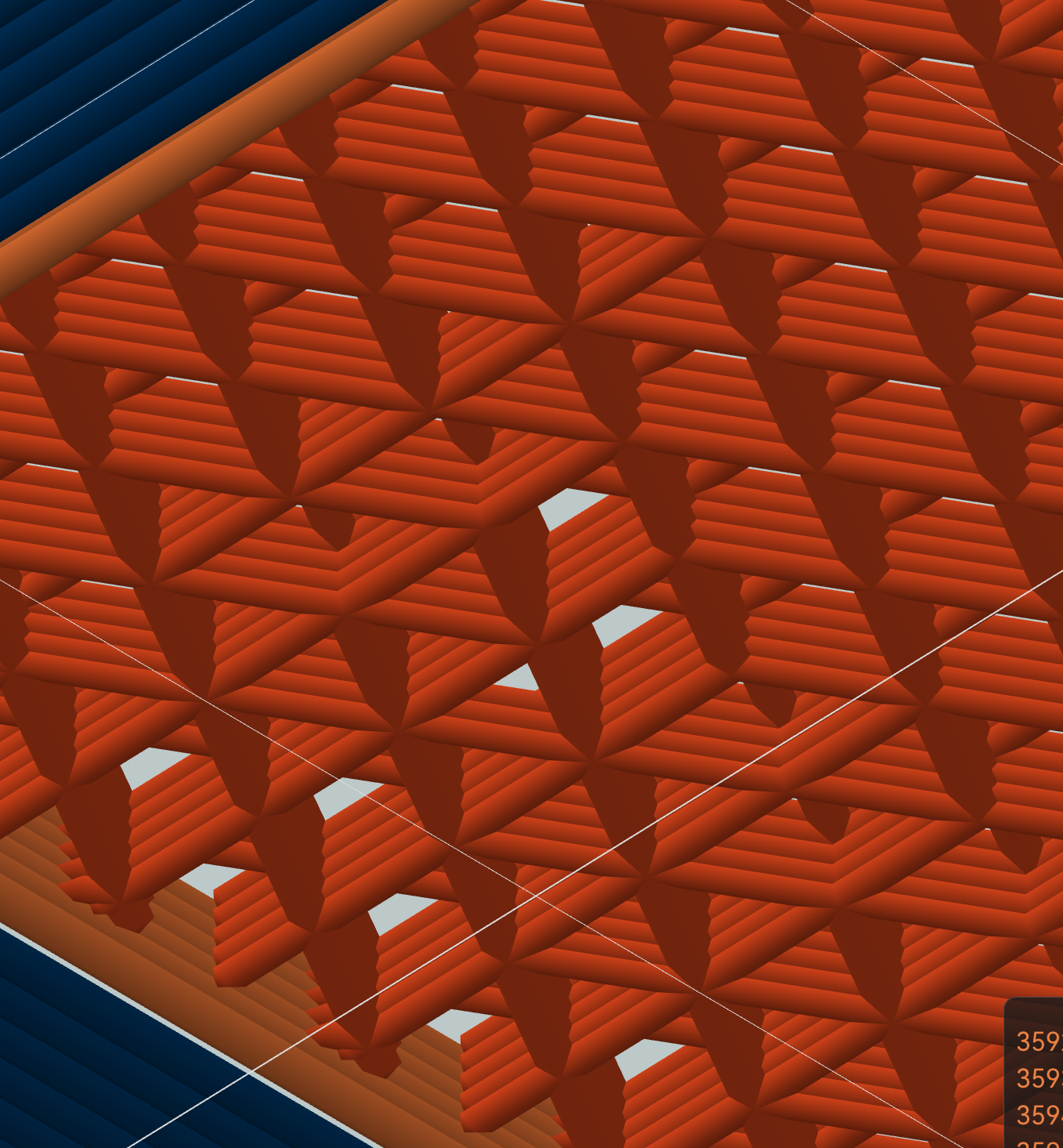
Close-up of the lattice from inside the part, showing the windows — every paired cell has a gap in its shared wall so plastic injected into one tube flows through and fills its U-tube partner.
Dual zone fill

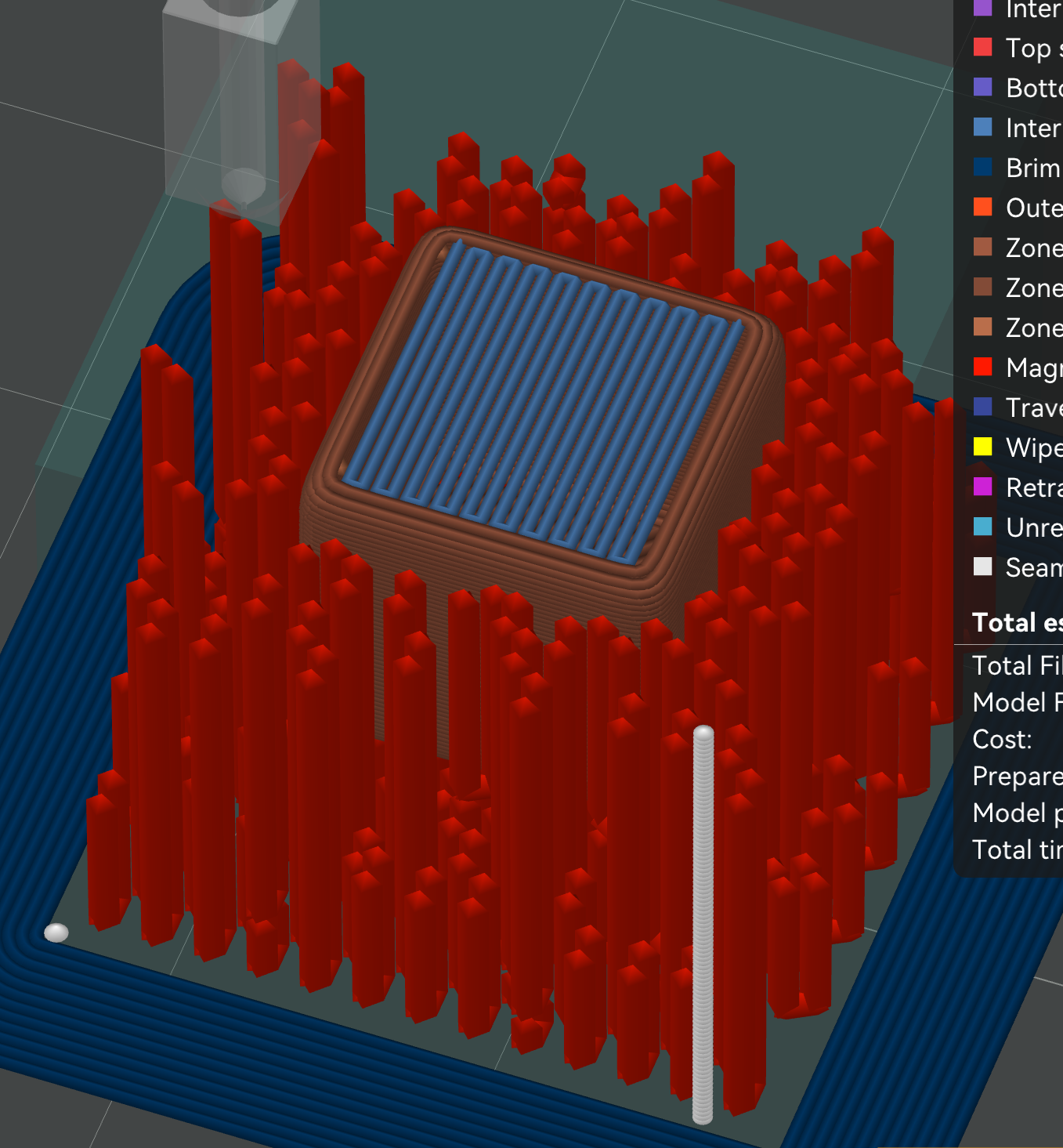
Cutaway preview after slicing: the red Magma triangle tubes form the outer reinforcement zone, surrounding the solid blue inner zone (yolk). The brown band visible above the inner solid is the zone-boundary shell — perimeter walls between the two zones.
Spiral interlock

With magma_spiral_interlock on, the entire lattice rotates slightly per layer — the result is helical tube paths rather than straight vertical columns. The intent is mechanical interlock with the surrounding lattice walls (potentially better pullout resistance), but this hasn’t been measured — the actual benefit vs. straight tubes is unknown. There’s a real cost: the spiral arc effectively widens each tube footprint, so fewer full tubes fit, especially in thin sections. Default is off; turn on only if you’re specifically testing this trade-off.
Zone boundary overlay

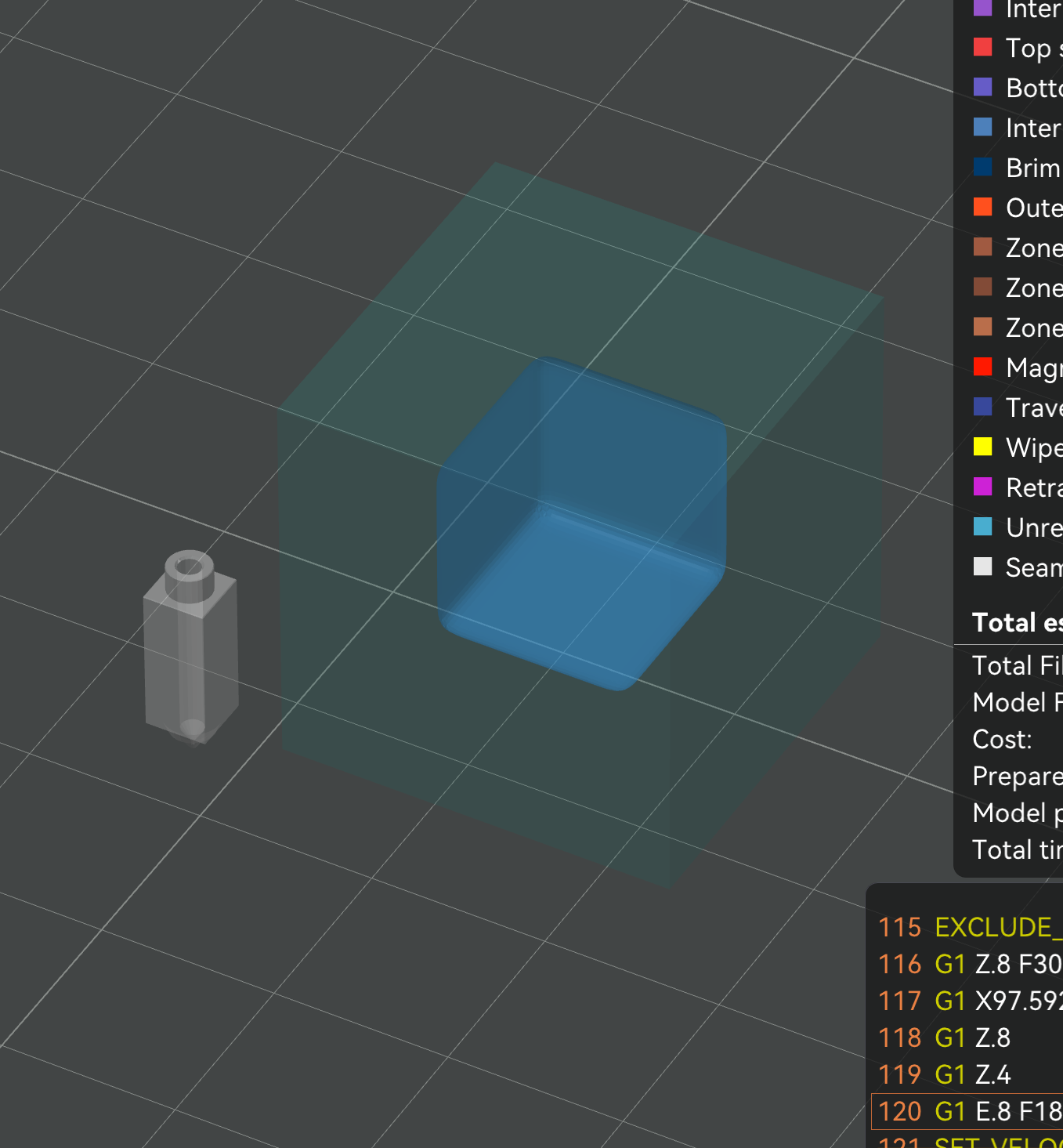
Press J in the preview to toggle the zone-boundary shell overlay — the transparent volumes show the computed inner-zone region (raw vs. smoothed). Useful for diagnosing zone splitting on complex models.

The clever bits are in the solver (figuring out which cells to pair into U-tubes for maximum coverage with weak-plane avoidance), the spiral offset (so tube boundaries don’t form weak Z-planes), and the injection G-code (parking, sealing, multi-material support).

Full design documentation:


Defensive publication

The algorithms, data structures, and techniques in Magma are dedicated to the public domain via a CC0 1.0 Universal defensive publication, dated before public release.

Read it: DEFENSIVE_PUBLICATION.md

This means anyone is free to use, modify, build on, or commercialize any of the techniques. The intent is to prevent third parties from patenting these ideas later.


Why I’m releasing this in this state

I’ve been working on this for months. The software is solid. I don’t have the printer setups, materials, or shop time to characterize all the materials variables, and continuing alone would take another year of trial and error.

The community is much better at materials science than I am. The slicer is the bottleneck — once it exists, anyone with a dual-extruder Voron, a lathe and some brass, or a stash of exotic filaments can experiment in hours.

If this turns into something useful, it should belong to the community. Hence the CC0 dedication.


License

  • OrcaSlicer fork: AGPL-3.0 (inherited from upstream)
  • Magma algorithms and design (this repo): CC0 1.0 Universal — public domain dedication

  • Issues: GitHub issues — for the design/docs
  • Bug reports for the slicer: Fork issuesnot the upstream OrcaSlicer repo
  • Mark Gunlogson — GitHub