






The Internet Movie Database (IMDb) was founded in 1990—an almost inconceivable fact for a website that holds present-day relevance. The site began as a series of Usenet message boards and later evolved into an encyclopedic reference point for all film knowledge.
For a millennial film nerd, IMDb was the playground of my early internet days. I spent endless hours wandering the site, memorizing Oscar winners, reading user reviews, and absorbing an alarming amount of useless trivia. It was thrilling, at least for a certain type of indoor kid, and it was just there, on the internet—for free. I absorbed all IMDb had to offer until my search for film knowledge hit diminishing returns. And then I discovered Letterboxd.
Letterboxd is a hip (slightly more pretentious) IMDb with a greater emphasis on social experience. The site focuses on list creation, with users sharing film preferences through curated guides and movie reviews. Examples of popular lists include:
The site has taken off since the pandemic, amassing tens of millions of users and billions of movie ratings, cementing itself as a pillar of contemporary film-nerd culture. But alas, Letterboxd—and its decidedly twee appeal—may be in danger. Earlier this year, reports surfaced that the startup’s largest investor was looking to sell its 60% stake in the platform, just three years after buying in. The news sparked a familiar anxiety: that Letterboxd has reached a pivotal moment in its development, and that the site’s charm could be corrupted if it falls into the wrong hands.
So today, we’ll explore Letterboxd’s unlikely rise, what makes the platform so distinctive, and the economics underlying its current dilemma.
In the late ‘90s, there was roughly one movie rental store for every 9,000 people in the United States. These stores served as watering holes for film culture, providing a locale for cinephiles to discuss movies and breeding a generation of film lovers and directors, including Quentin Tarantino, Kevin Smith, and Paul Thomas Anderson.
Fast forward to the present day: video stores are nearly extinct, leaving movies without a physical place for community (because people don’t really socialize at theaters).
Enter Letterboxd. If IMDb and early-stage Twitter had a baby, it would look something like Letterboxd: a social network built around the compulsion to log, review, and argue about movies. At its most basic level, the site recreates the feeling of a long, spirited conversation held after the credits roll.
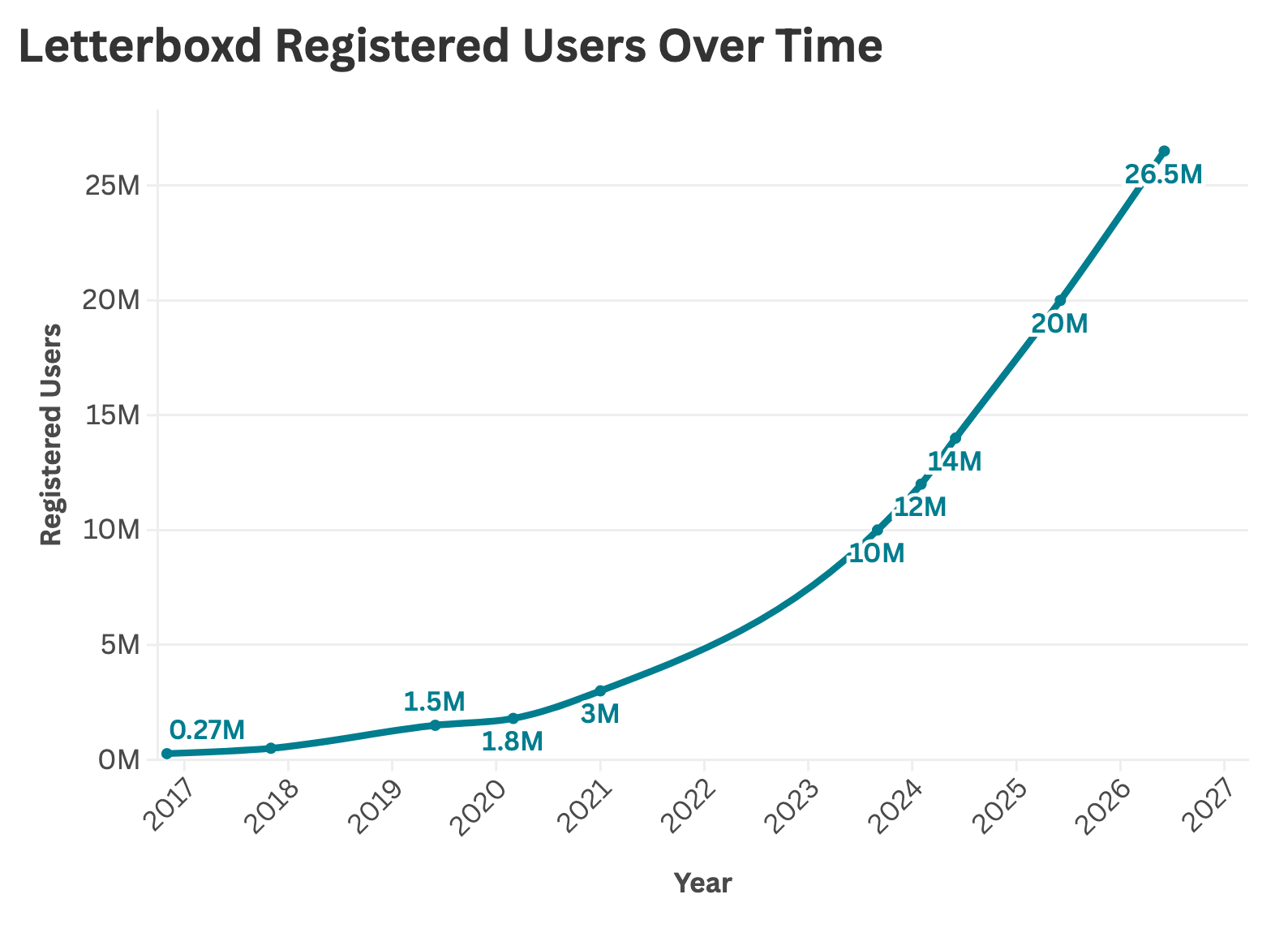
Letterboxd’s popularity has surged since 2020, with the site growing from 1.5 million users in 2019 to more than 26 million by early 2026.
For first-time visitors, Letterboxd may resemble a slightly modernized version of IMDb, which raises a fair question: what’s the big deal? Why does the world need another website where people can argue about Green Book and/or The Last Jedi?
The answer has less to do with the arguments themselves than with who is doing the arguing, and how that audience is reshaping modern movie culture.
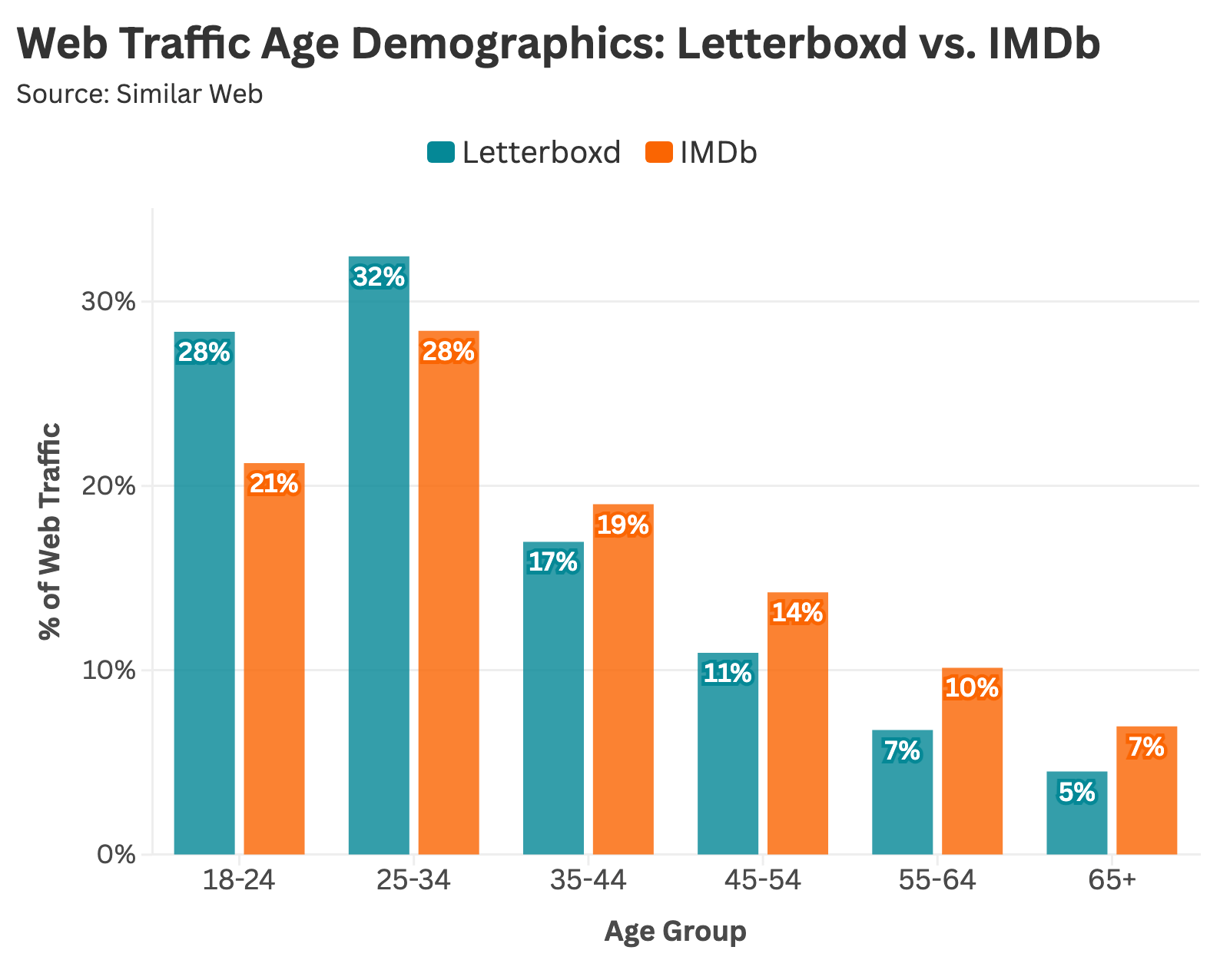
The site’s user base skews younger, helping Gen Z—and soon, Gen Alpha—discover 20th-century classics and little-seen international gems.
A few months ago, I decided to see a Taiwanese film called Yi Yi at the theater down the street from my house. This particular theater does not offer digital ticketing, so seating is determined by arrival time, with most attendees arriving at least 30 minutes in advance. For Yi Yi, I took a more lax approach. How many people were going to see a 25-year-old, three-hour Taiwanese film on a Sunday night?
The answer: a full movie theater’s worth of humans.
Upon arrival, I was shocked to learn that I had received the last available seat for a sold-out screening, leaving me in the literal corner of a 400-person auditorium. Stranger still, nearly everyone in the theater appeared to be under the age of 30.
The reason? Yi Yi currently ranks as Letterboxd’s thirteenth-highest-rated film of all time.
When the movie ended, an audience full of people born after 9/11 burst into vigorous applause. For a brief 30 seconds, I genuinely wondered if I was hallucinating.
I am not alone in this experience. What I witnessed was part of a broader phenomenon media outlets have dubbed “the Letterboxd effect”: younger, digitally native audiences being drawn into movie culture via the platform.
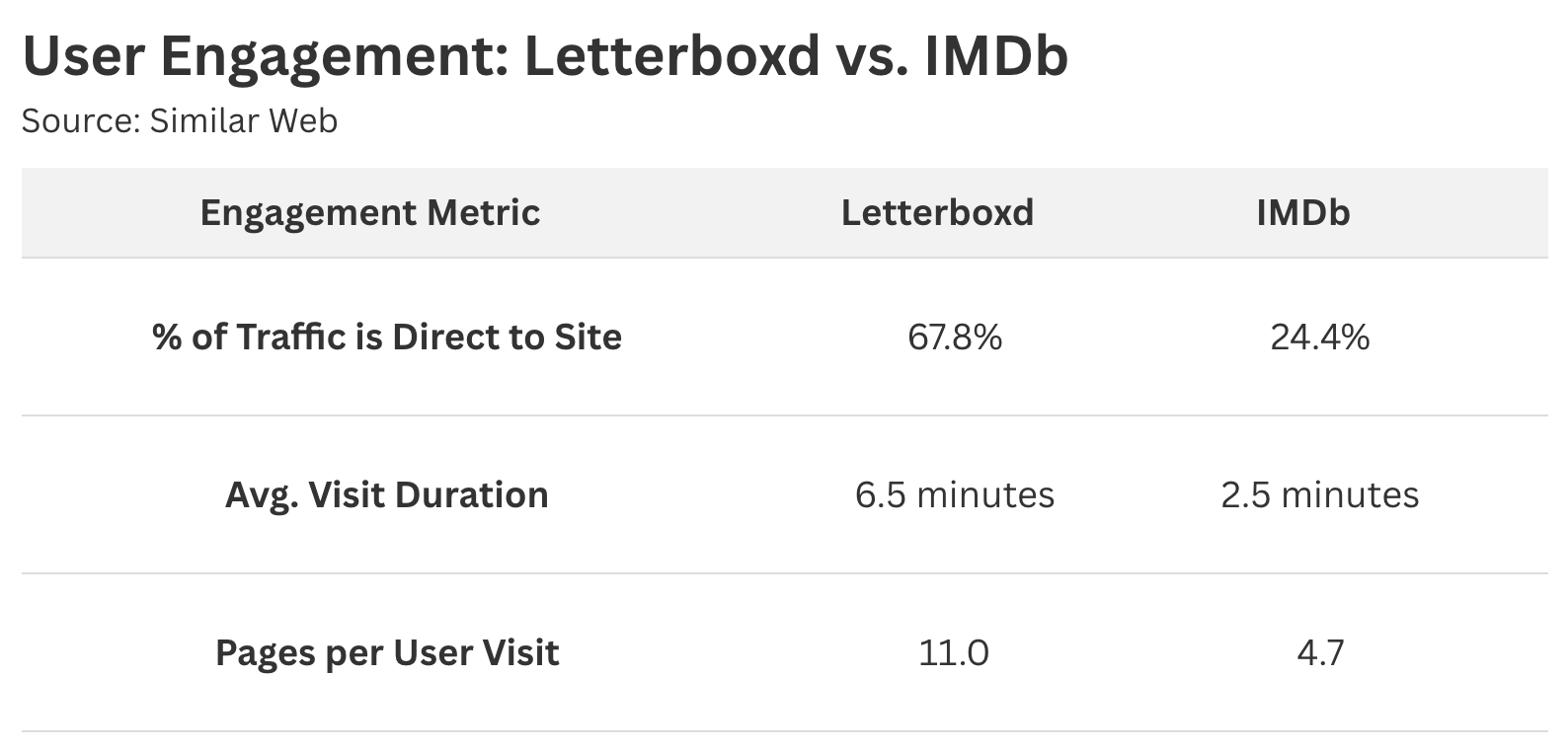
While IMDb functions primarily as an online reference guide, Letterboxd offers something closer to a social discovery engine. Most visitors arrive directly at Letterboxd.com rather than arriving via Google search, and its users tend to spend more time per visit and engage with more content.
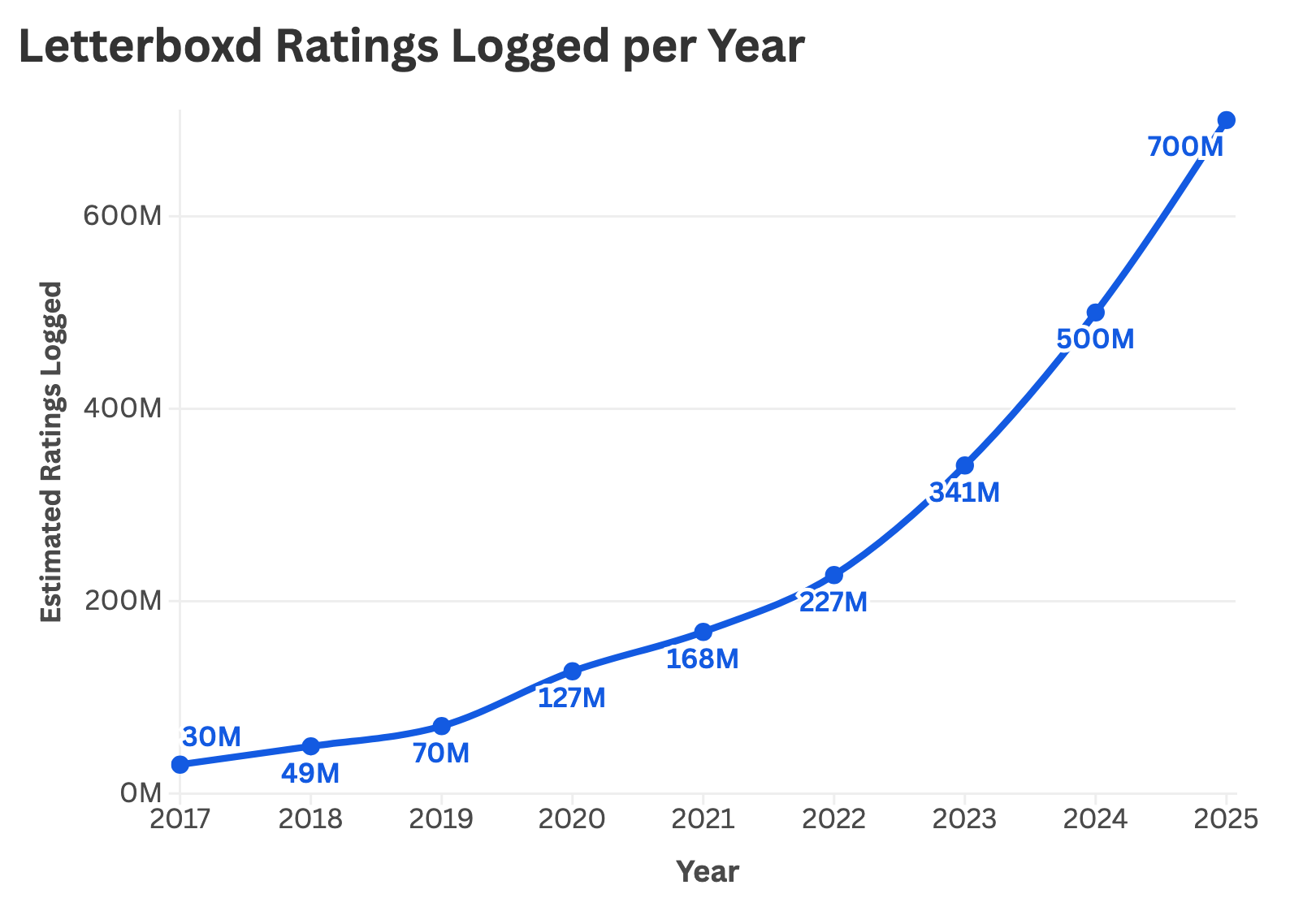
Much of this stickiness can be attributed to the holy grail of digital media: user-generated content. As the site grows, so does its repository of user ratings and reviews, with 2025 seeing an estimated 700 million ratings logged—outpacing IMDb by a significant margin.
On Letterboxd, the reviews can be as entertaining as the movies themselves. I often find myself reading comments for films I’ve never seen, simply because I enjoy eavesdropping on the thoughts of other movie nerds.
By most user-engagement metrics, Letterboxd is a juggernaut: one of the rare 2010s social media startups to achieve critical mass. But there is an important caveat. For all its momentum, Letterboxd has yet to translate its growing user base into meaningful revenue.
The site may have a passionate, highly engaged audience, but its estimated per-user value remains far below that of larger social platforms.
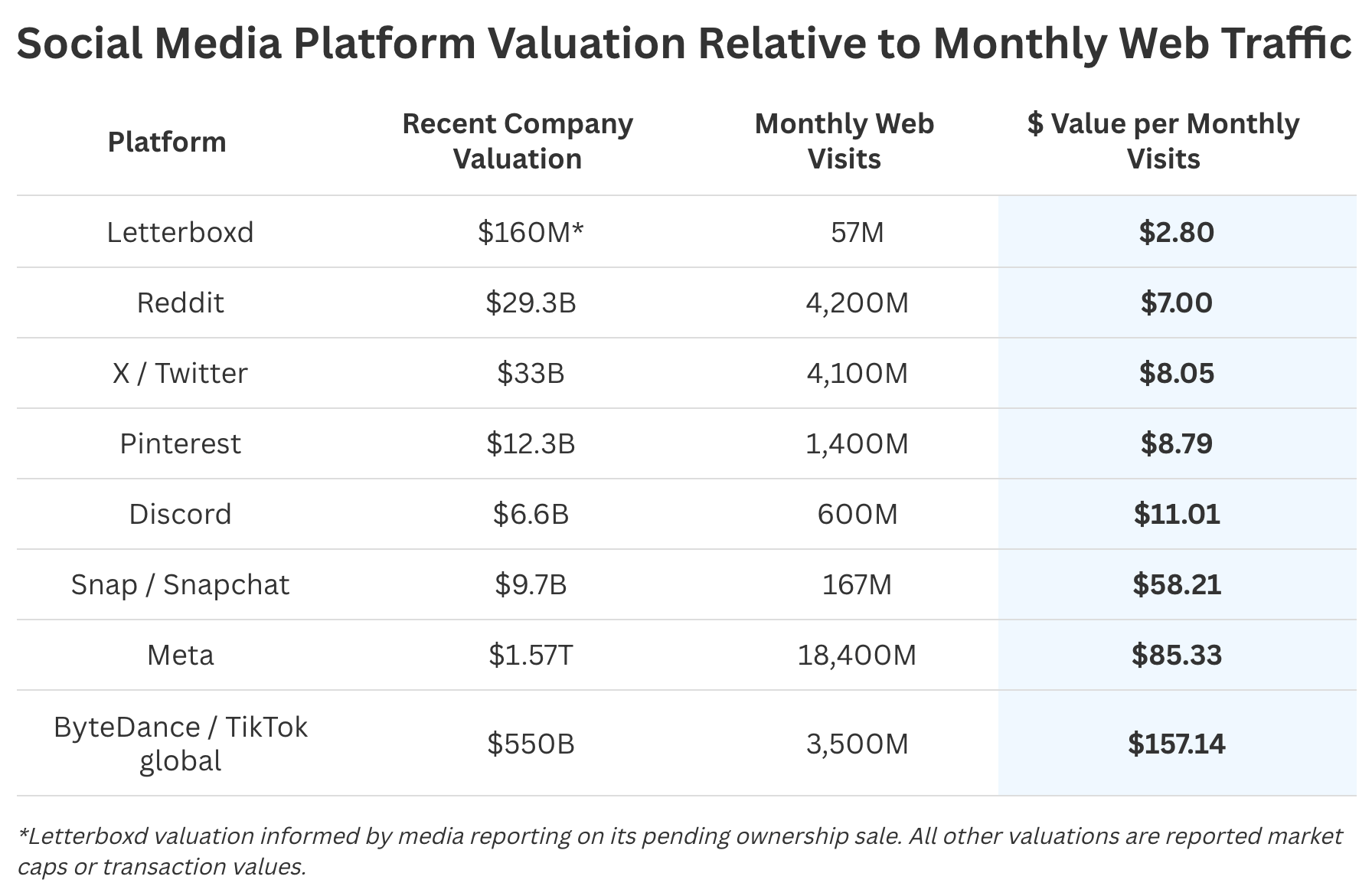
Letterboxd has solved the hard part of building a social platform: getting people to show up, participate, and care. Now comes the even harder part: turning that devotion into revenue. If you’re a heartless corporate goblin, the gap between Letterboxd’s cultural value and its financial performance looks like an obvious opportunity.
This monetization dilemma stokes a familiar anxiety for extremely online individuals: enshittification. The platforms most successful at monetizing their user base tend to follow a familiar playbook: manipulative algorithms, endless gamification, ads for low-quality products, and a social experience increasingly organized around consumption, à la TikTok Shop. Every one of these tactics runs counter to Letterboxd’s stripped-down appeal. Yet if the site fell into the hands of private-equity vampires with little attachment to its Web 1.0 charm, these would be obvious tools for extracting more value from the platform.
To avoid exploitation of the Letterboxd community, a group of industry professionals—including friend-of-the-newsletter Ted Hope—is organizing a crowdfunding campaign to place the site under the control of a public trust.
The proposed structure would resemble Wikipedia’s model: Letterboxd would be governed with an eye toward its long-term existence rather than generating shareholder value for venture capitalists, founders, or private-equity vampires.
Admittedly, I’m a bit skeptical of this approach, since Wikipedia is the only organization that has sustained something like this at a scale comparable to Letterboxd.
But a long-shot effort to preserve something I love still sounds preferable to watching an asset-management firm gradually suck the life out of it.
So, if you would like to help save Letterboxd, you can check out the campaign here.
Or don’t. You’re a free-thinking individual. You can do whatever you want.
Enjoying the article thus far and want more data-centric pop culture content?
As Letterboxd grows, so will its costs, and the expectations of its investors. This dilemma—how to sustain the site’s growth and ambition without eroding its cultural value—sits between two competing parts of my personality.
On one side is the deeply American part of me that believes economic Darwinism should determine what survives and what fades into obscurity. Opposing this impulse is a willfully naive romantic who keeps asking the same question: “Why can’t we have nice things?”
As you might imagine, this internal dialogue mostly consists of me 1) fretting over the endangerment of “nice things,” then 2) answering my own concern with apathetic economic theory. According to the latter, Letterboxd’s existential dilemma is the simple product of a free-market “discovery process,” one that unfolds in two stages:
Identifying a need: for example, people enjoy wearing shoes when walking around outside.
Determining the economic value of that need: The global shoe market is worth billions of dollars, offering a range of price points and styles.
With Letterboxd, these two stages work against each other.
The platform has proven a need exists: cinephiles want a social community where they can log, review, debate, and celebrate movies.
The platform resists maximizing the economic value of that need: much of Letterboxd’s appeal rests on its community focus and its reluctance to introduce disruptive algorithms, aggressive advertising, or unnatural product placement. People like Letterboxd because it extracts relatively little from them—and many would leave if it started to resemble Pinterest, TikTok, or any over-optimized hellscape.
Paradoxically, Letterboxd’s greatest asset may also be the biggest obstacle to its long-term financial sustainability: its user base.
Which brings us back to IMDb, the only other site to build a meaningful social community around movies. How has this 36-year-old website survived all this time? The simplest answer is that IMDb found a benefactor, and that benefactor was Amazon. The Internet Movie Database functions as a loss leader for the e-commerce giant, with its user-generated content utilized in streaming features, movie rentals, and the broader Amazon entertainment ecosystem.
Contrary to my earlier belief, IMDb was never “just there, on the internet, for free.” There was a cost, and that cost was its independence.
Perhaps Letterboxd can defy the odds, operating as a quasi-public utility sustained by benevolent cinephiles. Yet absent a fundraising miracle, all roads may lead to a familiar question: Why can’t we have nice things?
Become a paying subscriber for interactive dashboards, free datasets, and to support independent journalism.
The Stat Significant Dataset Hub (Updated Weekly): a collection of free datasets across movies, music, TV, and economics.
Interactive Data Hubs:
Streaming TV: what people are watching on television.
Movies: the films watched in theaters and on TV, plus historical trends.
Music: the songs, artists, and styles dominating Spotify and TikTok.
Podcasts: the most-listened-to episodes and series.
Wikipedia: the top pages trending on Wikipedia.
*Note: For best results, open this link in a web browser while logged in to your Substack account.
This post is public so feel free to share it.
Want to promote your data tool or media publication to Stat Significant’s 25,800 readers? Email daniel@statsignificant.com
Need help with a data problem? Book a free data consultation
Connect with me on LinkedIn if you want to chat about a data project.
Like movies? Follow me on Letterboxd