












Snapshot isolation (SI) is a popular approach to concurrency control in databases systems. It avoids many forms of anomalies, yet provides a high degree of concurrency, especially for read-heavy workloads. Yet, as shown by a classic paper (Berenson et al. 1995), SI does not guarantee serializability. A concurrent execution of a set of transactions is said to be serializable if it is equivalent to executing the transactions in sequence. Serializability is therefore the strongest guarantee of correctness for database transactions, analogous to sequential consistency in general concurrent programming.1 This has led to attempts to "patch up" SI, including serializable snapshot isolation (SSI) (Cahill, Röhm, and Fekete 2009) which adds addtional checks on top of the standard SI implementation. SSI has been adopted by mainstream systems including PostgreSQL. Personally, I find SSI to be unsatisfying, as it feels like a bolt-on solution to fix the already-broken SI. I was therefore delighted to stumble upon A Critique of Snapshot Isolation (Yabandeh and Gómez Ferro 2012) which describes a method to fix SI by addressing the root cause and guarantee serializability, all by changing one single line of code. I'll distill the core idea of WSI in the rest of this post, and hopefully after reading, you'll feel like you could have come up with the algorithm yourself.
Another benefit of SI is that it's so simple to implement: you fork the DB at the beginning of the transaction, run your queries over your fork, then try to merge the DB back in. If you've used git, this will feel just like merging a branch, and you'd be right to feel that. Under SI, each DB item (say a row) has a timestamp recording the last committed update, then for each transaction at commit time, we check if each item the transaction wants to write has been overwritten since the transaction started. If so, the transaction aborts. In other words, SI avoids writing over "stale values".
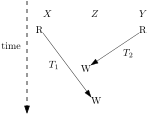
For example, consider the following sequence diagram, where T1 sets Z to X+1, and T2 sets Z to Y+1. Because T2 updated Z as T1 is running, when T1 wants to commit, the Z value it sees has already become stale, so T1 aborts. Concretely, T2 would increment Z's timestamp when it commits, and T1 will see that the last updated time of Z is after T1's own start time.
For another example, suppose T1 wants to set Y to X+1, and T2 wants to set X to Y+1. As the diagram below shows, neither of the transactions is writing over stale value, so both of them succeed.
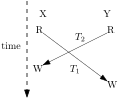
The pair of examples also demonstrate the issue with SI: the first execution is serializable, yet aborted by SI, whereas the second is allowed by SI, but not serializable! In particular, the first example is equivalent to the serial execution where T2 runs before T1, in which case T1 would overwrite T2 anyways. In the second example, both X and Y would be incremented by 1 at the end of execution, but in any serial schedule, one of them would be incremented by 1, and the other one by 2. Overall, this means SI both forbids certain correct executions (false negatives) and permits incorrect ones (false postives).
The issue of snapshot isolation stems from the conflict check: SI checks for write-write conflicts, and aborts upon finding one. But that doesn't really make sense! In fact, you may have felt slightly uneasy when reading "stale writes" above - if a value becomes stale, why is it bad to overwrite it? Because it is not! What we really should be worrying about is stale reads. Intuitively, a transaction would only read a value to calculate what values it should write. Therefore, a stale read would mean the written values based on that read were calculated using outdated data, thereby resulting in inconsistencies in the database. The write-snapshot isolation (WSI) algorithm following (Yabandeh and Gómez Ferro 2012) checks exactly for such stale reads. During WSI execution, we still record the last-updated time for each DB item. But for each transaction T that is about to commit, we check if any value read by T has been overwritten, i.e., become stale. If so, T aborts.
Let's revisit the examples. In the first example, because X has not been updated since T1 read it, the value is still fresh, and T1 successfully commits, even though T2 has written to X in the mean time. T2's write is simply overwritten, and the execution is equivalent to a serial one where T1 runs after T2.
In the second example, because T2 updated X while T1 is running, the value of X read by T1 has become stale when T1 is ready to commit, so T1 must abort.
In general, Yabandeh and Gómez Ferro (2012) proves that WSI guarantees serializability, but also forbids certain serializable executions. In other words, WSI still under-approximates serializability (w.r.t. the set of allowed execution schedules). To show this, the authors gave an example schedule that is serializable yet forbidden by WSI. But, upon a closer look, the serial schedule equivalent to the given example reverses the commit ordering! In other words, the given example violates strict serializability which requires the commit order to be preserved. So one might ask: is WSI necessary for strict serializability? I believe the answer is yes, assuming a lock-free implementation based on MVCC. (Dis)proving this formally is left as an excercise to the reader :)
Yeah, I wonder that too. If WSI is so simple and elegant, why doesn't everyone implement it? One factor is timing: when (Yabandeh and Gómez Ferro 2012) was published, PostgreSQL already patched their SI implementation with additional checks following SSI, thereby guaranteeing serializability. And since that was a bolt-on solution, they did not have to change the SI implementation itself. In contrast, although WSI is a single-line diff on paper, implementing it in a real system can be more involved. On the other hand, SI itself works well enough despite not guaranteeing serializability, whereas WSI will necessarily abort some transactions that would be allowed under SI. This is hinted at by a later paper (Gómez Ferro et al. 2014) by Ferro and Yabandeh that surprisingly does not mention the WSI work at all. In any case, I think people should consider WSI if they are building a new DB system from scratch. I will certainly keep teaching it because it's so beautiful!
Berenson, Hal, Phil Bernstein, Jim Gray, Jim Melton, Elizabeth O’Neil, and Patrick O’Neil. 1995. “A Critique of ANSI SQL Isolation Levels.” In Proceedings of the ACM SIGMOD International Conference on Management of Data, 1–10. https://doi.org/10.1145/223784.223785.
Cahill, Michael J., Uwe Röhm, and Alan D. Fekete. 2009. “Serializable Isolation for Snapshot Databases.” ACM Transactions on Database Systems 34 (4): 20:1–42. https://doi.org/10.1145/1620585.1620587.
Gómez Ferro, Daniel, Flavio Junqueira, Ivan Kelly, Benjamin Reed, and Maysam Yabandeh. 2014. “Omid: Lock-Free Transactional Support for Distributed Data Stores.” In Proceedings of the 30th IEEE International Conference on Data Engineering (ICDE), 676–87. https://doi.org/10.1109/ICDE.2014.6816691.
Yabandeh, Maysam, and Daniel Gómez Ferro. 2012. “A Critique of Snapshot Isolation.” In Proceedings of the 7th ACM European Conference on Computer Systems (EuroSys), 155–68. https://doi.org/10.1145/2168836.2168853.
Strict serializability additionally requires that the transaction order is preserved, analogous to linearizability.↩︎
此内容由惯性聚合(RSS阅读器)自动聚合整理,仅供阅读参考。 原文来自 — 版权归原作者所有。