


惯性聚合 高效追踪和阅读你感兴趣的博客、新闻、科技资讯
阅读原文 在惯性聚合中打开

推荐订阅源

Threat Intelligence Blog | Flashpoint
C
CXSECURITY Database RSS Feed - CXSecurity.com
L
LINUX DO - 热门话题
S
Secure Thoughts
TaoSecurity Blog
TaoSecurity Blog
Security Archives - TechRepublic
T
Threat Research - Cisco Blogs
AI
AI
B
Blog RSS Feed
S
Schneier on Security
雷峰网
雷峰网
Schneier on Security
Help Net Security
Help Net Security
Cloudbric
Cloudbric
L
LINUX DO - 最新话题
罗磊的独立博客
有赞技术团队
有赞技术团队
Recent Commits to openclaw:main
Apple Machine Learning Research
P
Proofpoint News Feed
酷 壳 – CoolShell
酷 壳 – CoolShell
The Hacker News
The Hacker News
博客园 - Franky
Attack and Defense Labs
The Cloudflare Blog
Webroot Blog
Webroot Blog
Last Week in AI
Last Week in AI
Exploit-DB.com RSS Feed
博客园 - 叶小钗
美团技术团队
L
Lohrmann on Cybersecurity
T
The Blog of Author Tim Ferriss
The Last Watchdog
The Last Watchdog
T
Troy Hunt's Blog
H
Hackread – Cybersecurity News, Data Breaches, AI and More
Vercel News
Vercel News
Know Your Adversary
Know Your Adversary
O
OpenAI News
博客园 - 【当耐特】
Hacker News - Newest:
Hacker News - Newest: "LLM"
C
Cybersecurity and Infrastructure Security Agency CISA
让小产品的独立变现更简单 - ezindie.com
www.infosecurity-magazine.com
freeCodeCamp Programming Tutorials: Python, JavaScript, Git & More
PCI Perspectives
PCI Perspectives
H
Heimdal Security Blog
I
InfoQ
GbyAI
GbyAI
T
Threatpost
C
Cisco Blogs

Hacker News

Introducing Claude Opus 4.7 Qwen Studio The Future of Everything is Lies, I Guess: Where Do We Go From Here? GitHub - SeanFDZ/macmind: Single-layer transformer in HyperTalk for the classic Macintosh Show HN: Agent-cache – Multi-tier LLM/tool/session caching for Valkey and Redis Moving a large-scale metrics pipeline from StatsD to OpenTelemetry / Prometheus GitHub - Nightmare-Eclipse/RedSun: The Red Sun vulnerability repository GitHub - SethPyle376/hiraeth: Local AWS emulator focused on fast integration testing, with SQS support, SQLite-backed state, and a debug-friendly web UI. GitHub - macOS26/Agent: Any AI, replaces Claude Code, Cursor, OpenClaw. Over 18 LLM providers (Claude, OpenAI, Gemini, Ollama, Zai, HF, Qwen) wired into a native Mac app that writes code, builds Xcode projects, bumps versions, manages git, automates Safari, use AppleScript, JS or Accessibility, extend Agent! w/ MCP Servers, run tasks from your iPhone via Messages. YouTube now lets you turn off Shorts I Made a Terminal Pager Burgers | マクドナルド公式 Commands — HackerNews CLI documentation ChatGPT for Excel PiCore - Raspberry Pi Port of Tiny Core Linux Live Nation illegally monopolized ticketing market, jury finds Google Broke Its Promise to Me. Now ICE Has My Data. Founding Engineer at Adaptional | Y Combinator CRISPR takes important step toward silencing Down syndrome’s extra chromosome GitHub - saffron-health/libretto: The AI toolkit for building reliable browser automations US v. Heppner (S.D.N.Y. 2026) no attorney-client privilege for AI chats [pdf] Unexpected €54k billing spike in 13 hours: Firebase browser key without API restrictions used for Gemini requests Retrofitting JIT Compilers into C Interpreters IPv6 – Google The Accursèd Alphabetical Clock Cybersecurity Looks Like Proof of Work Now Fragments: April 14 Cal.com Goes Closed Source: Why AI Security Is Forcing Our Decision | Cal.com - Scheduling Software for Online Bookings Laravel raised money and now injects ads directly into your agent When moving fast, talking is the first thing to break Too much Discussion of the XOR swap trick – Heather Cafe Introduction to Spherical Harmonics for Graphics Programmers The Grand Line Building a Z-Machine in the worst possible language High-Level Rust: Getting 80% of the Benefits with 20% of the Pain GitHub - duguyue100/midnight-captain: Inspired by Midnight Commander, tailored to my taste. How to build a `git diff` driver · Jamie Tanna | Software Engineer Center for Responsible, Decentralized Intelligence at Berkeley The Local Universe’s Expansion Rate Is Clearer Than Ever, but Still Doesn’t Add Up - A new synthesis of astronomical measurements confirms a persistent mismatch that could point to physics beyond current models The air throughout our homes is infused with microplastics. But there are things you can do to breathe less of them The disturbing white paper Red Hat is trying to erase from the internet – OSnews The Future of Everything is Lies, I Guess: Annoyances ‘Abhorrent’: the inside story of the Polymarket gamblers betting millions on war Productive procrastination — Max van IJsselmuiden maps, territory and LMs 447 Terabytes per Square Centimetre at Zero Retention Energy: Non-Volatile Memory at the Atomic Scale on Fluorographane Show HN: Pardonned.com – A searchable database of US Pardons 20 Years on AWS and Never Not My Job The Seasons are Wrong Artemis II crew splashes down near San Diego after historic moon mission We gave an AI a 3 year retail lease in SF and asked it to make a profit | Andon Labs How a dancer with ALS used brainwaves to perform live On filing the corners off my MacBooks Installing every* Firefox extension OpenClaw’s memory is unreliable, and you don’t know when it will break Steve Blank Nowhere Is Safe Chimpanzees in Uganda locked in vicious 'civil war', say researchers watgo - a WebAssembly Toolkit for Go linux/Documentation/process/coding-assistants.rst at master · torvalds/linux GitHub - callumlocke/json-formatter: Makes JSON easy to read. Founding Product Engineer at Bild AI | Y Combinator A compelling title that is cryptic enough to get you to take action on it GitHub - Keychron/Keychron-Keyboards-Hardware-Design: Industrial design files for Keychron keyboards and mice. 100+ models with CAD assets in STEP, DXF, DWG, and PDF. Source-available, with commercial use allowed for original compatible accessories within the license terms. [ANNOUNCE] WireGuardNT v0.11 and WireGuard for Windows v0.6 Released 1D-Chess Helium Is Hard to Replace Cooperative Vectors Introduction | Evolve Keeping a Postgres queue healthy — PlanetScale Our response to the Axios developer tool compromise Do Americans read print books, e-books or audiobooks more? The Zettelkasten Method in Obsidian: A Practical Setup Guide Artemis II Is Competency Porn and We Are Starving For It WeakC4 Flight Viz — Cockpit View A Mexican surveillance giant you’ve never heard of is now watching the U.S. border Surelock: Deadlock-Free Mutexes for Rust RISC-V 101 – what is it and what does it mean for Canonical? | Ubuntu The Problem That Built an Industry How Much Linear Memory Access Is Enough? | Solidean Investigating Split Locks on x86-64 Simplest hash functions Sybilproof reputation mechanisms (2005) [pdf] What is a property? How Complex is my Code? Static code analysis in Kotlin — tools overview Toffoli gates are all you need PGLite evangelism dcmake: a new CMake debugger UI Clojure on Fennel part one: Persistent Data Structures Fragments: April 2 Python Release Python install manager 26.1 The Life and Death of the Book Review - Liberties Introducing Database Traffic Control — PlanetScale Bitcoin miners are losing $19,000 on every BTC produced as difficulty drops 7.8% God sleeps in the minerals Building slogbox Apple Silicon and Virtual Machines: Beating the 2 VM Limit Who was “Not Even Wrong” first? Pokemon Evolution Vs Darwinian Evolution The APL Programming Language Source Code
Rock carving facts - Världsarvet Tanums hällristningar
2026-04-20 · via Hacker News

The rock carvings in Tanum are images that were chiselled into the rock during the Bronze Age and the beginning of the Iron Age, from 1,700 to 300 BCE. The term “carving” is actually misleading. The images were hammered into the rock using pounding stones, and the tools are sometimes found during archaeological excavations near the sites. The carvings rarely depict everyday life; instead, the images seem to be related to power, ritual, and warrior ideals.

In the Tanum World Heritage area, there are over 600 known sites with rock carvings. Today, these sites are located a few kilometres inland, but when the carvings were made, many of them were situated directly adjacent to the ancient coastline. Due to post-glacial rebound, these panels are now situated between 9 and 17 meters above sea level. Other rock carvings are located at higher elevations and have never had direct contact with the seashore. An example is Fossum, which is situated at an elevation of over 40 meters above sea level. Ships are a common motif on panels, regardless of whether they were close to the Bronze Age sea or not. Therefore, the maritime connection does not necessarily have a geographic basis; rather, the presence of ships reflects the importance of water travel in many parts of Bronze Age society and culture.
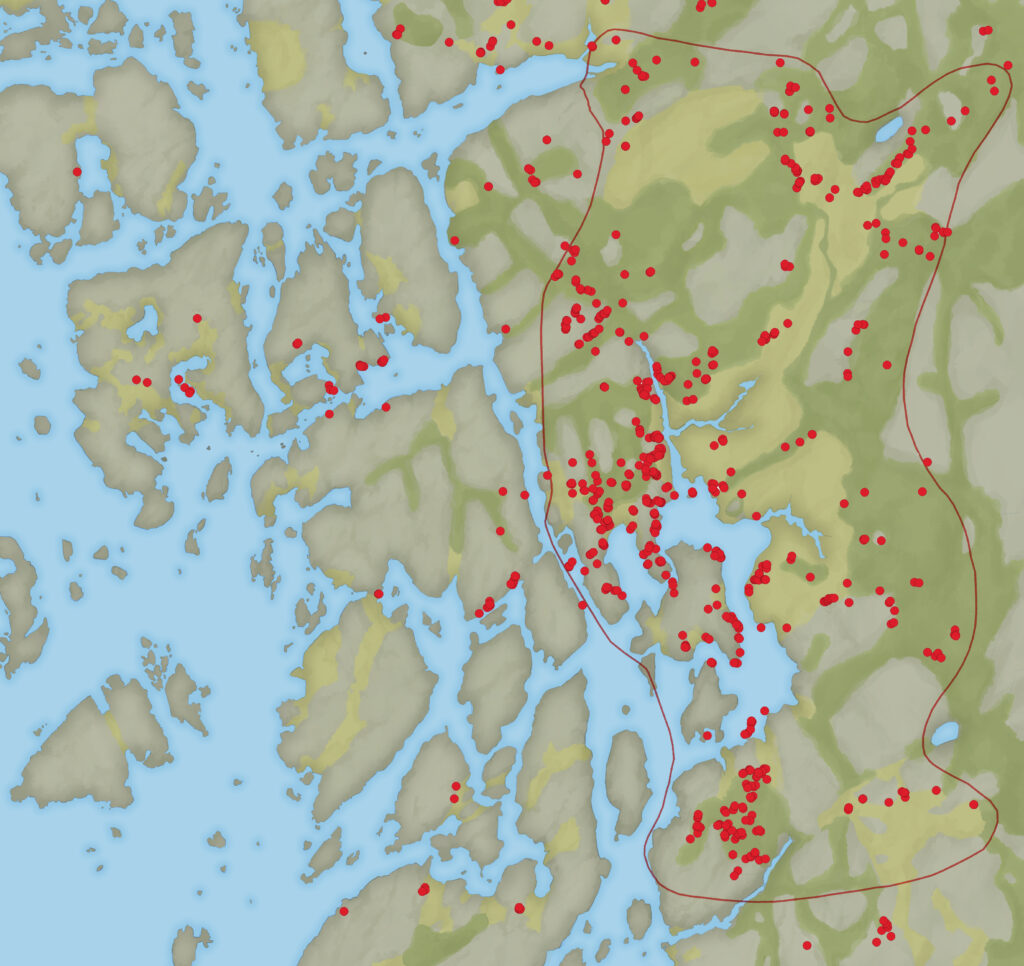
The map shows what the Tanum area looked like during the Early Bronze Age (period II, 1500-1300 BC) and how the rock carvings are located in the landscape of that time. The red line is the boundary of the World Heritage Tanum Rock Carvings. Illustration: Fredrik Dimrå.

What do the rock carvings depict?

Although there are tens of thousands of individual rock carvings, the motifs are relatively few. The most common are the round pits called cup marks, and other recurring images include ships, humans, and animals. Less common motifs include foot soles, circles, wagons, trees, ards (predecessor to the plow), hands, net figures, and weapons. The challenge with rock carvings usually lies not in identifying what they depict but in understanding why the carver made the image. We may never fully comprehend the rock carvings, but by studying the chosen motifs, we can learn a great deal about the world of the Bronze Age people.

Learn more about the rock carvings motifs.

How do we determine the age of the rock carvings?

There are several ways to determine the age of rock carvings. The most common method is to compare images with actual archaeological finds and examine ship depictions engraved on objects from the Bronze Age. The age of objects can be determined through methods such as artifact chronologies or radiocarbon dating (C14 dating). The assumption is that if the depiction and the object appear similar, they are likely from the same era.

There are a few sites where the landscape’s post-glacial rebound can be used to determine the age of the carvings. For example, there is a theory that the carvings at the lower part of the Gerum panel cannot be from the beginning of the Bronze Age because that section of the panel would have been underwater at the time.

When rock carvings overlap each other, it is sometimes possible to determine which image was carved first. By studying these overlapping carvings, called overcuts, it is possible to create a relative chronology. This chronology does not provide the exact age of the carvings but indicates the sequence in which they were made.

Many rock carvings were created over a long period, and images located just a few centimetres apart can have several hundred years between them. Therefore, it is impossible to interpret an entire panel as a single narrative. However, it is sometimes possible to see that multiple images are connected, such as the bridal couple at Vitlycke or the horseback battle at Litsleby. Some panels have a consistent style and execution across most of the images, suggesting that the carvings were created over a relatively short period. An example in the World Heritage area is the Fossum panel, where all the boats look the same, and the people seem to be cast from the same mould.

When were the rock carvings discovered?

The first mention of a rock carving from the Tanum World Heritage area is in 1751 when Colonel Klinkowström wrote: “In Tanum parish, not far from the sea, I have also seen a rock surface with a carved man holding a spear. The story goes that a Scottish leader was killed during ancient warfare and the position in which he was found was carved into the rock.” This refers to the so-called Spear God on the Litsleby panel.

Systematic studies of the rock carvings began in the 19th century when archaeology emerged as a scientific discipline. Carl Georg Brunius, who was a pastor’s son from Tanum, made drawings of several of the large panels in the area between 1815 and 1818. In 1845, the antiquarian and clergyman Axel Emanuel Holmberg visited Tanum and made drawings, including those of the Vitlycke panel. Throughout the 20th century, repeated surveys have led to a significant increase in the number of known rock carvings. In 1969, there were 1,200 known carvings in the entire Bohuslän region, and twenty years later, the number had grown to 2,300. As of 2023, a search for rock carvings in Bohuslän in the Swedish National Heritage Board’s Cultural Environment Register yields nearly 4,200 results.

It is, however, more challenging to determine how long the rock carvings have been known among the local population or whether they were ever forgotten. Many examples exist of residential houses located near or on top of deeply carved and distinct rock carvings, making it difficult to believe that the images went unnoticed. Moreover, the cup marks, also known as “elven mills,” played a role in folklore well into the 20th century. There is, therefore, much evidence to suggest that the images carved into the rocks have been known for much longer than when they were first recognized by scholars.
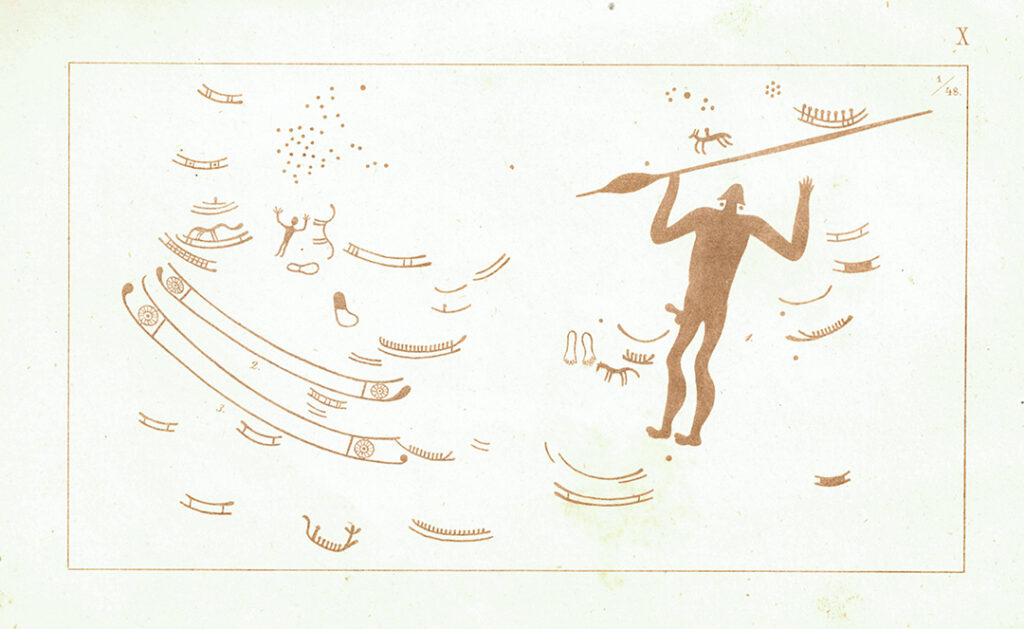
Carl Georg Brunius illustration of the Litsleby panel. Source: C. G. Brunius. Försök till förklaring öfver hällristningarna. Lund, 1868.

Are there more rock carvings to discover?

When the large panels were documented in the 19th century, the landscape in Bohuslän looked different. There was almost no forest, and many panels that are now buried were exposed. Therefore, the conditions for discovering rock carvings were better than they are today, and it is likely that the largest panels have already been found. However, there are undoubtedly smaller carvings yet to be discovered, as evidenced by the fact that many “new” sites are exposed each year.
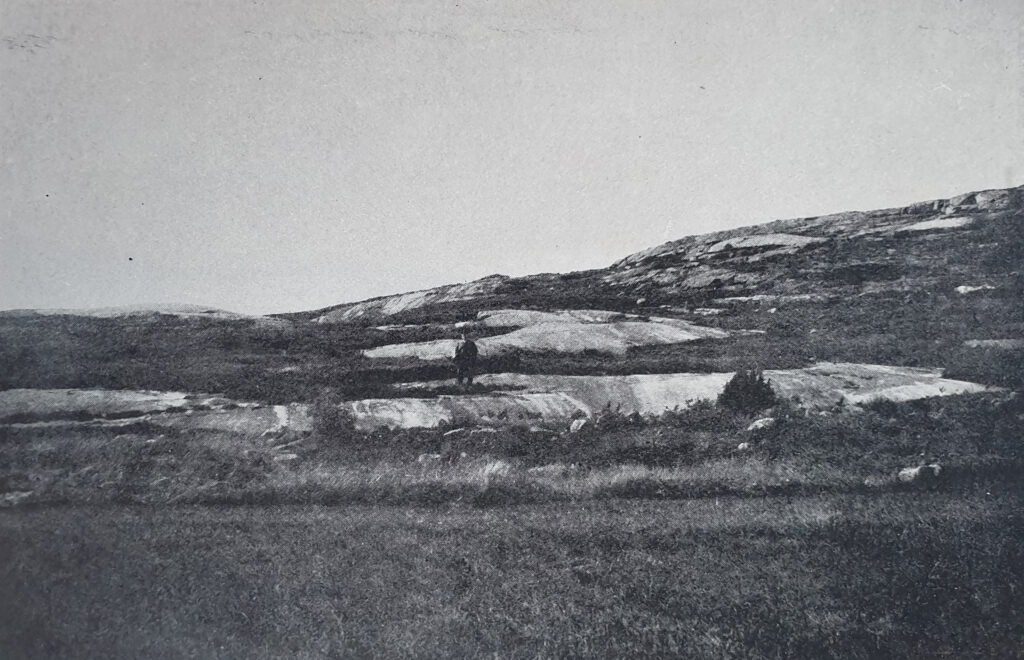
The Vitlycke panel in the early 20th century. Source: L. Baltzer. Några af de viktigaste hällristningarna samt en del af de fasta fornminnena i Bohuslän. Göteborg, 1911.

Are the rock carvings visible?

Rock carvings can be challenging to see—many are very shallow and have also been damaged by weathering in many cases. To enhance the visibility for visitors, about ten of the over 600 sites in the World Heritage Site have been coloured in. The colour found on some of the accessible panels is not from the Bronze Age but serves to show visitors what the rock carvings look like. The colour is not an attempt to reconstruct how the carvings appeared when they were made and used, as no traces of ancient paint in the carvings have been found.

Learn more about why some carvings are painted.

One tip for easier viewing of unpainted carvings is to visit the sites in the dark and shine a flashlight on them from the side. The shadows in the carvings make the images much clearer. Depending on how the panel is positioned in the landscape, a similar effect can be achieved in the morning or afternoon. The images are also more visible when the rock surface is wet, such as after rain.
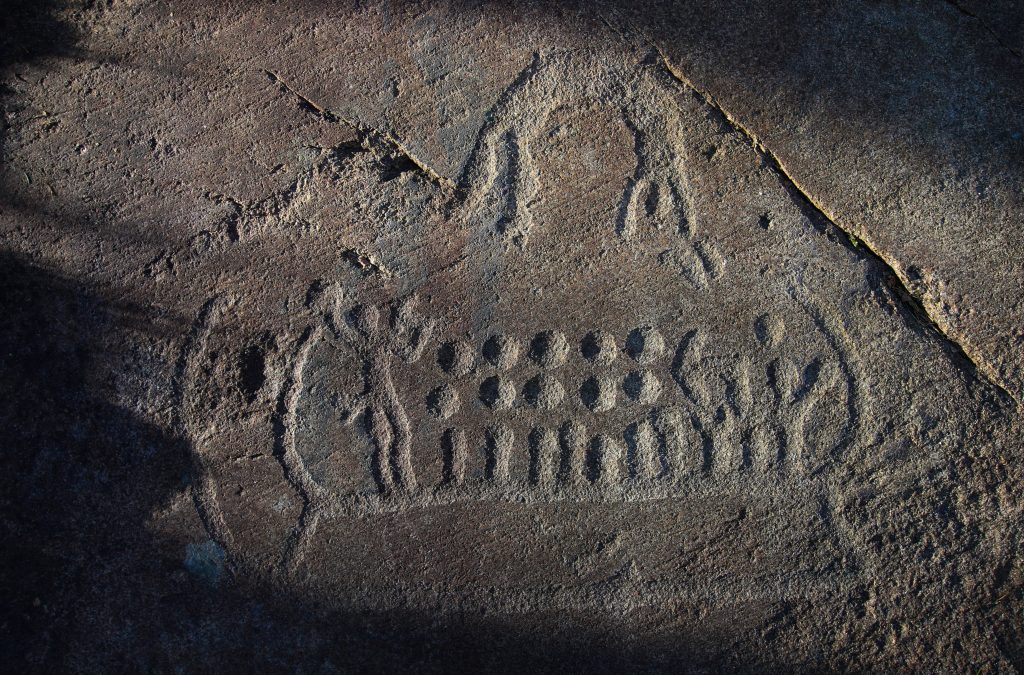
Oblique lighting on a carving at Sotetorp. The site is located along the World Heritage Walks trail. Photo: Hans Lundenmark, Vitlycke museum.