


Two Ways to Draw Infinite Jest's Sierpinski Gasket
Table of Contents
- 1. About infiniteJest dfw fractals sierpinski
- 2. Method 1: The Geometer's Construction geometry construction
- 3. Method 2: The Chaos Game chaos fractals emergence
- 4. The Three Vertices structure dfw
- 5. Finite Book, Infinite Gasket rereading
- 6. TLDR tldr
1. About infiniteJest dfw fractals sierpinski
In a 1996 Bookworm interview with Michael Silverblatt, David Foster Wallace confirmed something Silverblatt had spotted about Infinite Jest.
Silverblatt, talking about Infinite Jest's structure:
I said to myself, this must be fractals.
DFW replied:
I've heard you're an acute reader…. That's one of the things, structurally, that's going on… It's actually structured like something called a Sierpinski Gasket, which is a very primitive kind of pyramidical fractal, although what was structured as a Sierpinski Gasket was the draft that I delivered to [my editor] Michael in '94, and it went through some I think 'mercy cuts', so it's probably kind of a lopsided Sierpinski Gasket now…. it looks basically like a pyramid on acid
A Sierpinski Gasket is a fractal triangle composed of triangles within triangles within triangles within…. You get the idea. Here's an illustration.
Infinite Jest's structure as a Sierpinski Gasket, I think, explains something I've noticed about the book during my 3rd reread. Every time I reread the book, it seems to pay out more and more, and its structure, the relationships between its characters, and its plot arcs become clearer and clearer. The text doesn't change, but with each read my internal representation of its structure does change.
This post elaborates on that: there are two ways to construct a Sierpinski Gasket. Wallace (the geometer) used the first, and rereaders (the players in a chaos game) use the second.
2. Method 1: The Geometer's Construction geometry construction
The classical method is top-down.
You start with a triangle and 'remove' the middle by creating an equilateral triangle from the midpoints between the original vertices. You now have three smaller triangles around the second triangle. Repeat this with those 3 triangles, and on and on, and you get a Sierpinski Gasket.
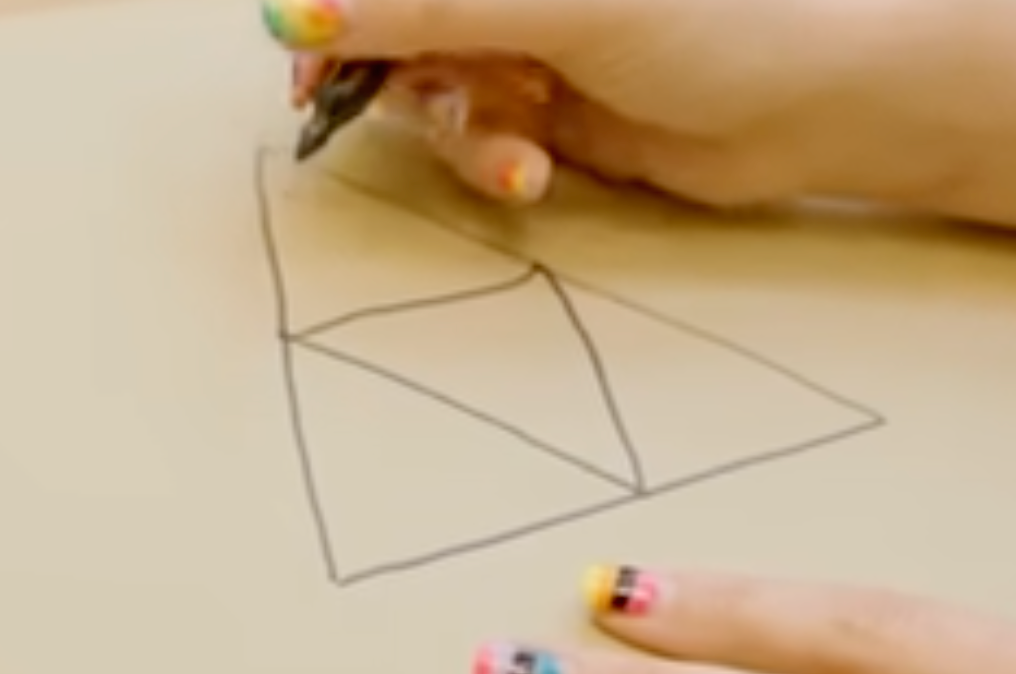
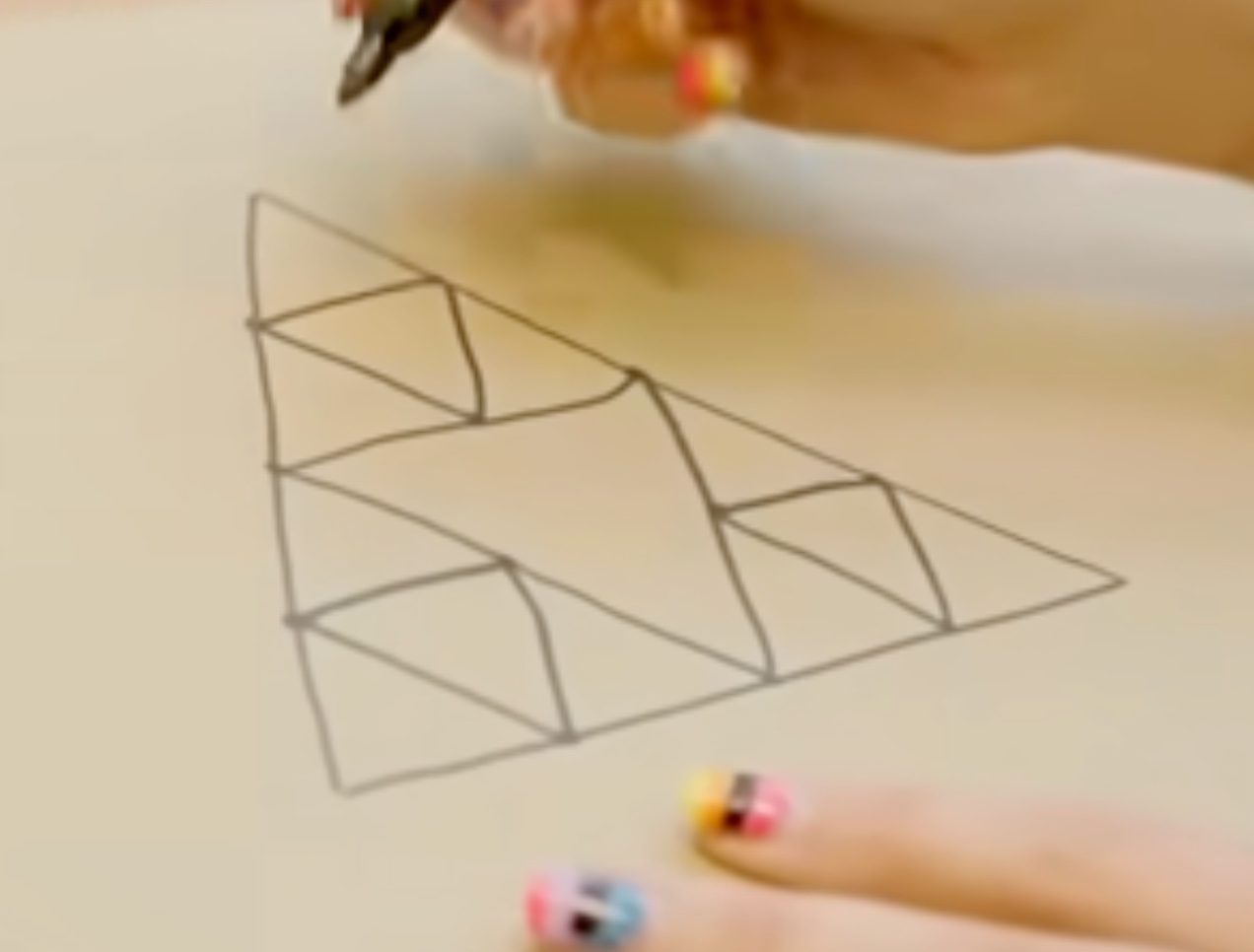
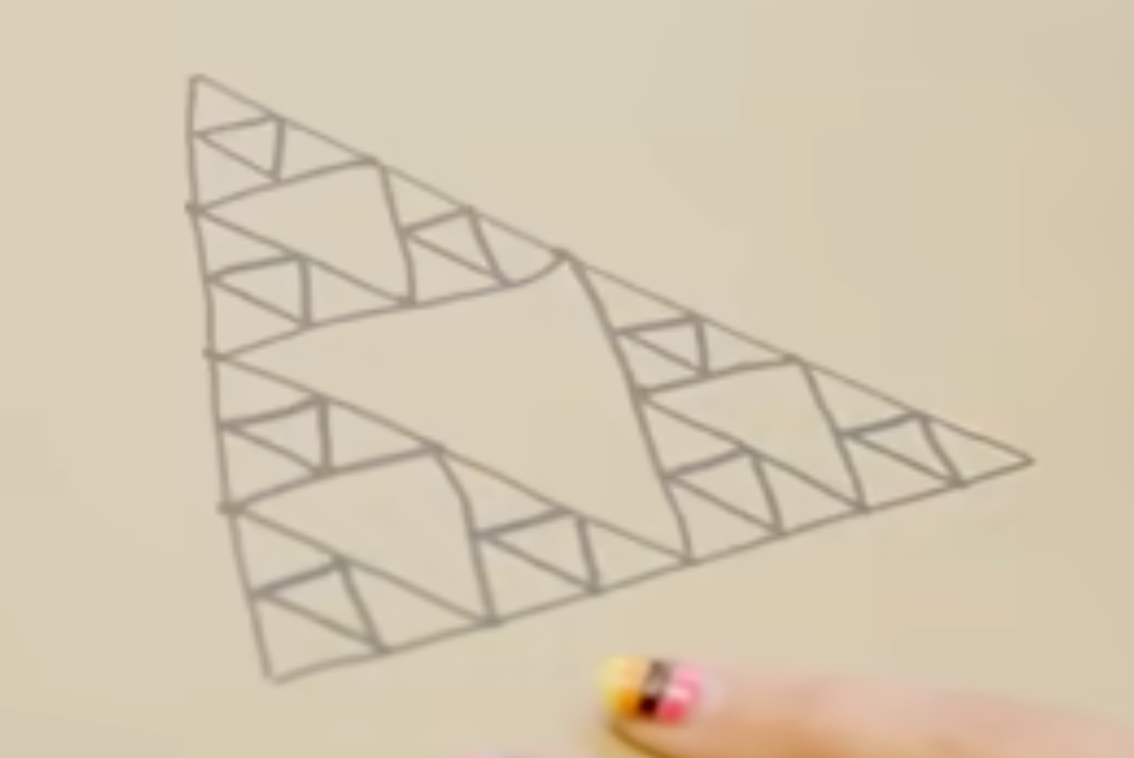
This video shows the method concretely (the relevant section runs roughly 0:52 to 2:45). Sierpinski triangle: classical recursive construction (YouTube).
This is what Wallace did when he wrote Infinite Jest. He seeded the Gasket by drawing the outer triangle, then subdivided.
Infinite Jest has three institutional poles (or vertices): Enfield Tennis Academy, Ennet House Drug and Alcohol Recovery House, and Les Assassins des Fauteuils Rollents (the Wheelchair Assassins) of Quebec. At every scale below that, the same shape recurs among the relationships between these institutions, and the complex relationships between their characters.
Wallace's substructure is deliberate, and he placed these pieces with the Sierpinski Gasket in mind.
3. Method 2: The Chaos Game chaos fractals emergence
The second method is mindblowing:
- Pick three points on a plane. These are the vertices.
- Pick a starting point anywhere.
- Randomly pick one of the 3 vertices and draw a point halfway between that vertex and your previous point.
- Repeat ad nauseam, using the most recent point each time.
As you do this, you will gradually see a Sierpinski Gasket emerge.
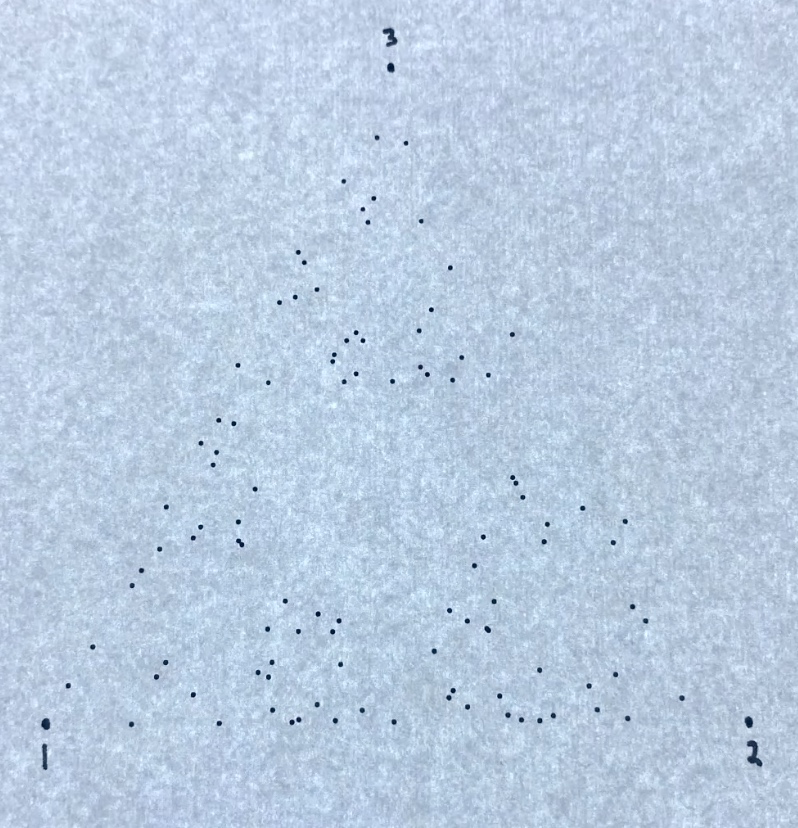
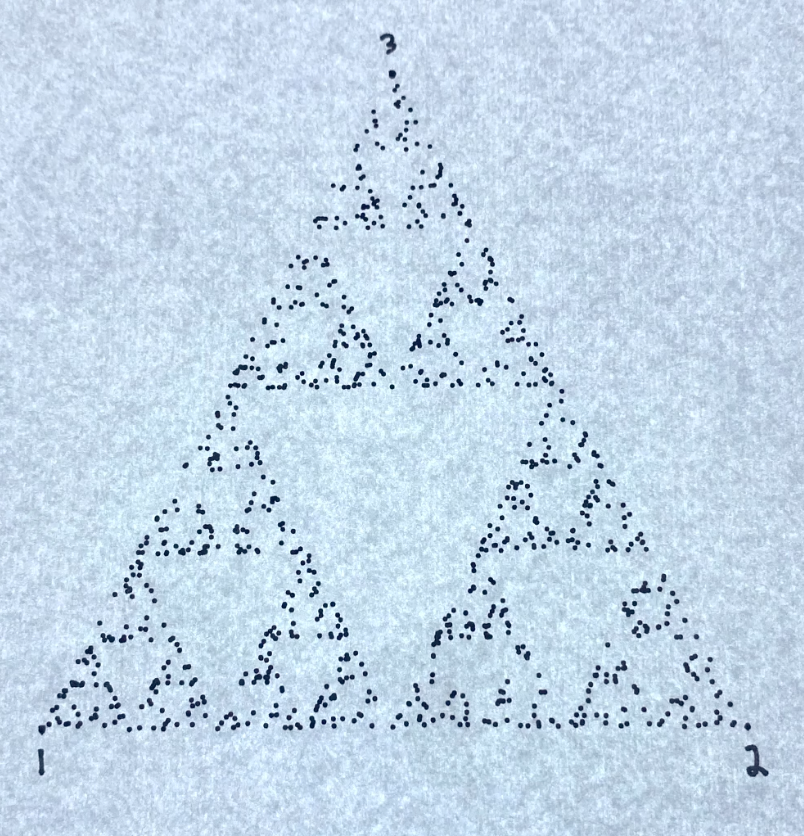
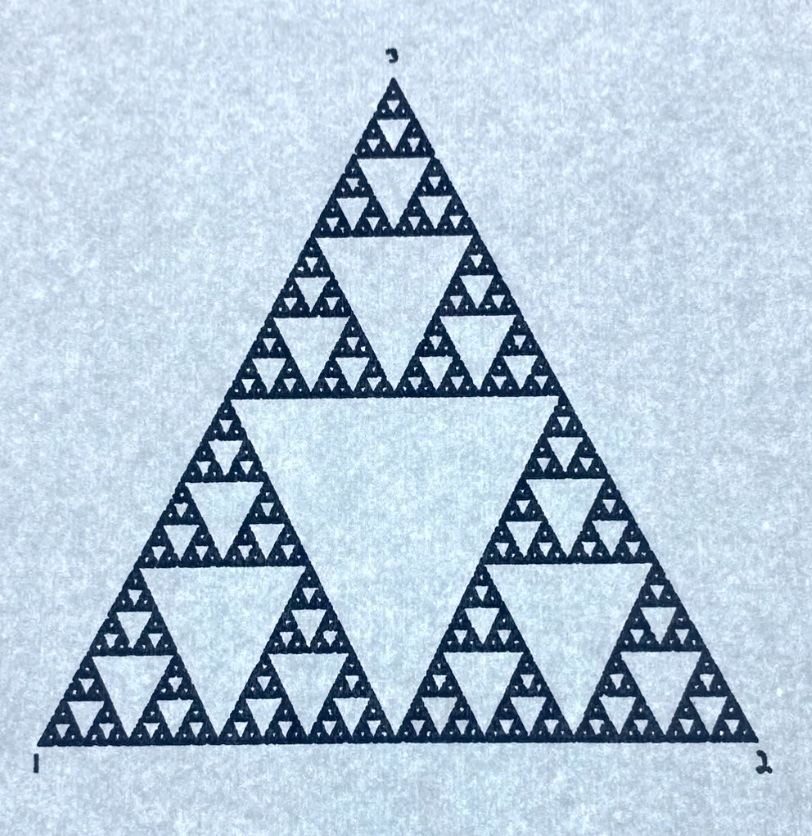
The above images are from this video. You can watch it to get a better sense of how to build the Gasket in this way. The chaos game producing a Sierpinski triangle (YouTube)
The chaos game produces a clear Sierpinski Gasket, but you arrived at it by an entirely different method than the geometer's.
This is the Infinite Jest reader's methodology for building the Gasket. On the first pass through the book, the points scattered by your attention look like noise. That's certainly how I felt in my first read-through. As I reread the novel (I'm currently on my third), I fill in more and more points, and the structure of the novel and the relationships between its characters fill in a more complete internal representation of the novel, closer and closer to the geometer's Gasket.
Three features of the chaos game support this metaphor:
The first iterations are noise. Chaos-game simulations conventionally discard the first ~20–30 points as "burn-in". They haven't yet represented the Sierpinski Gasket. This is what a first reading of Infinite Jest felt like to me.
The starting point doesn't matter. The attractor (the Sierpinski Gasket) is determined entirely by the three vertices and the halving rule. Wherever you start, you converge to the same Gasket. Burn-in is why the starting point doesn't matter. It doesn't matter whether you came to Infinite Jest for Hal, Gately, or the Quebecois separatists. As you play the chaos game through rereading, you converge on the same Sierpinski triangle shape.
Each step depends only on where you just were. You don't need to remember the whole history of your previous moves to add the next point, just the most recent one. In rereading terms, this means you can dip back into the book at almost any scene and still add to the Gasket's picture. Infinite Jest rewards non-sequential rereading.
4. The Three Vertices structure dfw
A chaos game needs three seed vertices. In my opinion, Infinite Jest's 3 seed vertices are:
- Enfield Tennis Academy (ETA): the will annihilated into pure performance. Schtitt's and Lyle's lessons are about giving the self away to the discipline.
- Ennet House: surrender as recovery. What Gately realizes is that AA works only by being also a form of self-erasure ("Keep Coming Back," "turn it over").
- Les Assassins des Fauteuils Rollents (AFR): surrender as ideology. Marathe's catechism that you have already chosen your temple, whether you admit it or not.
Three primary settings, three institutions, and three cults of surrender: discipline (ETA), higher power (Ennet), ideology (AFR). The Sierpinski Gasket gets filled in as these three institutions and their characters encounter one another in the novel.
A Sierpinski Gasket is defined as much by what is removed as by its three vertices. At every iteration of the geometric construction, a middle triangle is cut out. Infinite Jest has a literal removed middle: the Entertainment (Himself's last, lethal cartridge) and Himself himself, James O. Incandenza, dead before page one. Himself founded ETA. Joelle, his muse, lands at Ennet. The AFR are hunting his film. The three institutional vertices all triangulate around a center the novel deliberately refuses to show you head-on, maybe because looking at the Entertainment directly kills its viewers. So Wallace put it at the void rather than at a vertex.
5. Finite Book, Infinite Gasket rereading
The title is Infinite Jest, but the book is of course not infinite. On the other hand, the reader's chaos game has no such cap. Each reread adds points, making the Sierpinski structure resolve further and further, assuming each pass surfaces material the previous ones missed. What changes with each read is your sampling density.
This is, I think, what Wallace built the book for. Not for the first reading or second reading, which are almost guaranteed to feel like noise, but for the asymptote, the long limit of attention, where the book's structure emerges more and more clearly.
Another interesting aspect of the Gasket is that the seed vertices can be changed. In a Hacker News thread about this post, ofalkaed proposed a different triplet (family, education, and society). The fact that IJ's Gasket can be seeded with more than one set of vertices is an interesting player's choice in the chaos game, and even more interesting that the player still converges on a Sierpinski Gasket with a different starting load out.
6. TLDR tldr
David Foster Wallace (DFW) designed Infinite Jest as a Sierpinski Gasket using the classical top-down construction, placing three institutional vertices (ETA, Ennet House, the Wheelchair Assassins) and subdividing the structure at many scales below. Readers, on each reread, fill in the same Gasket using the chaos game, a non-sequential sampling that converges on the Sierpinski Gasket over many iterations. This explains why first readings feel like noise (burn-in), why the entry point doesn't matter, and why the book rewards near-infinite rereading. Although the book is naturally finite, the Gasket built over it by the reader is infinite.