Me again! I'm so happy you're all here. Thanks for letting me nerd out in your inbox week after week.
💙 Amanda
Look out your window. Can you see three trees?
That's the first question of the 3-30-300 test — a standard that has become the go-to for solving a universal urban problem: Does this city have enough trees, and are they in the right place?
The 3-30-300 test is simple. Every home, school and office should have a view of at least three trees, be in a neighbourhood with 30% tree cover, and be within 300 metres of a park.
Proposed just a few years ago by Cecil Konijnendijk, the rule has spread quickly. The Italian city of Florence committed to planting 50,000 trees by 2030 under the framework. Fort Collins, Colorado made it a formal planning target. Cities from Haarlem, Netherlands to Saanich, British Columbia have followed suit.
Its popularity makes sense: 3-30-300 is a catchy, straightforward test that sets a clear benchmark for measuring equal access to nature.
But is it achievable?
Having greenery in sight, not just nearby, is good for your head. People who can see at least three trees from their window have better mental health than those who can't.
It seems like the easiest of the three goals to achieve, but a study assessing the 3-30-300 rule in 862 European cities found that only about half the population has a three-tree view.
There are fewer tree-lined views for southern Europeans
Population, by city, that achieves the three-trees rule.
When it comes to seeing green, Europe is roughly split down the middle. In half its cities, most residents have three trees in view; in the other half, the majority don't. Cities with the poorest tree visibility tend to be in southern Europe. Valencia, in Spain, has one of the worst records: Only one in ten residents can see three trees.
How do I compare?
I can only see two trees from where I'm working today. That's one tree too few.
How do you compare?
This one's easy to assess. Just look out the window!
Is 30% of your neighbourhood covered by trees?
Viewed from above, one third of your neighbourhood should be covered by trees. As our planet warms, the consequences of not meeting that standard are measurable: Hitting the 30% goal across all European cities could prevent 2,644 heat deaths each summer, found a Lancet study. And that's the bare minimum. Researchers in Madison, Wisconsin concluded that meaningful cooling really only kicks in at 40% tree cover.
Unfortunately, that study of 862 European cities found the tree-cover standard is rarely met.
One in three Europeans live in an area with at least 30% tree cover
Population, by city, that achieves the 30% rule.
In seventeen cities, at least three quarters of residents live in an area that meets the 30% tree cover requirement. However, these are all relatively small places, with populations of just a few hundred thousand. Interestingly, ten of these cities are tightly clustered together in Western Germany, near the Dutch border.
How do I compare?
Apparently the tree cover in my area is only 17%, which I worked out using Tree Equity Score. That's disappointing.
How do you compare?
US and UK readers: You can use Tree Equity Score to find canopy cover percentages for your neighbourhood. Everyone else: Consider getting a rough estimate by using Google Maps to look at your neighbourhood from a bird's-eye view.
Do you live 300m from a park?
Of the three criteria, this is the most-often met. Regular use of parks and green spaces is associated with lower rates of obesity, improved cardiovascular health, reduced stress and better mental health. But these spaces need to be close enough; park use drops sharply when it's beyond a 300-metre walking distance (roughly a five minute stroll, or the length of about three American football fields).
Again, northern countries fare better. Nearly all cities with the best park access are in northern Europe.
Almost 60% of Europeans live within 300m of a park
Population, by city, that achieves the 300m rule.
How do I compare?
I was absolutely convinced I would pass this last rule! But using Google Maps, I found that my closest park isn't 300 metres away, it's 400 metres. That's close, but a fail.
How do you compare?
Open Google Maps, drop a pin on your home and draw a 300m radius. Do you see a park? Or use the navigation feature to get walking directions to your nearest green space. It should note the distance.
An ambitious target
The 3-30-300 rule is simple, but that doesn't mean it's easy to achieve. In fact, only 14% of Europeans live in an area that meets all three criteria. And 21% live somewhere that doesn't meet a single one.
Most Europeans don't live in an area that passes the 3-30-300 test
Portion of European population living in areas that meet 1,2,3 or none of the requirements.
There are only two European cities where more than half of residents satisfy the rule: Espoo in Finland and Varese in Italy. There are also only about 20 cities where this percentage is above 40%, most of which are located in Scandinavia, Germany and Poland. These low percentages are primarily due to the lack of places meeting the 30% tree cover requirement.
The global picture is equally sobering. Testing the rule across eight major cities, different researchers found that only Singapore met the standard.
Of eight global cities, Singapore alone passes the 3-30-300 test
Percentage of buildings in each city that passes each part of the 3-30-300 test.
It doesn't seem like too much to ask: Trees in your eyeline, shade over your street, a park down the road. And not just in the best parts of town. (As I wrote back in March: Shade, like so much else, is often a privilege of the wealthy.) These are meant to be minimum standards, not aspirations. But the findings of these two studies show that cities across the world aren't meeting them.
And the 3-30-300 rule isn't just for making nice places to live; it has measurable health consequences. People living in areas that achieve the rule have better mental health and use fewer medications. And as summer heat grows more dangerous, adequate tree cover is increasingly vital.
If you tested the 3-30-300 rule yourself, how did it turn out? I live in a beautiful, leafy city with lots of parks. So, I was confident about passing at least two of the three measures. But I was wrong! The data show I'm certainly not alone. And it's likely you were surprised by your results, too.
So how can the 3-30-300 rule actually be implemented? I like what the researchers behind the eight-city study concluded. A simple but powerful call to action:
Tear up the asphalt; plant trees.
I DIDN'T DO IT
I absolutely did not employ the pun 'tree-o' in reference to the three tree-based metrics in this piece. Not once. Not. Even. Once.
THE 10-90 RULE
The 3-30-300 rule exists to make nature accessible to all, regardless of income or neighbourhood. Not-Ship runs on a similar principle: 10% of readers pay so the other 90% don't have to. Data, like trees, should be available to everyone. If you agree, it's only $9/month ($90/year).
FROM ELSEWHERE
Here's what I found interesting, important or delightful this week:
The handmade web. The Tiny Awards celebrate the Internet's small things. I particularly like the 2024 winner, One Minute Park, which lets you spend time in a public green space somewhere in the world. After 60 seconds, it shifts to a new one.
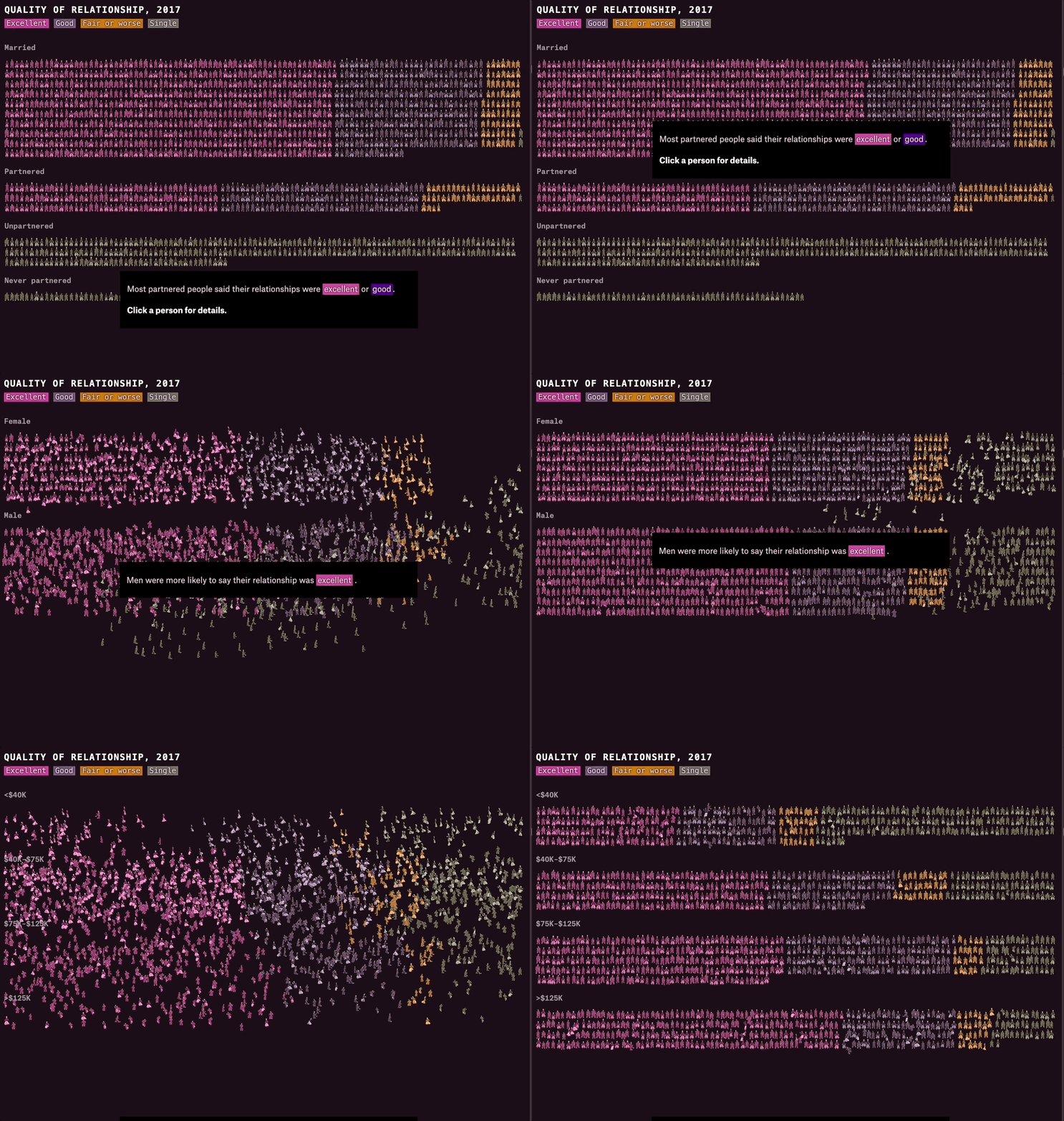
What's normal? For the Pudding, Alvin Chang tracks 1,000 people through the ups and downs of their relationships. I love how the charts come alive with the small people icons.
MORE NOT-SHIP
People don’t linger like they used to. It’s a problem.
In public: Walking speed is up, group gatherings are down, and we’ve lost the art of lingering.
 Amanda Shendruk

Looking for the rich? Check in the shadows.
Across the world, shade is a privilege of the wealthy.
 Not-ShipAmanda Shendruk
Huh. Apparently cars don’t have to kill people.
For a fast way to reduce traffic deaths: Just slow down.
 Not-ShipAmanda Shendruk