


惯性聚合 高效追踪和阅读你感兴趣的博客、新闻、科技资讯
阅读原文 在惯性聚合中打开

推荐订阅源

GbyAI
GbyAI
freeCodeCamp Programming Tutorials: Python, JavaScript, Git & More
IT之家
IT之家
K
KPMG report finds enterprise disconnect between AI and its ROI | CIO
N
News | PayPal Newsroom
Cloudbric
Cloudbric
Webroot Blog
Webroot Blog
www.infosecurity-magazine.com
Simon Willison's Weblog
Spread Privacy
Spread Privacy
Threat Intelligence Blog | Flashpoint
V
Vulnerabilities – Threatpost
Attack and Defense Labs
C
Cyber Attacks, Cyber Crime and Cyber Security
Cisco Talos Blog
Cisco Talos Blog
C
Cybersecurity and Infrastructure Security Agency CISA
H
Hackread – Cybersecurity News, Data Breaches, AI and More
P
Proofpoint News Feed
阮一峰的网络日志
阮一峰的网络日志
S
Secure Thoughts
T
Tor Project blog
Latest news
Latest news
aimingoo的专栏
aimingoo的专栏
V2EX - 技术
V2EX - 技术
Exploit-DB.com RSS Feed
OSCHINA 社区最新新闻
OSCHINA 社区最新新闻
钛媒体:引领未来商业与生活新知
钛媒体:引领未来商业与生活新知
S
Securelist
T
Tenable Blog
N
Netflix TechBlog - Medium
Google Online Security Blog
博客园 - Franky
T
Troy Hunt's Blog
量子位
大猫的无限游戏
大猫的无限游戏
T
Threat Research - Cisco Blogs
T
The Exploit Database - CXSecurity.com
MongoDB | Blog
MongoDB | Blog
H
Heimdal Security Blog
D
Docker
W
WeLiveSecurity
Stack Overflow Blog
Stack Overflow Blog
G
Google Developers Blog
博客园 - 叶小钗
腾讯CDC
The Hacker News
The Hacker News
WordPress大学
WordPress大学
人人都是产品经理
人人都是产品经理
Project Zero
Project Zero
Martin Fowler
Martin Fowler

Hacker News

Introducing Claude Opus 4.7 Qwen Studio The Future of Everything is Lies, I Guess: Where Do We Go From Here? GitHub - SeanFDZ/macmind: Single-layer transformer in HyperTalk for the classic Macintosh Show HN: Agent-cache – Multi-tier LLM/tool/session caching for Valkey and Redis Ancient DNA reveals pervasive directional selection across West Eurasia [pdf] Moving a large-scale metrics pipeline from StatsD to OpenTelemetry / Prometheus GitHub - Nightmare-Eclipse/RedSun: The Red Sun vulnerability repository GitHub - SethPyle376/hiraeth: Local AWS emulator focused on fast integration testing, with SQS support, SQLite-backed state, and a debug-friendly web UI. GitHub - macOS26/Agent: Any AI, replaces Claude Code, Cursor, OpenClaw. Over 18 LLM providers (Claude, OpenAI, Gemini, Ollama, Zai, HF, Qwen) wired into a native Mac app that writes code, builds Xcode projects, bumps versions, manages git, automates Safari, use AppleScript, JS or Accessibility, extend Agent! w/ MCP Servers, run tasks from your iPhone via Messages. YouTube now lets you turn off Shorts I Made a Terminal Pager Burgers | マクドナルド公式 Commands — HackerNews CLI documentation ChatGPT for Excel PiCore - Raspberry Pi Port of Tiny Core Linux Live Nation illegally monopolized ticketing market, jury finds Google Broke Its Promise to Me. Now ICE Has My Data. Founding Engineer at Adaptional | Y Combinator CRISPR takes important step toward silencing Down syndrome’s extra chromosome GitHub - saffron-health/libretto: The AI toolkit for building reliable browser automations US v. Heppner (S.D.N.Y. 2026) no attorney-client privilege for AI chats [pdf] Unexpected €54k billing spike in 13 hours: Firebase browser key without API restrictions used for Gemini requests Retrofitting JIT Compilers into C Interpreters IPv6 – Google The Accursèd Alphabetical Clock Cybersecurity Looks Like Proof of Work Now Fragments: April 14 Cal.com Goes Closed Source: Why AI Security Is Forcing Our Decision | Cal.com - Scheduling Software for Online Bookings Laravel raised money and now injects ads directly into your agent When moving fast, talking is the first thing to break Too much Discussion of the XOR swap trick – Heather Cafe Introduction to Spherical Harmonics for Graphics Programmers The Grand Line Building a Z-Machine in the worst possible language High-Level Rust: Getting 80% of the Benefits with 20% of the Pain GitHub - duguyue100/midnight-captain: Inspired by Midnight Commander, tailored to my taste. How to build a `git diff` driver · Jamie Tanna | Software Engineer Center for Responsible, Decentralized Intelligence at Berkeley The Local Universe’s Expansion Rate Is Clearer Than Ever, but Still Doesn’t Add Up - A new synthesis of astronomical measurements confirms a persistent mismatch that could point to physics beyond current models The air throughout our homes is infused with microplastics. But there are things you can do to breathe less of them The disturbing white paper Red Hat is trying to erase from the internet – OSnews The Future of Everything is Lies, I Guess: Annoyances ‘Abhorrent’: the inside story of the Polymarket gamblers betting millions on war Productive procrastination — Max van IJsselmuiden maps, territory and LMs 447 Terabytes per Square Centimetre at Zero Retention Energy: Non-Volatile Memory at the Atomic Scale on Fluorographane Show HN: Pardonned.com – A searchable database of US Pardons 20 Years on AWS and Never Not My Job The Seasons are Wrong Artemis II crew splashes down near San Diego after historic moon mission We gave an AI a 3 year retail lease in SF and asked it to make a profit | Andon Labs How a dancer with ALS used brainwaves to perform live On filing the corners off my MacBooks Installing every* Firefox extension OpenClaw’s memory is unreliable, and you don’t know when it will break Steve Blank Nowhere Is Safe Chimpanzees in Uganda locked in vicious 'civil war', say researchers watgo - a WebAssembly Toolkit for Go linux/Documentation/process/coding-assistants.rst at master · torvalds/linux GitHub - callumlocke/json-formatter: Makes JSON easy to read. Founding Product Engineer at Bild AI | Y Combinator A compelling title that is cryptic enough to get you to take action on it GitHub - Keychron/Keychron-Keyboards-Hardware-Design: Industrial design files for Keychron keyboards and mice. 100+ models with CAD assets in STEP, DXF, DWG, and PDF. Source-available, with commercial use allowed for original compatible accessories within the license terms. [ANNOUNCE] WireGuardNT v0.11 and WireGuard for Windows v0.6 Released 1D-Chess Helium Is Hard to Replace Cooperative Vectors Introduction | Evolve Keeping a Postgres queue healthy — PlanetScale Our response to the Axios developer tool compromise Do Americans read print books, e-books or audiobooks more? The Zettelkasten Method in Obsidian: A Practical Setup Guide Artemis II Is Competency Porn and We Are Starving For It WeakC4 Flight Viz — Cockpit View A Mexican surveillance giant you’ve never heard of is now watching the U.S. border Surelock: Deadlock-Free Mutexes for Rust RISC-V 101 – what is it and what does it mean for Canonical? | Ubuntu The Problem That Built an Industry How Much Linear Memory Access Is Enough? | Solidean Investigating Split Locks on x86-64 Sybilproof reputation mechanisms (2005) [pdf] What is a property? How Complex is my Code? Static code analysis in Kotlin — tools overview Toffoli gates are all you need PGLite evangelism dcmake: a new CMake debugger UI Clojure on Fennel part one: Persistent Data Structures Fragments: April 2 Python Release Python install manager 26.1 The Life and Death of the Book Review - Liberties Introducing Database Traffic Control — PlanetScale Bitcoin miners are losing $19,000 on every BTC produced as difficulty drops 7.8% God sleeps in the minerals Building slogbox Apple Silicon and Virtual Machines: Beating the 2 VM Limit Who was “Not Even Wrong” first? Pokemon Evolution Vs Darwinian Evolution The APL Programming Language Source Code
Simplest hash functions
2026-04-07 · via Hacker News

Hacker News

What came to your mind when you read “hash functions” in the title?

If you’re pragmatic, you probably remembered SHA-256 or MD5. Those are cryptographic hash functions, and they work fast and well for arbitrary inputs, even if they are supplied by malicious actors. Or at least they’re designed to.

That’s the exact opposite of what I want to talk about. I want to talk about the cheapest, stupidest, most ridiculous hash functions you can get away with.

Like rapidhash?

As good a conversation starter as any. Here’s what the core of rapidhash looks like:

hash = 0 # a 64-bit variable
seed = ... # a hidden constant

while still has data:
    # read the next 128 bits (16 bytes) of input
    a, b = next_64_bits(), next_64_bits()
    # compute this weird formula, producing a 128-bit output
    product = (a ^ hash) * (b ^ seed)
    # XOR the two 64-bit halves together
    hash = (product % 2**64) ^ (product >> 64)

return hash

I’d rate this hash function AAA, for the scream you might witness if you show this to a cryptographer. Suffice to say, we don’t have any estimate on how cooked you are if you use this in a critical service. If you’re processing user input, it’s possible (or at least not known to be hard) to generate many inputs that produce the same hash, overloading the hash table and causing your application to grind to a halt.

But what if you don’t have adversaries? What if you’re processing vetted song lyrics, or maybe writing a compiler? Now we’re talking: rapidhash is clearly bloat, we don’t want those pesky XORs and multiplications, and we can find something cheaper.

Like?..

Like addition! Here’s your hash:

hash = 0

while still has data:
    hash = (hash + next_32_bits()) % 2**32

return hash

It reliably reacts to shifts, removals, and doesn’t use the same hash for similar strings. It doesn’t recognize reordering, but maybe it’s not a problem on your data! Or maybe it is, but then you just add a rotate to make the operation non-commutative:

hash = 0

while still has data:
    hash = ((hash << 3) % 2**32) | (hash >> 29)
    hash = (hash + next_32_bits()) % 2**32

return hash

Now that I think about it, not all bytes need to contribute to the hash. We could sample words randomly or skip every second word. Save electricity!

It’s beautiful, it’s clever, it’s art – the three vital characteristics of a hash function.

Are you for real?

Well, look at it like this: while I wouldn’t use this in production without a paper trail, it doesn’t mean it’s right to ignore the option altogether.

For one thing, maybe you’re working with static data or can otherwise verify you’re not vulnerable to HashDoS. Maybe you’re doing retrocomputing and need something extremely cheap. Or maybe you are hard-pressed to produce a hash within 20 ticks.

Stripping hashes to the bare minimum also shows how expensive hash tables usually are. I’ve seen JS projects using `${x},${y}` as a map key instead of nesting arrays, and I always wonder if we’d need to optimize tables if people used the right data structure. Maybe you’ll become a responsible programmer after reading this, who knows!

Quality

So what makes a hash “good”? Here’s a quick refresher on hash tables:

Say we want a hashmap to store n entries. To do this, make an array of n buckets, each of which is in turn an array of entries. Each entry kv is pushed to bucket hash(k)modn. To access the value by key, iterate over the key’s bucket until you find the key you searched for. If the hash is “good enough”, entries will be distributed roughly equally and buckets will be small, so iteration will be fast.

The remainder is used because we can’t allocate all 264 or 232 buckets. For example, if n is a power of two, this ends up dropping high bits. (Dropping low bits is a common alternative.) Being “good enough” requires two things:

  1. The hash function should produce few collisions, and
  2. It should keep producing few collisions even if some of its bits are dropped, otherwise buckets will be populated unevenly.

Many functions only satisfy the first requirement. For example, if you’re hashing a 32-bit number, the value itself is a 32-bit hash that doesn’t have any collisions! But truncating the bits can easily make realistic numbers collide.

Let’s take a look at a few examples. We’ll start with paragraphs from this blog as a known-good dataset and the addition-based hash.

print("total strings:", len(strings))
print("average length:", sum(map(len, strings)) / len(strings))
print("example string:", random.choice(strings))
total strings: 3579
average length: 217.69935736239174
example string: `next_f32` is implemented by generating $24$ random bits and dividing them by $2^{24}$. Such a division is exact, and casting `f32` to `f64` is always exact as well, so the last line of `is_bedrock` is equivalent to:

The most basic characteristic is bit probabilities. In an ideal world, 1s and 0s would be evenly distributed, so we want it to be close to 50% for each bit:

stats = [0] * 32
for string in strings:
    h = addition_hash(string)
    for bit in range(32):
        stats[bit] += (h >> bit) & 1
for bit in range(32):
    print(round(stats[bit] / len(strings) * 100) - 50, "%", sep="", end="\t")

A bit probability plot for the addition-based hash applied to site paragraphs, showing that for all 32 bits, the probability is within +-3% of 50%.

The actual probabilities are within ±3% of 50%. Despite being objectively horrible, addition behaves well here because the inputs are so long and unstructured that most imperfections can be eliminated.

This is further confirmed by bit correlation, which measures the repetitiveness of information stored in different bits. +100% in column x, row y of the heatmap means that the bits x and y are always equal, while 100% means they are always distinct. We want 0% here, which denotes independence:

correlation = [[0] * 32 for bit1 in range(32)]
for string in strings:
    h = addition_hash(string)
    for bit1 in range(32):
        for bit2 in range(bit1):
            correlation[bit1][bit2] += ((h >> bit1) & 1) == ((h >> bit2) & 1)
for bit1 in range(32):
    for bit2 in range(bit1 + 1, 32):
        correlation[bit1][bit2] = correlation[bit2][bit1]
for bit1 in range(32):
    for bit2 in range(32):
        if bit1 == bit2:
            cell = ""
        else:
            cell = str(round(correlation[bit1][bit2] / len(strings) * 200) - 100)
        print(cell, end="\t")
    print()

A correlation heatmap drawn as a 32-by-32 table. Most entries get only as high as +-4%, though there is one entry (mirrored diagonally) with +8%.

The heatmap is mostly well-behaved, with a lone +8% as an exception (drawn twice due to symmetry). We can further confirm the practicality of this hash function experimentally by measuring collisions on a bit subset:

# There are 3579 strings, which is about 2^12, so let's allocate a hash table that large.
hash_table = [0] * 4096
collisions = 0
for string in strings:
    bucket = addition_hash(string) & 4095
    collisions += hash_table[bucket]
    hash_table[bucket] += 1
print("collisions:", collisions)
collisions: 1643

For comparison, SHA-256 produces 1530 collisions.

Finalization

If the input gets shorter or more well-structured, though, cracks begin to appear.

Say we’re hashing domain names. I’ll use top 5000 domains according to Cloudflare.

total strings: 5000
average length: 12.0444
example string: thawte.com

A bit probability plot. Most bits are close to 0%, but several are as far out as -10%.

A correlation heatmap. About two dozen entries are bright, with large differences like -53% or +37%. Most entries are much closer to 0%, though still worse than previously.

Since high bits of ASCII letters are always fixed, there are island of predictability every 8 bits, four in total. This significantly increases the collision rate:

  • With SHA-256: 2987
  • With addition hash: 5471

Adding rotation to the mix only partially improves the situation: while bits become more random, the correlation never goes away. Perhaps that’s the wrong approach: the addition hash has zero collisions on the full 32 bits, so what we can do instead is add a post-processing step that spreads entropy across bits.

Sometimes the best way to improve entropy is to run a few more rounds of the core algorithm, e.g. by virtually appending null bytes to the input. For instance, rapidhash does something like that.

But more often, the finalization round has completely different properties, because its purpose is to make the hash easier to consume for hash tables, not to reduce collisions per se. In many cases, this transform is designed to be one-to-one.

foldmul

Multiplication is a very efficient way to spread entropy across multiple bits:

a = 0x5c57fb3fbdb59af7
b = 0xf95b4f985f327714
hex((a * b) % 2**64) # 0xd9f6efcc2a76ec4c
a ^= 1 << 17 # flip one bit
hex((a * b) % 2**64) # 0x7927ae31189eec4c

Suppose a is the hash we’re improving and b is a constant. Notice how every bit above 17-th changed seemingly randomly. Multiplication only transfers entropy upward, but we’re close. Let’s remove the modulo for now:

a = 0x5c57fb3fbdb59af7
b = 0xf95b4f985f327714
hex(a * b) # 0x59f2835d6c4ac70bd9f6efcc2a76ec4c
a ^= 1 << 17 # flip one bit
hex(a * b) # 0x59f2835d6c4cb9c27927ae31189eec4c

In this example, flipping the 17-th bit increases a by 217, so ab is increased by 217b. b has 64 binary digits, so this affects about 64 bits in the middle of ab:

old: 0x59f2835d6c4 ac70bd9f6efcc2a76 ec4c
new: 0x59f2835d6c4 cb9c27927ae31189e ec4c

So by XORing the two halves of the full 128-bit product instead of only using the lower half, we can ensure all bits are updated. Addition or subtraction would work as well, but they’d be more predictable because of the distributive property.

a = 0x5c57fb3fbdb59af7
b = 0xf95b4f985f327714
hex(((a * b) % 2**64) ^ ((a * b) >> 64)) # 0x80046c91463c2b47
a ^= 1 << 17 # flip one bit
hex(((a * b) % 2**64) ^ ((a * b) >> 64)) # 0x20d52d6c74d2558e

This operation is called folded multiplication, and it’s the core of foldhash and some other non-cryptographic hash functions. Applying this after the addition hash yields only 3199 collisions, which is pretty close to SHA-256, and almost no correlation.

Technically, this hash still isn’t great. We’d like bit flips to affect the output completely randomly, flipping each output bit with a 50% probability, but that’s not the case here. I only learned why this happens recently, so I’d like to share the reason with you.

Remember how flipping a bit affects about 64 bits in the middle of the product? Let’s focus on those bits alone. Say those bits were p in the original product and are now equal to p=p+b after a bit flip. Three values contribute to the i-th bit of p:

  1. The i-th bit of p.
  2. The i-th bit of b. For any specific instance of a hasher, this is a constant.
  3. The carry into the i-th bit.

The main contributing factor to the output bit flip is the carry-in. It happens if p0(i1)+b0(i1)2i, where the subscript denotes the lowest i bits. Since b is a constant and p is basically random, the carry probability is b0(i1)/2i. A high-quality hash should have 0.5 here, but random bs can’t maintain this consistently:

b = 0xf95b4f985f327714
max_error = 0
for i in range(1, 65):
    max_error = max(max_error, b % 2 ** i / 2 ** i - 0.5)
print(max_error) # goal: 0, max: 0.5
0.47491029649972916

The foldhash README neatly visualizes this failure:
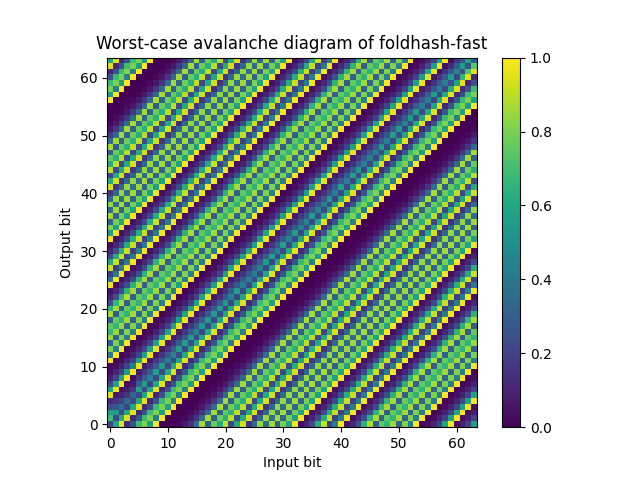
A heatmap titled "Worst-case avalanche diagram of foldhash-fast", showing how each input bit affects the output bit. It's visibly split into diagonals, e.g. bit 10 affects bit 20 in almost the same way as bit 11 affects bit 21. Probabilities are unnatural, often close to 0% or 100%.

Since a single foldmul doesn’t guarantee a good reaction to bit flips, foldhash chains two foldmuls in hopes that distributing entropy twice does so more evenly, and that seems to work, though we don’t really know why:

A heatmap titled "Worst-case avalanche diagram of foldhash-quality", showing how each input bit affects the output bit. It's much more plain and doesn't have visible diagonals, all entries concentrated around 50%.

The ugly

If this section was confusing, don’t worry, I just wanted to yap about how complex hashes used in the wild are, because that isn’t really necessary.

For one thing, if you’re using a separate chaining hash table, that’s an overkill. Its design requires the mod-reduced hash to have few collisions, nothing else. If the hash table has a fixed size, you don’t need avalanche at all: a pass-through hash will put 0x00 and 0x80 in different buckets, as long as the hash table has at least 256 of them. And if you need resizing, you only have to move entropy towards lower bits.

Now imagine a world where people realized that early and designed APIs accordingly, because that’s not the world we live in.

Recall that multiplication can easily move entropy upward, but we need to move it downward. We can steal the workaround from foldmul: compute a wide product with a constant and take its high half. That produces high-quality results, and provably so. That’s great, except it’s completely unnecessary – had hash tables used the few top bits of the hash as the bucket index instead of the few bottom bits, we could use a normal truncated product, which is faster to compute on most hardware.

Granted, that only works reliably for separate chaining, and not open addressing. But SwissTable keeps 16 elements in a bucket, so it is kind of like separate chaining, so you might be perfectly fine on realistic data. Big Hash is lying to you!

Since HashBrown requires bottom bits, rustc-hash uses rotate_left to move entropy downward, which is imperfect, but it’s the fastest way to do so (byte swapping, CRC, and pext are all slower). Abseil uses low bits too, and Folly gives you a choice between using low bits or automatically mixing bits with CRC or ad-hoc foldmul.

Conclusion

Here’s your recipe for a simple hash function:

  1. Mixing: If the input is long or variable-length, try combining it in the stupidest way possible. Maybe addition works!
  2. Avalanche: Rearrange bits for your hash table. Be bold: multiply by a constant and take high bits, use the crc32 instruction, or maybe try bswap.
  3. ???
  4. Outcome: Profit!

Would you like me to provide a code example?