



 Getty Images
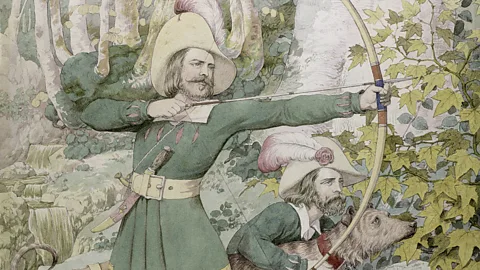
Robin Hood began as an oral tradition in the 12th Century before morphing into a heroic, family-friendly stereotype – here's how new takes are restoring his dark side.
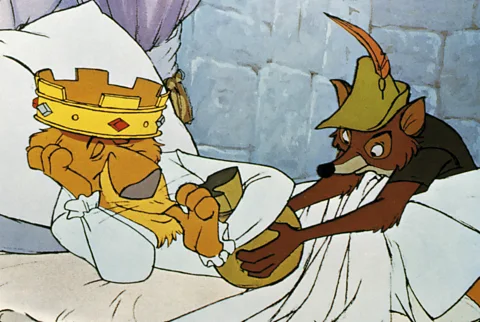
When writer and director Michael Sarnoski began shooting his new film, he showed the cast and crew one he has always loved. It was Disney's 1973 animated Robin Hood, its hero a fox with a feather in his green cap, robbing the rich to give to the poor.
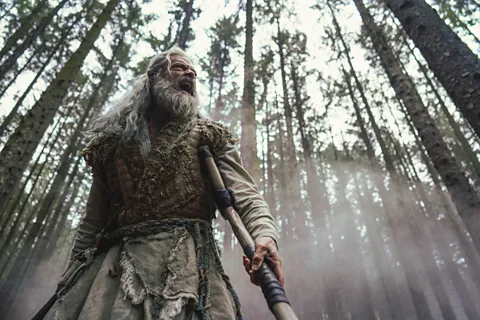
That beloved version could not be further from The Death of Robin Hood, Sarnoski's dark, thoughtful drama. Hugh Jackman stars as a grey-haired, battle-weary Robin, reflective at the end of his life and acutely aware of his own legend.
Warning: This article contains a graphic description of violence that some may find upsetting.
When he encounters a woman who talks about the virtuous, justice-seeking Robin Hood, he denies who he is and speaks of himself in the third person. "He was not a hero. He robbed and killed for the joy of it, nothing more."
It turns out that this violent Robin Hood and other revisionist takes pushing back against his heroic, do-gooder image are closer to the original medieval legends than the family-friendly stereotype we might think of today.
Knowing the Disney Robin Hood and then reading the Death of Robin Hood, those two versions of the character, really stuck with me as a kid – Michael Sarnoski
The depiction of Robin Hood has morphed through the centuries, each change reflecting the era that reinterpreted him. These darker 21st-Century variations look backward to the story's origins, but as some of their creators note, they also speak to the present. Complicated views of the character challenge a polarised world in which heroes and villains are often starkly good or bad, as simplified as the Robin Hood legend became over the centuries.
Who was Robin Hood?
Although there has been plenty of speculation about an actual Robin Hood, historians largely agree that there was no single, living person behind the character, just a vastly unequal society of wealthy landowners and impoverished peasants that inspired his creation. The stories began as an oral tradition in the 12th Century, but the first written accounts didn't arrive until two centuries later, in ballads that showed him as a celebrated figure even then.
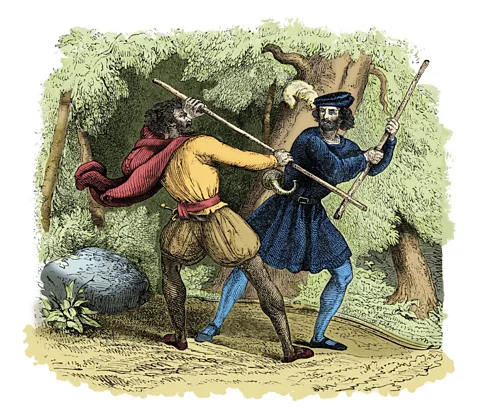
In those first written accounts, he wasn't the noble Sir Robin of Locksley as later versions made him. He wasn't noble at all, but a yeoman, a rung above a peasant. There was no Maid Marian in the story until the 16th Century. And while he was perfectly nice to the poor, helping them was not his main purpose. His enemies were the corrupt clergy and the land-owning nobles who took advantage of their underlings.
 Getty Images
In an afterword to her revisionist novel, The Traitor of Sherwood Forest (2025), medieval historian Amy S Kaufman describes the Robin Hood of the early legends as "a morally grey medieval trickster," and a "violent, irreverent rogue". Disney was right about one thing: the first ballads suggest that Robin was as sly as a fox.
A major change in the story came in the 16th Century. King Henry VIII was a fan and sometimes dressed up as Robin Hood. During the reign of the monarch who split from the Catholic Church, Robin's devotion to the Virgin Mary vanished from the legend.
As the upper classes embraced him, in influential chronicles of the time the character no longer hated the nobility, but became noble himself. Positioned as a morally upright nobleman battling his disreputable equals, he stopped questioning the power structure of society. He was enlisted to help the good King Richard return to the throne that had been usurped by his evil brother, Prince John, a trope that persists through Disney's depiction of John as a greedy, power-hungry lion.
 Alamy
Alamy
During the 19th Century, children's books helped turn Robin Hood even more into a sanitised do-gooder acceptable to the Victorians. And in the 20th Century, cinema perpetuated that portrayal, with the matinee idol Errol Flynn as the swashbuckling Sir Robin in 1938's popular The Adventures of Robin Hood. Disney, in perhaps the most formative version, solidified that image in the culture.
'Two versions of the same character'
Sarnoski tells the BBC that the contrast between the Disney film and the original legends has fascinated him since childhood, when he read a storybook version of the medieval ballad The Death of Robin Hood. There, Robin dies quietly, killed by an evil prioress and her lover. "Knowing the Disney Robin Hood and then reading the Death of Robin Hood, those two versions of the character – trying to grapple with that and understand how that can be the same character really stuck with me as a kid," he says.
I grew up on the fox Robin Hood, and then I went into medieval studies and discovered the ballads and thought, 'Where's my Robin Hood that I know and love?' – Amy S Kaufman
In Sarnoski's film, Robin is injured during a graphic battle – an arrow flies through the back of a boy's head and comes out through his eye – and is taken to a priory to recover. Jodie Comer plays the prioress, who, departing from the ballad's depiction of her, is kind.
"I didn't want the prioress to just be this simple evil nun and I didn't want Robin to just be this simple goodly hero," Sarnoski says, about creating more nuanced characters. And as Robin reflects on and begins to regret his past, "It [the film] really becomes a story about him grappling with his own legend and then grappling with his own desire for what he sees as a right death," he says.
 A24
A24
The falsity of legends is also a major theme in Kaufman's novel, and Disney shaped her early impressions too. She tells the BBC, "I grew up on the fox Robin Hood, and then I went into medieval studies and discovered the ballads and thought, 'Where's my Robin Hood that I know and love?'"
The Traitor of Sherwood Forest centres on the fictional Jane, a peasant who falls for Robin Hood's legend. She swoons over him and becomes part of his outlaw band, but begins to wonder if his heroic image and the seductive Robin himself have led her astray. Kaufman's Robin, neither hero nor villain, is true to the character's origins. In the ballads, she says, "He is incredibly subversive when you look at the way he goes up against people in power, like kings, like nobility, like the church. But he also, in every one of the ballads, either has a tragic end or is a victim of his own flaws."
In the last century, such complex views of Robin Hood have been rare. On screen, actors from Douglas Fairbanks to Kevin Costner and Russell Crowe have played the part, and almost all follow the stereotypical image. One notable outlier is Robin and Marian (1976), a smart, elegant film that deserves to be much better known. Sean Connery plays the ageing Robin, reunited after decades with Marian (Audrey Hepburn), now a prioress. This Robin denies that the legendary stories are true, and is contemplative at the end of his life. "I keep thinking of all the death I've seen," he tells Marian, and wonders what it was for.
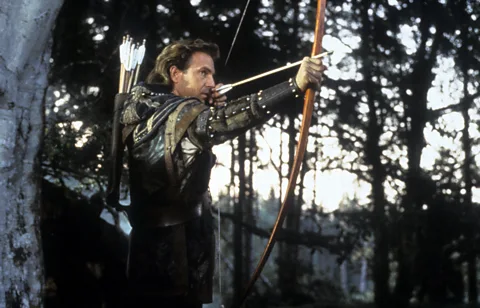 Getty Images
Such questions – about power, heroes, and how their stories are told – are exactly what make revisionist views feel so contemporary. "The world is consolidating power in ways similar to what the Middle Ages had," Kaufman says. "Some of the things that they had to think about are things that we are going to have to think about."
Sarnoski points out how his characters wield stories as power. "Robin used stories as a weapon and as a way to perpetuate violence," as he lured in followers, he says, while "The prioress uses stories as a way to help and heal people."
Those strategies are everywhere today. "We are so steeped in narrative right now between social media and the internet and just everything that's swirling around us," Sarnoski says. "We're so quick to dive into camps and tribalism and create heroes and villains and not live in the grey area that life actually exists in."
As bracing as darker new versions of Robin Hood are, they are not likely to replace the Disneyfied image. "Not everybody wants to have their Robin Hood fantasy disrupted," Kaufman says. "He's become like Santa Claus in the sense that he stands for something bigger than whatever the actual legend was."
The Death of Robin Hood is released in the US on 19 June.