
惯性聚合 高效追踪和阅读你感兴趣的博客、新闻、科技资讯
阅读原文 在惯性聚合中打开

推荐订阅源

Threat Intelligence Blog | Flashpoint
量子位
M
MIT News - Artificial intelligence
Y
Y Combinator Blog
钛媒体:引领未来商业与生活新知
钛媒体:引领未来商业与生活新知
Google DeepMind News
Hugging Face - Blog
Hugging Face - Blog
博客园_首页
雷峰网
雷峰网
I
InfoQ
罗磊的独立博客
博客园 - 聂微东
酷 壳 – CoolShell
酷 壳 – CoolShell
大猫的无限游戏
大猫的无限游戏
D
Docker
H
Hackread – Cybersecurity News, Data Breaches, AI and More
腾讯CDC
博客园 - 三生石上(FineUI控件)
The GitHub Blog
The GitHub Blog
K
Kaspersky official blog
P
Privacy & Cybersecurity Law Blog
S
SegmentFault 最新的问题
T
Threat Research - Cisco Blogs
H
Help Net Security
小众软件
小众软件
Cyber Security Advisories - MS-ISAC
C
CERT Recently Published Vulnerability Notes
WordPress大学
WordPress大学
T
Tenable Blog
T
The Blog of Author Tim Ferriss
C
Cisco Blogs
Simon Willison's Weblog
博客园 - Franky
A
Arctic Wolf
T
Threatpost
Scott Helme
Scott Helme
C
Cybersecurity and Infrastructure Security Agency CISA
D
Darknet – Hacking Tools, Hacker News & Cyber Security
T
The Exploit Database - CXSecurity.com
G
GRAHAM CLULEY
Security Latest
Security Latest
Spread Privacy
Spread Privacy
L
LINUX DO - 热门话题
V
Vulnerabilities – Threatpost
P
Privacy International News Feed
S
Schneier on Security
Latest news
Latest news
cs.CL updates on arXiv.org
C
Cyber Attacks, Cyber Crime and Cyber Security
C
CXSECURITY Database RSS Feed - CXSecurity.com

Hacker News

Introducing Claude Opus 4.7 Qwen Studio The Future of Everything is Lies, I Guess: Where Do We Go From Here? GitHub - SeanFDZ/macmind: Single-layer transformer in HyperTalk for the classic Macintosh Show HN: Agent-cache – Multi-tier LLM/tool/session caching for Valkey and Redis Moving a large-scale metrics pipeline from StatsD to OpenTelemetry / Prometheus GitHub - Nightmare-Eclipse/RedSun: The Red Sun vulnerability repository GitHub - SethPyle376/hiraeth: Local AWS emulator focused on fast integration testing, with SQS support, SQLite-backed state, and a debug-friendly web UI. GitHub - macOS26/Agent: Any AI, replaces Claude Code, Cursor, OpenClaw. Over 18 LLM providers (Claude, OpenAI, Gemini, Ollama, Zai, HF, Qwen) wired into a native Mac app that writes code, builds Xcode projects, bumps versions, manages git, automates Safari, use AppleScript, JS or Accessibility, extend Agent! w/ MCP Servers, run tasks from your iPhone via Messages. YouTube now lets you turn off Shorts I Made a Terminal Pager Burgers | マクドナルド公式 Commands — HackerNews CLI documentation ChatGPT for Excel PiCore - Raspberry Pi Port of Tiny Core Linux Live Nation illegally monopolized ticketing market, jury finds Google Broke Its Promise to Me. Now ICE Has My Data. Founding Engineer at Adaptional | Y Combinator CRISPR takes important step toward silencing Down syndrome’s extra chromosome GitHub - saffron-health/libretto: The AI toolkit for building reliable browser automations US v. Heppner (S.D.N.Y. 2026) no attorney-client privilege for AI chats [pdf] Unexpected €54k billing spike in 13 hours: Firebase browser key without API restrictions used for Gemini requests Retrofitting JIT Compilers into C Interpreters IPv6 – Google The Accursèd Alphabetical Clock Cybersecurity Looks Like Proof of Work Now Fragments: April 14 Cal.com Goes Closed Source: Why AI Security Is Forcing Our Decision | Cal.com - Scheduling Software for Online Bookings Laravel raised money and now injects ads directly into your agent When moving fast, talking is the first thing to break Too much Discussion of the XOR swap trick – Heather Cafe Introduction to Spherical Harmonics for Graphics Programmers The Grand Line Building a Z-Machine in the worst possible language High-Level Rust: Getting 80% of the Benefits with 20% of the Pain GitHub - duguyue100/midnight-captain: Inspired by Midnight Commander, tailored to my taste. How to build a `git diff` driver · Jamie Tanna | Software Engineer Center for Responsible, Decentralized Intelligence at Berkeley The Local Universe’s Expansion Rate Is Clearer Than Ever, but Still Doesn’t Add Up - A new synthesis of astronomical measurements confirms a persistent mismatch that could point to physics beyond current models The air throughout our homes is infused with microplastics. But there are things you can do to breathe less of them The disturbing white paper Red Hat is trying to erase from the internet – OSnews The Future of Everything is Lies, I Guess: Annoyances ‘Abhorrent’: the inside story of the Polymarket gamblers betting millions on war Productive procrastination — Max van IJsselmuiden maps, territory and LMs 447 Terabytes per Square Centimetre at Zero Retention Energy: Non-Volatile Memory at the Atomic Scale on Fluorographane Show HN: Pardonned.com – A searchable database of US Pardons 20 Years on AWS and Never Not My Job The Seasons are Wrong Artemis II crew splashes down near San Diego after historic moon mission We gave an AI a 3 year retail lease in SF and asked it to make a profit | Andon Labs How a dancer with ALS used brainwaves to perform live On filing the corners off my MacBooks Installing every* Firefox extension OpenClaw’s memory is unreliable, and you don’t know when it will break Steve Blank Nowhere Is Safe Chimpanzees in Uganda locked in vicious 'civil war', say researchers watgo - a WebAssembly Toolkit for Go linux/Documentation/process/coding-assistants.rst at master · torvalds/linux GitHub - callumlocke/json-formatter: Makes JSON easy to read. Founding Product Engineer at Bild AI | Y Combinator A compelling title that is cryptic enough to get you to take action on it GitHub - Keychron/Keychron-Keyboards-Hardware-Design: Industrial design files for Keychron keyboards and mice. 100+ models with CAD assets in STEP, DXF, DWG, and PDF. Source-available, with commercial use allowed for original compatible accessories within the license terms. [ANNOUNCE] WireGuardNT v0.11 and WireGuard for Windows v0.6 Released 1D-Chess Helium Is Hard to Replace Cooperative Vectors Introduction | Evolve Keeping a Postgres queue healthy — PlanetScale Our response to the Axios developer tool compromise Do Americans read print books, e-books or audiobooks more? The Zettelkasten Method in Obsidian: A Practical Setup Guide Artemis II Is Competency Porn and We Are Starving For It WeakC4 Flight Viz — Cockpit View A Mexican surveillance giant you’ve never heard of is now watching the U.S. border Surelock: Deadlock-Free Mutexes for Rust RISC-V 101 – what is it and what does it mean for Canonical? | Ubuntu The Problem That Built an Industry How Much Linear Memory Access Is Enough? | Solidean Investigating Split Locks on x86-64 Simplest hash functions Sybilproof reputation mechanisms (2005) [pdf] What is a property? How Complex is my Code? Static code analysis in Kotlin — tools overview Toffoli gates are all you need PGLite evangelism dcmake: a new CMake debugger UI Clojure on Fennel part one: Persistent Data Structures Fragments: April 2 Python Release Python install manager 26.1 The Life and Death of the Book Review - Liberties Introducing Database Traffic Control — PlanetScale Bitcoin miners are losing $19,000 on every BTC produced as difficulty drops 7.8% God sleeps in the minerals Building slogbox Apple Silicon and Virtual Machines: Beating the 2 VM Limit Who was “Not Even Wrong” first? Pokemon Evolution Vs Darwinian Evolution The APL Programming Language Source Code
Algorithmic Monocultures in Hiring
Rishi Bommasani* Stanford University · 2026-06-08 · via Hacker News

Paper Code Blog Cite

Over 90% of U.S. employers rely on hiring algorithms to screen job applicants. Many different employers use algorithms from the same few vendors. We conduct the largest empirical study of algorithmic hiring with data for 3.4 million real job applicants submitting 4 million applications to 156 employers across 11 market sectors. Every application was assessed by algorithms from a single vendor: we test whether this algorithmic monoculture bottlenecks job opportunities. We are the first to demonstrate large-scale evidence of racial disparities and homogeneous outcomes in high-stakes hiring decisions.


Key Findings

1 Large-scale adverse impact for Asians and Blacks. We are the first to demonstrate adverse impact in deployed algorithmic hiring as one of the largest demonstrations of unfair outcomes in real high-stakes AI decisions. 25.87% of applications submitted by Black applicants and 14.74% of applications submitted by Asian applicants are directed to positions that adversely impact them based on the standards of the relevant U.S. employment law (Title VII).

2 Adverse impact only revealed by disaggregated position-by-position analysis. While empirical studies of algorithmic hiring are very constrained due to data access limitations, prior studies showed minimal adverse impact due studying all of the vendor's data as a whole. By studying each position separately, in accordance with the standards of Title VII, we identify positions that demonstrate adverse impact that gets washed out in aggregate.

3 Algorithmic monocultures in hiring yield systemic rejections. We are the first to demonstrate systemic rejections in deployed algorithmic hiring as posited in prior theoretical research about algorithmic monoculture. The observed systemic rejection rate significantly exceeds that of the baseline of statistically independent decisions, even though the baseline accurately predicted observed systemic rejection rates in other hiring data in the absence of centralized algorithmic monocultures.

4 Data access inhibits independent research into hiring algorithms. We are the first and only group to independently conduct empirical research deployed hiring algorithms at scale, even though hiring algorithms mediate high-stakes decisions and are pervasively adopted. Given the data barriers, policy intervention may be necessary to enable scientific inquiry and increase accountability into this high-impact application of AI.


Algorithmic Hiring Pipeline

Many employers procure hiring algorithms from the same third-party vendors. Over 60% of the Fortune 100 use HireVue's algorithms. When hiring algorithms from a single vendor mediate hiring decisions at multiple employers, they constitute an algorithmic monoculture.
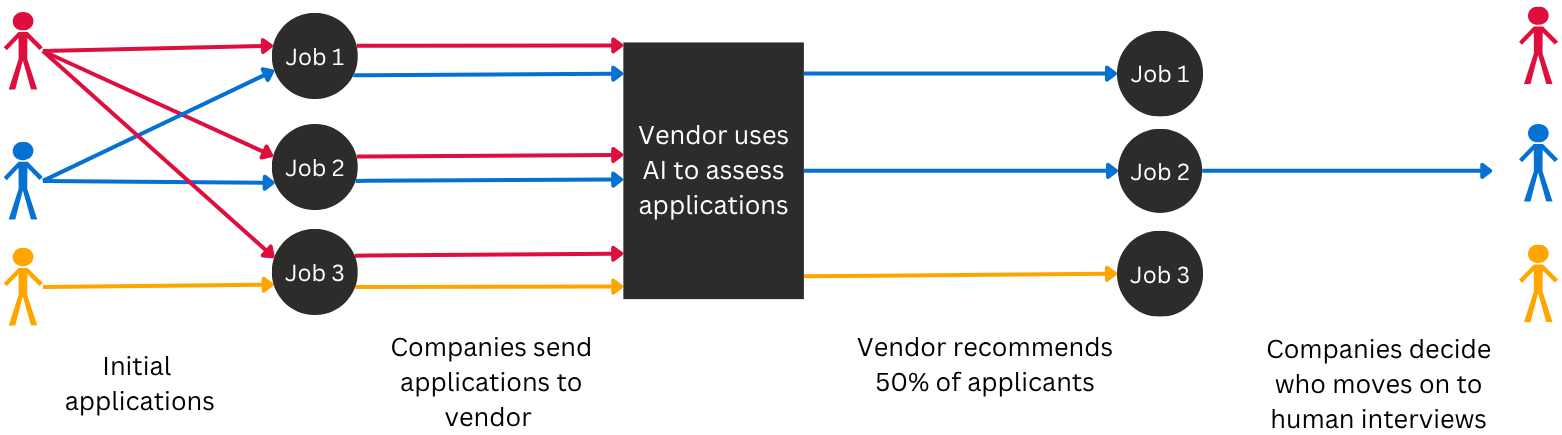
Diagram of the AI-mediated hiring pipeline showing how applicants are screened by shared algorithms across multiple employers
Figure 1. Job applications are assessed by hiring AI to be recommended or not recommended. If an applicant is not recommended by the algorithm, they are likely to be rejected without further consideration by a human.

Revealing Adverse Impact

Title VII of the US Civil Rights Act governs discrimination in hiring. Prior studies found very limited adverse impact in algorithmic hiring data as a whole. We surface previously-overlooked adverse impact by studying positions separately. Black applicants are the most likely to be adversely impacted: 30% of Black applicants apply to at least one position that demonstrates adverse impact against Black applicants. In terms of total effect, Asian applicants experience the largest shortfall: if Asians were selected at the same rate as the most selected racial group for each position, then 29000 additional Asian applications would be recommended.
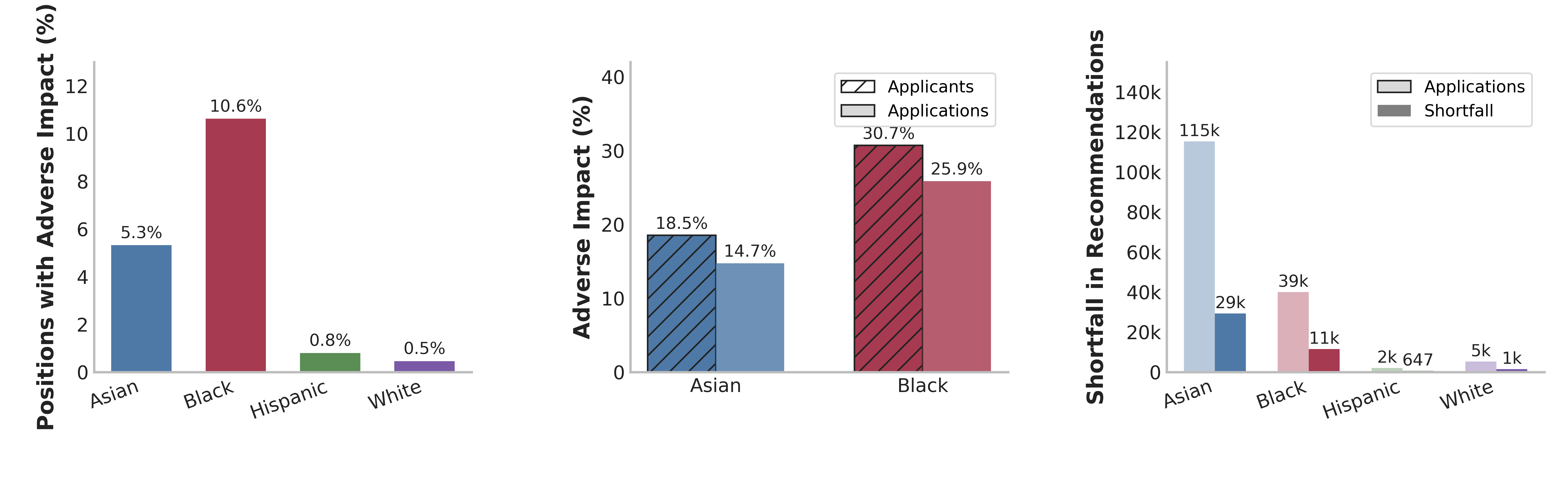
Adverse impact across applicant groups
Figure 2. Adverse impact according to the Title VII four-fifths rule measured at the level of positions (left) and applications/applicants (center). The shortfall (right) is the number of applications that would have been selected if the adversely impacted racial group was selected at the same rate as the most selected group.

Identifying Systemic Rejection

When applicants apply to multiple positions, they can receive the same outcomes. Algorithmic monoculture could make this most likely. If so, the systemic rejections where applicants are rejected everywhere would be especially concerning. Of applicants that submit 4 applications, 10% are systemically rejected. The observed systemic rejection rate significantly exceeds the baseline rate expected under independent decisions (χ2 = 18,481, p < 0.001).
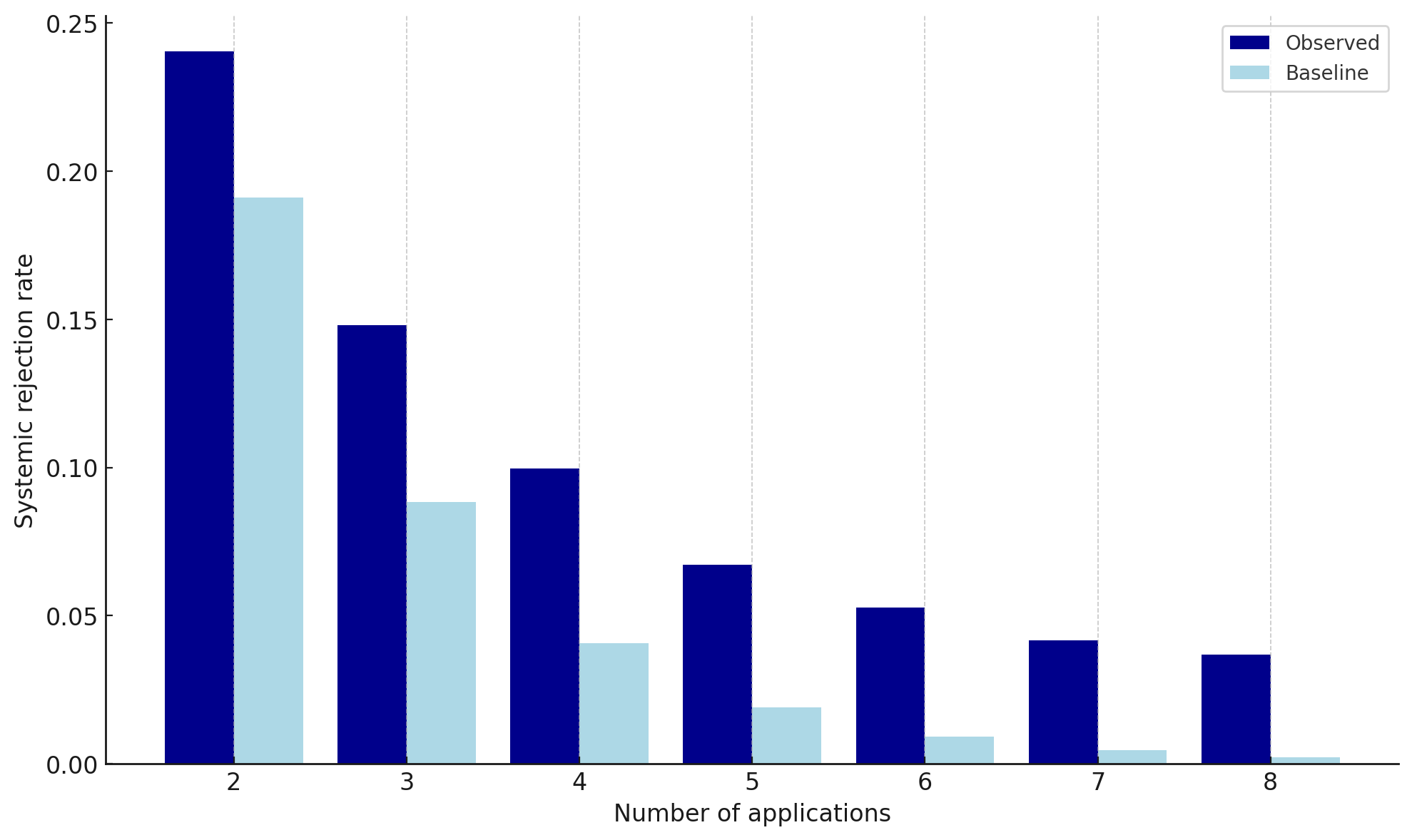
Chart showing systemic rejection rates exceed baseline predictions
Figure 3. Systemic rejection rates in hiring AI data. The observed rates always exceed the baseline: shared dependence on one vendor yields homogeneous outcomes.

To contextualize the observed systemic rejection rates, we introduce the baseline of independent decisions (Toups et al., 2023). To test the predictivity of this baseline, we use data from the largest prior study of hiring (Kline et al., 2022), which sent 83,000 applications to 108 Fortune 500 firms. The baseline accurately predicts the observed rates (χ2 = 20.05, p = 0.69). Therefore, excess homogeneity is distinctive of centralized algorithmic assessment.
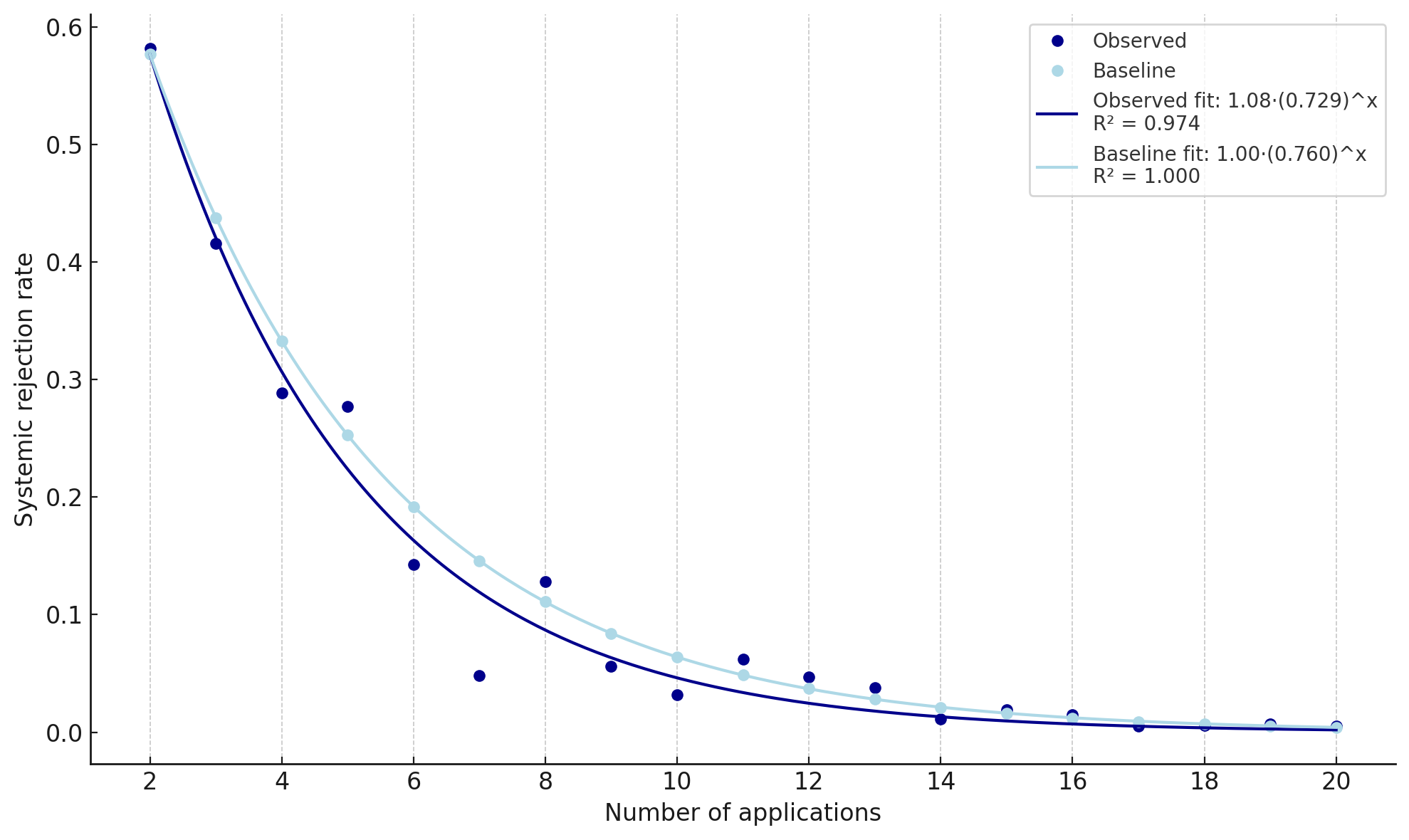
Kline et al. systemic rejection rates matching baseline predictions
Figure 4. Systemic rejection rates for data from Kline et al. (2022). Unlike the algorithmic hiring data, the baseline accurately predicted the observed rates.

Simulating Counterfactual Outcomes

What would happen if applicants applied more broadly than they did in reality? Would this lessen their chances of systemc rejection? When applicants apply everywhere, we find that at least one model recommends them. But under more realistic behavior, applicants need to submit 25 applications to ensure at least one recommendation with 99.9% probability — compared to just 10 applications for independent decisions.
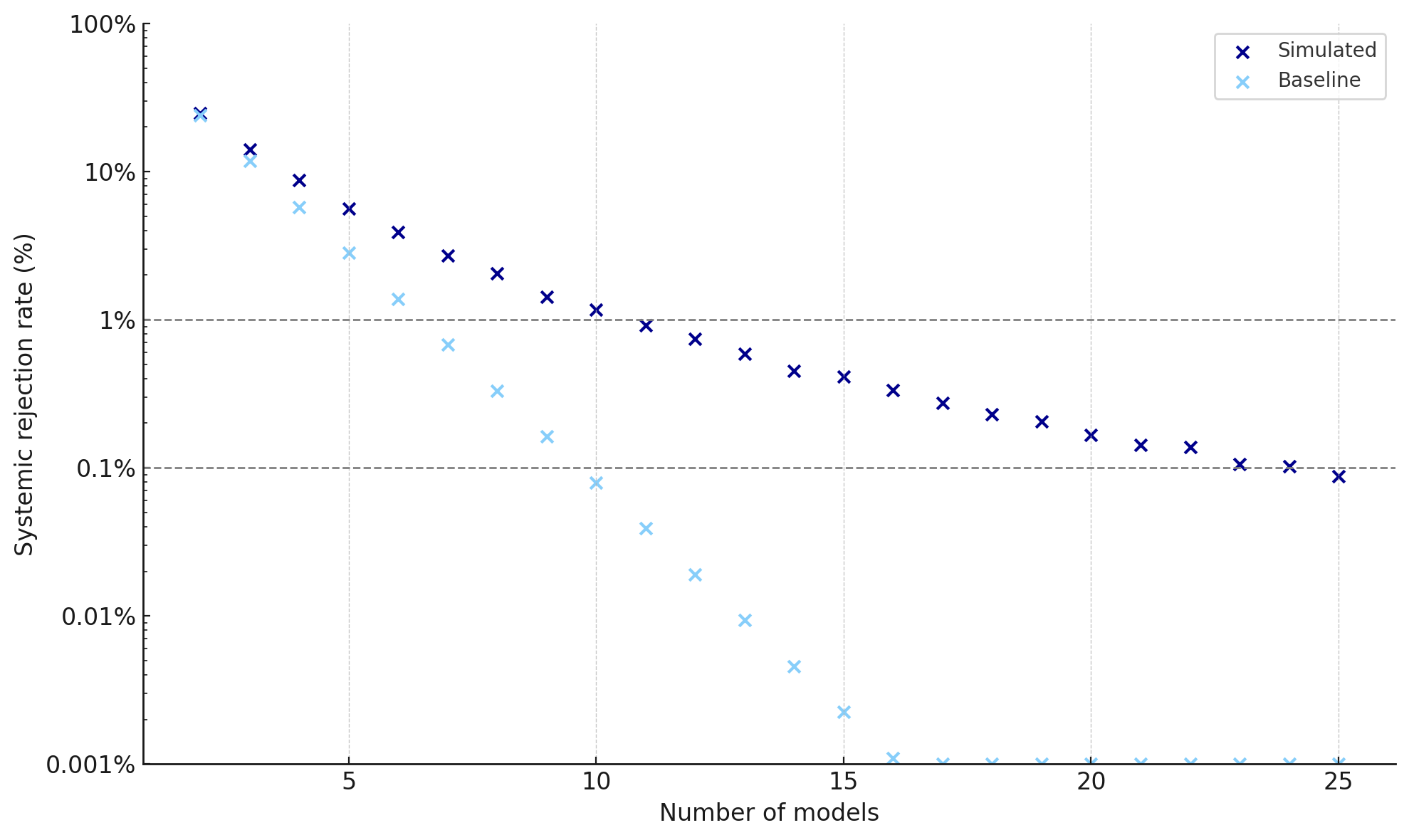
Simulation showing systemic rejection rates under broader application behavior
Figure 5. Simulated systemic rejection rates if applicants applied where they applied in reality, as well as to neighboring models that share applicants.

Policy Recommendations

Hiring AI is governed by employment discrimination law, general AI regulation, and specific rules for algorithmic hiring. In the U.S., Title VII already evaluates adverse impact at the level of specific jobs rather than blended aggregates. More broadly, hiring systems are increasingly treated as high-risk AI, including under the EU AI Act. At the municipal level, New York City Local Law 144 established an early framework for regulating automated employment decision tools, but current guidance does not adequately address the position-level effects we document.

1

Measure adverse impact per position. Regulators and auditors should evaluate adverse impact ratios at the level of individual positions. Aggregate-only analyses can conceal disparate impact.

2

Strengthen market surveillance. Federal agencies should quantify the rate of homogeneous outcomes. Without cross-employer links, existing reporting won't capture systemic rejection.

3

Monitor algorithmic monoculture. Policymakers should surveil shared dependencies in the hiring supply chain. Concentrated reliance on the same systems can yield correlated failures, systemic rejection, and reduced competition in hiring.

4

Expand researcher access. Legislators should stimulate independent research, including underlying data access, into major hiring platforms. Issues will be difficult to diagnose, let alone rectify, without the foundation of empirically-grounded externally-conducted inquiry.


Citation

@article{bommasani2026algorithmic, title={Algorithmic Monocultures in Hiring}, author={Bommasani, Rishi and Bana, Sarah H. and Creel, Kathleen A. and Jurafsky, Dan and Liang, Percy}, booktitle={Proceedings of the 2026 ACM Conference on Fairness, Accountability, and Transparency}, year={2026} }