




In My Stratum-1 Desk Clock I wrote about my quest for accurate and precise timekeeping that lead me to hack together a desk clock that disciplined its system clock against time taken from the U.S. global positioning system (GPS). I have come to think of this first effort as "O-1", inspired by John Harrison, the eighteenth-century carpenter who invented the marine chronometer and many of the fundamental innovations that remain in quality mechanical clocks today. As detailed in Dava Sobel's excellent book Longitude: The True Story of a Lone Genius Who Solved the Greatest Scientific Problem of His Time, Harrison designed and built a series of chronometers which he named H-1 (for Harrison-1) through H-5, in competition for the prize offered by England's Board of Longitude, an organization that in many ways was the DARPA and NSF of its day. Some other horologists of his time adopted his nomenclature for their own entries into that competition.
But O-1 has a flaw: it is only as good as its signal from the GPS satellites. Should the GPS transmissions, from which the one Hertz 1PPS pulse was synthesized, be unavailable, due to weather or what not, O-1 would be only as good as the standard quartz oscillator used by its Raspberry Pi 3. In time, O-1 would drift away from UTC. What good is that? What I needed was a better, more stable oscillator.
What I needed for O-2 was an atomic clock.
Atomic clocks are not clocks in the sense of telling the time of day or measuring time duration. What they are are extremely stable frequency sources, a mechanism to generate very regular ticks, tied to a fundamental physical property of the universe. Modern atomic clocks have the usual trade off of cost versus accuracy and precision, so that they can range from the big refrigerator-sized units fielded by the U.S. National Institute of Standards and Technology (NIST) costing hundreds of thousands of dollars, to the suitcase-sized commercial units found in telecommunications systems and which cost tens of thousands of dollars (and which from time to time you can find used on eBay for around U.S. twelve to fifteen grand).
All of those were outside my price range.
In 2001, and again in 2008, emboldened by developments in practical manufacturing of micro-electro-mechanical systems (MEMS), and by research by organizations like NIST into exploiting quantum effects to eliminate some of the bulkier portions of classic atomic clock designs, the U.S. Defense Advanced Projects Agency (DARPA) notified the R&D community, in BAA-01-32 and BAA-08-32 respectively, that it was interested in funding research in, and development of, a chip-scale atomic clock (CSAC). A CSAC would be an atomic clock - specifically, a cesium-133 reference oscillator - packaged in a surface-mount device.
The implications of such a device are wide ranging and profound. Precision frequency sources are ubiquitous components in both military and civilian applications in the realm of telecommunications, sensors and instrumentation, navigation, and even munitions. A relatively inexpensive, easily portable, and - it must be said - economically destructible cesium reference oscillator would open up vast possibilities of new mobile devices requiring precision timing and frequency standards.
Your tax dollars at work: San Jose-based Symmetricom, who had already purchased the frequency and time standard business unit of Agilent, formerly Hewlett-Packard, the folks who made the suitcase-sized cesium atomic clocks, developed the SA.45s CSAC. (Symmetricom has since been acquired by its California neighbor Microsemi.) Symmetricom with Las Vegas-based Jackson Labs Technologies, a developer of GPS-disciplined oscillators (GPSDO), integrated the CSAC "physics package" (as it is euphemistically called) with a board that incorporates a u-blox GPS chip and a 32-bit ARM-based microcontroller, to create a CSAC GPSDO. This provides the time of day via the output of the GPS chip, and phase locks the cesium oscillator with the 1PPS derived from the GPS system.
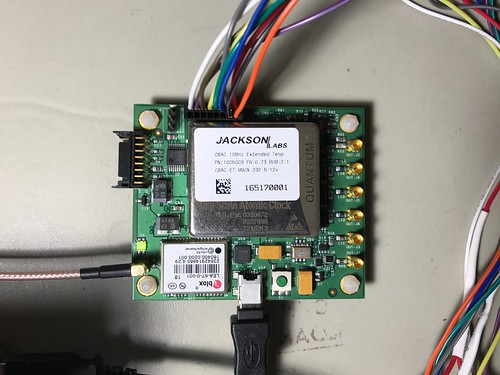
Once the output of the CSAC is initially disciplined against GPS, the board can maintain better than 0.3 parts per billion stability in the absence of a GPS signal. An O-2 built with the JLT CSAC GPSDO could be within a few microseconds of UTC per day, even without GPS.
It sure wasn't cheap, but it was doable.
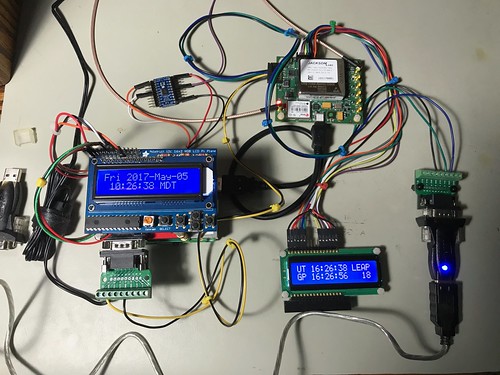
O-2 runs virtually the same software as O-1, with only minor tweaks. The function of the O-1 GPS board has been replaced by the JLT GPSDO, but the interface to the Raspberry Pi 3 is the same: NMEA 0183 sentences arrive via the serial port, and the 1PPS via a GPIO pin. The interface between the two boards was only complicated by the need for level translation: from RS-232 on the GPSDO to TTL on the O-2 for NMEA, and from 5V logic on the GPSDO to 3.3V logic on the O-2 for 1PPS.
The ARM microcontroller on the GPSDO has its own LCD display (on the right) in addition to the O-2 LCD display (on the left). Here I show it - somewhat redundantly - displaying the time, but a button on the GPSDO can be used to cycle through a number of status displays.
The GPSDO has two serial ports, one read-only providing the raw NMEA stream from the u-blox chip which I use to drive the GPS daemon on the Raspberry Pi, and one read-write serial port used for ASCII commands to the ARM microcontroller on the GPSDO to which I attached a FTDI serial-to-USB convertor connected to my desktop. The GPSDO exports a second serial control interface via its own FTDI chip over the USB connection to the Raspberry Pi that is also used to power the device.
Like O-1 (a.k.a. "hourglass"), O-2 (a.k.a. "astrolabe") doubles as a stratum-1 NTP server on my local area network, accessible via either WiFi or by a CAT5 cable.
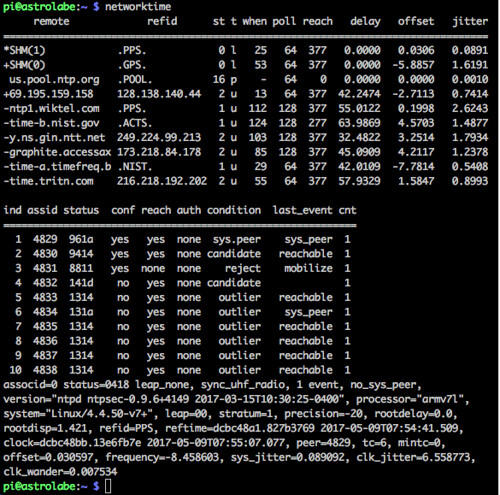
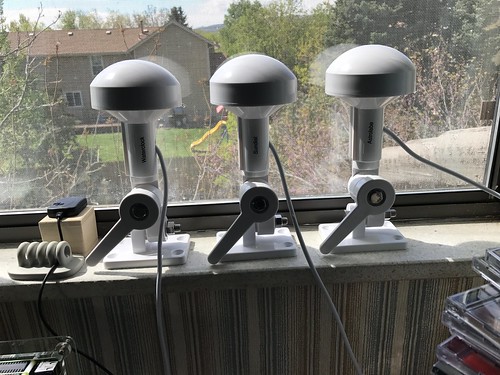
(I now have four stratum-1 NTP servers on my LAN, all requiring GPS antennas. I dunno, is that too many?)
O-1 got mounted on a fixture to become a desk clock in my home office, costing hundreds of dollars in materials. I anticipate O-2 similarly becoming a mantle or wall clock, costing thousands of dollars. But both projects were sure awesome learning experiences.
Acknowledgements
Thanks to reader Fazal Majid who shamed me into developing the O-2. Thanks also to Said Jackson and the folks at Jackson Labs Technologies who graciously put up with some questions.
Repositories
https://github.com/coverclock/com-diag-astrolabe
https://www.ntpsec.org/white-papers/stratum-1-microserver-howto/clockmaker
git://git.savannah.nongnu.org/gpsd.git
https://gitlab.com/NTPsec/ntpsec.git
Sources
R. L. Beard, J. D. White, J. A. Murray, "Military Applications of Time and Frequency", Proc. of the 28th Annual Precise Time and Time Interval Systems and Applications Meeting, Reston, Virginia, 1996
Jackson Labs, CSAC GPSDO User Manual, ver. 1.6, 80200506, 2014-03-16
Jackson Labs, CSAC GPSDO Release Notes, rel. 1.2, 80200505, 2012-01-30
Jackson Labs, CSAC GPSDO Operating Recommendations, rev. 1.1, 2016-04-13
J. Jespersen, J. Fitz-Randolph, From Sundials to Atomic Clocks: Understanding Time and Frequency, 2nd ed., Dover, 1999
A. Lal, "Integrated Micro Primary Atomic Clock Technology (IMPACT)", DARPA BAA-08-32, 2008-04-21
Microsemi, SA.45s Chip-Scale Atomic Clock User Guide, rev. C, 098-00055-000, 2016-07
G. Miller, E. Raymond, GPSD Time Service HOWTO, ver. 2.10, 2016-09
E. Raymond et. al, Building GPSD from source, 2016-04-10
E. Raymond et. al, Hacker's Guide to GPSD, 2016-09-02
K. Shenoi, "Clock, Oscillators, and PLLs: An introduction to synchronization and timing in telecommunications", Workshop on Synchronization in Telecommunication Systems, San Jose, CA, 2013-04
D. Sobel, Longitude: The True Story of a Lone Genius Who Solved the Greatest Scientific Problem of His Time, Bloomsbury USA, 1995
Symmetricom, "Introduction to Symmetricom's QUANTUM(tm) Chip Scale Atomic Clock SA.45s CSAC", 2012 International Technical Meeting of The Institute of Navigation, Newport Beach, CA, 2012-01
Symmetricom, The SA.45S Chip-Scale Atomic Clock, 2011 Sanford PNT Symposium, Menlo Park, CA, 2011-11-18
W. Tang, "A Chip-Scale Atomic Clock", DARPA BAA-01-32, 2001-07-06
此内容由惯性聚合(RSS阅读器)自动聚合整理,仅供阅读参考。 原文来自 — 版权归原作者所有。