





Source: CNBC, Financial Times, BBC, Reuters
At this point it’s almost routine: Almost every time Donald Trump makes a major announcement about the Iran War, that announcement is preceded — sometimes by only a few minutes — by huge and hugely profitable bets in the oil market.
The influential Kobeissi Letter documents the latest example:
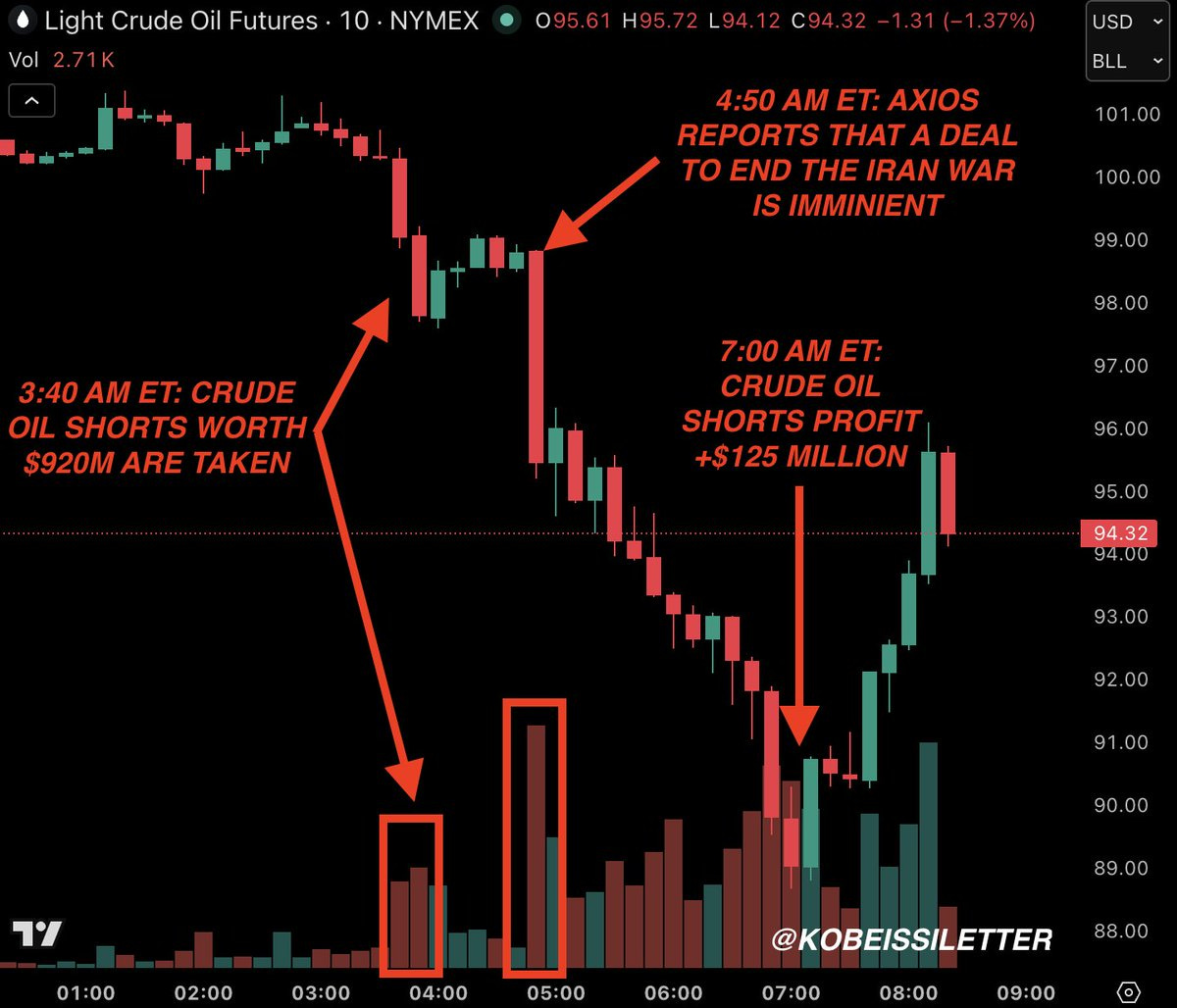
BREAKING: According to our analysis, ~$920 million worth of crude oil shorts were taken 70 minutes before an Axios report claimed the US and Iran were near a “14-point” deal to end the war.
At 3:40 AM ET today, nearly 10,000 contracts worth of crude oil shorts were taken without any major news.
This is equivalent to ~$920 million in notional value, an unusually large trade for 3:40 AM ET.
At 4:50 AM ET, just 70 minutes later, Axios reported that the US is “close” to a “memorandum of understanding” to end the Iran War.
By 7:00 AM ET, oil prices had fallen over -12% with these crude oil shorts gaining approximately +$125 million.
Minutes later, Iran launched the “Persian Gulf Strait Authority” and oil prices surged +8%.
What just happened?
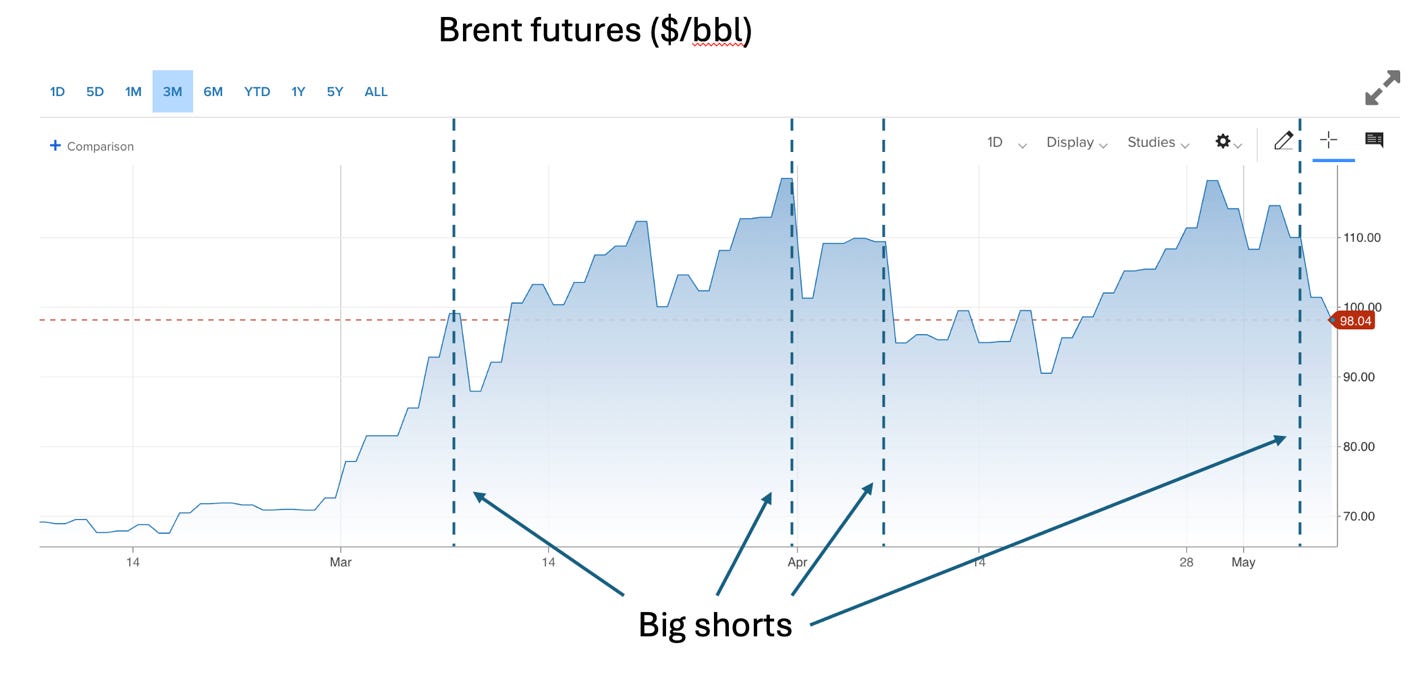
As the BBC among others has documented, this isn’t the first time, or the second time, that this has happened. Again and again, just before Trump makes announcements that raise hopes about the reopening of the Strait of Hormuz, one or more “whales,” very large traders, sell large quantities of oil futures, almost instantly reaping big profits as prices fall.
What’s truly remarkable is that this keeps happening even though the pattern has become familiar. This tells us two things: The Trump administration is making no real effort to crack down on whoever is trading using inside information, and these inside traders are operating with a complete sense of impunity, assured that they can get away with it.
The stench of corruption is overwhelming. Yet aside from the raw corruption, these incidents also raise a larger question. The insiders ripped off the parties who sold futures to them at what turned out to be very unfavorable prices to the sellers. What broader damage does this kind of unchecked insider trading do?
There’s both a narrow and a broad answer.
The narrow answer involves economic efficiency. How is the functioning of the economy affected by the realization that somebody — it’s not hard to make guesses, but we don’t know for sure — is trading oil futures based on advance knowledge about what will soon appear on Truth Social or Fox News?
It took me a while to figure this out. But I think I have an answer.
First, ask yourself what purpose is served by the oil futures market. Unlike the prediction markets Polymarket and Kalshi, the oil futures market is not intended to be mainly a vehicle for gambling. Instead, it is a market that serves to reduce risk through hedging.
Here’s how it works. There are people and institutions, such as oil producers, who will need to sell oil at a future date. They want to lock in the price today on those future sales. There are also people and institutions, such as airlines, who have a future need for oil and would like to lock in the price today. Thus the futures market lets both sellers and buyers of oil eliminate a major source of risk – fluctuations in the price of oil. This reduces uncertainty in the economy as a whole.
But what if there are substantial players in the futures market with inside information? Then if you are, say, a corporation trying to lock in the price of oil you plan to buy next month, you may not be making a mutually beneficial deal with future sellers. You may, instead, be being played for a sucker — paying what in retrospect will have been an excessive price — by people who know what’s about to appear in the president’s social media feed.
The same could apply to sellers of oil futures, although the examples of insider trading we know about involved Trump insiders getting ahead of falling, not rising, prices.
Either way, the effect of traders’ suspicion that they may be losers in a rigged game will be to make them reluctant to play at all — reluctant either to buy or to sell oil futures. And this will mean losing the risk-reducing benefits of a properly functioning futures market.
Now, insider trading of oil futures probably isn’t big enough to do critical damage to those markets. But it does do damage, which hurts all of us, not just the buyers who got stuck with the immediate losses.
And beyond the narrow economic losses, insider trading on oil is part of the broader rise of what we can call the predation economy.
Under Trump II, corruption runs rampant. Success in business depends not on what you know but on who you know, and there are no rules beyond having — and, obviously, buying — the right connections.
This is bad for everyone who doesn’t have those connections. It’s bad for economic growth. And it undermines the moral basis of the economy and society as a whole. It’s the path of how a country slides into third-world status.
I’ll have much more to say about the predation economy in future posts.
MUSICAL CODA