


There’s a certain type of sign hanging on every Main Street in America, seen on every road trip exit ramp, and shining brightly above the doorways to our local car mechanic, salon, and bar. These plastic, bubbly, lit-up signs have quietly ingrained themselves in our history and cultural identity here in the US, sometimes without thought or recognition, guiding us into the businesses that have sustained our local communities and economies for decades. And once you’re aware of their folk art glory, you’ll notice that they are…everywhere.
Found deep in online message boards, niche Facebook groups, and Flickr accounts, these 3D “vacuum-formed” signs are referred to as pan-faced signs, Signtronix, Dynalites, thermoformed signs, or vacu-form signs. Whichever way they are known, these names all lead to a 3-dimensional plastic sign with embossed letters dating back to the 1950s. And oh boy, this style of signage is just the tip of the iceberg in the history of sign design. So down the rabbit hole we shall go…
Before the 1900s, signs were primarily hand-painted wooden or metal signboards. At the turn of the century, the transition to electric sign advertising began to boom, with bright bulbs lighting up Broadway theaters and downtowns up until the 1920s, when the invention of neon lighting by the French engineer Georges Claude swooped in. These neon signs, considered a luxury with their multicolored fluorescent tubes, hit the US in the 1920s and were found across every major city, remaining popular until the early 1950s.
In the early 1950s, the world of plastics had significantly accelerated due to the military’s need during WWII for lighter, more durable materials to create 3D topographical maps. Advancements in manufacturing, with the invention of the vacuum-forming machine and thermoplastics, allowed sign manufacturers to reimagine how illuminated vacuum-formed signage could appear across the US.
Side Note: What the heck are thermoforming plastics, and what does a vacuum-forming machine do? Let me tell you so you can bring this information up at parties.The quick answer is using a large vacuum-forming machine, a sheet of thermoplastic was heated until soft, draped over a sign mold, and a vacuum from below drew the plastic tightly into the mold’s form.
Sign companies were off to the races with this new technology! Midwestern companies like Timely Products Mfg Co. found their niche in making vacuum-formed signs for breweries such as Yuengling, while the Chicago-based company Embosograf Corporation joined the fun with soft drink giants like Coca-Cola. With the vacuum-forming machine and new plastics at their fingertips, they could achieve faster turnarounds, more durable signs, and mass-produced signage.
Meanwhile in Southern California…
A lively salesman from East Los Angeles named Conrad Escalante worked for a small Southern California sign company called Gulf Development. According to his obituary, he was known to attach metal frames and handlebars to his signs as if they were suitcases. Outside of the office, though, Conrad was busy inventing and patenting numerous, 7 to be exact, vacuum-formed and electrical signs for development.
It was at Gulf Development that he met a young machinist named Kozy Boren, and in 1958, the two ventured off to start their own sign company, Superior Outdoor Display Co., in an 8,000 sq/ft industrial property in Long Beach, California.
At this point in the late 1950s, even the new, more affordable, brightly lit vacuum-formed plastic signage seemed to be reserved for larger businesses like Coca-Cola. Small businesses felt the pain of this, especially at night. Wooden motel signs off the highway were difficult to see, and Kozy and Conrad took note. With their sign-making experience, they solved this small-business challenge by inventing the iconic flashing “superior arrow,” an electric, lit-up arrow designed to attach to an existing sign. A perfect solution to bring attention to small businesses that couldn’t afford to update their whole exterior signage.
The Iconic “Superior Arrow” Sign Design by Superior Outdoor Display Co.
See the Superior Arrow in action next to the mechanical illustrations submitted by Conrad to the U.S. Patent Office in the early 1960s…
Here’s what Paul W. Stache Hartnagel had to say on a Facebook Signtronix Group: “Conrad (the marketing genius) came up with the idea while the two were having lunch at the White City Diner in the Worcester, MA area. He drew the design on a napkin, Kozy (the engineering genius) went home and built it in his garage. And the rest as they say...”
Even with the success of their business and the “Superior Arrow”, Conrad and Kozy split ways, with Kozy purchasing Gulf Development, Inc., and Conrad continuing on to build Superior Electrical Advertising. Their legacy continued on!
The Branding of Main Street America
The Superior Arrow's success sparked an idea for Kozy Boren. After purchasing Gulf Development (later known as Signtronix) in 1964, he realized they could carve out a niche by making affordable signs that help small businesses get noticed that large companies wouldn’t approach. Thus began the new branding of Main Street America, and soon the boom of affordable, plastic vacuum-formed signage.
According to past Signtronix documents, the criteria for a new product must meet these 2 requirements:
It must meet the needs of “Mom & Pop” businesses
It must be capable of semi-mass production
By the year 2000, Gulf Development/Signtronix had created over 500,000 signs and more than 700 pieces of original copyrighted art. I spoke to signmaker Chris Fato, and he shared that many of the designs we see are meant to be repurposed in case the business owner sells their shop. That’s why we see generic sign titles like “BAKERY” and “GROCERY COLD BEER.”
So, how can we tell if it’s a sign made by Gulf Development/Signtronix?
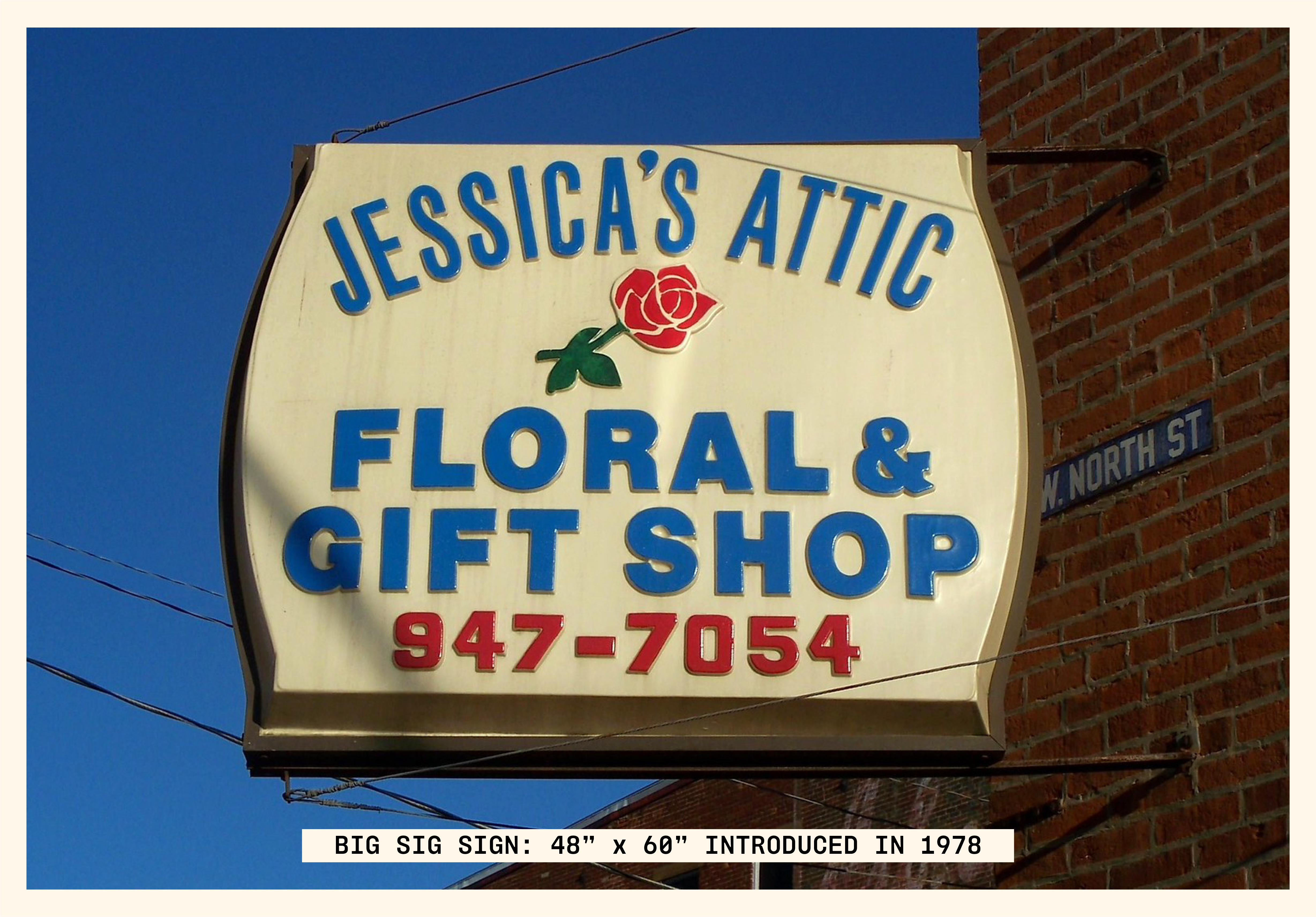
There are a few telltale Signtronix details that stand out once we learn how to recognize them. For one, once you pore over 15 pages of vacuum-formed signage in this Flickr album, you’ll start to notice the symbols and graphics repeated across the country. For two, the shape. Gulf Development created 2 main vacuum-formed shapes called the “Dynalite” and the “Big Sig”. And once you learn the shape and notice the rounded edges and embossed text, you’ll never be able to unsee them!
Dynalite: A small rectangular sign with rounded edges approximately 2’ x 4’. Introduced in 1964, with their heydey between 1970 and 1980
“Spell-Out”: Dynalite signs installed sideways with each face containing a single letter
Big Sig: Introduced in 1978, “Big Sig” is a larger 4’x5’ vacuum-formed sign with curved sides and was installed either in portrait or landscape
A Walking Tour of Signtronix Vacuum-Formed Signage
I decided to take this knowledge for a spin and do a walking tour of my Northeast Los Angeles neighborhood to see if I could spot a few Dynalites or Big Sigs. Within half a mile, I saw 8 Signtronix signs! Some were still in working order, some felt like ghosts of the past.
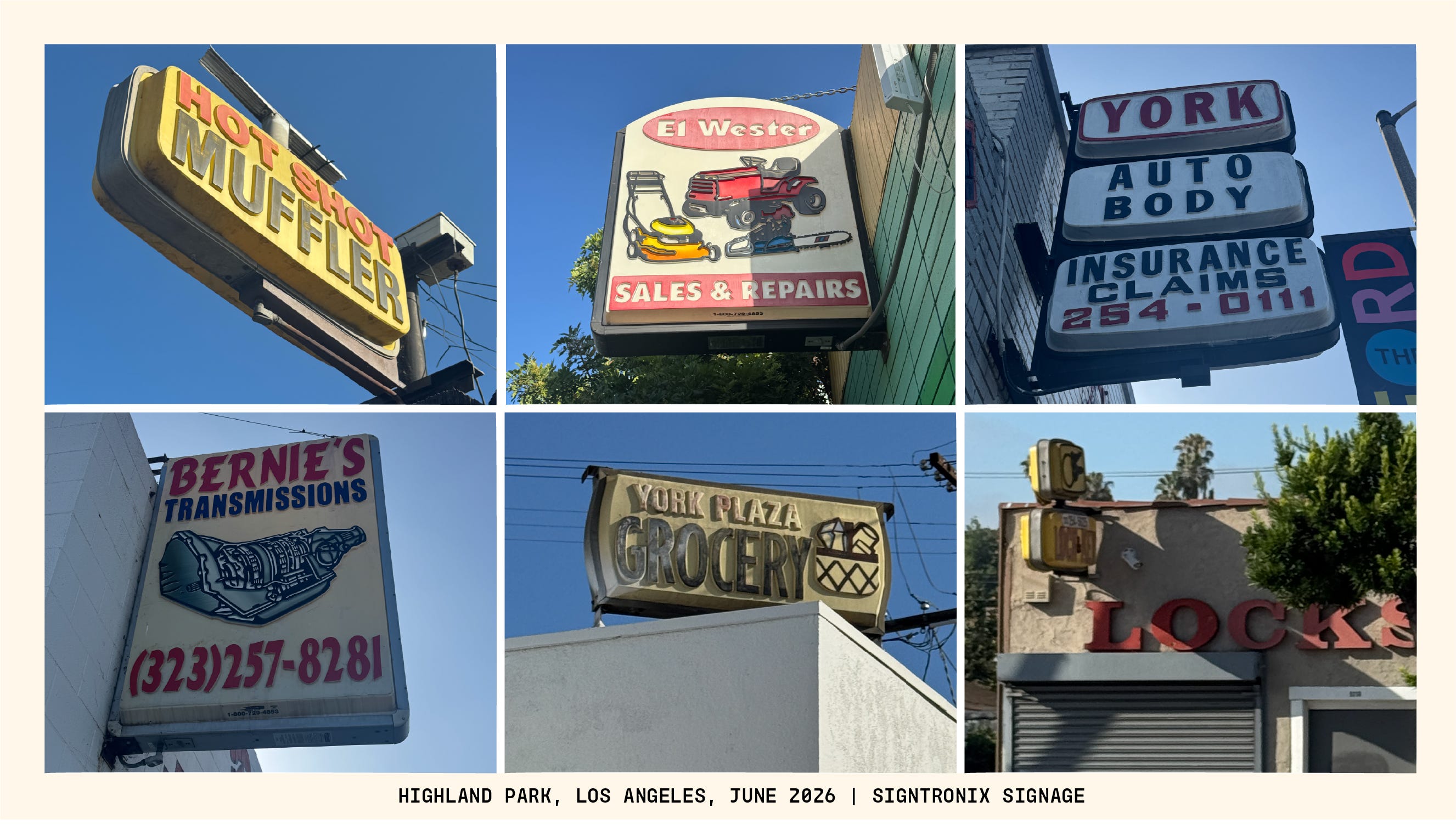
As I close this rabbit hole that has consumed my thoughts for the past two weeks, I’m reflecting on why I care so much about these vacuum-formed signs. To me, signs feel like pieces of art that are consistently there for us, whether we consider them “good” art or simply something that helps us get from one destination to the next. These pieces of art are meaningful, though, as they usually lead to some form of human connection. While on my walking sign tour, I stopped to take a photo of “El Wester Sales & Repairs”. I snapped the photo, and as I started to walk away, a group of older gardener gentlemen loaded up in their truck with their tools pulled out of the business driveway. I smiled and said, “I like your sign!” and they smiled, waved, and drove away. I love these kinds of positive micro-interactions out in the world, and I thank the sign-making community for making them possible. So cheers to noticing these things hanging in clear sight, and if you happen to take your own walking tour, I’d love to hear about what you see!
Love,
Beth
此内容由惯性聚合(RSS阅读器)自动聚合整理,仅供阅读参考。 原文来自 — 版权归原作者所有。