


惯性聚合 高效追踪和阅读你感兴趣的博客、新闻、科技资讯
阅读原文 在惯性聚合中打开

推荐订阅源

D
Docker
爱范儿
爱范儿
人人都是产品经理
人人都是产品经理
博客园 - 司徒正美
cs.AI updates on arXiv.org
量子位
罗磊的独立博客
cs.CL updates on arXiv.org
小众软件
小众软件
C
Cybersecurity and Infrastructure Security Agency CISA
Cyberwarzone
Cyberwarzone
大猫的无限游戏
大猫的无限游戏
Threat Intelligence Blog | Flashpoint
雷峰网
雷峰网
Simon Willison's Weblog
The Cloudflare Blog
博客园 - 三生石上(FineUI控件)
D
Darknet – Hacking Tools, Hacker News & Cyber Security
C
Cyber Attacks, Cyber Crime and Cyber Security
博客园_首页
博客园 - 叶小钗
V
Vulnerabilities – Threatpost
T
The Exploit Database - CXSecurity.com
T
Tailwind CSS Blog
IT之家
IT之家
博客园 - 聂微东
Spread Privacy
Spread Privacy
V2EX - 技术
V2EX - 技术
S
Security Affairs
宝玉的分享
宝玉的分享
V
V2EX
C
Cisco Blogs
博客园 - Franky
美团技术团队
酷 壳 – CoolShell
酷 壳 – CoolShell
月光博客
月光博客
S
Securelist
J
Java Code Geeks
Webroot Blog
Webroot Blog
让小产品的独立变现更简单 - ezindie.com
P
Proofpoint News Feed
Last Week in AI
Last Week in AI
L
LINUX DO - 热门话题
NISL@THU
NISL@THU
WordPress大学
WordPress大学
W
WeLiveSecurity
T
Threatpost
freeCodeCamp Programming Tutorials: Python, JavaScript, Git & More
腾讯CDC
阮一峰的网络日志
阮一峰的网络日志

Hacker News

Introducing Claude Opus 4.7 Qwen Studio The Future of Everything is Lies, I Guess: Where Do We Go From Here? GitHub - SeanFDZ/macmind: Single-layer transformer in HyperTalk for the classic Macintosh Show HN: Agent-cache – Multi-tier LLM/tool/session caching for Valkey and Redis Moving a large-scale metrics pipeline from StatsD to OpenTelemetry / Prometheus GitHub - Nightmare-Eclipse/RedSun: The Red Sun vulnerability repository GitHub - SethPyle376/hiraeth: Local AWS emulator focused on fast integration testing, with SQS support, SQLite-backed state, and a debug-friendly web UI. GitHub - macOS26/Agent: Any AI, replaces Claude Code, Cursor, OpenClaw. Over 18 LLM providers (Claude, OpenAI, Gemini, Ollama, Zai, HF, Qwen) wired into a native Mac app that writes code, builds Xcode projects, bumps versions, manages git, automates Safari, use AppleScript, JS or Accessibility, extend Agent! w/ MCP Servers, run tasks from your iPhone via Messages. YouTube now lets you turn off Shorts I Made a Terminal Pager Burgers | マクドナルド公式 Commands — HackerNews CLI documentation ChatGPT for Excel PiCore - Raspberry Pi Port of Tiny Core Linux Live Nation illegally monopolized ticketing market, jury finds Google Broke Its Promise to Me. Now ICE Has My Data. Founding Engineer at Adaptional | Y Combinator CRISPR takes important step toward silencing Down syndrome’s extra chromosome GitHub - saffron-health/libretto: The AI toolkit for building reliable browser automations US v. Heppner (S.D.N.Y. 2026) no attorney-client privilege for AI chats [pdf] Unexpected €54k billing spike in 13 hours: Firebase browser key without API restrictions used for Gemini requests Retrofitting JIT Compilers into C Interpreters IPv6 – Google The Accursèd Alphabetical Clock Cybersecurity Looks Like Proof of Work Now Fragments: April 14 Cal.com Goes Closed Source: Why AI Security Is Forcing Our Decision | Cal.com - Scheduling Software for Online Bookings Laravel raised money and now injects ads directly into your agent When moving fast, talking is the first thing to break Too much Discussion of the XOR swap trick – Heather Cafe Introduction to Spherical Harmonics for Graphics Programmers The Grand Line Building a Z-Machine in the worst possible language High-Level Rust: Getting 80% of the Benefits with 20% of the Pain GitHub - duguyue100/midnight-captain: Inspired by Midnight Commander, tailored to my taste. How to build a `git diff` driver · Jamie Tanna | Software Engineer Center for Responsible, Decentralized Intelligence at Berkeley The Local Universe’s Expansion Rate Is Clearer Than Ever, but Still Doesn’t Add Up - A new synthesis of astronomical measurements confirms a persistent mismatch that could point to physics beyond current models The air throughout our homes is infused with microplastics. But there are things you can do to breathe less of them The disturbing white paper Red Hat is trying to erase from the internet – OSnews The Future of Everything is Lies, I Guess: Annoyances ‘Abhorrent’: the inside story of the Polymarket gamblers betting millions on war Productive procrastination — Max van IJsselmuiden maps, territory and LMs 447 Terabytes per Square Centimetre at Zero Retention Energy: Non-Volatile Memory at the Atomic Scale on Fluorographane Show HN: Pardonned.com – A searchable database of US Pardons 20 Years on AWS and Never Not My Job The Seasons are Wrong Artemis II crew splashes down near San Diego after historic moon mission We gave an AI a 3 year retail lease in SF and asked it to make a profit | Andon Labs How a dancer with ALS used brainwaves to perform live On filing the corners off my MacBooks Installing every* Firefox extension OpenClaw’s memory is unreliable, and you don’t know when it will break Steve Blank Nowhere Is Safe Chimpanzees in Uganda locked in vicious 'civil war', say researchers watgo - a WebAssembly Toolkit for Go linux/Documentation/process/coding-assistants.rst at master · torvalds/linux GitHub - callumlocke/json-formatter: Makes JSON easy to read. Founding Product Engineer at Bild AI | Y Combinator A compelling title that is cryptic enough to get you to take action on it GitHub - Keychron/Keychron-Keyboards-Hardware-Design: Industrial design files for Keychron keyboards and mice. 100+ models with CAD assets in STEP, DXF, DWG, and PDF. Source-available, with commercial use allowed for original compatible accessories within the license terms. [ANNOUNCE] WireGuardNT v0.11 and WireGuard for Windows v0.6 Released 1D-Chess Helium Is Hard to Replace Cooperative Vectors Introduction | Evolve Keeping a Postgres queue healthy — PlanetScale Our response to the Axios developer tool compromise Do Americans read print books, e-books or audiobooks more? The Zettelkasten Method in Obsidian: A Practical Setup Guide Artemis II Is Competency Porn and We Are Starving For It WeakC4 Flight Viz — Cockpit View A Mexican surveillance giant you’ve never heard of is now watching the U.S. border Surelock: Deadlock-Free Mutexes for Rust RISC-V 101 – what is it and what does it mean for Canonical? | Ubuntu The Problem That Built an Industry How Much Linear Memory Access Is Enough? | Solidean Investigating Split Locks on x86-64 Simplest hash functions Sybilproof reputation mechanisms (2005) [pdf] What is a property? How Complex is my Code? Static code analysis in Kotlin — tools overview Toffoli gates are all you need PGLite evangelism dcmake: a new CMake debugger UI Clojure on Fennel part one: Persistent Data Structures Fragments: April 2 Python Release Python install manager 26.1 The Life and Death of the Book Review - Liberties Introducing Database Traffic Control — PlanetScale Bitcoin miners are losing $19,000 on every BTC produced as difficulty drops 7.8% God sleeps in the minerals Building slogbox Apple Silicon and Virtual Machines: Beating the 2 VM Limit Who was “Not Even Wrong” first? Pokemon Evolution Vs Darwinian Evolution The APL Programming Language Source Code
Does the Rule of 40 Work for Hardware?
Brad Feld · 2026-06-16 · via Hacker News

I first wrote about the Rule of 40 in 2015. I’d heard a late-stage investor describe it at a board meeting - growth rate plus profit should add up to at least 40% - and the simplicity stuck with me. So I blogged about it. Fred Wilson was at the same board meeting and posted his own version a few days later. Between the two posts, the Rule of 40 spread. It’s now gospel in SaaS.

I still like it. It’s a clean way to compress two things that usually fight each other - growth and profitability - into one number. Grow 40% and break even, you pass. Grow 20% with 20% margins, you pass. Grow 50% and lose 10%, you pass. Below 40%, you have work to do.

The number isn’t really the point. Rather, the market rewards growth until it doesn’t, and then it rewards profitability. I learned that the hard way in 2000. The Rule of 40 is a simple way to check that you aren’t too far out over your skis in either direction.

Others have tried to sharpen it. Bessemer proposed a Rule of X that weighs growth more heavily than profit - growth times a multiplier of two or three, plus free cash flow margin. The logic is that a point of growth compounds and drives the revenue multiple, so it’s worth more than a point of profit. I think that’s right for SaaS but it also makes my point for me. The moment you start weighting the inputs, you’re admitting the flat number was never the whole story.

While I’ve done plenty of SaaS investments, I also invest in hardware companies. Formlabs, Whoop, and Sphero today, and before that, MakerBot, Fitbit, Harmonix, and many others. I periodically get asked if the Rule of 40 means anything for a company that makes physical things.

While the answer is yes, you have to read the curve, not the snapshot.


The Rule of 40 grew up in software for a reason. SaaS has low marginal costs, high gross margins, recurring revenue, and fast iteration. A customer who signs up keeps paying. Margins show up early and hold steady. In that world, a single quarter’s snapshot tells you a lot.

Hardware breaks most of those assumptions. I’ve called it software wrapped in plastic for years. Development cycles run in years, not weeks. You spend real money up front on tooling, manufacturing, and supply chain, long before you ship a unit. Revenue often comes as one-off sales instead of a subscription, and even when recurring revenue shows up, it builds over time. Margins are real, but they tend to arrive later in a company’s life.

Point the Rule of 40 at a young hardware company and it looks broken. Growth might be strong while margins (including gross margin) are negative because the company is still building the thing. The number says “unhealthy.” The company says “on track.”

That’s the trap. A hardware company doing everything right can fail the Rule of 40 for years. If you treat the snapshot as the verdict, you push for profitability too early, you focus on the wrong things, or you cut the growth investment that makes the company worth something.


The fix isn’t to throw out the Rule of 40. It’s to stop reading it in a single time period.

For hardware, the shape of the curve matters more than any one quarter. Is the gross margin trajectory improving? Is each product generation more profitable than the last? Is the company earning the right to turn on the profit engine, or just delaying it? Those questions tell you whether a sub-40 number is a problem. In hardware, gross margin often tells the story. I’ve written before that founders and investors should go deep on it. Most don’t.

I’ve watched this play out in boardrooms for 30 years and the conversation feels different in a hardware boardroom than a SaaS one. In SaaS, growth versus profitability is a dial you can turn from one quarter to the next. In hardware, it’s a set of bets - on a product generation, a factory, a supply chain - you placed years ago and are now living with. The hardware companies that worked looked bad on the Rule of 40 early and great on it later. The ones that didn’t work looked the same all the way through. The difference was the slope.


Formlabs is a dramatic positive example. Today it’s over $250m in revenue, profitable, and depending on the quarter, hovers around or exceeds the Rule of 40. It’s the market leader in its category, with economics that look completely different from those of other 3D printing companies.

Over the years, Formlabs has repeatedly launched successful new products and entirely new product categories while simultaneously streamlining operations and improving margins. By contrast, its longest-tenured publicly traded competitor, 3D Systems, has seen revenue decline quarter after quarter for nearly five years, alongside deteriorating margins. Stratasys, which currently leads the public peer group in revenue, has fared only marginally better: revenue has also trended downward, and margin improvements have been modest. The result is two businesses that have effectively been treading water.
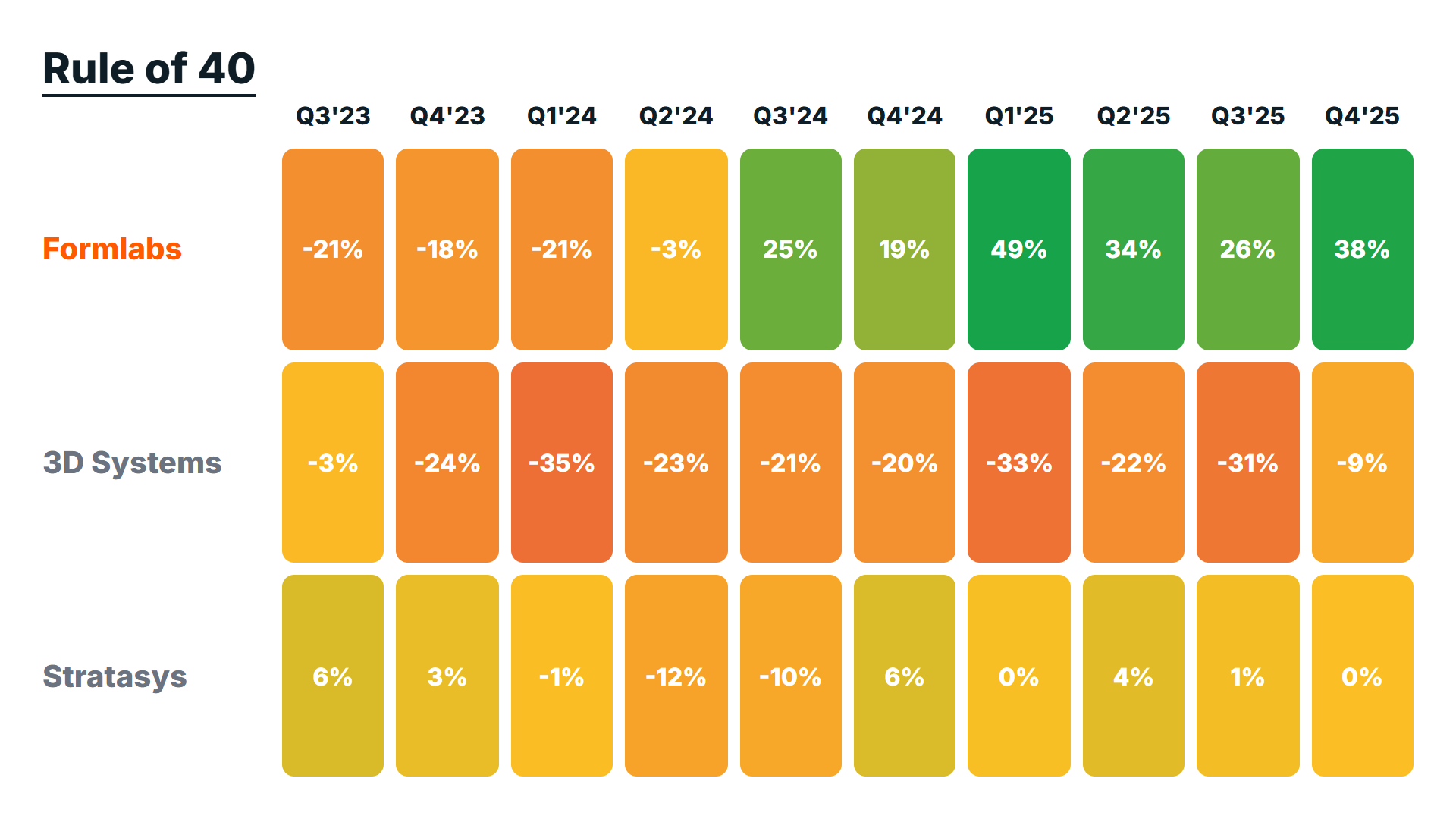
A Rule of 40 heatmap by quarter from Q3 2023 to Q4 2025 for Formlabs, 3D Systems, and Stratasys. Formlabs climbs from negative scores into the green 25 to 49 percent range, while 3D Systems stays deeply negative and Stratasys hovers near zero.

It did not look like that at the start. Getting a hardware business to the point where growth and profitability show up at the same time takes years of decisions that don’t fit on a single quarter’s scorecard. The decisions that get you there are the unglamorous kind - improving gross margin with each product generation, holding price discipline, and not turning on the profit engine until the growth engine has earned it. It also takes less capital than most people assume, which is one of the things that still surprises and delights me about well-run hardware companies.

If you had judged Formlabs based on a snapshot from its early years, you would have missed the company it eventually became.


The Rule of 40 is a good target. I’ll keep using it, in SaaS and in hardware.

Just don’t confuse the snapshot with the trajectory. Match the metric to the business model. In SaaS, you can mostly get away with the snapshot. In hardware, you can’t. Read the shape of the curve, not the single frame, and the Rule of 40 still tells you something useful.