





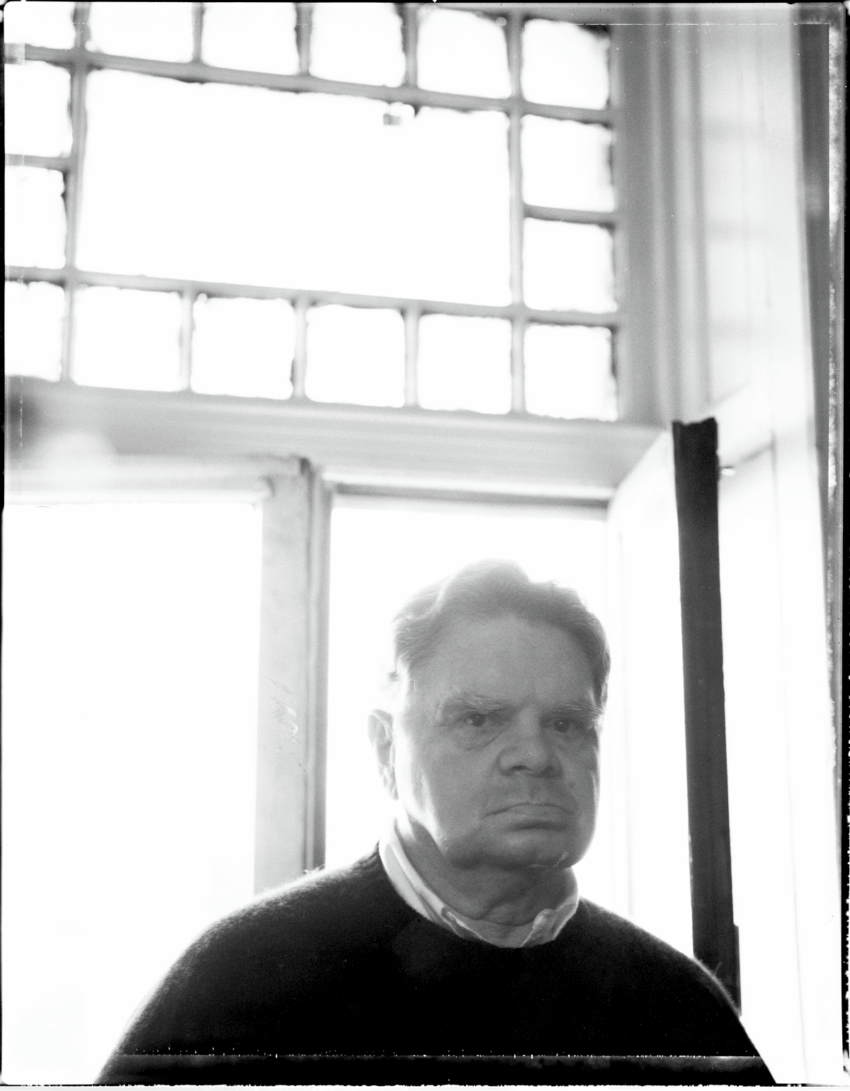
It’s october and I sit down to type. I gaze out the window to where the house across the road is blanketed in thick wisteria, its waxy leaves turning a deep, plummy red. I get up, put on another sweater, and return to stare at the winking cursor on the screen in front of me. These lapses of attention may be just procrastination. Or perhaps they’re a kind of preparation for writing an essay about James Schuyler, a poet whose work is characterized by lost trains of thought, cleavings of the mind, and the strangeness of writing about your writing as you’re writing it.
I open the book on my desk—Schuyler’s Collected Poems—and leaf through the pages until I land on the poem I’m looking for. It’s called “October”:
Books litter the bed,
leaves the lawn. It
lightly rains. Fall has
come: unpatterned, in
the shedding leaves.
The maples ripen. Apples
come home crisp in bags.
This pear tastes good.
It rains lightly on the
random leaf patterns.
The nimbus is spread
above our island. Rain
lightly patters on un-
shed leaves. The books
of fall litter the bed.
To catch and pin the ephemeral turn of a season is a well-worn poetic trope. But there are few poets who have done it as well—as attentively, as holistically—as Schuyler. “October” is galvanized by its repetitions: lightly appears in every stanza, suggesting the slant of autumn’s light but also the poem’s lyrical lightness; patterned, patterns, and patter drum like soft raindrops, nodding to the chance nature of nature’s designs. And look at all those leaves in the poem: some strewn haphazardly on the ground, others clinging tremblingly to branches, still more fanned out on the bed and held in place not by stems but by the glue of bookbindings.
For Schuyler, autumn isn’t just something you observe outside in the mellowing air, and poetry isn’t simply a means of registering it; the two are gently, carefully folded together like flour into cake batter. Here, crisp describes the quality not only of a freshly plucked apple but also of the paper bag in which it arrives; leaves the stuff of books and plant mulch alike. This is more than tactile whimsy (even if lines like “Apples / come home crisp in bags” are plosive enough to feel in the mouth). The literary and the organic are tangled up in “October” because pages and plants—writing and life—are inseparable in Schuyler’s poetry.
last year marked a milestone in life writing about Schuyler, with the appearance of Nathan Kernan’s long-anticipated biography of the poet, A Day Like Any Other. Almost thirty years in the making, Kernan’s hefty tome is a vivid account of Schuyler’s turbulent life, as well as an invaluable piece of cultural history, offering scintillating glimpses into New York’s queer artistic circles from the 1950s through the 1980s.
Born in Chicago in 1923 and raised in upstate New York, Schuyler would become one of the leading voices of the New York school, alongside Frank O’Hara, John Ashbery, Barbara Guest, and Kenneth Koch—though until recently, his work has received significantly less critical or popular attention than the better-known members of this coterie. After serving in the U.S. Navy during World War II (he was dismissed when his commander discovered that he was gay), Schuyler moved to New York City. A brief, troubled love affair with the Finnish American writer and Spanish Civil War veteran Bill Aalto (who likely inspired the character Robert Jordan in Ernest Hemingway’s For Whom the Bell Tolls) took Schuyler to Europe in the late 1940s, a period that Kernan’s biography brings dazzlingly into the light.
The details Kernan sketches may be true to life, but their piling up risks stripping Schuyler of his deep poetic sense of the beauty of life.
In 1952, back in New York, Schuyler befriended Ashbery and O’Hara—two Harvard graduates who had recently arrived in the city—and he began to apply himself seriously to writing. Yet his poetic career would be marked by belatedness: his first major collection, Freely Espousing, would not be published until 1969, when he was forty-six years old, and he would not give his first public reading until 1988, just three years before his death. A further four major poetry collections would follow Freely Espousing—The Crystal Lithium (1972), Hymn to Life (1974), The Morning of the Poem (1980), for which Schuyler was awarded the Pulitzer Prize, and A Few Days (1985).
Schuyler’s poetic style is marked by its attention to the daily. His poems are diaristic, often registering times and dates, with a relentlessly observational eye that comes to rest on what he calls “the said to be boring things / dreams, weather, a bus trip.” His compositions oscillate between intensely truncated lineation and long, page-spilling lines of Whitmanesque excess—both formal strategies that capture the rambling and digressive immediacies of a mind at work.
These “vagaries” of thinking, as Guest called them, gesture toward the bouts of mental instability that shadowed Schuyler’s life, and that were often followed by stretches in psychiatric hospitals. He was never accurately diagnosed or properly treated (a product, Kernan suggests, of a homophobic health-care system), but he likely had bipolar disorder, which crescendoed and decrescendoed in erratic patterns, making for a difficult and chaotic life. A Day Like Any Other offers the most complete account to date of Schuyler’s mental health crises. (It also includes Kernan’s extraordinary discovery that Schuyler’s first psychiatrist in New York, a Dr. Charles R. Hulbeck, was in fact the experimental Dada poet and performer Richard Hülsenbeck.) Incidents that readers had gleaned only a little about in the past (from Schuyler’s diaries or from accounts written by friends) are here fleshed out in grim detail, making up the narrative bulk of the biography.
Kernan gives us, for example, a blow-by-blow account of an infamous episode in 1971, when Schuyler, in the grip of a severe hallucinatory breakdown, terrorized the poet Ron Padgett and his family. Padgett called the cops. When they arrived, Schuyler was naked and covered in rose petals. And he tells of the occasion, years later, when Schuyler, in a paranoid prelude to another nervous collapse, accused his devoted caretaker Helena Hughes of stealing from him. “The bitch took my money,” he insisted. There was also the time when Schuyler, posing for a friend, the artist Anne Dunn, “suddenly got up and went into the bathroom, took off all his clothes, and came back and sat down again.…Anne felt that this was both a tease and an oblique way of making a kind of pass at her.”
It wouldn’t be possible to narrate the story of Schuyler’s life without including some of these uncomfortable details. (This may be, in part, why Kernan’s is the first full-length biography of the poet.) But there is something troubling about the way Kernan’s account pushes the poems to one side (as he notes at the outset, it “is not intended to be a critical biography”), revealing Schuyler at his most vulnerable. What do these disclosures offer literary study? What do they bring to the poetry? The details Kernan sketches may be true to life, but their piling up risks stripping Schuyler of his deep poetic sense of the beauty of life.
every literary biography wrestles with this question of the relationship between life and art. But it’s especially vexing in the case of Schuyler, where the gap between the life—tumultuous, painful, often miserable—and the work feels large. Kernan is aware of this tension. “Even at his most deranged,” he tells us, “[Schuyler] could appear, and perhaps be, calm and rational in his writing. There was a discipline and a sense of performance in writing that he could harness, making it hard at times for anyone reading his letters…to reconcile their sensible tone with his actual behavior around the time of writing.”
The contrast, in Kernan’s book—between the reality of Schuyler’s day-to-day existence and Schuyler’s own representation of that existence in his poetry—exposes the distinction between life writing and lyric poetry. Schuyler sometimes invites the reality of his life into his work, but the details are always in service to the poems. His verses about life inside the Payne Whitney sanatorium, for instance, are not histrionic or mad but focused on the banalities of the everyday. “What’s in those pills? / After lunch and I can / hardly keep my eyes / open. Oh, for someone to / talk small talk with.” Or: “This morning I / changed bedding. / At lunch I watched / someone shake out / the cloth, fold and / stow it in a side- / board.” And notably, in these poems, it’s writing—not pills—that figures as a “curative.” “Now, this moment / flows out of me / down the pen and / writes,” Schuyler tells us. “I’m glad I have / fresh linen.”
Schuyler’s capacity to knit together the mundane and the metaphysical is unparalleled.
All of which is to say that no poem by Schuyler is a vehicle for confession; instead, real events are like base metals that he transmutes into poetic gold. Take his well-known poem “Dining Out with Doug and Frank,” an almost narrative account of an evening with friends. (“Doug” is the poet Douglas Crase.) The poem’s descriptive elements (“so I went with Frank,” he writes, “to dine at McFeely’s / at West 23rd and Eleventh Avenue / by the West River”) are the foil for deeper, more digressive channels of thinking around death, distraction, and memory. Schuyler buries these in unwieldy parentheses (the longest bracketed aside spans thirty-seven lines), but they are never just incidental remarks: his parenthetical intrusions are more revealing than prattling. “I really like / dining out and last night was / especially fine,” Schuyler muses toward the end, but then swerves to confront the poem itself: “Why is this poem / so long? And full of death? / Frank and Doug are young and / beautiful and have nothing / to do with that.”
Schuyler’s poems are long because, for him, writing was more than an end-oriented process: the time of writing sustains the poem, stretching out the present to hold the future in abeyance. And this is true for his readers, too—we find ourselves buoyed along on the poem’s boundless present. What Schuyler does—in “Dining Out,” as in so many of his poems—is offer glimpses of a life (his own) to articulate something about the experience of Life with a capital L. He shows us the real world, the one we know, and then out of that dailiness, he brings forth moments of exquisite truth and clarity. Perhaps this is what all poetry does, but Schuyler’s capacity to knit together the mundane and the metaphysical is unparalleled.
now it’s november: crumpled pumpkin flesh in the street, leaves mulching beneath boots, cold air slicing at uncovered skin. And here I am reading about spring. What strange joy to evoke one season amid the depths of another, to see in the mind’s eye tulip tips breaking the surface of the soil while outside the trees are undressing. I’m reading Schuyler’s “Hymn to Life,” the title poem of his 1974 collection. It’s a work I find myself returning to each year, a poem that punctuates the rambling march of life, capturing the strange progress of aging, which, as Schuyler shows us, has as much to do with inhabiting the present as with recalling the past or anticipating the future. “Time brings us into bloom and we wait, busy, but wait / For the unforced flow of words and intercourse and sleep and dreams / In which the past seems to portend a future which is just more / Daily life.” We look for life’s meaning in our memories and predictions, but it emerges, for Schuyler, from a dailiness we hardly notice. “Life, I do not understand,” he writes, but “all these household tasks and daily work…are beautiful.”
Reading Schuyler is like looking at life under a magnifying glass. It is not only the radiant color and tender outline of a rose’s petal that you see but also the thorns on the stem, the dirt in the earth, worms munching on decomposed life: “Out of the death breeding / Soil, here, rise emblems of innocence, snowdrops that struggle / Easily into life and hang their white enamel heads toward the dirt.” Death is never out of sight. (“The threat / Is always there, even in balmy April sunshine,” but its presence only heightens life’s intensity, reminding us that “the world is filled with music.”) Reading “Hymn to Life” again, I am reminded of the following lines, written by Mozart—whose operas Schuyler loved—to his father: “As death (when closely considered) is the true goal of our life…not only has its image no longer anything alarming to me, but rather something most peaceful and consolatory.…I never lie down at night without thinking that (young as I am) I may be no more before the next morning dawns.” I think (maybe wishfully) that I can hear this sensibility in Mozart’s music, as I do in Schuyler’s words: “All jays are one to me. But not the sun which seems at / Each rising new, as though in the night it enacted death and rebirth, / As flowers seem to.”
Schuyler’s love of circularity—the sun’s diurnal rebirth, the reappearance of a jay, fresh blooms of roses each year—presents a challenge for Kernan, since the poet’s embrace of repetition is at odds with the linear telling of a life that biography demands. Biography is also an act of remembrance, an archival exercise that’s out of step with Schuyler’s wilfully forgetful streak: “Each day forgetting: / What is there so striking to remember?” The stark facts of the biography might persuade readers to decode this amnesiac instinct as a defense mechanism, a way for Schuyler to protect himself from “that which we forget: / Pain,” as he writes in “Hymn to Life.” And perhaps this was, in part, true for Schuyler. But to read these poems purely through the scrim of biography—to think about Schuyler’s writing only as a “curative,” a form of processual therapy—would be to impose a falsely linear narrative onto the poetry and obscure the way that events occur and accrue haphazardly in life, like leaves littering a lawn. Poetry is built not out of narrative order but out of devious and circuitous rhythms of thinking, and to forget isn’t simply to ward off a troubled past but to plant both feet in the present: “Press your face into the / Wet April chill: a life mask. Attune yourself to what is happening / Now.”
during his lifetime, Schuyler was overshadowed by his more famous friends, O’Hara and Ashbery. (I first encountered his work in passing, during an undergraduate class on Ashbery. Some lines from one of his poems were briefly read aloud, and I must have just caught his name, because the only record of this initiation is a large handwritten note in the margin of my textbook: read skyler!) Today, though, we’re in the middle of what feels like a Schuyler renaissance. Readers seem to be increasingly drawn to his poems’ seemingly unmediated immediacy, the way they masquerade as diary entries or letters to friends without collapsing into the confessional. The timing of Kernan’s biography could not be better.
They’re bubbles of bliss that remind us, just before they burst, that life is fleeting, hard, and bittersweet—but so beautiful.
Why is this happening now? O’Hara and Ashbery were poets for their generations: O’Hara’s work captured the modernity and urbanity of the world’s greatest city at mid-century, while Ashbery’s poems spoke to the postmodern cultures of the 1970s and ’80s. But Schuyler’s minutely attentive urban pastoral (to borrow a phrase from the critic Timothy Gray) feels oddly of our troubled moment. Reading a poem by Schuyler doesn’t propel you out with eyes upturned to re-see workaday details through freshly polished lenses; it keeps you fixed on the page in front of you, which becomes a window onto a world built of observation, memory, and the inevitability of forgetting. To forget feels like a precious commodity in a world chained to networked clouds and unerasable digital archives. And to follow the zigzags of erratic thinking is to step, for a moment, out of the trammels of our efficiency-oriented lives.
Perhaps the aspect of Schuyler’s work that most resonates with contemporary audiences is his desire to find moorings amid flux, to see and to still the everyday, and to hold the present in a kind of suspension. For Schuyler, this want was born out of the psychological precarity that conditioned his life. For people today, it may be born out of the social and financial precarity of their lives. In a world where one’s economic position seems permanently unstable, what meaning can the grand narrative—the illusion of life lived linearly—continue to hold? Instead, we look for joy in tiny, chance details, “like washing up the lunch dishes. Bubbles / Rise, rinse and it is done. Let the dishes air dry, the way / You let your hair after a shampoo. All evaporates, water, time, the / Happy moment and—harder to believe—the unhappy.” These pleasures of the poem—humdrum tasks made remarkable by their elevation out of the prosaic and into verse—cannot be bought or sold or hoarded; they’re bubbles of bliss that remind us, just before they burst, that life is fleeting, hard, and bittersweet—but so beautiful. “And in the yellow grass are small wild crocuses from hills goats / Have cropped to barrenness. The corms come by mail, are planted. / Then do their thing: to live! To live! So natural and so hard.”
此内容由惯性聚合(RSS阅读器)自动聚合整理,仅供阅读参考。 原文来自 — 版权归原作者所有。