
惯性聚合 高效追踪和阅读你感兴趣的博客、新闻、科技资讯
阅读原文 在惯性聚合中打开

推荐订阅源

The Hacker News
The Hacker News
F
Full Disclosure
Cloudbric
Cloudbric
Blog — PlanetScale
Blog — PlanetScale
W
WeLiveSecurity
N
News and Events Feed by Topic
T
Troy Hunt's Blog
V2EX - 技术
V2EX - 技术
CTFtime.org: upcoming CTF events
B
Blog
GbyAI
GbyAI
C
Check Point Blog
B
Blog RSS Feed
Application and Cybersecurity Blog
Recorded Future
Recorded Future
The Last Watchdog
The Last Watchdog
N
News and Events Feed by Topic
T
The Blog of Author Tim Ferriss
O
OpenAI News
V
V2EX
人人都是产品经理
人人都是产品经理
cs.AI updates on arXiv.org
IT之家
IT之家
WordPress大学
WordPress大学
www.infosecurity-magazine.com
S
Security @ Cisco Blogs
C
Cisco Blogs
Security Latest
Security Latest
S
Security Affairs
V
Visual Studio Blog
C
Cybersecurity and Infrastructure Security Agency CISA
Hacker News - Newest:
Hacker News - Newest: "LLM"
博客园 - 司徒正美
freeCodeCamp Programming Tutorials: Python, JavaScript, Git & More
Microsoft Azure Blog
Last Week in AI
Last Week in AI
AWS News Blog
AWS News Blog
雷峰网
雷峰网
Apple Machine Learning Research
PCI Perspectives
PCI Perspectives
博客园_首页
U
Unit 42
Google DeepMind News
Hugging Face - Blog
Hugging Face - Blog
Project Zero
Project Zero
Cisco Talos Blog
Cisco Talos Blog
The Register - Security
N
Netflix TechBlog - Medium
L
LINUX DO - 热门话题
H
Hacker News: Front Page

Hacker News

Introducing Claude Opus 4.7 Qwen Studio The Future of Everything is Lies, I Guess: Where Do We Go From Here? GitHub - SeanFDZ/macmind: Single-layer transformer in HyperTalk for the classic Macintosh Show HN: Agent-cache – Multi-tier LLM/tool/session caching for Valkey and Redis Moving a large-scale metrics pipeline from StatsD to OpenTelemetry / Prometheus GitHub - Nightmare-Eclipse/RedSun: The Red Sun vulnerability repository GitHub - SethPyle376/hiraeth: Local AWS emulator focused on fast integration testing, with SQS support, SQLite-backed state, and a debug-friendly web UI. GitHub - macOS26/Agent: Any AI, replaces Claude Code, Cursor, OpenClaw. Over 18 LLM providers (Claude, OpenAI, Gemini, Ollama, Zai, HF, Qwen) wired into a native Mac app that writes code, builds Xcode projects, bumps versions, manages git, automates Safari, use AppleScript, JS or Accessibility, extend Agent! w/ MCP Servers, run tasks from your iPhone via Messages. YouTube now lets you turn off Shorts I Made a Terminal Pager Burgers | マクドナルド公式 Commands — HackerNews CLI documentation ChatGPT for Excel PiCore - Raspberry Pi Port of Tiny Core Linux Live Nation illegally monopolized ticketing market, jury finds Google Broke Its Promise to Me. Now ICE Has My Data. Founding Engineer at Adaptional | Y Combinator CRISPR takes important step toward silencing Down syndrome’s extra chromosome GitHub - saffron-health/libretto: The AI toolkit for building reliable browser automations US v. Heppner (S.D.N.Y. 2026) no attorney-client privilege for AI chats [pdf] Unexpected €54k billing spike in 13 hours: Firebase browser key without API restrictions used for Gemini requests Retrofitting JIT Compilers into C Interpreters IPv6 – Google The Accursèd Alphabetical Clock Cybersecurity Looks Like Proof of Work Now Fragments: April 14 Cal.com Goes Closed Source: Why AI Security Is Forcing Our Decision | Cal.com - Scheduling Software for Online Bookings Laravel raised money and now injects ads directly into your agent When moving fast, talking is the first thing to break Too much Discussion of the XOR swap trick – Heather Cafe Introduction to Spherical Harmonics for Graphics Programmers The Grand Line Building a Z-Machine in the worst possible language High-Level Rust: Getting 80% of the Benefits with 20% of the Pain GitHub - duguyue100/midnight-captain: Inspired by Midnight Commander, tailored to my taste. How to build a `git diff` driver · Jamie Tanna | Software Engineer Center for Responsible, Decentralized Intelligence at Berkeley The Local Universe’s Expansion Rate Is Clearer Than Ever, but Still Doesn’t Add Up - A new synthesis of astronomical measurements confirms a persistent mismatch that could point to physics beyond current models The air throughout our homes is infused with microplastics. But there are things you can do to breathe less of them The disturbing white paper Red Hat is trying to erase from the internet – OSnews The Future of Everything is Lies, I Guess: Annoyances ‘Abhorrent’: the inside story of the Polymarket gamblers betting millions on war Productive procrastination — Max van IJsselmuiden maps, territory and LMs 447 Terabytes per Square Centimetre at Zero Retention Energy: Non-Volatile Memory at the Atomic Scale on Fluorographane Show HN: Pardonned.com – A searchable database of US Pardons 20 Years on AWS and Never Not My Job The Seasons are Wrong Artemis II crew splashes down near San Diego after historic moon mission We gave an AI a 3 year retail lease in SF and asked it to make a profit | Andon Labs How a dancer with ALS used brainwaves to perform live On filing the corners off my MacBooks Installing every* Firefox extension OpenClaw’s memory is unreliable, and you don’t know when it will break Steve Blank Nowhere Is Safe Chimpanzees in Uganda locked in vicious 'civil war', say researchers watgo - a WebAssembly Toolkit for Go linux/Documentation/process/coding-assistants.rst at master · torvalds/linux GitHub - callumlocke/json-formatter: Makes JSON easy to read. Founding Product Engineer at Bild AI | Y Combinator A compelling title that is cryptic enough to get you to take action on it GitHub - Keychron/Keychron-Keyboards-Hardware-Design: Industrial design files for Keychron keyboards and mice. 100+ models with CAD assets in STEP, DXF, DWG, and PDF. Source-available, with commercial use allowed for original compatible accessories within the license terms. [ANNOUNCE] WireGuardNT v0.11 and WireGuard for Windows v0.6 Released 1D-Chess Helium Is Hard to Replace Cooperative Vectors Introduction | Evolve Keeping a Postgres queue healthy — PlanetScale Our response to the Axios developer tool compromise Do Americans read print books, e-books or audiobooks more? The Zettelkasten Method in Obsidian: A Practical Setup Guide Artemis II Is Competency Porn and We Are Starving For It WeakC4 Flight Viz — Cockpit View A Mexican surveillance giant you’ve never heard of is now watching the U.S. border Surelock: Deadlock-Free Mutexes for Rust RISC-V 101 – what is it and what does it mean for Canonical? | Ubuntu The Problem That Built an Industry How Much Linear Memory Access Is Enough? | Solidean Investigating Split Locks on x86-64 Simplest hash functions Sybilproof reputation mechanisms (2005) [pdf] What is a property? How Complex is my Code? Static code analysis in Kotlin — tools overview Toffoli gates are all you need PGLite evangelism dcmake: a new CMake debugger UI Clojure on Fennel part one: Persistent Data Structures Fragments: April 2 Python Release Python install manager 26.1 The Life and Death of the Book Review - Liberties Introducing Database Traffic Control — PlanetScale Bitcoin miners are losing $19,000 on every BTC produced as difficulty drops 7.8% God sleeps in the minerals Building slogbox Apple Silicon and Virtual Machines: Beating the 2 VM Limit Who was “Not Even Wrong” first? Pokemon Evolution Vs Darwinian Evolution The APL Programming Language Source Code
The Rise and Fall of Snake Oil
2026-05-08 · via Hacker News

In the late autumn of 1901 a woman named Laura Masall set off alone into the rocky grasslands of central Oklahoma to hunt for rattlesnakes. Contemporary newspapers painted Masall as one of the most successful snake hunters in the United States of America. She had begun her professional life as a circus performer, but some unspecified accident had left her with a ‘disfigured’ face severe enough to push her out of show business and into the snake trade. From her home in the foothills of the Wichita Mountains – an area called ‘Venom Spring’ by locals because it was reputed to be ‘infested with snakes of all sorts’ – she sold live snakes to snake charmers and zoological gardens, taxidermy snakes to curators of museums, and snake venom to experimental chemists and physicians. One of the most ‘remunerative’ parts of her business, though, was in the preparation and sale of snake oil.

Today, most people know the term ‘snake oil’ as a figure of speech: an image to capture a fake medicine or quack nostrum. The character of the ‘snake oil salesman’ has likewise become synonymous with falsehood, sleaze, and slick (but ultimately empty) promises. But what actually was snake oil and how did it acquire this slithery reputation?

Snake oil had traditionally been used in Britain and America for hundreds of years as a folk remedy for rheumatism, muscle strain, and various other bodily aches and pains. Snakes do not naturally secrete oily substances, but fat taken from butchered snakes could be rendered down into a liquid by slow heating and then filtering out any remaining pieces of meat or gristle. ‘The oil produced’, as the Dawson News described it in 1896, ‘is from two to three ounces a snake, almost white in colour, and has the consistency of tortoise oil, which it closely resembles.’ In 1902 The Lancet speculated that the oil – which reminded the medical writer of the ‘baleful viper broth’ boiled up by Shakespeare’s witches in Macbeth – had probably first been incorporated into ancient magic and medicine ‘in accordance with the savage theory that fat, blood, sputum and so forth contain the life-principle or “soul” of men and animals, and are therefore a cure for many diseases’. For mainstream 19th-century medicine snake oil was, at best, either a ‘savage’ curiosity or an unpleasant survival from some older, pre-scientific era of the healing art. In 1876 the American Journal of Pharmacy looked back scornfully on the old, outmoded style of apothecary, whose ‘bottled snakes, jars of rancid dog lard, snake oil, human fat and numerous other repulsive and unnecessary remedies’ were now mercifully being ‘displaced [by] modern science’.

In spite of official disapproval, though, snake oil retained its popular following into the early 20th century. Particularly in America, the milky, nacreous fluid was (as one journalist put it):

Looked upon as a panacea for every ill that defies either diagnosis or ordinary treatment … Whatever ailing or failing does not yield to ordinary applications is believed susceptible to the efficacy of rattlesnake oil.
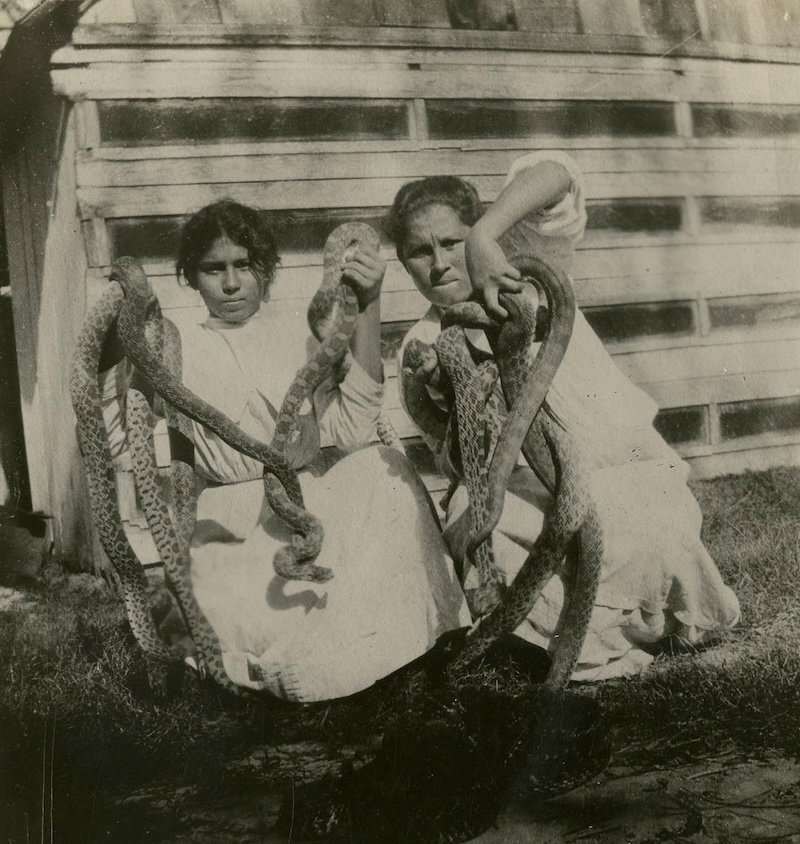
Snake hunters show off their haul, early 20th century. Texas State Library. Public Domain.

Patent medicine manufacturers were happy to capitalise on the oil’s reputed powers of healing. Schuh’s Rattlesnake Oil promised itself to be ‘A remarkable and wonderful remedy for the speedy relief and cure of rheumatism, neuralgia, sore throat, pneumonia, stiff joints, chilblains, sprains, bruises and lumbago’. Clark Stanley, who styled himself ‘the rattlesnake king’, claimed to have learned the secret recipe for his snake oil from the Hopi people of Arizona. For a mere 50 cents a bottle, Stanley’s Snake Oil Liniment would ‘penetrate muscle, membrane, and tissue to the very bone’ to banish pain with ‘wonderful power’.

And if there was money to be made from snake oil itself, then American newspapers were equally keen to advertise the strange cast of snake hunters and farmers who made their living supplying the flourishing industry. John Gotleib of Germantown in New York state was brought up in the snake hunting business by his father and his uncle. In 1884 he gave the New York Times a phlegmatic assessment of snake oil and its powers. ‘Oh, it’s wonderful good’, he said:

For sickness and rheumatix and ear-ache and such like – leastwise so most folks think, and I encourages them to think so, cause it makes a demand for snake oil. I gets $1 an ounce for the oil. The nastier a thing is, the better some people like it for sickness, don’t they? But I don’t care so long’s it pays me.

 While John Gotleib and Laura Masall tracked their snakes down in the wild, other enterprising souls turned to farming the animals for their skins, venom, and oil. The Armstrong farm in Brownsville, Texas raised ground, diamond, Texas, and green rattlesnakes, and was supposed to employ a huge number of Mexican children to catch rats and mice to feed to their stock. In Galton, Illinois, Captain Dan Stover and his wife ran the Rattlesnake Forty ranch (so-called because of the 40 acres it occupied). The Wiseman Brothers raised Garter snakes in Indiana, and in the wilds of the Ozark mountains ‘Snakey George’ Jaynes’ farm was reputed to contain ‘everything that a snake could desire to make life a pleasure’. By 1907 there were ‘three wholesale snake houses’ operating in San Antonio. Between them, wrote the Tennessee Comet, ‘they handle all kinds of snakes known to Mexico and west Texas’.

The end came for snake oil, however, with the passing of the Pure Food and Drug Act in 1906. Government investigation and analysis undermined the snake oil purveyors’ exaggerated claims and revealed that many of them actually contained only small amounts of real snake oil to begin with. In 1915 an analysis of Stanley’s Snake Oil Liniment by the US Bureau of Chemistry showed it to ‘consist principally of a light mineral oil mixed with about 1 per cent of fatty oil (probably beef fat), capsicum, and possibly a trace of camphor or turpentine’. Stanley pleaded guilty to the charge of mis-branding his product, and paid a fine of $20. Though the company would continue to trade as the Stanley Snake Oil Liniment Co. until 1920, the end was assured. Government analysis and enforcement of standards meant that snake oil had acquired a reputation for infamy that it retains to this day.

Douglas R.J. Small is a writer and historian of medicine based in Glasgow.