


惯性聚合 高效追踪和阅读你感兴趣的博客、新闻、科技资讯
阅读原文 在惯性聚合中打开

推荐订阅源

钛媒体:引领未来商业与生活新知
钛媒体:引领未来商业与生活新知
T
Troy Hunt's Blog
P
Proofpoint News Feed
V
Vulnerabilities – Threatpost
C
Cybersecurity and Infrastructure Security Agency CISA
K
Kaspersky official blog
Cyberwarzone
Cyberwarzone
T
Tor Project blog
Cisco Talos Blog
Cisco Talos Blog
S
Securelist
L
Lohrmann on Cybersecurity
Security Latest
Security Latest
T
Threatpost
H
Heimdal Security Blog
W
WeLiveSecurity
A
Arctic Wolf
Cyber Security Advisories - MS-ISAC
奇客Solidot–传递最新科技情报
奇客Solidot–传递最新科技情报
G
GRAHAM CLULEY
IT之家
IT之家
freeCodeCamp Programming Tutorials: Python, JavaScript, Git & More
TaoSecurity Blog
TaoSecurity Blog
A
About on SuperTechFans
cs.CL updates on arXiv.org
N
News and Events Feed by Topic
Hacker News - Newest:
Hacker News - Newest: "LLM"
Last Week in AI
Last Week in AI
T
The Blog of Author Tim Ferriss
Threat Intelligence Blog | Flashpoint
Microsoft Azure Blog
Hugging Face - Blog
Hugging Face - Blog
Google DeepMind News
量子位
Stack Overflow Blog
Stack Overflow Blog
Know Your Adversary
Know Your Adversary
B
Blog RSS Feed
阮一峰的网络日志
阮一峰的网络日志
WordPress大学
WordPress大学
cs.CV updates on arXiv.org
AI
AI
OSCHINA 社区最新新闻
OSCHINA 社区最新新闻
博客园 - 司徒正美
Apple Machine Learning Research
GbyAI
GbyAI
Vercel News
Vercel News
C
Cyber Attacks, Cyber Crime and Cyber Security
Latest news
Latest news
D
Darknet – Hacking Tools, Hacker News & Cyber Security
大猫的无限游戏
大猫的无限游戏
Forbes - Security
Forbes - Security

Hacker News

Introducing Claude Opus 4.7 Qwen Studio The Future of Everything is Lies, I Guess: Where Do We Go From Here? GitHub - SeanFDZ/macmind: Single-layer transformer in HyperTalk for the classic Macintosh Show HN: Agent-cache – Multi-tier LLM/tool/session caching for Valkey and Redis Moving a large-scale metrics pipeline from StatsD to OpenTelemetry / Prometheus GitHub - Nightmare-Eclipse/RedSun: The Red Sun vulnerability repository GitHub - SethPyle376/hiraeth: Local AWS emulator focused on fast integration testing, with SQS support, SQLite-backed state, and a debug-friendly web UI. GitHub - macOS26/Agent: Any AI, replaces Claude Code, Cursor, OpenClaw. Over 18 LLM providers (Claude, OpenAI, Gemini, Ollama, Zai, HF, Qwen) wired into a native Mac app that writes code, builds Xcode projects, bumps versions, manages git, automates Safari, use AppleScript, JS or Accessibility, extend Agent! w/ MCP Servers, run tasks from your iPhone via Messages. YouTube now lets you turn off Shorts I Made a Terminal Pager Burgers | マクドナルド公式 Commands — HackerNews CLI documentation ChatGPT for Excel PiCore - Raspberry Pi Port of Tiny Core Linux Live Nation illegally monopolized ticketing market, jury finds Google Broke Its Promise to Me. Now ICE Has My Data. Founding Engineer at Adaptional | Y Combinator CRISPR takes important step toward silencing Down syndrome’s extra chromosome GitHub - saffron-health/libretto: The AI toolkit for building reliable browser automations US v. Heppner (S.D.N.Y. 2026) no attorney-client privilege for AI chats [pdf] Unexpected €54k billing spike in 13 hours: Firebase browser key without API restrictions used for Gemini requests Retrofitting JIT Compilers into C Interpreters IPv6 – Google The Accursèd Alphabetical Clock Cybersecurity Looks Like Proof of Work Now Fragments: April 14 Cal.com Goes Closed Source: Why AI Security Is Forcing Our Decision | Cal.com - Scheduling Software for Online Bookings Laravel raised money and now injects ads directly into your agent When moving fast, talking is the first thing to break Too much Discussion of the XOR swap trick – Heather Cafe Introduction to Spherical Harmonics for Graphics Programmers The Grand Line Building a Z-Machine in the worst possible language High-Level Rust: Getting 80% of the Benefits with 20% of the Pain GitHub - duguyue100/midnight-captain: Inspired by Midnight Commander, tailored to my taste. How to build a `git diff` driver · Jamie Tanna | Software Engineer Center for Responsible, Decentralized Intelligence at Berkeley The Local Universe’s Expansion Rate Is Clearer Than Ever, but Still Doesn’t Add Up - A new synthesis of astronomical measurements confirms a persistent mismatch that could point to physics beyond current models The air throughout our homes is infused with microplastics. But there are things you can do to breathe less of them The disturbing white paper Red Hat is trying to erase from the internet – OSnews The Future of Everything is Lies, I Guess: Annoyances ‘Abhorrent’: the inside story of the Polymarket gamblers betting millions on war Productive procrastination — Max van IJsselmuiden maps, territory and LMs 447 Terabytes per Square Centimetre at Zero Retention Energy: Non-Volatile Memory at the Atomic Scale on Fluorographane Show HN: Pardonned.com – A searchable database of US Pardons 20 Years on AWS and Never Not My Job The Seasons are Wrong Artemis II crew splashes down near San Diego after historic moon mission We gave an AI a 3 year retail lease in SF and asked it to make a profit | Andon Labs How a dancer with ALS used brainwaves to perform live On filing the corners off my MacBooks Installing every* Firefox extension OpenClaw’s memory is unreliable, and you don’t know when it will break Steve Blank Nowhere Is Safe Chimpanzees in Uganda locked in vicious 'civil war', say researchers watgo - a WebAssembly Toolkit for Go linux/Documentation/process/coding-assistants.rst at master · torvalds/linux GitHub - callumlocke/json-formatter: Makes JSON easy to read. Founding Product Engineer at Bild AI | Y Combinator A compelling title that is cryptic enough to get you to take action on it GitHub - Keychron/Keychron-Keyboards-Hardware-Design: Industrial design files for Keychron keyboards and mice. 100+ models with CAD assets in STEP, DXF, DWG, and PDF. Source-available, with commercial use allowed for original compatible accessories within the license terms. [ANNOUNCE] WireGuardNT v0.11 and WireGuard for Windows v0.6 Released 1D-Chess Helium Is Hard to Replace Cooperative Vectors Introduction | Evolve Keeping a Postgres queue healthy — PlanetScale Our response to the Axios developer tool compromise Do Americans read print books, e-books or audiobooks more? The Zettelkasten Method in Obsidian: A Practical Setup Guide Artemis II Is Competency Porn and We Are Starving For It WeakC4 Flight Viz — Cockpit View A Mexican surveillance giant you’ve never heard of is now watching the U.S. border Surelock: Deadlock-Free Mutexes for Rust RISC-V 101 – what is it and what does it mean for Canonical? | Ubuntu The Problem That Built an Industry How Much Linear Memory Access Is Enough? | Solidean Investigating Split Locks on x86-64 Simplest hash functions Sybilproof reputation mechanisms (2005) [pdf] What is a property? How Complex is my Code? Static code analysis in Kotlin — tools overview Toffoli gates are all you need PGLite evangelism dcmake: a new CMake debugger UI Clojure on Fennel part one: Persistent Data Structures Fragments: April 2 Python Release Python install manager 26.1 The Life and Death of the Book Review - Liberties Introducing Database Traffic Control — PlanetScale Bitcoin miners are losing $19,000 on every BTC produced as difficulty drops 7.8% God sleeps in the minerals Building slogbox Apple Silicon and Virtual Machines: Beating the 2 VM Limit Who was “Not Even Wrong” first? Pokemon Evolution Vs Darwinian Evolution The APL Programming Language Source Code
www.space.com
https://www.space.com/author/tereza-pultarova · 2026-06-20 · via Hacker News
Artist's illustration of a U.S. GPS satellite in orbit around Earth.
Artist's illustration of a U.S. GPS satellite, an increasingly frequent target for jamming, in orbit around Earth. (Image credit: Lockheed Martin and U.S. Space Force)

An experimental satellite has mapped the scale of GPS jamming across Europe and the Middle East from space for the first time.

The data surprised the team behind the project and indicated that satellites orbiting far from Earth aren't the only ones that experience degradation of their positioning, navigation and timing (PNT) signals, which could affect their performance and the safety of their operations.

The new measurements were made by Pulsar-0, the first satellite of the novel Pulsar navigation constellation developed by California-based Xona Space Systems. The experimental satellite orbits 310 miles (500 kilometers) above Earth, testing Xona's technology before the company begins deploying its navigation constellation of 300 spacecraft in low Earth orbit (LEO) later this year.

The purpose of the Pulsar constellation is to provide a more resilient PNT service compared to the United State's GPS network and other global navigation satellite systems (GNSS), such as Europe's Galileo or China's Beidou. The PNT signals distributed by GNSS satellites underpin many systems that our civilization relies on in everyday life, including the operation of power grids, finance operations and oil drilling.

But because GNSS satellites orbit quite far from Earth — at altitudes abve 12,000 miles (19,000 km) — the signal that ground-based receivers detect is weak and can be easily jammed.

GNSS jamming (the overpowering of GNSS signals with noise) and spoofing (which involves overriding the original signals with false ones carrying incorrect coordinates), have become almost a global emergency over the past five years.

For example, Russian jammers have been disrupting GNSS signals along Russia's western borders, officially to protect the country from Ukrainian drone attacks. Every month, this interference affects tens of thousands of flights that cruise over the region. The warring parties in the Middle East, too, use jamming and spoofing to deflect drone attacks and hide the positions of illegal ships at sea.
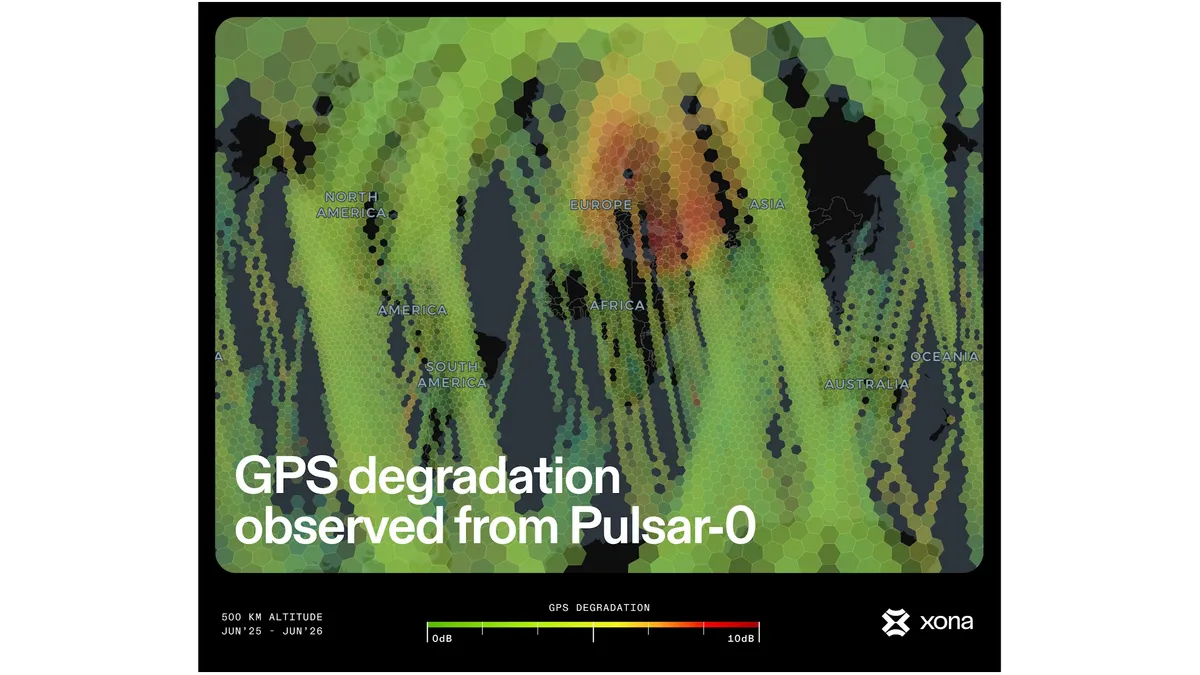
Pulsar-0 navigation satellite has mapped areas of GNSS jamming on Earth with unprecedented accuracy.

Xona's Pulsar-0 navigation satellite has mapped areas of GNSS jamming on Earth with unprecedented accuracy. (Image credit: Xona)

Xona's satellites will use a similar signal, but one that's 100 times stronger, to offer greater resiliency against such deliberate interference. But the Pulsar-0 spacecraft also carries a GPS receiver to make sure the two systems will be able to work together. When the Xona team first turned on that receiver a few months after Pulsar-0's launch last year, they were shocked by the scale of signal degradation the receiver was reporting above Europe and parts of the Middle East.

"When we fly over North America, for example, we see a beautiful signal all the time," Kaz Gunning, Xona's co-founder, told Space.com. "But as soon as we started doing any operations above Europe, we noticed that there was really something going on there. We thought we were going to see some jamming, but it's quite a bit more than we expected."

In the hardest-hit areas, the strength of the GPS signals at the satellite's altitude dropped from the regular 40 decibels to as little as 10 decibels.

Gunning says that, due to the altitude of the Pulsar-0 satellite, the map may not truthfully reflect where jamming is worst for users on the ground. The data, however, revealed that satellites in heavily used LEO suffer from some degree of GPS signal disruption all the way from France in the west to the borders of Pakistan in the east.

The measurements mean that satellites in LEO are not out of the reach of ground-based jammers, and that the PNT signals those satellites need to time-sync their operations and determine their position in space can't always be relied upon.

"You lose the GPS capability as soon as you pass over these regions," said Gunning. "That may be a problem for imaging satellites that are trying to position themselves to take images of a certain region. You can't do altitude determination, you can't do the positioning without the GPS signal. You can't even accurately point at your telecommand antenna on the ground. That's generally going to disrupt satellite operations."

Satellite constellations such as SpaceX Starlink also rely on GPS to avoid collisions with other spacecraft.
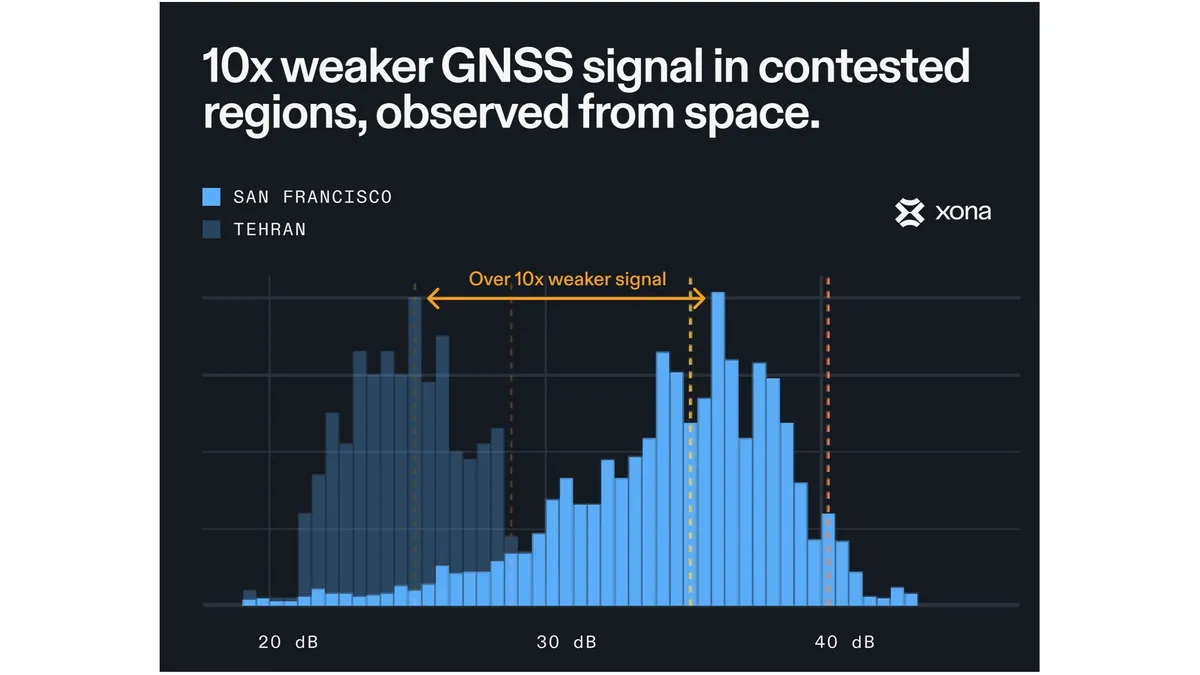
Pulsar-0 navigation satellite has mapped areas of GNSS jamming on Earth with unprecedented accuracy.

Pulsar-0 has found that GNSS signals are tampered with more extensively over regions in conflict. (Image credit: Xona)

It's not just deliberate jamming and spoofing that can wreak havoc with the precious PNT signal. Severe solar storms, too, can cause serious disruptions. The Gannon superstorm in May 2024, for example, distorted the GNSS signal so much that precision farming machinery in parts of the U.S. couldn't operate for days. Technologists are therefore racing to find backup solutions to transmit the PNT signal to everyone who needs it whenever GNSS is down.

Xona hopes that the Pulsar constellation, once up and running, will make the lives of those dependent on GNSS much easier.

Gunning says that, with the superior strength of the PNT signal transmitted by the company's planned LEO constellation, existing jammers would only be able to affect about 5% of the area they can currently disrupt.

"The effect of the jamming is going to be reduced to a smaller radius," Gunning said. "The degradation area will go down, and the full lock-out radius will also go down."

Xona plans to launch a batch of six satellites in October and begin ramping up production shortly thereafter. The company raised $170 million in a "Series C" funding round this March and hopes to begin delivering basic service in early 2027.

"We expect early customers in timekeeping to begin utilizing Pulsar at the end of this year with intermittent coverage," Max Eunice, Xona's head of communications, told Space.com. "Pulsar's capability will increase with every subsequent launch, unlocking new advantages for new customer segments as our constellation fills out."

Tereza is a London-based science and technology journalist, aspiring fiction writer and amateur gymnast. She worked as a reporter at the Engineering and Technology magazine, freelanced for a range of publications including Live Science, Space.com, Professional Engineering, Via Satellite and Space News and served as a maternity cover science editor at the European Space Agency.