


惯性聚合 高效追踪和阅读你感兴趣的博客、新闻、科技资讯
阅读原文 在惯性聚合中打开

推荐订阅源

Exploit-DB.com RSS Feed
WordPress大学
WordPress大学
云风的 BLOG
云风的 BLOG
Stack Overflow Blog
Stack Overflow Blog
MongoDB | Blog
MongoDB | Blog
腾讯CDC
V
V2EX
Martin Fowler
Martin Fowler
A
About on SuperTechFans
大猫的无限游戏
大猫的无限游戏
Blog — PlanetScale
Blog — PlanetScale
Cyber Security Advisories - MS-ISAC
酷 壳 – CoolShell
酷 壳 – CoolShell
C
Check Point Blog
博客园 - 【当耐特】
Cisco Talos Blog
Cisco Talos Blog
The Hacker News
The Hacker News
K
Kaspersky official blog
Security Latest
Security Latest
H
Help Net Security
博客园_首页
美团技术团队
Spread Privacy
Spread Privacy
博客园 - 司徒正美
Hugging Face - Blog
Hugging Face - Blog
S
SegmentFault 最新的问题
G
Google Developers Blog
NISL@THU
NISL@THU
爱范儿
爱范儿
I
Intezer
OSCHINA 社区最新新闻
OSCHINA 社区最新新闻
阮一峰的网络日志
阮一峰的网络日志
N
News and Events Feed by Topic
P
Privacy International News Feed
Application and Cybersecurity Blog
S
Security @ Cisco Blogs
Schneier on Security
雷峰网
雷峰网
人人都是产品经理
人人都是产品经理
V
Vulnerabilities – Threatpost
W
WeLiveSecurity
P
Palo Alto Networks Blog
G
GRAHAM CLULEY
Hacker News: Ask HN
Hacker News: Ask HN
I
InfoQ
The Cloudflare Blog
F
Full Disclosure
SecWiki News
SecWiki News
宝玉的分享
宝玉的分享
N
Netflix TechBlog - Medium

Hacker News

Introducing Claude Opus 4.7 Qwen Studio The Future of Everything is Lies, I Guess: Where Do We Go From Here? GitHub - SeanFDZ/macmind: Single-layer transformer in HyperTalk for the classic Macintosh Show HN: Agent-cache – Multi-tier LLM/tool/session caching for Valkey and Redis Moving a large-scale metrics pipeline from StatsD to OpenTelemetry / Prometheus GitHub - Nightmare-Eclipse/RedSun: The Red Sun vulnerability repository GitHub - SethPyle376/hiraeth: Local AWS emulator focused on fast integration testing, with SQS support, SQLite-backed state, and a debug-friendly web UI. GitHub - macOS26/Agent: Any AI, replaces Claude Code, Cursor, OpenClaw. Over 18 LLM providers (Claude, OpenAI, Gemini, Ollama, Zai, HF, Qwen) wired into a native Mac app that writes code, builds Xcode projects, bumps versions, manages git, automates Safari, use AppleScript, JS or Accessibility, extend Agent! w/ MCP Servers, run tasks from your iPhone via Messages. YouTube now lets you turn off Shorts I Made a Terminal Pager Burgers | マクドナルド公式 Commands — HackerNews CLI documentation ChatGPT for Excel PiCore - Raspberry Pi Port of Tiny Core Linux Live Nation illegally monopolized ticketing market, jury finds Google Broke Its Promise to Me. Now ICE Has My Data. Founding Engineer at Adaptional | Y Combinator CRISPR takes important step toward silencing Down syndrome’s extra chromosome GitHub - saffron-health/libretto: The AI toolkit for building reliable browser automations US v. Heppner (S.D.N.Y. 2026) no attorney-client privilege for AI chats [pdf] Unexpected €54k billing spike in 13 hours: Firebase browser key without API restrictions used for Gemini requests Retrofitting JIT Compilers into C Interpreters IPv6 – Google The Accursèd Alphabetical Clock Cybersecurity Looks Like Proof of Work Now Fragments: April 14 Cal.com Goes Closed Source: Why AI Security Is Forcing Our Decision | Cal.com - Scheduling Software for Online Bookings Laravel raised money and now injects ads directly into your agent When moving fast, talking is the first thing to break Too much Discussion of the XOR swap trick – Heather Cafe Introduction to Spherical Harmonics for Graphics Programmers The Grand Line Building a Z-Machine in the worst possible language High-Level Rust: Getting 80% of the Benefits with 20% of the Pain GitHub - duguyue100/midnight-captain: Inspired by Midnight Commander, tailored to my taste. How to build a `git diff` driver · Jamie Tanna | Software Engineer Center for Responsible, Decentralized Intelligence at Berkeley The Local Universe’s Expansion Rate Is Clearer Than Ever, but Still Doesn’t Add Up - A new synthesis of astronomical measurements confirms a persistent mismatch that could point to physics beyond current models The air throughout our homes is infused with microplastics. But there are things you can do to breathe less of them The disturbing white paper Red Hat is trying to erase from the internet – OSnews The Future of Everything is Lies, I Guess: Annoyances ‘Abhorrent’: the inside story of the Polymarket gamblers betting millions on war Productive procrastination — Max van IJsselmuiden maps, territory and LMs 447 Terabytes per Square Centimetre at Zero Retention Energy: Non-Volatile Memory at the Atomic Scale on Fluorographane Show HN: Pardonned.com – A searchable database of US Pardons 20 Years on AWS and Never Not My Job The Seasons are Wrong Artemis II crew splashes down near San Diego after historic moon mission We gave an AI a 3 year retail lease in SF and asked it to make a profit | Andon Labs How a dancer with ALS used brainwaves to perform live On filing the corners off my MacBooks Installing every* Firefox extension OpenClaw’s memory is unreliable, and you don’t know when it will break Steve Blank Nowhere Is Safe Chimpanzees in Uganda locked in vicious 'civil war', say researchers watgo - a WebAssembly Toolkit for Go linux/Documentation/process/coding-assistants.rst at master · torvalds/linux GitHub - callumlocke/json-formatter: Makes JSON easy to read. Founding Product Engineer at Bild AI | Y Combinator A compelling title that is cryptic enough to get you to take action on it GitHub - Keychron/Keychron-Keyboards-Hardware-Design: Industrial design files for Keychron keyboards and mice. 100+ models with CAD assets in STEP, DXF, DWG, and PDF. Source-available, with commercial use allowed for original compatible accessories within the license terms. [ANNOUNCE] WireGuardNT v0.11 and WireGuard for Windows v0.6 Released 1D-Chess Helium Is Hard to Replace Cooperative Vectors Introduction | Evolve Keeping a Postgres queue healthy — PlanetScale Our response to the Axios developer tool compromise Do Americans read print books, e-books or audiobooks more? The Zettelkasten Method in Obsidian: A Practical Setup Guide Artemis II Is Competency Porn and We Are Starving For It WeakC4 Flight Viz — Cockpit View A Mexican surveillance giant you’ve never heard of is now watching the U.S. border Surelock: Deadlock-Free Mutexes for Rust RISC-V 101 – what is it and what does it mean for Canonical? | Ubuntu The Problem That Built an Industry How Much Linear Memory Access Is Enough? | Solidean Investigating Split Locks on x86-64 Simplest hash functions Sybilproof reputation mechanisms (2005) [pdf] What is a property? How Complex is my Code? Static code analysis in Kotlin — tools overview Toffoli gates are all you need PGLite evangelism dcmake: a new CMake debugger UI Clojure on Fennel part one: Persistent Data Structures Fragments: April 2 Python Release Python install manager 26.1 The Life and Death of the Book Review - Liberties Introducing Database Traffic Control — PlanetScale Bitcoin miners are losing $19,000 on every BTC produced as difficulty drops 7.8% God sleeps in the minerals Building slogbox Apple Silicon and Virtual Machines: Beating the 2 VM Limit Who was “Not Even Wrong” first? Pokemon Evolution Vs Darwinian Evolution The APL Programming Language Source Code
New (Old) 3D Golf: porting PC-9801 & Virtual Boy to Mega Drive  ⌘I  Get Info
2026-06-20 · via Hacker News

The Japanese Mega Drive ports of T&E SOFT’s New 3D Golf Simulation series are my favourite golf games, and recently I’ve been living inside their ROMs.

As with all the craziest ideas, it began with a “I wonder if I could”… In the early hours of one April morning I managed to pull a single course out of the game—its terrain and flyby data—and reimplement it in a viewer of my own, written in Three.js. Over the following week or so of continued reverse engineering, that viewer quietly grew into something resembling a 3D golf game running in the browser. Finding the data had some big clues: we know that there are 18 holes, the distances of each hole and their sequence order, and I’d read the courses were made of ~256 points, so adding all these heuristics together meant it was much easier to find the data than finding a needle in a haystack.

Understanding the data that well meant I could go the other way, too—back into the original Mega Drive games themselves. First I added a terrain modifier. To test it I flattened the entire course like a pancake to confirm my understanding was correct, and then cranked it up to 11 into a sort of “Hyperactive Terrain Mode” that warps the fairways into something wild. Both worked well.

An early attempt changed its mind on every run; turned out I was seeding it from an uninitialised memory location. 🤦 With no debugger console to hand, I’d been hunting bugs like this the crude way—scribbling values into the cartridge’s SRAM (its battery-backed save memory) and reading them back out, a poor man’s printf. So it wasn’t exactly straightforward.

Once that was sorted, I gave the 32-year-old game some brand new, custom user interface to match.

Next I wondered if the course data was the same across all of the four Mega Drive games, could it be the same across the games on other platforms? The answer is yes: the same course data format turns out to be used right across the series, from the original PC-9801 games (and almost certainly X68000 and FM Towns) through to the Mega Drive and even the Virtual Boy. If my (little-endian) maths is correct that’s a total of 7 unique courses, all sharing one format. There’s some reformatting that needs to be done, but the data structure is the same. And since I could already read the courses, I could write them too—patching the games to pick a course at random, or to load one that was never available on the Mega Drive in the first place. PC-9801 to Mega Drive required sorting the polygons to match how they were expected to be stored.

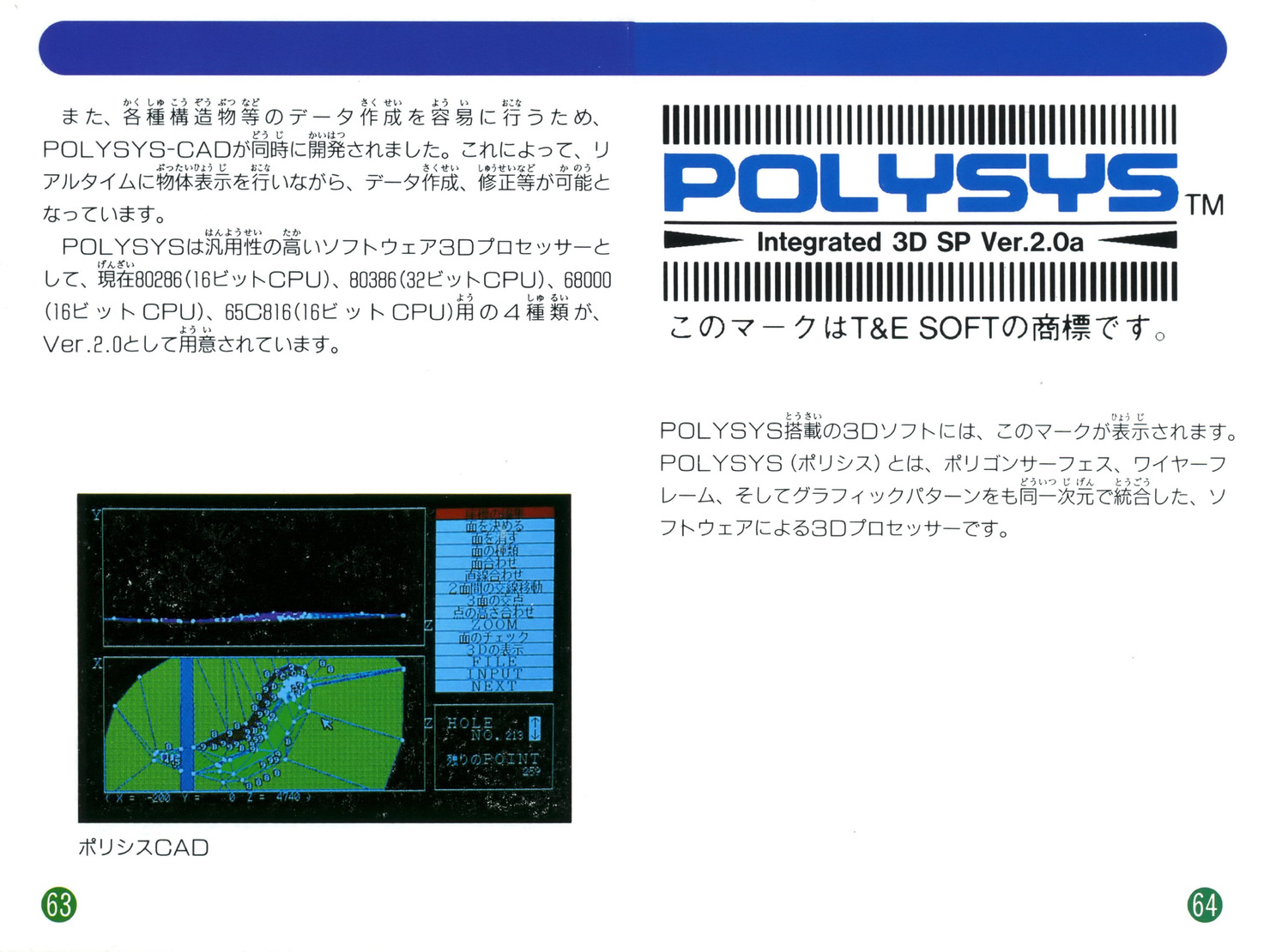
But I guess T&E SOFT used the same POLYSYS-CAD software to design all the courses over several years? I love how such a tool could have that sort of longevity.
IMG


That last part is the really fun bit. (Can this even be more fun?)

Here are three courses running on the Mega Drive for the first time:

T&E Selection

Extracted from the NEC PC-9801 add-on course disk:

This course is somewhat unique as it has messages spelled using coloured topology:
the 1st has “GO!” by the tee position; the 18th has “T&E” just beyond the final green


Eight Lakes G.C.

Also extracted from NEC PC-9801 add-on course disk:

A fact perhaps only I care about: during development, prior to Feb 1990, it was Seven Lakes G.C.

<em>Seven Lakes G.C.</em>


Papillon C.C.

Extracted from the Nintendo Virtual Boy game T&E Virtual Golf:

It’s called Papillon—the French word for butterfly—because the course holes were laid out in the shape of a butterfly. Which was surely a nod to the shape of the Virtual Boy controller.

That last one needed a little extra work. T&E Golf on Virtual Boy doesn’t have a hole flyby, so I had to generate the camera path myself: a bezier curve from tee to pin, nudged towards the centre point of the visible course as it appears on the mini-map.

Playing these on Mega Drive is truly special and the effort was very much worthwhile.


A few things I learned along the way

Living inside the disassembly for weeks, I kept tripping over the little decisions T&E SOFT made all those years ago. Some are clever, some are quietly bonkers, and all of them made me grin:

  • The hole is three times too big. The cup grabs any ball within ~6.7 inches—triple a real hole’s radius—so balls drop from further out than they look. A fudge for the 320×224 screen, where ball and cup were both sub-pixel.
  • The polygons pre-sort themselves. No depth buffer on the Mega Drive, so the draw order is baked into the course data, back-to-front (the painter’s algorithm). The giveaway: it doesn’t match the original PC-9801 CAD order.
  • Backspin can reverse a putt. Spin isn’t cosmetic: it’s fed back into the roll and can make the ball check up and trickle backwards. Real ballistic physics in a 1993 cartridge. Love it!
  • Water isn’t a hazard—just very sticky. There’s no “in the water” state; water polygons carry friction so high it kills the ball in one frame. The penalty falls out of the ordinary maths.
  • Wind is a real force, not an aim fudge. It becomes a horizontal acceleration applied every frame of flight, exactly like gravity.
  • Augusta’s wind never actually changes. The direction is never written—only strength varies. The arrow only seems to swing because it’s drawn relative to the camera.

What the old magazines turned up

Reverse engineering only tells you what the games do; for the why, I went digging through a stack of Japanese computer magazines from the era, OCRing the scans to pull out the text. A 1989 developer interview about Harukanaru Augusta (遙かなるオーガスタ)—the PC-9801 original that kicked off the series—turned out to be a goldmine:

  • The 3D engine came first. T&E’s POLYSYS pre-dated the golf games by a couple of years, already appearing—only in the 3D intro logos, as far as I can tell—in DAIVA STORY 7: Light of Kali Yuga and Psy-O-Blade.
  • Trees were nearly real 3D. They tried modelling trees as polygons, leaves and all—but one tree took as long to draw as a whole screen. So scaled sprites were used instead.
  • The first game had no hills. T&E’s 3-D Golf Simulation, written in BASIC six years earlier, had no terrain undulation at all—and on the Sharp X1, 18 holes took half a day to play through.
  • POLYSYS was meant to be general-purpose: swap the data and it renders anything. T&E planned an RPG and a shooter on it and intended to license it to other software houses.
  • One programmer, mostly: Eiji Kato (加藤英治).

And the Augusta course itself came with a wonderful backstory:

  • They licensed the real thing. An official contract with Augusta National, working from the club’s blueprints. Staff visited, didn’t play, but “rubbed their cheeks on the grass.”
  • Augusta sent back ~60 corrections: eg. pine trees too short and too spread out, flowers too pink, bunker sand the wrong colour.
  • No do-overs, by design. You could save mid-round, but loading erased the save data—so no replaying holes to pad your score.
  • Best of all: the dev build’s four caddies were all women. Augusta’s are all men, so the final game swapped them. The ladies returned in the expansion courses and Mega Drive games.
  • The T&E Selection caddies are real people: four women who worked at Brother Industries—whose TAKERU software vending machines sold these add-on course disks.

What Next?

There’s an extra bit of hacking I’m working on but am unsure if it will lead to anything, but if it does it will need a post all of its own. Hold your thumbs. Fingers crossed. 🤞

It would be possible to release a small script which given both original games would do the extraction and patching, but for now I don’t feel comfortable doing that. I still need to figure out the correct tree mapping for each game, decide which of the four Mega Drive games is most suited to each of the three new courses, add new title screens and a few more bits of detail work.

I’d love to see these ported courses released officially some day—the series IP is now owned and managed by D4 Enterprise—so if you know anybody there please hook us up! If you are an employee of D4 Enterprise then please check my request to licence the IP. 🙏

There are more period games in the series that I’d like to take a look at to see if they use the same data format, or modify it in any specific way. SNES and 3DO seem to be the most interesting. 🧐

But for now it’s just me, a pile of disassembly files, rizin and vasmm68k, the BlastEm emulator, and a soft spot for blue skies and FM synth — still trying to get the ball in the hole. ⛳️🏌️‍♂️