




惯性聚合 高效追踪和阅读你感兴趣的博客、新闻、科技资讯
阅读原文 在惯性聚合中打开

推荐订阅源

B
Blog RSS Feed
Threat Intelligence Blog | Flashpoint
G
GRAHAM CLULEY
Hacker News - Newest:
Hacker News - Newest: "LLM"
C
Cybersecurity and Infrastructure Security Agency CISA
Simon Willison's Weblog
Latest news
Latest news
C
CERT Recently Published Vulnerability Notes
T
Threatpost
V
Vulnerabilities – Threatpost
AWS News Blog
AWS News Blog
Blog — PlanetScale
Blog — PlanetScale
C
Cisco Blogs
cs.AI updates on arXiv.org
U
Unit 42
The Register - Security
T
The Blog of Author Tim Ferriss
Stack Overflow Blog
Stack Overflow Blog
The Hacker News
The Hacker News
AI
AI
Project Zero
Project Zero
Scott Helme
Scott Helme
S
Securelist
Vercel News
Vercel News
GbyAI
GbyAI
S
Security @ Cisco Blogs
I
InfoQ
aimingoo的专栏
aimingoo的专栏
Cyber Security Advisories - MS-ISAC
C
Check Point Blog
Forbes - Security
Forbes - Security
Google Online Security Blog
W
WeLiveSecurity
CTFtime.org: upcoming CTF events
H
Heimdal Security Blog
G
Google Developers Blog
D
DataBreaches.Net
The Last Watchdog
The Last Watchdog
D
Docker
MyScale Blog
MyScale Blog
T
Tor Project blog
Cyberwarzone
Cyberwarzone
Recent Announcements
Microsoft Security Blog
T
Tenable Blog
T
Threat Research - Cisco Blogs
Cisco Talos Blog
Cisco Talos Blog
H
Hackread – Cybersecurity News, Data Breaches, AI and More
博客园 - 聂微东
月光博客
月光博客

Hacker News

Introducing Claude Opus 4.7 Qwen Studio The Future of Everything is Lies, I Guess: Where Do We Go From Here? GitHub - SeanFDZ/macmind: Single-layer transformer in HyperTalk for the classic Macintosh Show HN: Agent-cache – Multi-tier LLM/tool/session caching for Valkey and Redis Moving a large-scale metrics pipeline from StatsD to OpenTelemetry / Prometheus GitHub - Nightmare-Eclipse/RedSun: The Red Sun vulnerability repository GitHub - SethPyle376/hiraeth: Local AWS emulator focused on fast integration testing, with SQS support, SQLite-backed state, and a debug-friendly web UI. GitHub - macOS26/Agent: Any AI, replaces Claude Code, Cursor, OpenClaw. Over 18 LLM providers (Claude, OpenAI, Gemini, Ollama, Zai, HF, Qwen) wired into a native Mac app that writes code, builds Xcode projects, bumps versions, manages git, automates Safari, use AppleScript, JS or Accessibility, extend Agent! w/ MCP Servers, run tasks from your iPhone via Messages. YouTube now lets you turn off Shorts I Made a Terminal Pager Burgers | マクドナルド公式 Commands — HackerNews CLI documentation ChatGPT for Excel PiCore - Raspberry Pi Port of Tiny Core Linux Live Nation illegally monopolized ticketing market, jury finds Google Broke Its Promise to Me. Now ICE Has My Data. Founding Engineer at Adaptional | Y Combinator CRISPR takes important step toward silencing Down syndrome’s extra chromosome GitHub - saffron-health/libretto: The AI toolkit for building reliable browser automations US v. Heppner (S.D.N.Y. 2026) no attorney-client privilege for AI chats [pdf] Unexpected €54k billing spike in 13 hours: Firebase browser key without API restrictions used for Gemini requests Retrofitting JIT Compilers into C Interpreters IPv6 – Google The Accursèd Alphabetical Clock Cybersecurity Looks Like Proof of Work Now Fragments: April 14 Cal.com Goes Closed Source: Why AI Security Is Forcing Our Decision | Cal.com - Scheduling Software for Online Bookings Laravel raised money and now injects ads directly into your agent When moving fast, talking is the first thing to break Too much Discussion of the XOR swap trick – Heather Cafe Introduction to Spherical Harmonics for Graphics Programmers The Grand Line Building a Z-Machine in the worst possible language High-Level Rust: Getting 80% of the Benefits with 20% of the Pain GitHub - duguyue100/midnight-captain: Inspired by Midnight Commander, tailored to my taste. How to build a `git diff` driver · Jamie Tanna | Software Engineer Center for Responsible, Decentralized Intelligence at Berkeley The Local Universe’s Expansion Rate Is Clearer Than Ever, but Still Doesn’t Add Up - A new synthesis of astronomical measurements confirms a persistent mismatch that could point to physics beyond current models The air throughout our homes is infused with microplastics. But there are things you can do to breathe less of them The disturbing white paper Red Hat is trying to erase from the internet – OSnews The Future of Everything is Lies, I Guess: Annoyances ‘Abhorrent’: the inside story of the Polymarket gamblers betting millions on war Productive procrastination — Max van IJsselmuiden maps, territory and LMs 447 Terabytes per Square Centimetre at Zero Retention Energy: Non-Volatile Memory at the Atomic Scale on Fluorographane Show HN: Pardonned.com – A searchable database of US Pardons 20 Years on AWS and Never Not My Job The Seasons are Wrong Artemis II crew splashes down near San Diego after historic moon mission We gave an AI a 3 year retail lease in SF and asked it to make a profit | Andon Labs How a dancer with ALS used brainwaves to perform live On filing the corners off my MacBooks Installing every* Firefox extension OpenClaw’s memory is unreliable, and you don’t know when it will break Steve Blank Nowhere Is Safe Chimpanzees in Uganda locked in vicious 'civil war', say researchers watgo - a WebAssembly Toolkit for Go linux/Documentation/process/coding-assistants.rst at master · torvalds/linux GitHub - callumlocke/json-formatter: Makes JSON easy to read. Founding Product Engineer at Bild AI | Y Combinator A compelling title that is cryptic enough to get you to take action on it GitHub - Keychron/Keychron-Keyboards-Hardware-Design: Industrial design files for Keychron keyboards and mice. 100+ models with CAD assets in STEP, DXF, DWG, and PDF. Source-available, with commercial use allowed for original compatible accessories within the license terms. [ANNOUNCE] WireGuardNT v0.11 and WireGuard for Windows v0.6 Released 1D-Chess Helium Is Hard to Replace Cooperative Vectors Introduction | Evolve Keeping a Postgres queue healthy — PlanetScale Our response to the Axios developer tool compromise Do Americans read print books, e-books or audiobooks more? The Zettelkasten Method in Obsidian: A Practical Setup Guide Artemis II Is Competency Porn and We Are Starving For It WeakC4 Flight Viz — Cockpit View A Mexican surveillance giant you’ve never heard of is now watching the U.S. border Surelock: Deadlock-Free Mutexes for Rust RISC-V 101 – what is it and what does it mean for Canonical? | Ubuntu The Problem That Built an Industry How Much Linear Memory Access Is Enough? | Solidean Investigating Split Locks on x86-64 Simplest hash functions Sybilproof reputation mechanisms (2005) [pdf] What is a property? How Complex is my Code? Static code analysis in Kotlin — tools overview Toffoli gates are all you need PGLite evangelism dcmake: a new CMake debugger UI Clojure on Fennel part one: Persistent Data Structures Fragments: April 2 Python Release Python install manager 26.1 The Life and Death of the Book Review - Liberties Introducing Database Traffic Control — PlanetScale Bitcoin miners are losing $19,000 on every BTC produced as difficulty drops 7.8% God sleeps in the minerals Building slogbox Apple Silicon and Virtual Machines: Beating the 2 VM Limit Who was “Not Even Wrong” first? Pokemon Evolution Vs Darwinian Evolution The APL Programming Language Source Code
Introducing SubQ 1.1 Small
EDM115 · 2026-06-16 · via Hacker News

The hardest enterprise AI problems share a common shape. They require reasoning over complete artifacts: entire codebases, document collections, contracts, financial filings.

For years, the industry worked around this problem by building retrieval pipelines, chunking strategies, and agentic scaffolding — useful tools, but ultimately workarounds for context limitations of the model architecture. The underlying constraint was attention: compute that scales quadratically with context length, making direct reasoning over large artifacts prohibitively expensive.

SubQ is built to remove that constraint. Today we're releasing the model card for SubQ 1.1 Small — the second iteration of our Subquadratic Sparse Attention (SSA) model, at the smallest size. We are in the process of deploying SubQ 1.1 Small with select design partners and plan to deploy a broader lineup of models ranging from 2M to 12M tokens later in the year.

Key Features

  • Near-perfect long-context retrieval up to 12M tokens on the needle-in-a-haystack test, with up to nearly 1,000x attention compute reduction.
  • A balance of long-context optimization and general reasoning ability, with strong performance retained across knowledge, coding, and non-coding enterprise agent benchmarks.
  • At 1M tokens, SubQ 1.1 Small requires 64.5x less compute than dense attention and runs 56x faster than FlashAttention-2.

These results reflect the scaling advantage that SSA's efficiency gains make possible.

Benchmarks

SubQ 1.1 Small was evaluated across five axes, covering long-context retrieval, context-length generalization, knowledge, coding, and long-horizon agentic tasks.

Long-Context Retrieval & Generalization

We selected Needle-In-A-Haystack (NIAH) and Nvidia's RULER test because together they test whether the model can find a single fact buried deep in a large context, and whether it can connect the dots across that context.

NIAH is the precision test. It places one retrievable fact at a controlled depth within a long context and asks the model to return it exactly. SubQ 1.1 Small scores near-perfect at 1M, 2M, 6M, and 12M tokens. The model was trained predominantly at 1M tokens yet the retrieval held near perfectly at 12x that length, despite compressing attention to just 0.13% of relationships. This generalization is a direct consequence of SSA routing attention based on content relevance rather than fixed positional patterns.

RULER is the capability test. It's 13 tasks go beyond single-fact lookup to cover multi-hop variable tracing, frequency extraction, and aggregation across the full context using the kind of reasoning complete-artifact workloads actually require. SubQ 1.1 Small scores 99.12% at 128K.

Multi-task retrievalRULER (128K)

Single-fact retrievalNeedle-in-a-haystack (1M–12M)

General Knowledge & Reasoning

SubQ 1.1 Small balances long-context optimization with general reasoning ability without compromise. GPQA Diamond at 85.4% sits just below mid-tier frontier models and well above the smaller tier. LiveCodeBench at 89.7% pass@4 is close to the absolute frontier. AutomationBench Finance at 13% places SubQ 1.1 Small close to the strongest models on that benchmark, ahead of mid-tier and smaller baselines. Absolute scores remain low across all models on this benchmark.

BenchmarkSubQ 1.1 SmallGPT-5.5Opus 4.8Sonnet 4.6GPT-5.4-miniGPT-5.4-nanoHaiku 4.5

Graduate-level science

GPQA Diamond · pass@1

85.493.29287.587.581.767.2

Agentic finance

AutomationBench

13%18%16%8%0%n/r3%

Competitive programming

LiveCodeBench v6 · pass@4

89.79292.288.978.678.269.7

n/r = result not reported by the model provider

Efficiency

SSA replaces the O(n²) dense attention pass with a learned sparse formulation that scales linearly with context length. SSA's advantage over dense attention grows as context length increases. At 1M tokens, SubQ requires 64.5x fewer compute than dense attention and runs 56x faster than FlashAttention-2 on a single attention layer. In practice, this drastically changes the economics of long-context training and inference.

A full breakdown of the mechanism and how it compares to FlashAttention, DeepSeek sparse attention, and recurrent architectures is in the Technical Report.
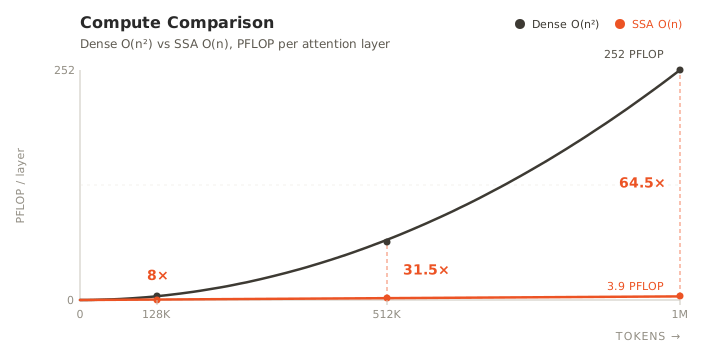
Compute comparison: dense O(n²) attention reaches 252 PFLOP per layer at 1M tokens, while SubQ's SSA O(n) attention stays near-flat — up to 64× less compute.

SubQ uses 64.5x less compute than dense attention, and is 56× faster than FlashAttention-2 at 1M-token context

Training

We started with an existing open-weight frontier model, replaced dense attention with SSA, and built long-context capability through staged context extension (262K, 512K, 1M, 2M) followed by roughly one trillion tokens of continued pretraining on naturally long artifacts: books, documents, and repository-scale code.

The strongest lever we found for improving long-context retrieval was long-context continued pretraining, made possible by the efficiency of the SSA algorithm. The 12M generalization result reflects both factors: SSA's selection criterion is independent of absolute position, and the capability to use that generalization reliably develops through training on long data.

Additionally, we ran more than one hundred experiments across six to seven model generations to get the balance of capabilities between long- and short-context tasks right. That kind of iteration is only possible because SSA enabled our team to run multi-million-token experiments as a standard procedure rather than a rare event, making the research loop more efficient.

Use Cases

SubQ is designed for workloads that require reasoning over information distributed across the artifact without fragmentation. Here are just a few of the use cases from our initial research:

  • Financial analysis and due diligence. Filings, earnings reports, contracts, and internal records are only meaningful in combination. SubQ reasons across the full collection rather than summarizing each document in isolation.
  • Legal and contract work. A contract may define a term on page 2, qualify it on page 12, and carve out an exception on page 46. Retrieval finds the sentence but loses the relationships. SubQ holds the whole document and reasons across it directly.
  • Software engineering. Codebases distribute logic across files, modules, and dependencies in ways that short-context models can't hold at once. SubQ loads an entire repository into a single context window, enabling architecture-level reasoning, cross-file refactoring, and dependency tracing in one pass. We believe there will be significant value for long-context models in planning, review, and long-horizon memory within coding.

What's Next

We'll be kicking off with the first cohort of design partners in the next few weeks, with broader rollout through the quarter and general model releases by end of year.