


Two weeks ago we announced that we had identified and fixed an unprecedented number of latent security bugs in Firefox with the help of Claude Mythos Preview and other AI models. In this post, we’ll go into more detail about how we approached this work, what we found, and advice for other projects on making good use of emerging capabilities to harden themselves against attack.
Suddenly, the bugs are very good
Just a few months ago, AI-generated security bug reports to open source projects were mostly known for being unwanted slop. Dealing with reports that look plausibly correct but are wrong imposes an asymmetric cost on project maintainers: it’s cheap and easy to prompt an LLM to find a “problem” in code, but slow and expensive to respond to it.
It is difficult to overstate how much this dynamic changed for us over a few short months. This was due to a combination of two main factors. First, the models got a lot more capable. Second, we dramatically improved our techniques for harnessing these models — steering them, scaling them, and stacking them to generate large amounts of signal and filter out the noise.
Ordinarily we keep detailed bug reports private for several months after shipping fixes and issuing security advisories, largely as a precaution to protect any users who, for whatever reason, were slow to update to the latest version of Firefox. Given the extraordinary level of interest in this topic and the urgency of action needed throughout the software ecosystem, we’ve made the calculated decision to unhide a small sample of the reports behind the fixes we recently shipped. We’ve attempted to draw them from a range of browser subsystems, but the selection process was still somewhat arbitrary. Nevertheless, we hope that the depth and diversity of these reports lends credence to our assessment of the capabilities and our calls for defenders to begin applying these techniques:
| Bug ID | Description |
|---|---|
| 2024918 | An incorrect equality check can cause the JIT to optimize away the initialization of a live WebAssembly GC struct, creating a fake-object primitive with potential arbitrary read/write in code that had undergone extensive fuzzing by internal and external researchers. |
| 2024437 | A 15-year-old bug in the <legend> element triggered by meticulous orchestration of edge cases across distant parts of the browser, including recursion stack depth limits, expando properties, and cycle collection. |
| 2021894 | Reliably exploits a race condition over IPC, allowing a compromised content process to manipulate IndexedDB refcounts in the parent to trigger a UAF and potential sandbox escape. |
| 2022034 | A raw NaN crossing an IPC boundary can masquerade as a tagged JS object pointer, turning double deserialization into a parent-process fake-object primitive for a sandbox escape. |
| 2024653 | An intricate testcase weaving through nested event loops, pagehide listeners, and garbage collection to trigger a UAF in the attribute setter for <object> elements. |
| 2022733 | Triggers a parent UAF by flooding WebTransport with thousands of certificate hashes to stretch a race condition in a refcount-heavy copy loop, and exploits that race condition over IPC from a compromised content process. |
| 2023958 | Simulates a malicious DNS server by intercepting glibc DNS function calls in order to reproduce a UDP->TCP fallback edge case, triggering a buffer over-read and parent-process stack memory leak during HTTPS RR & ECH parsing. |
| 2025977 | 20-year-old XSLT bug in which reentrant key() calls cause a hash table rehash that frees its backing store while a raw entry pointer is still in use (one of several sec-high issues we fixed involving XSLT). |
| 2027298 | Patches the color picker to simulate otherwise non-automatable user selection, then uses a synchronous input event to spin a nested event loop that re-enters actor teardown and frees the callback while it is still unwinding, triggering a content process UAF. |
| 2023817 | A compromised content process could send an arbitrary wallpaper image to be decoded in the parent process, which could be paired with a hypothetical vulnerability in an image decoder to escape the sandbox. This entailed difficult-to-automate reasoning about the trust-level of inputs in the parent process. |
| 2029813 | Escapes our in-process sandboxing technology for third-party libraries (RLBox) by leveraging a gap in the verification logic used to copy values from the untrusted to the trusted side of the sandbox boundary. |
| 2026305 | Extremely small testcase that exploits the special rowspan=0 semantics in HTML tables by appending >65535 rows to bypass clamping and overflow a 16-bit layout bitfield, which went undetected for years by fuzzers. |
Note that a number of these bugs are sandbox escapes, which would need to be combined with other exploits to achieve a full-chain Firefox compromise. These reports presume that the sandboxed process that renders site content has already been compromised with some separate bug, and is now running attacker-controlled machine code attempting to escalate control into the privileged parent process. When crafting a sandbox escape, the model is permitted to patch the Firefox source code, so long as the modified code is restricted to run only in the sandboxed process[1]. Such bugs are notoriously difficult to find with fuzzing, and while we’ve had some success developing new techniques to close this gap, AI analysis provides much more comprehensive coverage of this critical surface.
Just as interesting as what the models found is what they didn’t find — not because they didn’t try, but because they were unable to circumvent Firefox’s layered defenses. For example, in recent years we received several clever reports from security researchers that managed to escape the process sandbox by triggering prototype pollution in the privileged parent process. Rather than fixing these problems one-by-one, we made an architectural change to freeze these prototypes by default. While auditing logs from the harness, we saw many attempts to pursue this line of escape that were thwarted by this design. Observing such direct payoff from previous hardening work was even more rewarding than finding and fixing more bugs.
Harnessing Models to Build a Hardening Pipeline
We’ve experimented internally with LLM code audits over the past few years, with early attempts using models like GPT 4 or Sonnet 3.5 to statically analyze high risk code for vulnerabilities. These experiments showed some promise, but the high rate of false positives made them impractical to scale.
The introduction of agentic harnesses that can reliably detect security issues has completely changed this. These can find real bugs and dismiss unreproducible speculation. The key feature of such a harness is that, given the right interfaces and instructions, it can create and run reproducible test cases to dynamically test hypotheses about bugs in code. After fixing the initial set of issues that Anthropic sent to us in February, we built our own harness atop our existing fuzzing infrastructure.
We began with small-scale experiments prompting the harness to look for sandbox escapes with Claude Opus 4.6. Even with this model, we identified an impressive amount of previously-unknown vulnerabilities which required complex reasoning over multiprocess browser engine code. At first, we supervised the process in the terminal to observe the process in real-time and tune the prompts and logic. Once this was working well, we parallelized the jobs across multiple ephemeral VMs, each tasked to hunt for bugs within a specific target file and write its findings back to a bucket.
A discovery subsystem is necessary but not sufficient. In order to scale the effort, we needed to integrate it with our full security bug lifecycle: determining what to look for, where to look, and how to handle what it produces. This last part includes deduplicating against known issues, tracking bugs, triaging them, and getting fixes shipped. While the model is the core primitive powering the harness, this full pipeline is necessary to make it useful at scale.
While harnesses may be reusable across projects, this pipeline is inherently project-specific, reflecting each codebase’s semantics, tooling, and processes. Standing this up required significant iteration, with a tight feedback loop alongside the Firefox engineers who were fielding the incoming bugs.
Upgrading the Models
Once the end-to-end pipeline is in place, it’s trivial to swap in different models when they become available. Building this pipeline early helped us find a number of serious bugs using publicly-available models, and it also helped us hit the ground running when we had the opportunity to evaluate Claude Mythos Preview. In our experience, model upgrades increase the effectiveness of the entire pipeline: the system gets simultaneously better at finding potential bugs, creating proof-of-concept test cases to demonstrate them, and articulating their pathology and impact.
In addition to fixing the 271 bugs identified by Claude Mythos Preview in the 150 release, we’ve shipped more of these fixes in 149.0.2, 150.0.1, and 150.0.2. We also continue to find bugs with other means internally, and, similar to other projects, we’ve seen a significant uptick in external reports in the last few months.
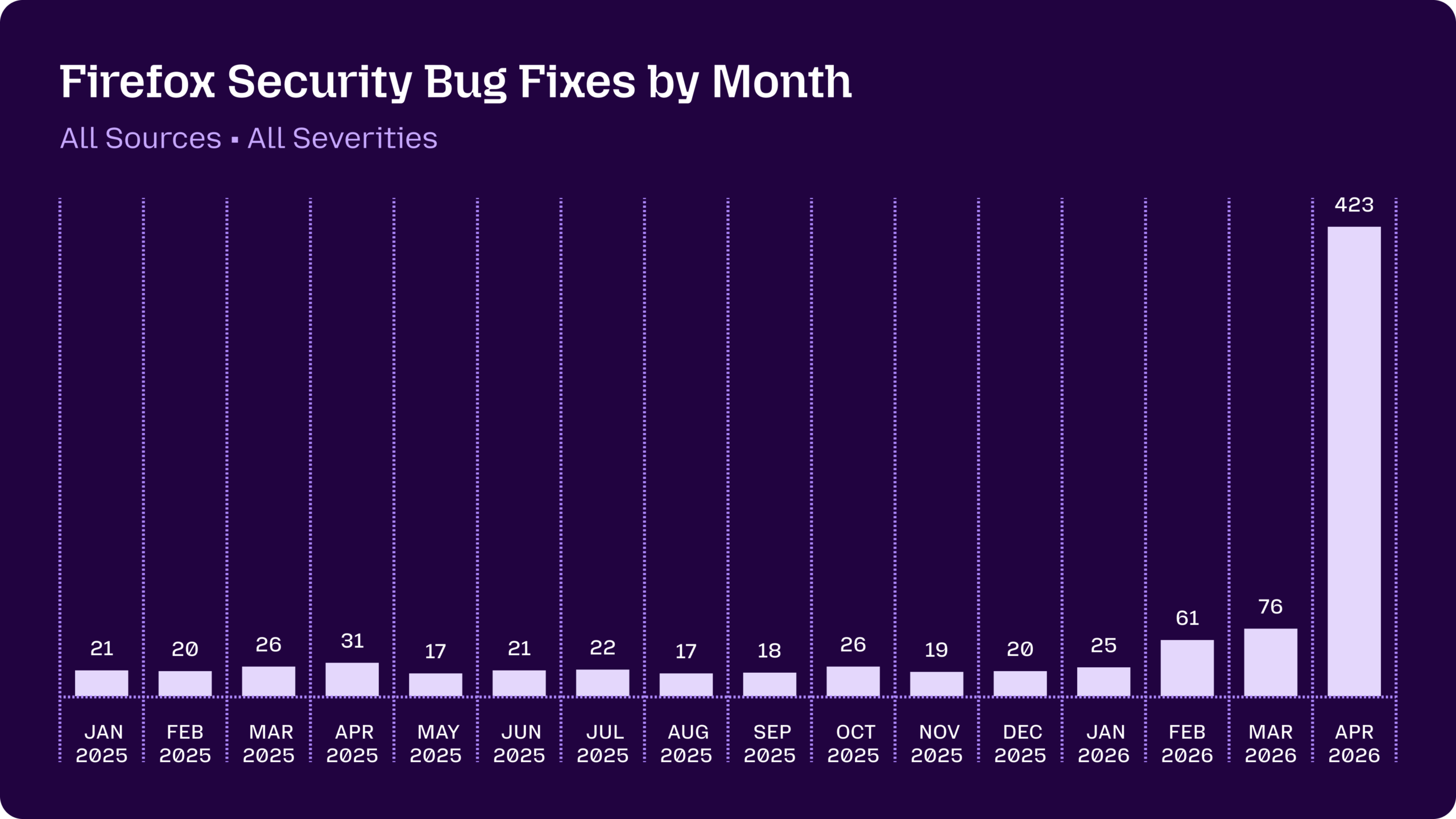
Ultimately, every bug requires care and attention to properly fix. Staying on top of this unprecedented volume has led to a lot of work and long days over the last few months, and we’re extremely proud of how the team has stepped up to meet this challenge. Over 100 people contributed code to this effort to ship the most secure Firefox yet. In addition to writing and reviewing patches, others have been building and scaling this pipeline, triaging, testing the fixes, and managing the release process for each bug.
Takeaways
Anyone building software can start using a harness with a modern model to find bugs and harden their code today. We recommend getting started now. You will find bugs, and you will set yourself up to take advantage of new models as soon as they become available.
You can start with very simple prompting, then observe and iterate. Our initial prompts were not dissimilar from those described here. Through iteration we’ve built out a lot of orchestration and tooling to optimize and scale the pipeline, but the essence of the inner loop remains the same: there is a bug in this part of the code, please find it and build a testcase.
We haven’t bottomed on all the latent bugs in Firefox, but are quite pleased with the trajectory. Today, our scanning is largely focused on specific areas of the code (files, functions) where we instruct the system to look, based on a mix of human judgement and automated signals. In the near future, we intend to integrate this analysis into our continuous integration system to scan patches as they land in the tree. Models are quite flexible with the form of context provided, and we expect patch-based scanning to work as well or even better than file-based scanning.
The current moment is a perilous one, but also full of opportunity. Let’s work together to secure the internet.
FAQ
The announcement said “271 bugs”, but I count something different. What’s going on?
On the advisories web page we group all internally-reported bugs as “rollup” CVEs with multiple bugs underneath them. The web page is built from yaml in the foundation-security-advisories repo, the canonical location for our CVE assignments. While some browsers do not create CVE identifiers for internally-discovered issues at all, we provide this information in order to be as transparent as possible.
In Firefox 150, there were three internal rollups: CVE-2026-6784 (154 bugs), CVE-2026-6785 (55 bugs), and CVE-2026-6786 (107 bugs).
Astute readers will notice the number of bugs in those internal rollups adds up to 316, which is more than the 271 we announced finding with Claude Mythos Preview. That’s because our security team hunts for new bugs every day by attacking Firefox with a combination of (a) fuzzing systems (b) manual inspection and (c) this new agentic pipeline across a variety of models.
We fixed a total of 423 security bugs in releases in April. In addition to the 271 bugs announced two weeks ago, there were 41 externally reported bugs, with the remaining 111 discovered internally and split roughly in third between:
- Bugs found using this pipeline with Claude Mythos Preview but fixed in releases other than Firefox 150
- Bugs found using this pipeline with other models
- Bugs found with other techniques like fuzzing
Note that we also directly credited 3 CVEs to Anthropic separate from this latest effort (CVE-2026-6746, CVE-2026-6757, CVE-2026-6758). These were fixes for bugs sent to us by the outstanding Anthropic Frontier Red team a couple months ago and we assigned unique CVEs for each as per our normal process.
What do security ratings mean?
As additional context, we apply security severity ratings from critical to low to indicate the urgency of a bug:
- sec-critical and sec-high are assigned to vulnerabilities that can be triggered with normal user behavior, like browsing to a web page. We make no technical difference between these, but sec-critical bugs are reserved for issues that are publicly disclosed or known to be exploited in the wild.
- sec-moderate is assigned to vulnerabilities that would otherwise be rated sec-high but require unusual and complex steps from the victim.
- sec-low is assigned to bugs that are annoying but far from causing user harm (e.g, a safe crash).
Of the 271 bugs we announced for Firefox 150: 180 were sec-high, 80 were sec-moderate, and 11 were sec-low.
While we care most about critical/high bugs, it’s normal for us to prioritize moderate and low security bugs in order to fix correctness issues and as a defense-in-depth mechanism.
Is a sec-high or sec-critical bug the same as a practical exploit?
Not necessarily.
In most cases, a single critical/high bug is not actually enough to compromise Firefox. This is because Firefox has a defense-in-depth architecture, so for example exploiting a JIT bug only achieves remote code execution in a sandboxed and site-specific process. Real-world attackers generally need to chain multiple exploits together to escalate privileges through one or more layers of sandboxing along with OS-level mitigations like ASLR.
We also generally don’t build exploits to see whether a bug could be used by an attacker in the real world. We classify sec-high based on predictable crash symptoms such as use-after-free or out-of-bounds memory issues being reported by AddressSanitizer, and our threat model assumes that any of them could be exploitable with sufficient effort. This reduces the risk of a false negative during exploitability analysis, and more importantly it allows us to focus our resources on finding and fixing more vulnerabilities.
[1] Our bug bounty program has similar rules. ↩