
惯性聚合 高效追踪和阅读你感兴趣的博客、新闻、科技资讯
阅读原文 在惯性聚合中打开

推荐订阅源

Security Latest
Security Latest
Recorded Future
Recorded Future
人人都是产品经理
人人都是产品经理
S
SegmentFault 最新的问题
Hacker News - Newest:
Hacker News - Newest: "LLM"
C
CXSECURITY Database RSS Feed - CXSecurity.com
博客园 - 三生石上(FineUI控件)
博客园 - 聂微东
P
Privacy & Cybersecurity Law Blog
WordPress大学
WordPress大学
Know Your Adversary
Know Your Adversary
Spread Privacy
Spread Privacy
Threat Intelligence Blog | Flashpoint
量子位
L
LINUX DO - 热门话题
L
Lohrmann on Cybersecurity
博客园 - Franky
酷 壳 – CoolShell
酷 壳 – CoolShell
T
Tor Project blog
钛媒体:引领未来商业与生活新知
钛媒体:引领未来商业与生活新知
雷峰网
雷峰网
阮一峰的网络日志
阮一峰的网络日志
V
Visual Studio Blog
T
Threatpost
T
Tenable Blog
有赞技术团队
有赞技术团队
大猫的无限游戏
大猫的无限游戏
Engineering at Meta
Engineering at Meta
GbyAI
GbyAI
C
Cisco Blogs
H
Heimdal Security Blog
Attack and Defense Labs
A
About on SuperTechFans
Last Week in AI
Last Week in AI
N
News and Events Feed by Topic
T
Threat Research - Cisco Blogs
cs.AI updates on arXiv.org
I
Intezer
V
V2EX
Cyberwarzone
Cyberwarzone
cs.CL updates on arXiv.org
B
Blog RSS Feed
V
Vulnerabilities – Threatpost
N
Netflix TechBlog - Medium
T
The Blog of Author Tim Ferriss
CTFtime.org: upcoming CTF events
U
Unit 42
PCI Perspectives
PCI Perspectives
P
Privacy International News Feed
D
Docker

Hacker News

Introducing Claude Opus 4.7 Qwen Studio The Future of Everything is Lies, I Guess: Where Do We Go From Here? GitHub - SeanFDZ/macmind: Single-layer transformer in HyperTalk for the classic Macintosh Show HN: Agent-cache – Multi-tier LLM/tool/session caching for Valkey and Redis Moving a large-scale metrics pipeline from StatsD to OpenTelemetry / Prometheus GitHub - Nightmare-Eclipse/RedSun: The Red Sun vulnerability repository GitHub - SethPyle376/hiraeth: Local AWS emulator focused on fast integration testing, with SQS support, SQLite-backed state, and a debug-friendly web UI. GitHub - macOS26/Agent: Any AI, replaces Claude Code, Cursor, OpenClaw. Over 18 LLM providers (Claude, OpenAI, Gemini, Ollama, Zai, HF, Qwen) wired into a native Mac app that writes code, builds Xcode projects, bumps versions, manages git, automates Safari, use AppleScript, JS or Accessibility, extend Agent! w/ MCP Servers, run tasks from your iPhone via Messages. YouTube now lets you turn off Shorts I Made a Terminal Pager Burgers | マクドナルド公式 Commands — HackerNews CLI documentation ChatGPT for Excel PiCore - Raspberry Pi Port of Tiny Core Linux Live Nation illegally monopolized ticketing market, jury finds Google Broke Its Promise to Me. Now ICE Has My Data. Founding Engineer at Adaptional | Y Combinator CRISPR takes important step toward silencing Down syndrome’s extra chromosome GitHub - saffron-health/libretto: The AI toolkit for building reliable browser automations US v. Heppner (S.D.N.Y. 2026) no attorney-client privilege for AI chats [pdf] Unexpected €54k billing spike in 13 hours: Firebase browser key without API restrictions used for Gemini requests Retrofitting JIT Compilers into C Interpreters IPv6 – Google The Accursèd Alphabetical Clock Cybersecurity Looks Like Proof of Work Now Fragments: April 14 Cal.com Goes Closed Source: Why AI Security Is Forcing Our Decision | Cal.com - Scheduling Software for Online Bookings Laravel raised money and now injects ads directly into your agent When moving fast, talking is the first thing to break Too much Discussion of the XOR swap trick – Heather Cafe Introduction to Spherical Harmonics for Graphics Programmers The Grand Line Building a Z-Machine in the worst possible language High-Level Rust: Getting 80% of the Benefits with 20% of the Pain GitHub - duguyue100/midnight-captain: Inspired by Midnight Commander, tailored to my taste. How to build a `git diff` driver · Jamie Tanna | Software Engineer Center for Responsible, Decentralized Intelligence at Berkeley The Local Universe’s Expansion Rate Is Clearer Than Ever, but Still Doesn’t Add Up - A new synthesis of astronomical measurements confirms a persistent mismatch that could point to physics beyond current models The air throughout our homes is infused with microplastics. But there are things you can do to breathe less of them The disturbing white paper Red Hat is trying to erase from the internet – OSnews The Future of Everything is Lies, I Guess: Annoyances ‘Abhorrent’: the inside story of the Polymarket gamblers betting millions on war Productive procrastination — Max van IJsselmuiden maps, territory and LMs 447 Terabytes per Square Centimetre at Zero Retention Energy: Non-Volatile Memory at the Atomic Scale on Fluorographane Show HN: Pardonned.com – A searchable database of US Pardons 20 Years on AWS and Never Not My Job The Seasons are Wrong Artemis II crew splashes down near San Diego after historic moon mission We gave an AI a 3 year retail lease in SF and asked it to make a profit | Andon Labs How a dancer with ALS used brainwaves to perform live On filing the corners off my MacBooks Installing every* Firefox extension OpenClaw’s memory is unreliable, and you don’t know when it will break Steve Blank Nowhere Is Safe Chimpanzees in Uganda locked in vicious 'civil war', say researchers watgo - a WebAssembly Toolkit for Go linux/Documentation/process/coding-assistants.rst at master · torvalds/linux GitHub - callumlocke/json-formatter: Makes JSON easy to read. Founding Product Engineer at Bild AI | Y Combinator A compelling title that is cryptic enough to get you to take action on it GitHub - Keychron/Keychron-Keyboards-Hardware-Design: Industrial design files for Keychron keyboards and mice. 100+ models with CAD assets in STEP, DXF, DWG, and PDF. Source-available, with commercial use allowed for original compatible accessories within the license terms. [ANNOUNCE] WireGuardNT v0.11 and WireGuard for Windows v0.6 Released 1D-Chess Helium Is Hard to Replace Cooperative Vectors Introduction | Evolve Keeping a Postgres queue healthy — PlanetScale Our response to the Axios developer tool compromise Do Americans read print books, e-books or audiobooks more? The Zettelkasten Method in Obsidian: A Practical Setup Guide Artemis II Is Competency Porn and We Are Starving For It WeakC4 Flight Viz — Cockpit View A Mexican surveillance giant you’ve never heard of is now watching the U.S. border Surelock: Deadlock-Free Mutexes for Rust RISC-V 101 – what is it and what does it mean for Canonical? | Ubuntu The Problem That Built an Industry How Much Linear Memory Access Is Enough? | Solidean Investigating Split Locks on x86-64 Simplest hash functions Sybilproof reputation mechanisms (2005) [pdf] What is a property? How Complex is my Code? Static code analysis in Kotlin — tools overview Toffoli gates are all you need PGLite evangelism dcmake: a new CMake debugger UI Clojure on Fennel part one: Persistent Data Structures Fragments: April 2 Python Release Python install manager 26.1 The Life and Death of the Book Review - Liberties Introducing Database Traffic Control — PlanetScale Bitcoin miners are losing $19,000 on every BTC produced as difficulty drops 7.8% God sleeps in the minerals Building slogbox Apple Silicon and Virtual Machines: Beating the 2 VM Limit Who was “Not Even Wrong” first? Pokemon Evolution Vs Darwinian Evolution The APL Programming Language Source Code
Using Opus 4.8 to get a second opinion on an MRI and where it leaves me
Blog Author · 2026-06-29 · via Hacker News

This article is about my experience using Opus 4.8 to read the results of an MRI and give me a sort of second opinion on the diagnosis. Of course, I know the technology might not be there yet, which is why I'm sharing this article. Maybe it can help someone or at least provide a bit of information or entertainment.

Disclaimer: I'm of course not a doctor (this is actually the problem!) so please take everything I say with a grain of salt.

Some context (feel free to skip)

For a few weeks now, I've been experiencing some pain in my right shoulder. Even though it seemed to be getting better, I decided to get an opinion from an orthopedist. I won't go into the details, but he suggested I get an MRI, which the clinic conveniently had available. I agreed and mainly learned that I had a "Grade III (>50%-width) partial-thickness tear at the apical insertion" of my subscapularis tendon. This, of course, means little to me, but their suggested course of treatment was extensive; they even started a few minutes after I got the MRI. Coming out of the clinic, I had the feeling they had jumped the gun.

Thankfully, before I left, I asked them to send me a copy of the MRI results and a list of all the treatments they performed and suggested we repeat a total of 3 times.

I sent everything over to GPT 5.5 Pro, and right away it flagged two things:

  1. They performed shockwave therapy on my shoulder even though a recent clinical practice guideline says clinicians should not use or recommend shockwave therapy for rotator-cuff tendinopathy without calcification; I was told during ultrasound that there was no calcification.
  2. They injected me with Traumeel, which is registered in Germany as a homeopathic medicine "without a therapeutic indication".

That did not increase my confidence. So it made me curious to analyze the MRI.

Setting up Opus to do a first review of the MRI

The MRI package was a standard DICOM export containing a few hundred files without extensions, totaling around 266 MB.

For the analysis, I decided to use Opus 4.8 (xhigh) within Claude Code to give it the ability to run code and install packages. Before any work was done, I told it to install any packages that it might need for the analysis. Using Claude Code is especially important to enable it to perform significant amounts of work on this matter. It might seem obvious to coders, but the difference between Claude Code and Claude.ai's chat is enormous, even if those two run the same model.

It was then time to get started. Considering I know nothing about MRIs, I set things up to have Claude work hard on a detailed plan and then take action. The only instruction I gave was "right shoulder pain for 2–3 weeks," which I later realized was less than the human doctors received.
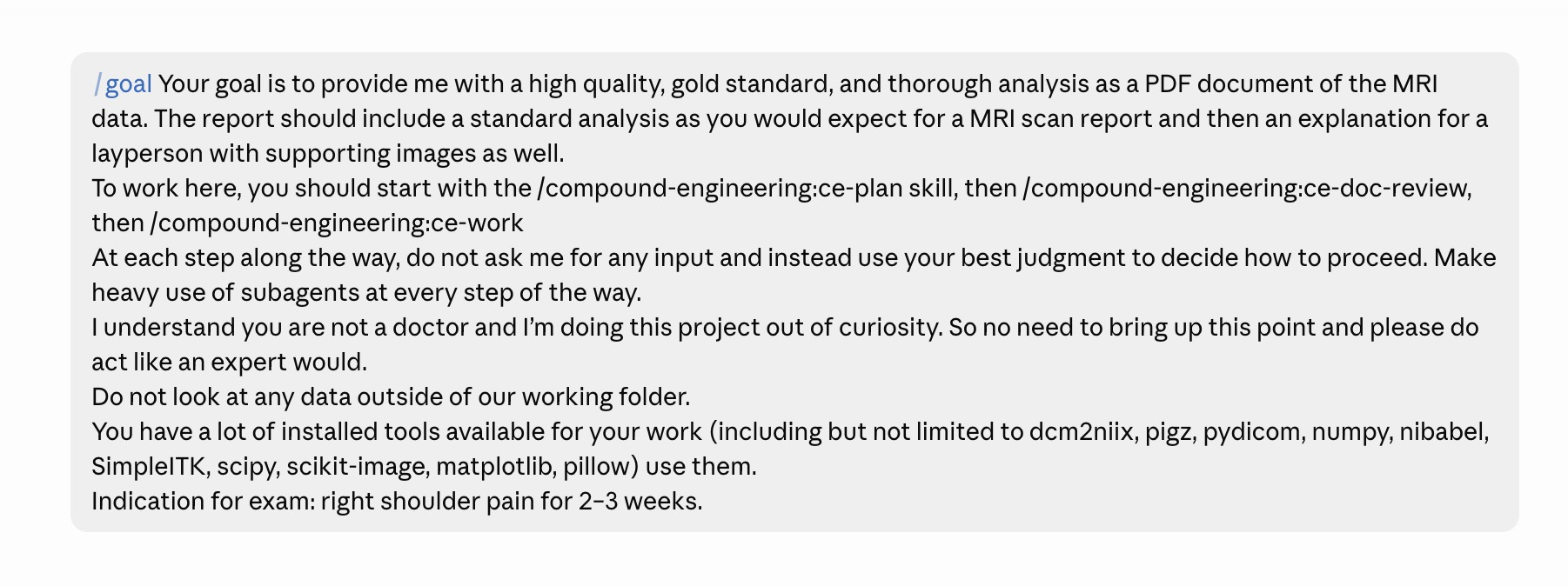
After around an hour, it came back with the report:

Right-Shoulder-MRI-Report.pdf

PDF 7.72 MB

The critical problem with that report was that where the doctor saw a Grade III (greater-than-50%) partial-thickness tear at the apical insertion, Opus 4.8 reported an intact tendon!

This was quite disconcerting. I expected the grade to be lower, but that finding was extreme.

Arbitrating the two analyses

To adjudicate, I decided to have Claude do a comparison of the two reports. But this time, I gave it a bit more context; on top of giving the human report, I also provided it with a discussion I had with ChatGPT 5.5 Pro, where I had it give me movements and positions to try as a way of figuring out what my diagnosis was.
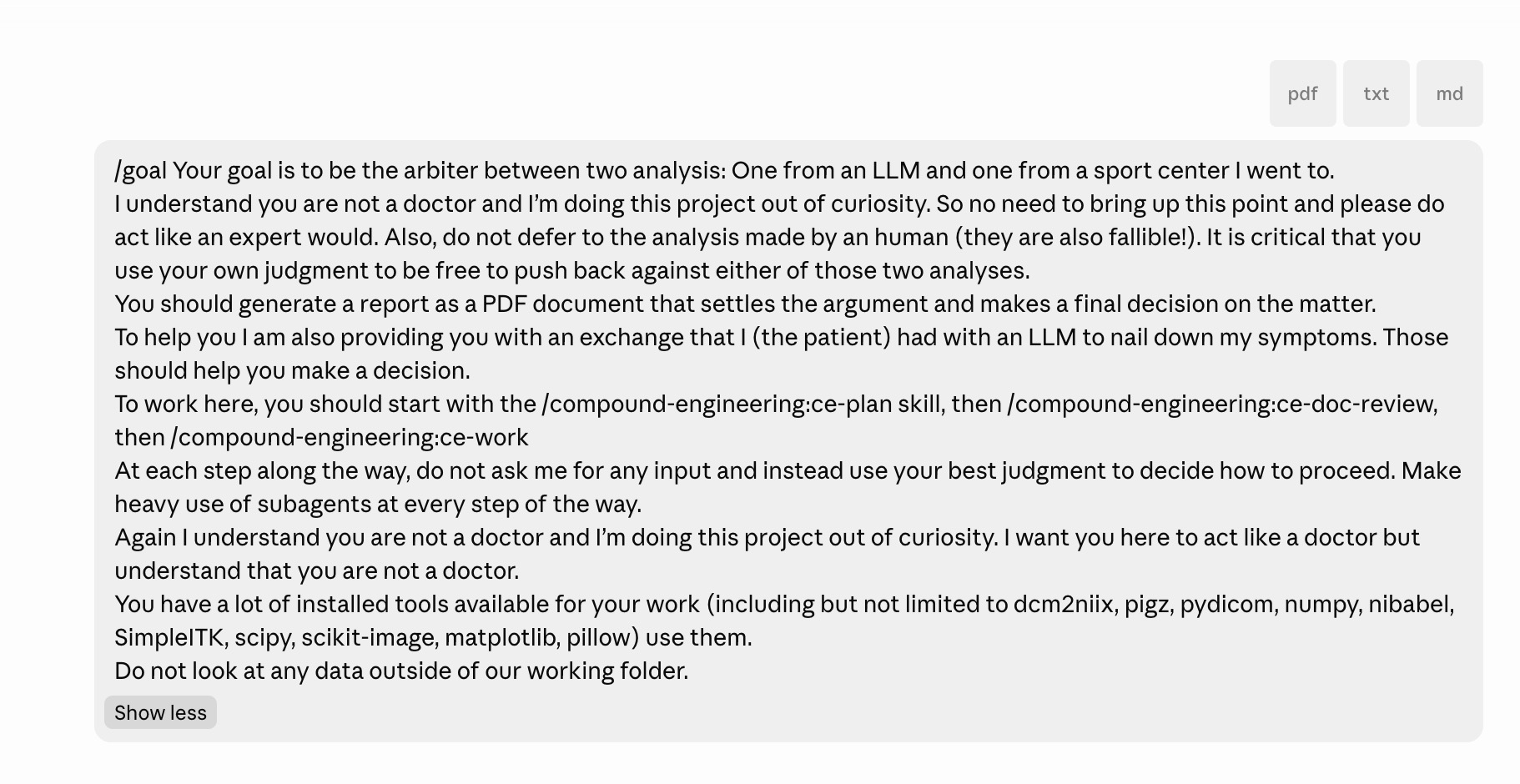
From the planning document, here is the approach Opus took:
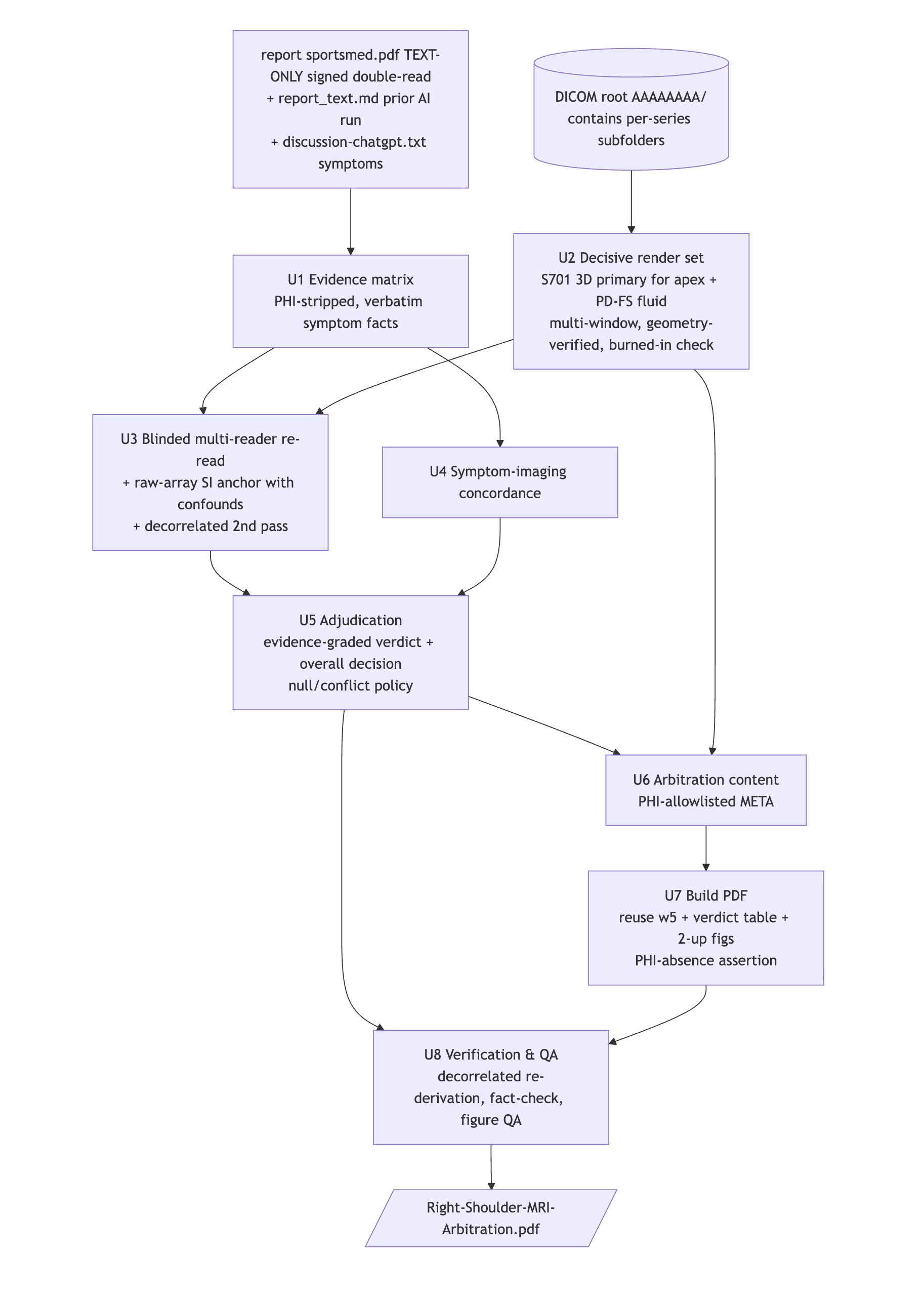
The approach was careful and methodical, with multiple subagents used as a way of getting new analyses that weren't biased by the existing context.

Again, after around an hour, I got a new report:

Right-Shoulder-MRI-Arbitration.pdf

PDF 4.52 MB

Its conclusion was:

Arbiter's verdict: Evidence favours Reader A (moderate-to-high confidence). Mild insertional tendinosis; NO discrete partial- or full-thickness tear identified, including at the apical insertion.
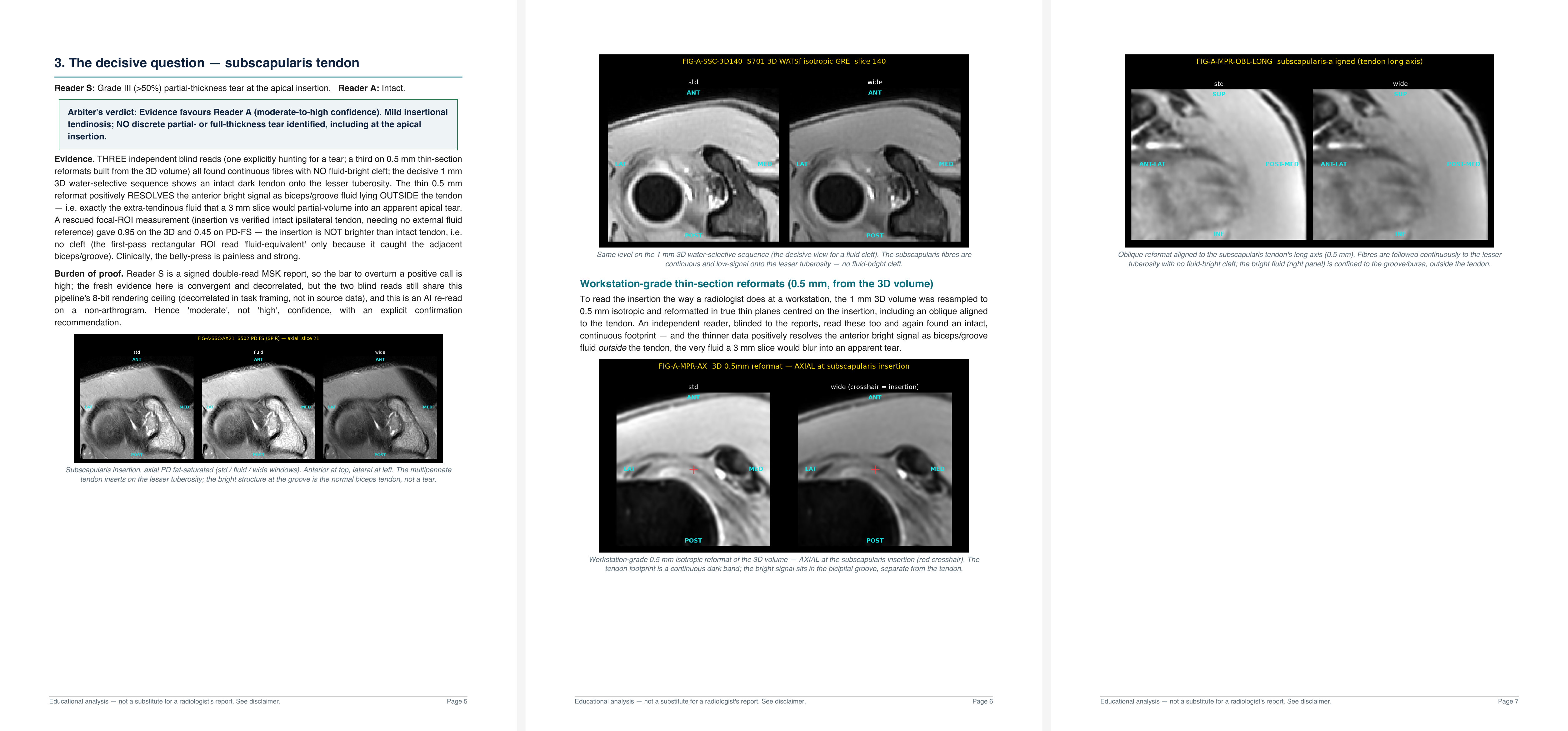
Extract from the arbitration's PDF

I can't help but find it fascinating that the verdicts are so far from each other. Looking further into the report, I can read that Opus wasn't afraid to say that there are some disputes between the two reports that it can't resolve, and yet this one it could; and very decisively.

Where does that leave me?

There's something incredibly peaceful about being in the hands of an expert you trust. You don't have to worry anymore and can let them guide you through the process.

AI can absolutely shatter that feeling in an uncomfortable way: After having gotten this AI-driven second opinion, the diagnosis and treatment plan look premature and more intervention-heavy than the facts seemed to justify... but I don't know if I can fully trust AI either. So I'm left in a state of limbo where I either try my luck with another doctor or wait and see if my shoulder gets better with the rehab I'm doing.

My hope is that in a couple of model generations, we'll trust AI to review MRIs the way we trust it to proofread our emails.

I am not naming the clinic or doctor because this isn't the point of the article. It's about sharing my technical curiosity about using AI to get second opinions. I may be wrong, or the AI might be wrong. I could also have misunderstood the doctors. So basically, none of this should be taken as medical advice :)