
惯性聚合 高效追踪和阅读你感兴趣的博客、新闻、科技资讯
阅读原文 在惯性聚合中打开

推荐订阅源

GbyAI
GbyAI
Simon Willison's Weblog
Microsoft Security Blog
Y
Y Combinator Blog
The GitHub Blog
The GitHub Blog
Engineering at Meta
Engineering at Meta
F
Fortinet All Blogs
OSCHINA 社区最新新闻
OSCHINA 社区最新新闻
A
About on SuperTechFans
Last Week in AI
Last Week in AI
月光博客
月光博客
有赞技术团队
有赞技术团队
P
Proofpoint News Feed
MyScale Blog
MyScale Blog
Martin Fowler
Martin Fowler
钛媒体:引领未来商业与生活新知
钛媒体:引领未来商业与生活新知
C
Check Point Blog
U
Unit 42
The Register - Security
奇客Solidot–传递最新科技情报
奇客Solidot–传递最新科技情报
Cyber Security Advisories - MS-ISAC
Hugging Face - Blog
Hugging Face - Blog
阮一峰的网络日志
阮一峰的网络日志
V
Visual Studio Blog
酷 壳 – CoolShell
酷 壳 – CoolShell
D
DataBreaches.Net
WordPress大学
WordPress大学
aimingoo的专栏
aimingoo的专栏
H
Hacker News: Front Page
Recent Announcements
C
CXSECURITY Database RSS Feed - CXSecurity.com
Latest news
Latest news
小众软件
小众软件
P
Palo Alto Networks Blog
PCI Perspectives
PCI Perspectives
Security Latest
Security Latest
S
Secure Thoughts
Scott Helme
Scott Helme
Threat Intelligence Blog | Flashpoint
T
Threat Research - Cisco Blogs
P
Proofpoint News Feed
M
MIT News - Artificial intelligence
Application and Cybersecurity Blog
Google DeepMind News
Recorded Future
Recorded Future
O
OpenAI News
S
Securelist
云风的 BLOG
云风的 BLOG
H
Help Net Security
T
Troy Hunt's Blog

Hacker News

Introducing Claude Opus 4.7 Qwen Studio The Future of Everything is Lies, I Guess: Where Do We Go From Here? GitHub - SeanFDZ/macmind: Single-layer transformer in HyperTalk for the classic Macintosh Show HN: Agent-cache – Multi-tier LLM/tool/session caching for Valkey and Redis Moving a large-scale metrics pipeline from StatsD to OpenTelemetry / Prometheus GitHub - Nightmare-Eclipse/RedSun: The Red Sun vulnerability repository GitHub - SethPyle376/hiraeth: Local AWS emulator focused on fast integration testing, with SQS support, SQLite-backed state, and a debug-friendly web UI. GitHub - macOS26/Agent: Any AI, replaces Claude Code, Cursor, OpenClaw. Over 18 LLM providers (Claude, OpenAI, Gemini, Ollama, Zai, HF, Qwen) wired into a native Mac app that writes code, builds Xcode projects, bumps versions, manages git, automates Safari, use AppleScript, JS or Accessibility, extend Agent! w/ MCP Servers, run tasks from your iPhone via Messages. YouTube now lets you turn off Shorts I Made a Terminal Pager Burgers | マクドナルド公式 Commands — HackerNews CLI documentation ChatGPT for Excel PiCore - Raspberry Pi Port of Tiny Core Linux Live Nation illegally monopolized ticketing market, jury finds Google Broke Its Promise to Me. Now ICE Has My Data. Founding Engineer at Adaptional | Y Combinator CRISPR takes important step toward silencing Down syndrome’s extra chromosome GitHub - saffron-health/libretto: The AI toolkit for building reliable browser automations US v. Heppner (S.D.N.Y. 2026) no attorney-client privilege for AI chats [pdf] Unexpected €54k billing spike in 13 hours: Firebase browser key without API restrictions used for Gemini requests Retrofitting JIT Compilers into C Interpreters IPv6 – Google The Accursèd Alphabetical Clock Cybersecurity Looks Like Proof of Work Now Fragments: April 14 Cal.com Goes Closed Source: Why AI Security Is Forcing Our Decision | Cal.com - Scheduling Software for Online Bookings Laravel raised money and now injects ads directly into your agent When moving fast, talking is the first thing to break Too much Discussion of the XOR swap trick – Heather Cafe Introduction to Spherical Harmonics for Graphics Programmers The Grand Line Building a Z-Machine in the worst possible language High-Level Rust: Getting 80% of the Benefits with 20% of the Pain GitHub - duguyue100/midnight-captain: Inspired by Midnight Commander, tailored to my taste. How to build a `git diff` driver · Jamie Tanna | Software Engineer Center for Responsible, Decentralized Intelligence at Berkeley The Local Universe’s Expansion Rate Is Clearer Than Ever, but Still Doesn’t Add Up - A new synthesis of astronomical measurements confirms a persistent mismatch that could point to physics beyond current models The air throughout our homes is infused with microplastics. But there are things you can do to breathe less of them The disturbing white paper Red Hat is trying to erase from the internet – OSnews The Future of Everything is Lies, I Guess: Annoyances ‘Abhorrent’: the inside story of the Polymarket gamblers betting millions on war Productive procrastination — Max van IJsselmuiden maps, territory and LMs 447 Terabytes per Square Centimetre at Zero Retention Energy: Non-Volatile Memory at the Atomic Scale on Fluorographane Show HN: Pardonned.com – A searchable database of US Pardons 20 Years on AWS and Never Not My Job The Seasons are Wrong Artemis II crew splashes down near San Diego after historic moon mission We gave an AI a 3 year retail lease in SF and asked it to make a profit | Andon Labs How a dancer with ALS used brainwaves to perform live On filing the corners off my MacBooks Installing every* Firefox extension OpenClaw’s memory is unreliable, and you don’t know when it will break Steve Blank Nowhere Is Safe Chimpanzees in Uganda locked in vicious 'civil war', say researchers watgo - a WebAssembly Toolkit for Go linux/Documentation/process/coding-assistants.rst at master · torvalds/linux GitHub - callumlocke/json-formatter: Makes JSON easy to read. Founding Product Engineer at Bild AI | Y Combinator A compelling title that is cryptic enough to get you to take action on it GitHub - Keychron/Keychron-Keyboards-Hardware-Design: Industrial design files for Keychron keyboards and mice. 100+ models with CAD assets in STEP, DXF, DWG, and PDF. Source-available, with commercial use allowed for original compatible accessories within the license terms. [ANNOUNCE] WireGuardNT v0.11 and WireGuard for Windows v0.6 Released 1D-Chess Helium Is Hard to Replace Cooperative Vectors Introduction | Evolve Keeping a Postgres queue healthy — PlanetScale Our response to the Axios developer tool compromise Do Americans read print books, e-books or audiobooks more? The Zettelkasten Method in Obsidian: A Practical Setup Guide Artemis II Is Competency Porn and We Are Starving For It WeakC4 Flight Viz — Cockpit View A Mexican surveillance giant you’ve never heard of is now watching the U.S. border Surelock: Deadlock-Free Mutexes for Rust RISC-V 101 – what is it and what does it mean for Canonical? | Ubuntu The Problem That Built an Industry How Much Linear Memory Access Is Enough? | Solidean Investigating Split Locks on x86-64 Simplest hash functions Sybilproof reputation mechanisms (2005) [pdf] What is a property? How Complex is my Code? Static code analysis in Kotlin — tools overview Toffoli gates are all you need PGLite evangelism dcmake: a new CMake debugger UI Clojure on Fennel part one: Persistent Data Structures Fragments: April 2 Python Release Python install manager 26.1 The Life and Death of the Book Review - Liberties Introducing Database Traffic Control — PlanetScale Bitcoin miners are losing $19,000 on every BTC produced as difficulty drops 7.8% God sleeps in the minerals Building slogbox Apple Silicon and Virtual Machines: Beating the 2 VM Limit Who was “Not Even Wrong” first? Pokemon Evolution Vs Darwinian Evolution The APL Programming Language Source Code
Rome Fell and Nobody Noticed
Fried Kielbasa · 2026-06-15 · via Hacker News

When I first began learning about the Roman Empire in middle school, I was most interested in what everyone else seems to be interested in — the time of Caesar and Augustus. Recently, however, I’ve become far more interested in the decline & fall of the Roman Empire. You always hear the date 476 as the definitive end. As far as dates go, 476 is as good a date as any to mark the end of the official Roman Empire, but it always struck me as a bit weird. After that date, could it be said that Rome no longer existed? When I investigated what Rome was like after 476, it seemed oddly continuous. The fundamental institutions mostly existed, and life went on as usual. Nobody at the time figured that was the end.

My favorite figure in the post-Roman period is Theoderic — ruling 493 to 526, twenty years after the “fall” of Rome. He took over the structure of the Roman Empire and ruled it as a functionally emperor-like figure. He was a Goth and an Arian Christian, or in other words, a barbarian and a heretic. He spent his youth as a hostage in Constantinople, which enabled him to understand the Roman system from the inside.

The fall of 476 was notable primarily for symbolic reasons. A general named Odoacer deposed the last western Roman emperor and shipped off the imperial regalia to Constantinople — ending the chain of emperors. He controlled Italy not as emperor, but as king — albeit keeping the Roman civil service intact. Theoderic was sent by the Eastern Roman Emperor in order to depose Odoacer, which he did first with an army, then with his own hands, at a banquet.

When he took over the machinery of the Western Roman Empire, he was able to preserve it for 33 years, longer than the previous nine western emperors combined. Things that people associate with the Roman Empire continued on under his care. Roads were repaired, trade continued, things generally ran well. This isn’t to say that everything was wonderful, but it didn’t seem clear at the time that Rome was in terminal decline and would never again rise to where it used to be.

At a real level, the Roman governmental system remained. Theoderic was not an emperor per se, but he did hold official titles which were associated with the Roman Empire. He technically was titled as magister militum and patricius — the legal fiction legitimizing his rule as custodian of the Western Roman Empire. There’s a lot of symbolic continuity through those terms! The Consuls continued to be appointed — Theoderic chose the western consul and Constantinople confirmed his choices. In 519, Theoderic’s son in law Eutharic actually held the consulship together with emperor Justin. Theoderic’s imperial communications were written by Roman scribes and writers who continued writing in the Roman imperial style (chancery style), which was at that point extremely intricate and could only be interpreted by well educated Romans. Even the communications with his bureaucracy and other government officials utilized Roman means and methods. The Senate continued to meet under Theoderic’s rule — the continuity of local power was maintained. During Theoderic’s visit to Rome in 500, he addressed the Senate, organized one of the last games ever in Rome, and likely created the gold medallion of himself to commemorate the occasion.
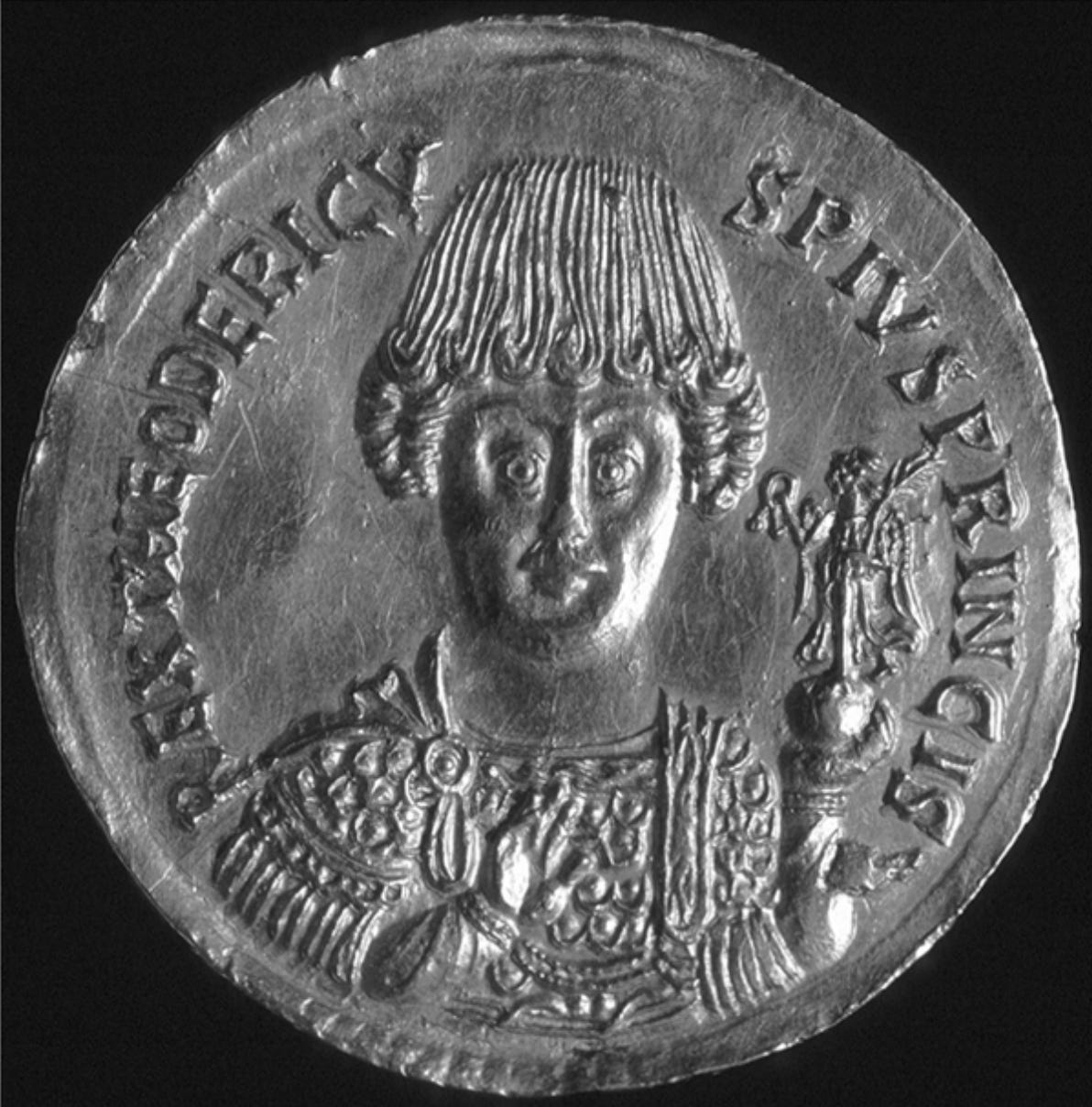
Portrait in imperial costume, but the text shows Rex, not Augustus, and he has a Gothic mustache. Note that regular coinage still bore the face of the Eastern Roman Emperor

After the Goths invaded Italy and defeated Odoacer, there was no competing military force — the Roman army was long gone and Odoacer’s army was destroyed. It was straightforward to swap the command top-down for a different military while keeping the civilian Roman infrastructure in place. This was enabled by a reform Diocletian began and Constantine completed: the separation of civilian and military command. The new magister peditum and magister equitum (later combined into the title of magister militum) sat on an entirely different career track from the provincial governors. The purpose behind this was to reduce the number of military coup attempts — governors with legions kept attempting to usurp the emperors. This parallel authority structure, which existed at the time of Theoderic’s takeover, meant that civilian governance could continue on as it previously had existed while the Gothic army could hot swap into the place where the Roman imperial army used to be. The exact reform that was intended to prevent internal strife enabled the easy docking of a foreign army onto the Roman state. This was a real discontinuity, but it didn’t disrupt the rest of government or regular life.

After Theoderic and his Goths invaded Italy, he needed to reward his Gothic army. He decided that the best path was to grant them land. Land, in this case, really means land rent, aristocrat style. Tenant farmers work for you while you collect rent and relax on your estate. This was accomplished in an extremely Roman way — the land redistribution was run by a Roman, Liberius, operating through the Roman bureaucracy. Liberius was given the office of praetorian prefect and he was represented locally by officials of the prefecture called delegatores. Once the Gothic recipients got their land, they also received certificates (pittacia) detailing their title of ownership. The Roman bureaucracy was present, useful, and was still able to serve Theoderic’s purposes. There is an interesting argument about whether the redistribution was monetary or whether it involved land actually changing hands. Walter Goffart, in an influential 1980 book, makes the argument that the land redistribution left so few detailed records that it implied the land was not actually redistributed, but instead only the money from the land was redistributed in the form of payment. Many historians think that real land did change hands, but I think the important point is that land redistribution was such a routine operation for the Roman bureaucracy that this generated no particularly noteworthy amount of paperwork. This was simply considered a matter of course.

In 523, Constantinople began persecuting Arians. Theoderic, king of a Catholic Italy, became suspicious of the Roman elite. His attempts at finding treason included putting Boethius on trial — who wrote the Consolation of Philosophy while awaiting execution. The first cracks in the West’s stability came from the East.

Within a decade after Theoderic’s demise, the Ostrogothic state had irreversibly begun disintegrating, and the Italian peninsula became a violent place. Succession to the throne led to infighting among the Goths, then Emperor Justinian began a reconquest of Italy. Akin more to cannibalism than conquest — the Eastern Roman Empire and not barbarians at the gates caused the collapse of Roman society. To give an idea of how bad it got, Venice was settled in the decades of chaos after Theoderic’s rule because Italy had become so dangerous that it was preferable to live on the water.

Rome was still around for a while after 476. The people were still around — the real disorder didn’t start until 50 years or so after the official fall. Political change doesn’t necessarily destroy culture in the same way that physical destruction can. The archaeological record after the official fall faced a steep decline, but it was continuous. The lights of Italy dimmed slowly into a long dusk.

Discussion about this post

Ready for more?