惯性聚合 高效追踪和阅读你感兴趣的博客、新闻、科技资讯
阅读原文 在惯性聚合中打开

推荐订阅源

T
Threatpost
aimingoo的专栏
aimingoo的专栏
OSCHINA 社区最新新闻
OSCHINA 社区最新新闻
T
Tailwind CSS Blog
J
Java Code Geeks
博客园_首页
Google Online Security Blog
Hugging Face - Blog
Hugging Face - Blog
C
CXSECURITY Database RSS Feed - CXSecurity.com
I
Intezer
P
Palo Alto Networks Blog
V
Vulnerabilities – Threatpost
雷峰网
雷峰网
O
OpenAI News
SecWiki News
SecWiki News
小众软件
小众软件
酷 壳 – CoolShell
酷 壳 – CoolShell
美团技术团队
N
News | PayPal Newsroom
Project Zero
Project Zero
Forbes - Security
Forbes - Security
IT之家
IT之家
A
Arctic Wolf
WordPress大学
WordPress大学
Jina AI
Jina AI
T
Tor Project blog
博客园 - 三生石上(FineUI控件)
S
Secure Thoughts
Google DeepMind News
Attack and Defense Labs
博客园 - 聂微东
Exploit-DB.com RSS Feed
P
Privacy International News Feed
Cloudbric
Cloudbric
G
GRAHAM CLULEY
博客园 - 叶小钗
H
Hacker News: Front Page
腾讯CDC
量子位
Help Net Security
Help Net Security
人人都是产品经理
人人都是产品经理
C
Cyber Attacks, Cyber Crime and Cyber Security
月光博客
月光博客
奇客Solidot–传递最新科技情报
奇客Solidot–传递最新科技情报
宝玉的分享
宝玉的分享
爱范儿
爱范儿
L
Lohrmann on Cybersecurity
Hacker News - Newest:
Hacker News - Newest: "LLM"
Recorded Future
Recorded Future
C
CERT Recently Published Vulnerability Notes

Hacker News

Introducing Claude Opus 4.7 Qwen Studio The Future of Everything is Lies, I Guess: Where Do We Go From Here? GitHub - SeanFDZ/macmind: Single-layer transformer in HyperTalk for the classic Macintosh Show HN: Agent-cache – Multi-tier LLM/tool/session caching for Valkey and Redis Moving a large-scale metrics pipeline from StatsD to OpenTelemetry / Prometheus GitHub - Nightmare-Eclipse/RedSun: The Red Sun vulnerability repository GitHub - SethPyle376/hiraeth: Local AWS emulator focused on fast integration testing, with SQS support, SQLite-backed state, and a debug-friendly web UI. GitHub - macOS26/Agent: Any AI, replaces Claude Code, Cursor, OpenClaw. Over 18 LLM providers (Claude, OpenAI, Gemini, Ollama, Zai, HF, Qwen) wired into a native Mac app that writes code, builds Xcode projects, bumps versions, manages git, automates Safari, use AppleScript, JS or Accessibility, extend Agent! w/ MCP Servers, run tasks from your iPhone via Messages. YouTube now lets you turn off Shorts I Made a Terminal Pager Burgers | マクドナルド公式 Commands — HackerNews CLI documentation ChatGPT for Excel PiCore - Raspberry Pi Port of Tiny Core Linux Live Nation illegally monopolized ticketing market, jury finds Google Broke Its Promise to Me. Now ICE Has My Data. Founding Engineer at Adaptional | Y Combinator CRISPR takes important step toward silencing Down syndrome’s extra chromosome GitHub - saffron-health/libretto: The AI toolkit for building reliable browser automations US v. Heppner (S.D.N.Y. 2026) no attorney-client privilege for AI chats [pdf] Unexpected €54k billing spike in 13 hours: Firebase browser key without API restrictions used for Gemini requests Retrofitting JIT Compilers into C Interpreters IPv6 – Google The Accursèd Alphabetical Clock Cybersecurity Looks Like Proof of Work Now Fragments: April 14 Cal.com Goes Closed Source: Why AI Security Is Forcing Our Decision | Cal.com - Scheduling Software for Online Bookings Laravel raised money and now injects ads directly into your agent When moving fast, talking is the first thing to break Too much Discussion of the XOR swap trick – Heather Cafe Introduction to Spherical Harmonics for Graphics Programmers The Grand Line Building a Z-Machine in the worst possible language High-Level Rust: Getting 80% of the Benefits with 20% of the Pain GitHub - duguyue100/midnight-captain: Inspired by Midnight Commander, tailored to my taste. How to build a `git diff` driver · Jamie Tanna | Software Engineer Center for Responsible, Decentralized Intelligence at Berkeley The Local Universe’s Expansion Rate Is Clearer Than Ever, but Still Doesn’t Add Up - A new synthesis of astronomical measurements confirms a persistent mismatch that could point to physics beyond current models The air throughout our homes is infused with microplastics. But there are things you can do to breathe less of them The disturbing white paper Red Hat is trying to erase from the internet – OSnews The Future of Everything is Lies, I Guess: Annoyances ‘Abhorrent’: the inside story of the Polymarket gamblers betting millions on war Productive procrastination — Max van IJsselmuiden maps, territory and LMs 447 Terabytes per Square Centimetre at Zero Retention Energy: Non-Volatile Memory at the Atomic Scale on Fluorographane Show HN: Pardonned.com – A searchable database of US Pardons 20 Years on AWS and Never Not My Job The Seasons are Wrong Artemis II crew splashes down near San Diego after historic moon mission We gave an AI a 3 year retail lease in SF and asked it to make a profit | Andon Labs How a dancer with ALS used brainwaves to perform live On filing the corners off my MacBooks Installing every* Firefox extension OpenClaw’s memory is unreliable, and you don’t know when it will break Steve Blank Nowhere Is Safe Chimpanzees in Uganda locked in vicious 'civil war', say researchers watgo - a WebAssembly Toolkit for Go linux/Documentation/process/coding-assistants.rst at master · torvalds/linux GitHub - callumlocke/json-formatter: Makes JSON easy to read. Founding Product Engineer at Bild AI | Y Combinator A compelling title that is cryptic enough to get you to take action on it GitHub - Keychron/Keychron-Keyboards-Hardware-Design: Industrial design files for Keychron keyboards and mice. 100+ models with CAD assets in STEP, DXF, DWG, and PDF. Source-available, with commercial use allowed for original compatible accessories within the license terms. [ANNOUNCE] WireGuardNT v0.11 and WireGuard for Windows v0.6 Released 1D-Chess Helium Is Hard to Replace Cooperative Vectors Introduction | Evolve Keeping a Postgres queue healthy — PlanetScale Our response to the Axios developer tool compromise Do Americans read print books, e-books or audiobooks more? The Zettelkasten Method in Obsidian: A Practical Setup Guide Artemis II Is Competency Porn and We Are Starving For It WeakC4 Flight Viz — Cockpit View A Mexican surveillance giant you’ve never heard of is now watching the U.S. border Surelock: Deadlock-Free Mutexes for Rust RISC-V 101 – what is it and what does it mean for Canonical? | Ubuntu The Problem That Built an Industry How Much Linear Memory Access Is Enough? | Solidean Investigating Split Locks on x86-64 Simplest hash functions Sybilproof reputation mechanisms (2005) [pdf] What is a property? How Complex is my Code? Static code analysis in Kotlin — tools overview Toffoli gates are all you need PGLite evangelism dcmake: a new CMake debugger UI Clojure on Fennel part one: Persistent Data Structures Fragments: April 2 Python Release Python install manager 26.1 The Life and Death of the Book Review - Liberties Introducing Database Traffic Control — PlanetScale Bitcoin miners are losing $19,000 on every BTC produced as difficulty drops 7.8% God sleeps in the minerals Building slogbox Apple Silicon and Virtual Machines: Beating the 2 VM Limit Who was “Not Even Wrong” first? Pokemon Evolution Vs Darwinian Evolution The APL Programming Language Source Code
Under the microscope: Pyramid (unreleased Saturn prototype)
bbayles · 2026-05-02 · via Hacker News

As of early 2026, Sega Retro has more than 300 pages about Unreleased Saturn games. There’s one game that doesn’t have a page, however: Pyramid.

What’s Pyramid? That’s what we wondered when we came across this disc:
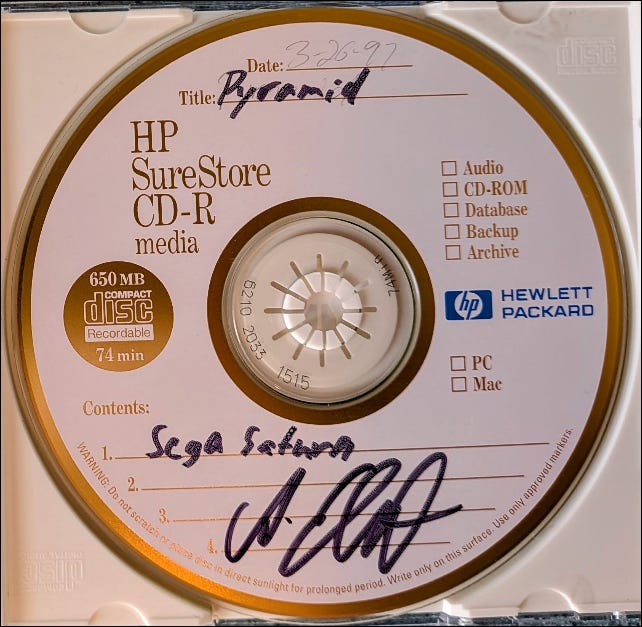
The disc’s owner wasn’t able to provide many details. Our best guess was that it was a version of Pyramid no Nazo: Ankh 2, an unreleased Saturn FMV game.

Thankfully, the CD-R managed to survive for 29 years perfectly intact – it booted right up and greeted us with this screen:
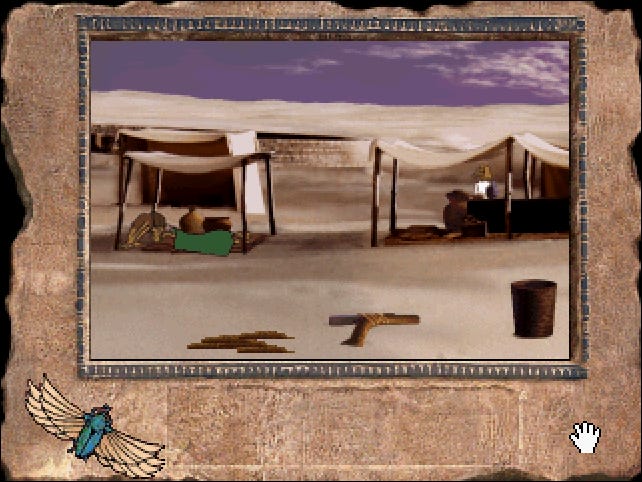
This didn’t match with our guess at all, but it was enough of a clue to ID the game.

Comparing the scene above to images associated with PC games that had “Pyramid” in the title revealed that it’s from Pyramid: Challenge of the Pharaoh’s Dream.
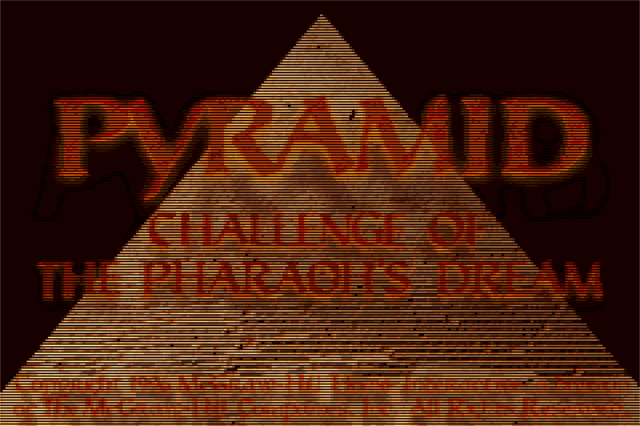
The PC version’s logo

Pyramid was developed by Knowledge Adventure and published by McGraw Hill Home Interactive. It was an edutainment title, the sort of thing you might have played in your elementary school’s computer lab in the mid-1990s. And indeed, YouTube videos and Reddit threads have comments from people who remember experiencing it that way.

The premise of the game is that you’re an archaeologist who gets transported back in time to ancient Egypt. You witness various scenes related to the building of a great pyramid. In the process, you hopefully learn something about the past – or are at least occupied long enough to let your teacher catch up on grading.

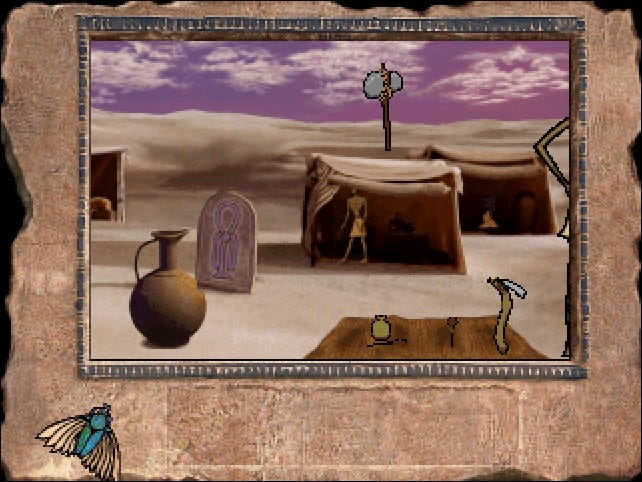
The Saturn version seems to be a tech demo. These controls are implemented:

  • Move the pointer around with the D-pad.

  • Pick up and put down objects with the Z button.

  • Scroll left with L and right with R.

  • Play a voice clip with A.

Picking up objects in the Saturn version

If you scroll over to the right, there are three guys standing around. They move around on their own, but you can’t really interact with them.
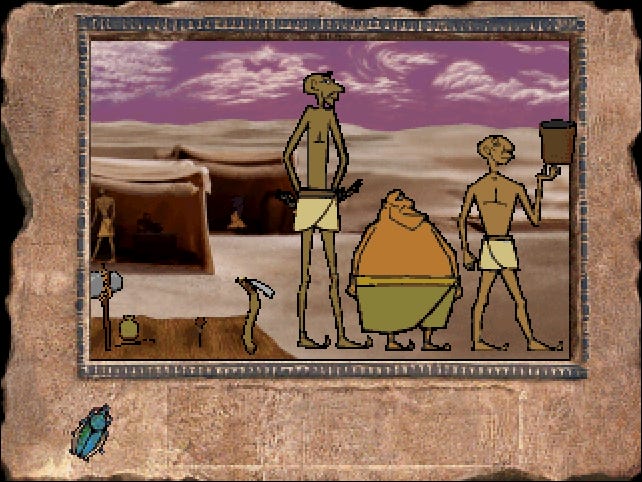
The three workers

According to the HINT_1.TXT file on the disc for the PC version, this scene is called Leveling the Foundation. You’re meant to show the objects to the workers. They’re supposed to tell you what each one is and whether it’s needed for this part of the pyramid’s construction.

This is the full walkthrough from that file:

1.  Click on the various tools and hand them to the workers for clues.
2.  You can also click on the journal at the top left of the screen 
    for details about the tools. 
3.  Click on the bucket.
4.  Then click on the Cistern to pour water into the bucket.
5.  Place the bucket full of water on the left side of the Tool Mat.
6.  Next pick up the scoring tool and place it next to the bucket.
7.  Then pick up the chisel and place it next to the scoring tool.
8.  Lastly, pick up the hammer and place it at the right side of the mat.

You can’t do all of that in the Saturn version, alas – the cistern doesn’t work, so you can’t fill the bucket with water. This video of the PC version (h/t Andrea Pannocchia) shows how things are supposed to go:

The Saturn disc has two files:

  • The first is called 0, and it’s the main game executable. It’s dated 1997-03-24.

  • The second is called TEST.MME, and it’s some type of custom archive. It’s dated 1997-03-23.

The primary game loop in the executable file is pretty easy to understand. Here’s some of the control code – labels have been added to Ghidra’s decompilation:

We made some progress in understanding the archive file. It’s got the background images, sprites, and probably the sound clip.
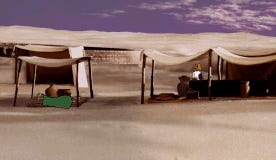
Part of the background image
The scarab sprite

Even after going through all of the game data, we still didn’t have any solid idea about who made it. There are no credits, no build strings, no hints.

Did you notice that the disc is signed?

We scoured MobyGames for names that resembled the signature and came upon Alexander Ehrath’s profile.

He turned out to have a YouTube channel with a series on his time as a game developer. And wouldn’t you know, one of the videos mentions porting “some educational Egyptian thing” to the Sega Saturn:

We got in touch, and Alexander kindly agreed to sit in for a podcast interview.

Regarding Pyramid, Alexander confirmed what we suspected: A publisher was exploring doing console ports of education games and hired him to work on a Saturn version. The project didn’t progress much further than the tech demo stage – alas.

Alexander mentioned that he saved the tools he developed while working on Pyramid and shopped them around to other publishers who were looking to do console ports of their games. None of those made it into released games, however.

The whole interview is well worth listening to. Alexander goes into detail on a number of topics, including:

  • How he came to be credited as The Man in the Nintendo 64 port of Resident Evil 2.

  • Several sports titles that he worked on that ultimately got canceled.

  • The technical challenge of rendering water realistically on GameCube.

Our mystery is solved. Here’s a video of Pyramid in action on the Saturn:

To experience the demo for yourself, check it out on Hidden Palace.

Thanks to Cerbero, Wesker, fafling, and Tongara for their help in preserving this historical artifact! Thanks also to Alexander Ehrath for sitting in for the podcast interview and regaling us with his development war stories.

Rings of Saturn will be back this weekend with more digital archaeology. Subscribe here on Substack to get the next edition as soon as it’s published.

No posts