



惯性聚合 高效追踪和阅读你感兴趣的博客、新闻、科技资讯
阅读原文 在惯性聚合中打开

推荐订阅源

H
Help Net Security
S
Secure Thoughts
I
Intezer
Project Zero
Project Zero
Stack Overflow Blog
Stack Overflow Blog
D
Darknet – Hacking Tools, Hacker News & Cyber Security
F
Full Disclosure
P
Proofpoint News Feed
T
The Exploit Database - CXSecurity.com
人人都是产品经理
人人都是产品经理
博客园_首页
J
Java Code Geeks
Recorded Future
Recorded Future
K
Kaspersky official blog
GbyAI
GbyAI
S
Schneier on Security
The Cloudflare Blog
Spread Privacy
Spread Privacy
C
Cisco Blogs
The Hacker News
The Hacker News
博客园 - 三生石上(FineUI控件)
H
Hackread – Cybersecurity News, Data Breaches, AI and More
CTFtime.org: upcoming CTF events
爱范儿
爱范儿
Microsoft Azure Blog
Know Your Adversary
Know Your Adversary
T
Tenable Blog
A
Arctic Wolf
Blog — PlanetScale
Blog — PlanetScale
H
Hacker News: Front Page
The Last Watchdog
The Last Watchdog
O
OpenAI News
Last Week in AI
Last Week in AI
B
Blog RSS Feed
T
Troy Hunt's Blog
G
GRAHAM CLULEY
N
Netflix TechBlog - Medium
Vercel News
Vercel News
量子位
The Register - Security
Google Online Security Blog
Apple Machine Learning Research
钛媒体:引领未来商业与生活新知
钛媒体:引领未来商业与生活新知
K
KPMG report finds enterprise disconnect between AI and its ROI | CIO
C
CERT Recently Published Vulnerability Notes
Cisco Talos Blog
Cisco Talos Blog
U
Unit 42
Security Archives - TechRepublic
C
Cyber Attacks, Cyber Crime and Cyber Security
N
News and Events Feed by Topic

Hacker News

Introducing Claude Opus 4.7 Qwen Studio The Future of Everything is Lies, I Guess: Where Do We Go From Here? GitHub - SeanFDZ/macmind: Single-layer transformer in HyperTalk for the classic Macintosh Show HN: Agent-cache – Multi-tier LLM/tool/session caching for Valkey and Redis Moving a large-scale metrics pipeline from StatsD to OpenTelemetry / Prometheus GitHub - Nightmare-Eclipse/RedSun: The Red Sun vulnerability repository GitHub - SethPyle376/hiraeth: Local AWS emulator focused on fast integration testing, with SQS support, SQLite-backed state, and a debug-friendly web UI. GitHub - macOS26/Agent: Any AI, replaces Claude Code, Cursor, OpenClaw. Over 18 LLM providers (Claude, OpenAI, Gemini, Ollama, Zai, HF, Qwen) wired into a native Mac app that writes code, builds Xcode projects, bumps versions, manages git, automates Safari, use AppleScript, JS or Accessibility, extend Agent! w/ MCP Servers, run tasks from your iPhone via Messages. YouTube now lets you turn off Shorts I Made a Terminal Pager Burgers | マクドナルド公式 Commands — HackerNews CLI documentation ChatGPT for Excel PiCore - Raspberry Pi Port of Tiny Core Linux Live Nation illegally monopolized ticketing market, jury finds Google Broke Its Promise to Me. Now ICE Has My Data. Founding Engineer at Adaptional | Y Combinator CRISPR takes important step toward silencing Down syndrome’s extra chromosome GitHub - saffron-health/libretto: The AI toolkit for building reliable browser automations US v. Heppner (S.D.N.Y. 2026) no attorney-client privilege for AI chats [pdf] Unexpected €54k billing spike in 13 hours: Firebase browser key without API restrictions used for Gemini requests Retrofitting JIT Compilers into C Interpreters IPv6 – Google The Accursèd Alphabetical Clock Cybersecurity Looks Like Proof of Work Now Fragments: April 14 Cal.com Goes Closed Source: Why AI Security Is Forcing Our Decision | Cal.com - Scheduling Software for Online Bookings Laravel raised money and now injects ads directly into your agent When moving fast, talking is the first thing to break Too much Discussion of the XOR swap trick – Heather Cafe Introduction to Spherical Harmonics for Graphics Programmers The Grand Line Building a Z-Machine in the worst possible language High-Level Rust: Getting 80% of the Benefits with 20% of the Pain GitHub - duguyue100/midnight-captain: Inspired by Midnight Commander, tailored to my taste. How to build a `git diff` driver · Jamie Tanna | Software Engineer Center for Responsible, Decentralized Intelligence at Berkeley The Local Universe’s Expansion Rate Is Clearer Than Ever, but Still Doesn’t Add Up - A new synthesis of astronomical measurements confirms a persistent mismatch that could point to physics beyond current models The air throughout our homes is infused with microplastics. But there are things you can do to breathe less of them The disturbing white paper Red Hat is trying to erase from the internet – OSnews The Future of Everything is Lies, I Guess: Annoyances ‘Abhorrent’: the inside story of the Polymarket gamblers betting millions on war Productive procrastination — Max van IJsselmuiden maps, territory and LMs 447 Terabytes per Square Centimetre at Zero Retention Energy: Non-Volatile Memory at the Atomic Scale on Fluorographane Show HN: Pardonned.com – A searchable database of US Pardons 20 Years on AWS and Never Not My Job The Seasons are Wrong Artemis II crew splashes down near San Diego after historic moon mission We gave an AI a 3 year retail lease in SF and asked it to make a profit | Andon Labs How a dancer with ALS used brainwaves to perform live On filing the corners off my MacBooks Installing every* Firefox extension OpenClaw’s memory is unreliable, and you don’t know when it will break Steve Blank Nowhere Is Safe Chimpanzees in Uganda locked in vicious 'civil war', say researchers watgo - a WebAssembly Toolkit for Go linux/Documentation/process/coding-assistants.rst at master · torvalds/linux GitHub - callumlocke/json-formatter: Makes JSON easy to read. Founding Product Engineer at Bild AI | Y Combinator A compelling title that is cryptic enough to get you to take action on it GitHub - Keychron/Keychron-Keyboards-Hardware-Design: Industrial design files for Keychron keyboards and mice. 100+ models with CAD assets in STEP, DXF, DWG, and PDF. Source-available, with commercial use allowed for original compatible accessories within the license terms. [ANNOUNCE] WireGuardNT v0.11 and WireGuard for Windows v0.6 Released 1D-Chess Helium Is Hard to Replace Cooperative Vectors Introduction | Evolve Keeping a Postgres queue healthy — PlanetScale Our response to the Axios developer tool compromise Do Americans read print books, e-books or audiobooks more? The Zettelkasten Method in Obsidian: A Practical Setup Guide Artemis II Is Competency Porn and We Are Starving For It WeakC4 Flight Viz — Cockpit View A Mexican surveillance giant you’ve never heard of is now watching the U.S. border Surelock: Deadlock-Free Mutexes for Rust RISC-V 101 – what is it and what does it mean for Canonical? | Ubuntu The Problem That Built an Industry How Much Linear Memory Access Is Enough? | Solidean Investigating Split Locks on x86-64 Simplest hash functions Sybilproof reputation mechanisms (2005) [pdf] What is a property? How Complex is my Code? Static code analysis in Kotlin — tools overview Toffoli gates are all you need PGLite evangelism dcmake: a new CMake debugger UI Clojure on Fennel part one: Persistent Data Structures Fragments: April 2 Python Release Python install manager 26.1 The Life and Death of the Book Review - Liberties Introducing Database Traffic Control — PlanetScale Bitcoin miners are losing $19,000 on every BTC produced as difficulty drops 7.8% God sleeps in the minerals Building slogbox Apple Silicon and Virtual Machines: Beating the 2 VM Limit Who was “Not Even Wrong” first? Pokemon Evolution Vs Darwinian Evolution The APL Programming Language Source Code
A Gopher Meets a Crab - Miren
2026-04-30 · via Hacker News

I’ve been writing Go for about a decade, and for most of that time Rust has been the language I respected from a polite distance. I bought the book, thumbed through it, but mostly it sat on the shelf. I gave rustlings a try once or twice but always ended up wandering away. I never had the hook to really motivate me to dig in. Miren is at the inaugural TokioConf this week (I’m writing this from the plane there), and my desire to cook up a decent demo presented the perfect opportunity.

So I built a chat server. Well, okay, I told Claude to build a chat server, and then spent a long time asking Claude about what the heck it just wrote. Treated it like my Rustacean pair I could bug to explain things to me. Not nearly as good as a human, but patient, and available over airplane wifi. It’s in our repo full of sample apps, running live at chat.miren.toys. Swing by this week and you might find a few friendly strangers already typing.
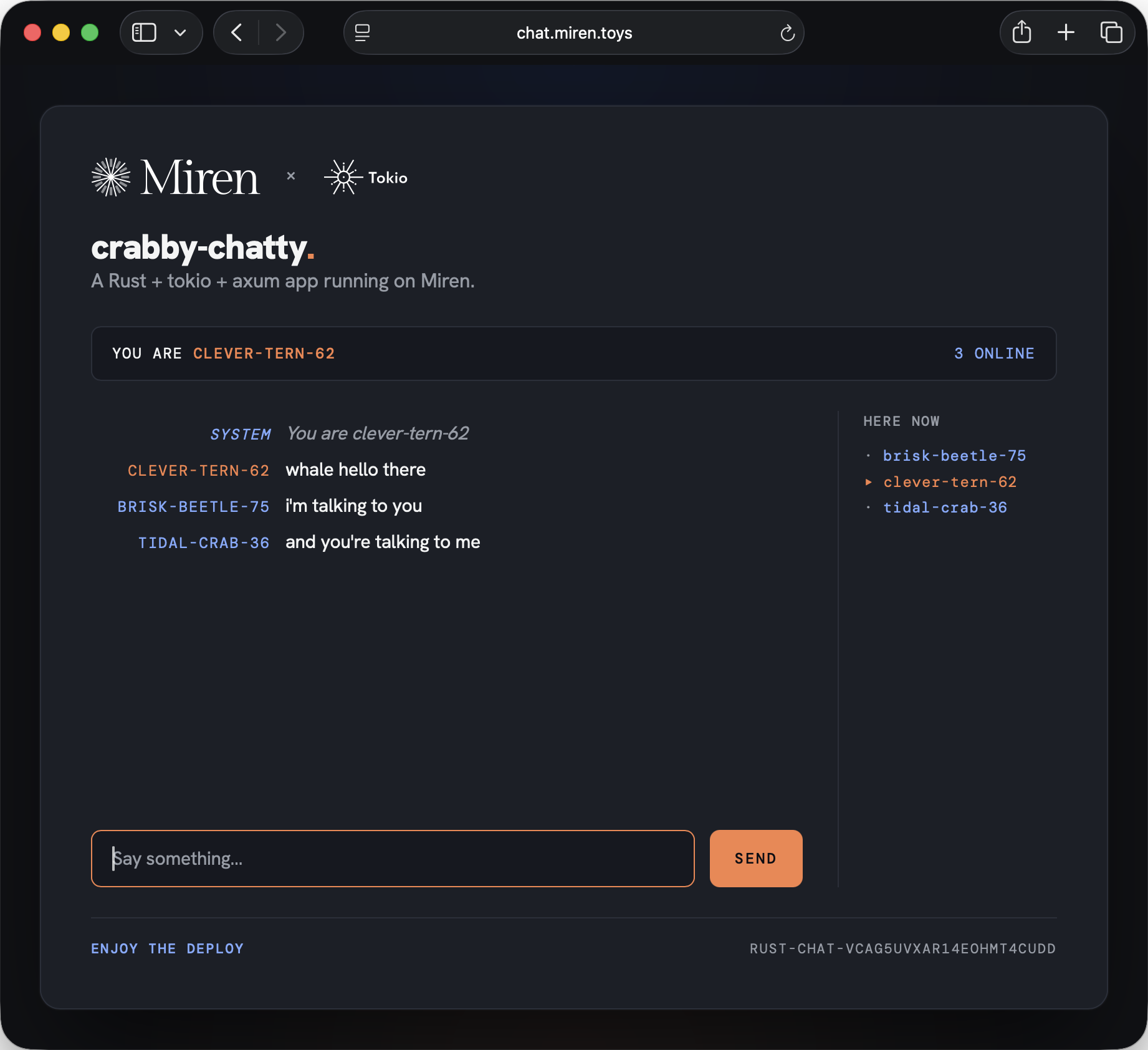
A screenshot of the rust-chat UI with three connected users saying hello to each other

Notes from a gopher

So now I’ve spent some honest hours trying to fit Rust into a Go-shaped brain. Here’s what fit nicely and what popped back out the other side.

Exhaustive enums are the thing I’ve wanted in Go for years. In Go, I either reach for codegen or write a test case any time I want to prove I handle every variant of a type. Rust’s compiler just checks. Add another variant tomorrow and every match in the codebase that doesn’t cover the new case lights up red at compile time. I can stop writing tests for my own forgetfulness.

The ? operator is kind of a revelation to an if err != nil-addled brain like mine. One character for what used to be a block. Though I’ll admit, the number of implicit exits from a function still makes me a little itchy. It’s an interesting spot where the two languages diverge on what’s worth making explicit. Go wants you to see every return path, even the sad ones. Rust trusts the type system to carry it instead.

The first line of Rust that made me laugh out loud:

match tokio::time::timeout(Duration::from_secs(2), receiver.next()).await {
    Ok(Some(Ok(Message::Text(t)))) => { /* happy path */ }
    _ => { /* anything else */ }
}

Reads like a nervous little parser muttering to itself. “Ok… some… ok… message… text!” Each layer hoping the next one holds. My reaction to Claude was “do rust-heads not blink at a line like that?” Answer: yes, a little. This is on the border of “clever” and “just write it flat.”

We refactored to lean on ? instead of the big match clause, which gets you to a slightly cleaner helper:

let msg = tokio::time::timeout(Duration::from_secs(2), receiver.next())
    .await
    .ok()?
    ?
    .ok()?;

That unfortunately just swaps out the nervous parser for a slightly deaf one. “Ok?” ”…?” “Ok?” Three tries at the answer, cupping its ear a bit more each time. It still reads funky to me, but to be fair it’s doing the work of about five nested if err != nil branches in Go, one of which I would absolutely forget.

The first line that made me swear:

async fn send_json<S>(sender: &mut S, msg: &ServerMessage) -> Result<(), ()>
where
    S: SinkExt<Message> + Unpin,
    S::Error: std::fmt::Debug,

I stared at these Curry-Howard crimes and typed a series of expletives at Claude that were in an original draft of this post but we decided to elide to preserve a sliver of corporate dignity. Claude patiently walked me through it, and it made sense piece-by-piece but absolutely did not stick. Please do not ask me to explain that snippet of code to you. At the end, Claude conceded that for an app, we could just write the concrete type here. So I backed away slowly. Go generics can get mind-bending pretty quickly too, but maybe not as quickly.

The runtime in plain sight

Rust’s async runtime isn’t part of Rust. There’s no go keyword, no built-in scheduler, no goroutines. The language gives you the syntax for async (async fn, .await, futures as types) and then tells you to go find a runtime that will actually poll them. Tokio is one of those runtimes. You import it into your app.

In Go, that whole apparatus is the language. You type go func() and the scheduler takes it from there. Goroutines, GC, stack growth, preemption: all of it lives under a carpet you can’t really lift.

Rust yanks the carpet. The runtime doesn’t hide its shape from me; the language insists I spell more of it out. That’s what Tokio is: not a feature bundled into the language, but a library I imported, with primitives I can watch and poke at directly.

It took me a while to realize this is what I’d been reading as verbosity. Go is verbose at the surface and quiet underneath. Rust is dense at the surface and quiet nowhere. I did not expect to come home thinking of Go as the more implicit language. But here we are.

Now watch this

That’s where tokio-console comes in. Go has pprof and it’s great; tokio-console live-tails the runtime rather than snapshotting it, so every task, channel, and mutex is a row you watch tick in real time.

Wiring it in took three lines of Rust and a service-port declaration in .miren/app.toml:

[[services.web.ports]]
port = 6669
name = "console"
type = "tcp"
node_port = 30669

Then, from the plane:

$ tokio-console http://chat.miren.toys:30669
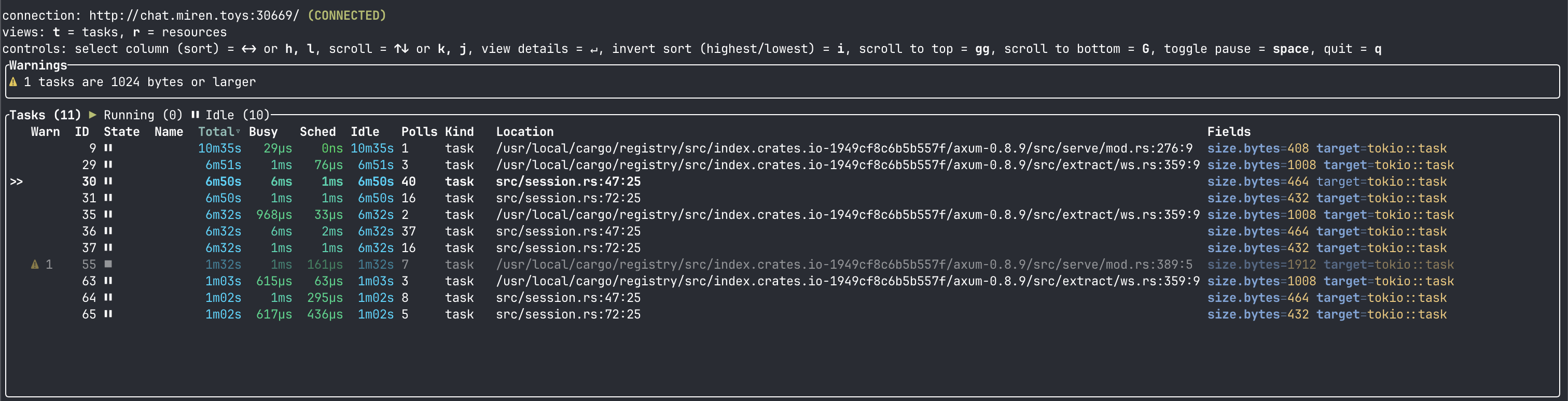
tokio-console connected to the live deployed rust-chat instance, showing 11 tasks including three symmetric trios, one per connected WebSocket client

Three humans in the chat room showed up as three trios of tasks: an extract, a send, a receive per client. The axum accept loop had spent 29 microseconds doing work across ten minutes of life (0.000005%), which is what async looks like when it’s working. And my code showed up in the console as naturally as Tokio’s own internals.

Not yet

I had fun finally learning some real Rust, but this old gopher hasn’t suddenly transformed into a crab. The trade-offs Go makes serve the kind of work I do most days. But I hear that over a long enough time span, chances are, it’ll happen.