


惯性聚合 高效追踪和阅读你感兴趣的博客、新闻、科技资讯
阅读原文 在惯性聚合中打开

推荐订阅源

T
Threatpost
W
WeLiveSecurity
V
Vulnerabilities – Threatpost
P
Privacy & Cybersecurity Law Blog
Cisco Talos Blog
Cisco Talos Blog
Blog — PlanetScale
Blog — PlanetScale
博客园 - 叶小钗
爱范儿
爱范儿
C
CERT Recently Published Vulnerability Notes
Hugging Face - Blog
Hugging Face - Blog
P
Proofpoint News Feed
Threat Intelligence Blog | Flashpoint
Know Your Adversary
Know Your Adversary
Latest news
Latest news
T
Tor Project blog
NISL@THU
NISL@THU
The Hacker News
The Hacker News
IT之家
IT之家
Last Week in AI
Last Week in AI
T
Tenable Blog
C
Cybersecurity and Infrastructure Security Agency CISA
阮一峰的网络日志
阮一峰的网络日志
小众软件
小众软件
D
Darknet – Hacking Tools, Hacker News & Cyber Security
V
Visual Studio Blog
Apple Machine Learning Research
T
Threat Research - Cisco Blogs
cs.CL updates on arXiv.org
C
CXSECURITY Database RSS Feed - CXSecurity.com
博客园 - 聂微东
T
The Exploit Database - CXSecurity.com
博客园 - 三生石上(FineUI控件)
Spread Privacy
Spread Privacy
S
Secure Thoughts
博客园 - 司徒正美
A
About on SuperTechFans
Attack and Defense Labs
Microsoft Security Blog
N
News and Events Feed by Topic
O
OpenAI News
V
V2EX
aimingoo的专栏
aimingoo的专栏
L
LangChain Blog
OSCHINA 社区最新新闻
OSCHINA 社区最新新闻
S
Security Affairs
MyScale Blog
MyScale Blog
S
Schneier on Security
宝玉的分享
宝玉的分享
Hacker News - Newest:
Hacker News - Newest: "LLM"
K
KPMG report finds enterprise disconnect between AI and its ROI | CIO

Hacker News

Introducing Claude Opus 4.7 Qwen Studio The Future of Everything is Lies, I Guess: Where Do We Go From Here? GitHub - SeanFDZ/macmind: Single-layer transformer in HyperTalk for the classic Macintosh Show HN: Agent-cache – Multi-tier LLM/tool/session caching for Valkey and Redis Bonsai 1-bit WebGPU - a Hugging Face Space by webml-community Moving a large-scale metrics pipeline from StatsD to OpenTelemetry / Prometheus GitHub - Nightmare-Eclipse/RedSun: The Red Sun vulnerability repository GitHub - SethPyle376/hiraeth: Local AWS emulator focused on fast integration testing, with SQS support, SQLite-backed state, and a debug-friendly web UI. GitHub - macOS26/Agent: Any AI, replaces Claude Code, Cursor, OpenClaw. Over 18 LLM providers (Claude, OpenAI, Gemini, Ollama, Zai, HF, Qwen) wired into a native Mac app that writes code, builds Xcode projects, bumps versions, manages git, automates Safari, use AppleScript, JS or Accessibility, extend Agent! w/ MCP Servers, run tasks from your iPhone via Messages. YouTube now lets you turn off Shorts I Made a Terminal Pager Burgers | マクドナルド公式 Commands — HackerNews CLI documentation ChatGPT for Excel PiCore - Raspberry Pi Port of Tiny Core Linux Live Nation illegally monopolized ticketing market, jury finds Google Broke Its Promise to Me. Now ICE Has My Data. Founding Engineer at Adaptional | Y Combinator CRISPR takes important step toward silencing Down syndrome’s extra chromosome GitHub - saffron-health/libretto: The AI toolkit for building reliable browser automations US v. Heppner (S.D.N.Y. 2026) no attorney-client privilege for AI chats [pdf] Retrofitting JIT Compilers into C Interpreters IPv6 – Google The Accursèd Alphabetical Clock Cybersecurity Looks Like Proof of Work Now Fragments: April 14 Cal.com Goes Closed Source: Why AI Security Is Forcing Our Decision | Cal.com - Scheduling Software for Online Bookings Laravel raised money and now injects ads directly into your agent When moving fast, talking is the first thing to break Too much Discussion of the XOR swap trick – Heather Cafe Introduction to Spherical Harmonics for Graphics Programmers The Grand Line Building a Z-Machine in the worst possible language High-Level Rust: Getting 80% of the Benefits with 20% of the Pain GitHub - duguyue100/midnight-captain: Inspired by Midnight Commander, tailored to my taste. How to build a `git diff` driver · Jamie Tanna | Software Engineer Center for Responsible, Decentralized Intelligence at Berkeley The Local Universe’s Expansion Rate Is Clearer Than Ever, but Still Doesn’t Add Up - A new synthesis of astronomical measurements confirms a persistent mismatch that could point to physics beyond current models The air throughout our homes is infused with microplastics. But there are things you can do to breathe less of them The disturbing white paper Red Hat is trying to erase from the internet – OSnews The Future of Everything is Lies, I Guess: Annoyances ‘Abhorrent’: the inside story of the Polymarket gamblers betting millions on war Productive procrastination — Max van IJsselmuiden maps, territory and LMs 447 Terabytes per Square Centimetre at Zero Retention Energy: Non-Volatile Memory at the Atomic Scale on Fluorographane Show HN: Pardonned.com – A searchable database of US Pardons 20 Years on AWS and Never Not My Job The Seasons are Wrong Artemis II crew splashes down near San Diego after historic moon mission We gave an AI a 3 year retail lease in SF and asked it to make a profit | Andon Labs How a dancer with ALS used brainwaves to perform live On filing the corners off my MacBooks Installing every* Firefox extension OpenClaw’s memory is unreliable, and you don’t know when it will break Steve Blank Nowhere Is Safe Chimpanzees in Uganda locked in vicious 'civil war', say researchers watgo - a WebAssembly Toolkit for Go linux/Documentation/process/coding-assistants.rst at master · torvalds/linux GitHub - callumlocke/json-formatter: Makes JSON easy to read. Founding Product Engineer at Bild AI | Y Combinator A compelling title that is cryptic enough to get you to take action on it GitHub - Keychron/Keychron-Keyboards-Hardware-Design: Industrial design files for Keychron keyboards and mice. 100+ models with CAD assets in STEP, DXF, DWG, and PDF. Source-available, with commercial use allowed for original compatible accessories within the license terms. [ANNOUNCE] WireGuardNT v0.11 and WireGuard for Windows v0.6 Released 1D-Chess Helium Is Hard to Replace Cooperative Vectors Introduction | Evolve Keeping a Postgres queue healthy — PlanetScale Our response to the Axios developer tool compromise Do Americans read print books, e-books or audiobooks more? The Zettelkasten Method in Obsidian: A Practical Setup Guide Artemis II Is Competency Porn and We Are Starving For It WeakC4 Flight Viz — Cockpit View A Mexican surveillance giant you’ve never heard of is now watching the U.S. border Surelock: Deadlock-Free Mutexes for Rust RISC-V 101 – what is it and what does it mean for Canonical? | Ubuntu The Problem That Built an Industry How Much Linear Memory Access Is Enough? | Solidean Investigating Split Locks on x86-64 Simplest hash functions Sybilproof reputation mechanisms (2005) [pdf] What is a property? How Complex is my Code? Static code analysis in Kotlin — tools overview Toffoli gates are all you need PGLite evangelism dcmake: a new CMake debugger UI Clojure on Fennel part one: Persistent Data Structures Fragments: April 2 Python Release Python install manager 26.1 The Life and Death of the Book Review - Liberties Introducing Database Traffic Control — PlanetScale Bitcoin miners are losing $19,000 on every BTC produced as difficulty drops 7.8% God sleeps in the minerals Building slogbox Apple Silicon and Virtual Machines: Beating the 2 VM Limit Who was “Not Even Wrong” first? Pokemon Evolution Vs Darwinian Evolution The APL Programming Language Source Code
Mines in the Strait of Hormuz, Iran’s almost invisible weapon that has put the world’s most powerful navy in check
Francisco Peregil · 2026-04-22 · via Hacker News

Neither elite espionage, nor artificial intelligence capable of processing a thousand targets on the first day of the war, nor the deployment of three U.S. aircraft carriers has proven sufficient. The muscle of the Pentagon and Israel has run up against Iranian naval mines in the Strait of Hormuz, a weapon as discreet and cheap as it is effective. Tehran didn’t even need to officially admit to planting them on the seabed. It was enough to designate “danger zones” in this funnel-shaped waterway, a little over 100 miles long and 20 miles wide at its narrowest point. In this way, it blocked the passage of 20% of the world’s crude oil for seven weeks, negotiated a ceasefire with the United States, and agreed to reopen the passage last Friday, although it reversed course on Saturday. Tehran has managed to remove regime change from the dialogue agenda. All this without detonating a single mine, based solely on the suspicion of their presence.
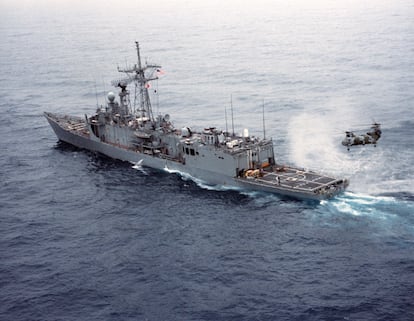
The curious thing is that this weapon was anything but secret, because Iran had been threatening to block the Strait of Hormuz for decades. And it used it in the so-called Tanker War (1984-1988), where the U.S. fought alongside Iraq in its battle against Iran. In April 1988, the U.S. frigate Samuel B. Roberts struck an Iranian mine that tore a four-meter gash in its hull. The Pentagon responded with Operation Praying Mantis, its largest naval action since 1945: it destroyed Iranian oil platforms used as military bases, sank two frigates, and caused dozens of Iranian casualties. It was a naval defeat for Tehran, but both sides learned valuable lessons. Among them, that just a few mines planted in the Strait of Hormuz were enough to trigger a global economic crisis.

How could the White House have ignored this background? Stéphane Audrand, a research associate at the French Institute of International Relations (Ifri), noted in an exchange of messages: “I know my American colleagues and I believe they didn’t underestimate anything at all. The Pentagon certainly provided the White House with an excellent report, outlining all possible scenarios and risks.”

Audrand is convinced that President Donald Trump and his Secretary of Defense Pete Hegseth “bought into” Benjamin Netanyahu’s thesis that the regime would fall after the assassination of Supreme Leader Ali Khamenei. “Under that premise, the risk of detonation was considered limited,” he adds.

Regarding the effectiveness of these explosives, Audrand explains that it lies in their price and the significant damage they can cause. “They are almost impossible for a merchant ship to detect, cost tens of thousands of dollars, and can cause millions of dollars in damage to a vessel, or even sink it.”

The French expert emphasizes that mines frighten crews, shipowners, and insurers. He recalls that their effectiveness had already been demonstrated in 2022 off the coast of Odesa in the Black Sea: “Ukraine’s mining of the waters contributed to driving all maritime transport operators away.”

“The biggest threat to ships”

However, sometimes the effectiveness of mines lies not only in their inherent qualities but also in the historical neglect they have received from major powers. This is the view of Mark F. Cancian, senior advisor at the Center for Strategic and International Studies (CSIS), who points out via email from Washington that for decades, U.S. Navy journals have been filled with articles expressing concern about mines. “They note that mines have been the greatest threat to ships since World War II.” However, mine clearance was never a priority at the Pentagon. “The United States preferred to delegate this mission to other partners. Now, most of those allies are unwilling to help, so the U.S. Navy relies on its own capabilities, which are clearly insufficient.”

Various sources estimate that Iran possesses an arsenal of approximately 5,000 mines. Some are contact mines; these can be anchored to the seabed with a cable or drift freely. On the ocean floor, they are often difficult to detect using conventional sonar. Other, more advanced devices include so-called “influence” mines, which detonate upon detecting magnetic, acoustic, or pressure signals — what is known in naval terminology as a ship’s “signature.” These latter mines can float. There are also sticky mines, which are manually deployed and designed for targeted attacks.

Iran “is removing sea mines”

Trump announced last Friday on his Truth Social network that Iran, “with the help of the U.S.A., has removed, or is removing, all sea mines.” If the ceasefire holds, everyone will be happy. But in the event of any setback, demining in the midst of war would be an extremely difficult task for the United States without Tehran’s cooperation.

For decades, Washington has allocated “less than 1% of its budget to mine warfare, despite mines causing approximately 80% of U.S. warship damage and over 75% of casualties since 1950,” according to a Financial Times article published in March.

Most experts agree that European countries are better equipped than Washington to handle mine warfare. The problem is that the military alliances the White House enjoyed in the 1980s, during the Tanker Wars, “have deteriorated considerably,” explains Sebastian Bruns, a member of the Royal Swedish Institute of Naval Sciences, via email.

Bruns points out that the European Union has also been reducing the number of vessels assigned to these tasks since 1990. “There hasn’t been a one-to-one replacement of the decommissioned units. The missions of the 2000s and 2010s, such as combating piracy or rescuing refugees, didn’t require mine warfare capabilities.” Bruns concludes that if the maritime route needs to be cleared of mines as soon as possible, a classic saying will apply: “You go into battle with the forces you have, not the ones you wish you had.”

Audrand adds that the major Western navies, such as France, the United Kingdom, the United States, Spain, Belgium, Italy, and the Netherlands, have very effective minehunters. But he acknowledges that they are usually very few in number. “There are between six and 10 per navy. And they can only neutralize a few mines a day.”

The fact that Western powers have so few mine-clearing units today is the other side of a coin that Iran understood decades ago. After its defeat at the hands of the United States in 1988, Tehran realized that the key was not competing in technology, but in dispersal. Audrand explains that, since then, the Iranian regime has developed a force based on small boats and drones that operate under the umbrella of a constantly growing arsenal of mines, designed, according to the researcher, to “threaten the Strait of Hormuz and protect its own coastline simultaneously.”

The temporary ceasefire allowed oil to flow again for a few hours, but the lessons of nearly two months of blockade will remain etched in the minds of both sides. Tehran has shown that it can always play the card of those almost invisible devices lurking at sea.

Sign up for our weekly newsletter to get more English-language news coverage from EL PAÍS USA Edition