







Fifteen-year-old August Lamm posted a picture of herself on the r/amiugly subreddit with the following caption:
15/f and curious what people think. I’ve never been a popular girl and I don’t get much attention from guys. My teeth are kind of wonky but I’m getting Invisalign tomorrow.
“I would make another post the following year, then again at eighteen, to see if I’d gotten any prettier,” she would write in 2024, reflecting on the experience. “I sought feedback in other ways too, on other platforms. I posted photos, drawings, collages, songs, videos. I wanted so badly for something to take off, go viral, launch me into notoriety.”
Lamm would soon find what she’d been seeking. In her early twenties, people took notice of her artistic talent. As fans responded to her intricate pen-and-ink drawings, her Instagram account exploded, gaining more than 175,000 followers.
Adapted from
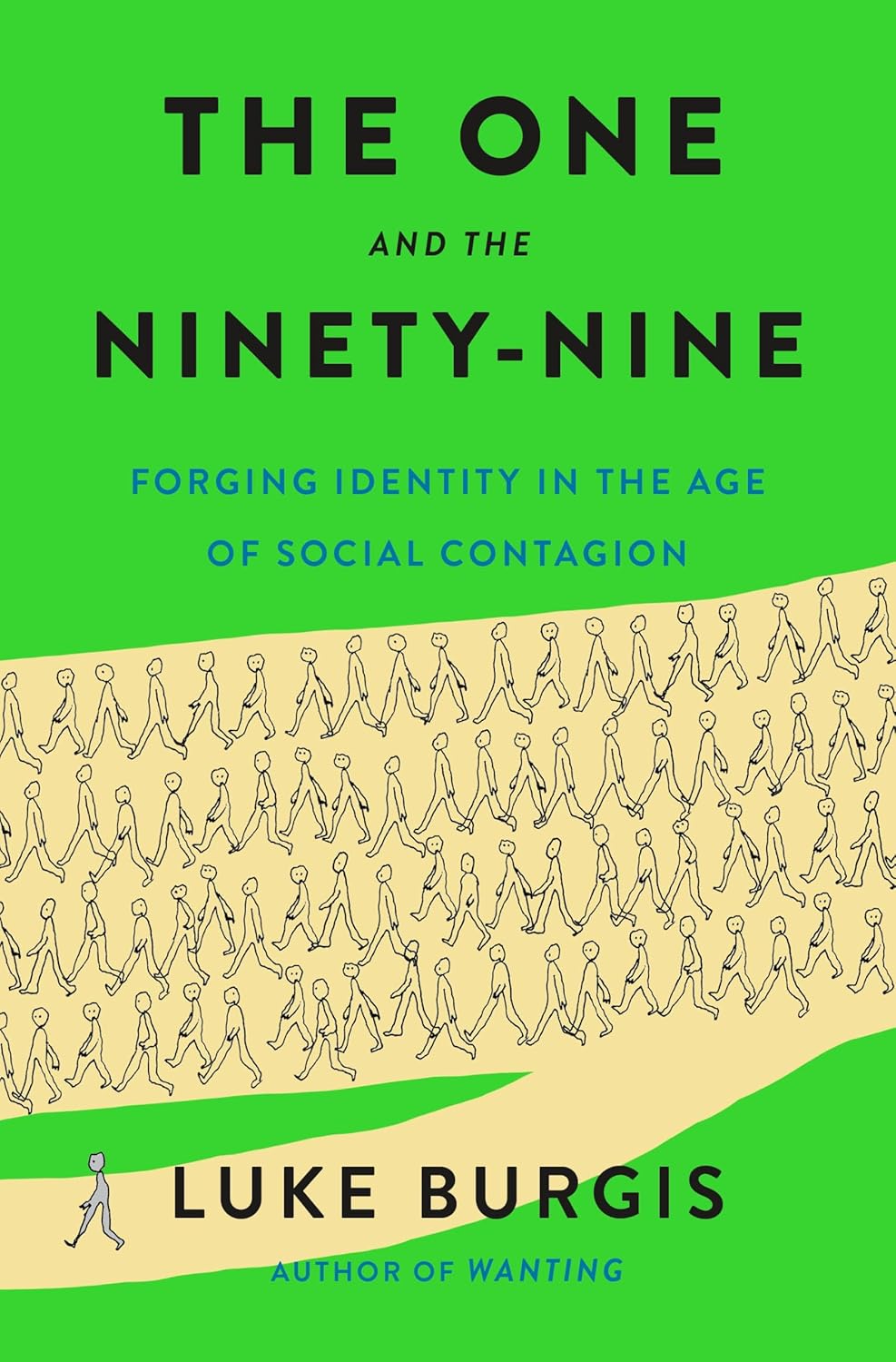
Luke Burgis
Copyright © 2026 by the author and reprinted by permission of St. Martin’s Publishing Group
But as her fame grew, so did her misery: She couldn’t stop checking her phone for updates and reactions to her posts. “A few more years and my mind wasn’t suited for much else,” she wrote. “I was anorexic and had no friends; I was absolutely killing it online. I had developed all these health issues and begun posting hospital selfies, crying selfies, depressive bathtub selfies. I was sick and sad.”
One day, a young girl recognized her on a train in Paris. “I’m fangirling,” the girl told her. For Lamm, it was a tipping point. Inside, she secretly felt that the social media platform she’d been building — the one that led this girl to admire her — had destroyed her life. She went home and poured out her true feelings into a camera for half an hour and uploaded the video to YouTube. She deactivated her Instagram account that same day.
Finally, one day, Lamm traded in her smartphone for a flip phone. To truly escape, she knew that she had to completely redesign her life — not to stop doing one thing, like posting on Instagram, but to transform her entire technological environment.
She compiled the notes about her lifestyle changes in a thirty-six-page pamphlet called “You Don’t Need a Smartphone: A Practical Guide to Downgrading & Reclaiming Your Life.” She partnered with an online platform to publish a short version of it. Soon, employees of this new partner sent her over four hundred emails in the span of two months. She was bombarded with text messages from the marketing team, including emojis that her “dumb” phone could not even render. They didn’t seem to accept that she had, in fact, given up her smartphone and was trying to stay offline as much as possible. “I was spending entire days toggling between Zoom meetings, documents, emails, and design files, in service of an anti-tech message,” she remembers.
The audacity of her project was such that those who had praised it in the abstract faltered when faced with its reality. So tethered was their work to the technology that they couldn’t help but push her boundaries. Despite her resolve to resist — to break away from the prevailing norm — Lamm found herself once again pulled back into the fold for a time.
The pathologies of digital life are many, and our smartphones are a Pandora’s box of them. Three pathologies that have not received much attention are particularly acute, but most people are not developing antidotes because they don’t know these pathologies exist. That is, in part, because they are not named. I’ll attempt to do that here. The question that naming them leads to is: How do you reclaim a solid self — a real person who is able to be in communion with others — in place of the pseudo-self, the shape-shifting simulacrum of a self that digital technology tends to create?
Anthropologist Robin Dunbar’s research on social bonding shows that humans organize their relationships in concentric circles, with the innermost circle made up of about five people. Many know his famous “Dunbar’s number” — which refers to the roughly 150 meaningful social ties that humans can maintain — but fewer realize his work also shows that psychological security depends on far smaller groups.
Microcommunities of four to seven people, usually immediate family and closest friends, act as the strongest buffers against the fragmentation of modern digital life. While there are certainly situations where digital technology can bolster those tight-knit relationships (I have been on a text thread with several old friends for years, and it keeps us bonded and close despite living in different cities today), many of these tools pull us out into vast, shallow networks if we’re not careful.
When relationship networks grow beyond our natural capacity to navigate them, many of us start negotiating our sense of self in response to overwhelming amounts of feedback, demands, and resulting anxiety. And that is a temptation for the solid self to erode and the pseudo-self to emerge. Technology extends the human person — to use an image from Marshall McLuhan — so far and so wide and into so many places that a person is practically forced to make compromises at the deepest levels of the self. In its place, the pseudo-self becomes more prominent.
Three specific pathologies of digital life make the work of maintaining, or recovering, a solid self extraordinarily difficult.
Rites of passage shape and strengthen us, marking our transition from one stage of life to another. They involve challenge, risk, and the guidance of those who have already completed them. Technology is changing their shape, introducing new ones, and rendering others ineffective.
In no arena has the Internet more thoroughly warped rites of passage than sexual discovery. Isabel Hogben discovered the pornography website PornHub for the first time when she was ten years old — by accident. “The site is easy to find, impossible to avoid, and has become a frequent rite of passage for kids my age,” she wrote in The Free Press in 2023, when she was sixteen.
The Internet has imposed this counterfeit rite of passage that no child has asked for, yet nearly all are dragged through. It’s counterfeit because it leads away from the real, and toward the fake. It feeds the illusions of the pseudo-self, not the solid self.
A generation ago, the transition into adulthood was marked by meaningful passageways: a nerve-wracking call to ask someone out, the shock of leaving home with no digital tether, the silence of a first job interview waiting room, navigating a long-distance trip without GPS. They created friction — forcing people to think seriously about who they were and who they were becoming. Today, most friction has been sanded over. We drift through key life transitions without ever really knowing where we stand. The result is confusion about how to engage with the world, and, more profoundly, confusion about who we are.
As information becomes more abundant, we have begun to prefer the consumption of information to the actual movement that traditional rites of passage offer us. The sheer abundance of information may be obscuring the trailheads of the passageways we need to take.
The average person scrolls through three hundred feet of content per day, the height of the Statue of Liberty. In 2025, it was estimated that Americans listened to around 773 million hours of podcasts every week. Is this simply the kind of curiosity we admire in a diligent student?
The Latin term curiositas was used by Saint Augustine of Hippo in a different sense from what we mean by the English word curiosity. Augustine, writing near the end of the fourth century, meant something closer to “distracting knowledge” — a restless thirst for knowledge that is not aimed at understanding but rather at satisfying one’s own superficial desires.
Driven by curiositas, we become hyperinformed but poorly formed, bonded to each other more through fragile digital networks than shared physical experiences.
Counterfeit rites of passage and curiositas have, as their root, a third pathology: a diminished sense of agency, which resembles an ancient spiritual disease called acedia.
Acedia, which is often said to mean sloth (a word that does not do the concept justice), is a kind of malaise that prevents a person from being able to act with intention. Instead, it causes a person to do everything but the one thing they should be doing. A person afflicted with acedia paces around their room, dreams about all the other things they could be doing, places they could go, people they could become. Freedom for the “acediac” means the possibility of doing anything, untethered from any sense of what one should do — like caring for the sick family member who is sitting in the next room.
Digital technology is contributing to the problem of acedia by giving us a false sense of freedom. What looks like a free choice has already been chosen for us. Algorithms take a vast amount of data and present it as personalized when it’s really the product of a large, impersonal collective. Things we see online have been sifted through by millions of other people and machines — that is probably the reason we’re seeing it.
Instead of encountering reality directly, we experience the world as a curated stream of group-mediated impressions. The self, rather than being something we build through intentional acts, is shaped passively — slowly and subtly conforming to algorithmic expectations.
When every choice is invisibly influenced before it is made, when every desire is preformed by unseen forces, what does freedom mean?
The three pathologies represent, respectively: a social problem (counterfeit rites), an intellectual problem (curiositas), and a spiritual problem (acedia). They’re interrelated. Without effective rites of passage, people feel stuck and turn to distraction. Distraction breeds the restlessness of curiositas, a refusal to face reality. Lastly, when reality itself is evaded, meaning slips away, leaving us hollow — prey to acedia. From there, acedia fuels a vicious cycle by exacerbating the first two diseases.
There are three specific antidotes — social, intellectual, and spiritual — to these pathologies that can help us reclaim our agency.
Rites of passage that are embodied and communal are essential. They should start in the family, but our education system is a natural place to rethink our approach. New rites are going to have to break students away from the technological milieu and show them new ways of living. They will have to make them say, as effective rites of passage do: I will never be the same again.
Wyoming Catholic College, a small school in Lander, Wyoming, initiates every new freshman with a twenty-one-day experience in the backcountry — phone-free. Olivia Jones, a 2022 graduate, reflected: “How do you know something’s effect on your life if you’ve never lived life without it?”
The problem is not smartphones alone but what they prevent or hinder, such as the ability to embark on and complete real, embodied rites of passage. If students won’t willingly give up their phones in ordinary life, they must be drawn into something more compelling, such as the promise of deep, lasting relationships that could shape the rest of their lives.
Curiositas is the restless pursuit of knowledge for its own sake. In contrast, the virtue that medieval thinkers called studiositas offers a way back. Studiositas is a virtue that helps govern our desire for knowledge. It directs knowledge toward the highest and best ends.
One promising trend is the rise of small, intentional learning communities that put this virtue into practice. They’re often made up of five to fifteen adults who come together to study a topic in depth. These aren’t casual book clubs or discussion groups — they’re structured efforts to explore complex ideas over time: the roots of liberal democracy, the history of scientific revolutions, the evolution of architecture, the writings of a major philosopher. What makes these groups distinct is not what they study, but how they study — slowly, deliberately, with a desire to connect what they’re learning to how they live.
I have to be honest: The weapons that have been most effective in my personal battle against acedia have been prayer, fasting, and asceticism. I’ve tried, and failed, too many times to overcome it without them. I realize that many readers might not believe in the efficacy of those spiritual practices, and might be unready or unwilling to try them — so I’m going to suggest something fundamental that is more universal.
One powerful antidote to acedia is the practice of good leisure. Leisure is not idleness or mere relaxation; it’s the act of being fully present without productive ends to measure everything by. It is a way of receiving life as a gift rather than a series of tasks to complete, or a set of problems to solve.
Learning how to do leisure well begins with small things: setting aside time to enjoy a meal without distraction, organizing a surprise celebration for a friend who had a minor win at work, or listening closely to an acquaintance without thinking about the next thing you want to say.
Leisure can also mean reclaiming one day of rest each week as a sacred time of celebration, not just recovery from work.
When practiced sincerely, these experiences become surprisingly joyful. To spend time in leisure is to resist the constant noise and restless urge to be somewhere else. We reclaim the freedom that acedia tries to erode.
The three pathologies — counterfeit rites of passage, curiositas, and diminished agency — are not merely technological or neurological, but social, intellectual, and spiritual. They erode the solid self, leaving us unable to sustain real community.
When strong communities disappear, ones in which people can be in serious relationships with one another without dissolving, power rushes in to fill their void. The development of the solid self — through effective rites of passage, the virtue of studiositas, and the proper exercise of leisure — is one way to prevent that from happening. It is how we pull the person out of the machine.
此内容由惯性聚合(RSS阅读器)自动聚合整理,仅供阅读参考。 原文来自 — 版权归原作者所有。