

惯性聚合 高效追踪和阅读你感兴趣的博客、新闻、科技资讯
阅读原文 在惯性聚合中打开

推荐订阅源

Threat Intelligence Blog | Flashpoint
Exploit-DB.com RSS Feed
The Last Watchdog
The Last Watchdog
K
KPMG report finds enterprise disconnect between AI and its ROI | CIO
T
Troy Hunt's Blog
L
LINUX DO - 最新话题
C
Check Point Blog
T
Threat Research - Cisco Blogs
OSCHINA 社区最新新闻
OSCHINA 社区最新新闻
罗磊的独立博客
V
Vulnerabilities – Threatpost
cs.CV updates on arXiv.org
J
Java Code Geeks
Apple Machine Learning Research
大猫的无限游戏
大猫的无限游戏
S
Security @ Cisco Blogs
IT之家
IT之家
T
The Exploit Database - CXSecurity.com
The GitHub Blog
The GitHub Blog
D
Docker
Engineering at Meta
Engineering at Meta
AWS News Blog
AWS News Blog
S
Security Affairs
U
Unit 42
P
Palo Alto Networks Blog
V
Visual Studio Blog
Y
Y Combinator Blog
D
DataBreaches.Net
Forbes - Security
Forbes - Security
阮一峰的网络日志
阮一峰的网络日志
美团技术团队
Security Latest
Security Latest
aimingoo的专栏
aimingoo的专栏
Simon Willison's Weblog
A
Arctic Wolf
博客园_首页
钛媒体:引领未来商业与生活新知
钛媒体:引领未来商业与生活新知
H
Hacker News: Front Page
博客园 - 司徒正美
博客园 - Franky
宝玉的分享
宝玉的分享
TaoSecurity Blog
TaoSecurity Blog
Latest news
Latest news
Scott Helme
Scott Helme
MongoDB | Blog
MongoDB | Blog
量子位
cs.AI updates on arXiv.org
C
Cisco Blogs
P
Privacy International News Feed
Application and Cybersecurity Blog

Hacker News

Introducing Claude Opus 4.7 Qwen Studio The Future of Everything is Lies, I Guess: Where Do We Go From Here? GitHub - SeanFDZ/macmind: Single-layer transformer in HyperTalk for the classic Macintosh Show HN: Agent-cache – Multi-tier LLM/tool/session caching for Valkey and Redis Moving a large-scale metrics pipeline from StatsD to OpenTelemetry / Prometheus GitHub - Nightmare-Eclipse/RedSun: The Red Sun vulnerability repository GitHub - SethPyle376/hiraeth: Local AWS emulator focused on fast integration testing, with SQS support, SQLite-backed state, and a debug-friendly web UI. GitHub - macOS26/Agent: Any AI, replaces Claude Code, Cursor, OpenClaw. Over 18 LLM providers (Claude, OpenAI, Gemini, Ollama, Zai, HF, Qwen) wired into a native Mac app that writes code, builds Xcode projects, bumps versions, manages git, automates Safari, use AppleScript, JS or Accessibility, extend Agent! w/ MCP Servers, run tasks from your iPhone via Messages. YouTube now lets you turn off Shorts I Made a Terminal Pager Burgers | マクドナルド公式 Commands — HackerNews CLI documentation ChatGPT for Excel PiCore - Raspberry Pi Port of Tiny Core Linux Live Nation illegally monopolized ticketing market, jury finds Google Broke Its Promise to Me. Now ICE Has My Data. Founding Engineer at Adaptional | Y Combinator CRISPR takes important step toward silencing Down syndrome’s extra chromosome GitHub - saffron-health/libretto: The AI toolkit for building reliable browser automations US v. Heppner (S.D.N.Y. 2026) no attorney-client privilege for AI chats [pdf] Unexpected €54k billing spike in 13 hours: Firebase browser key without API restrictions used for Gemini requests Retrofitting JIT Compilers into C Interpreters IPv6 – Google The Accursèd Alphabetical Clock Cybersecurity Looks Like Proof of Work Now Fragments: April 14 Cal.com Goes Closed Source: Why AI Security Is Forcing Our Decision | Cal.com - Scheduling Software for Online Bookings Laravel raised money and now injects ads directly into your agent When moving fast, talking is the first thing to break Too much Discussion of the XOR swap trick – Heather Cafe Introduction to Spherical Harmonics for Graphics Programmers The Grand Line Building a Z-Machine in the worst possible language High-Level Rust: Getting 80% of the Benefits with 20% of the Pain GitHub - duguyue100/midnight-captain: Inspired by Midnight Commander, tailored to my taste. How to build a `git diff` driver · Jamie Tanna | Software Engineer Center for Responsible, Decentralized Intelligence at Berkeley The Local Universe’s Expansion Rate Is Clearer Than Ever, but Still Doesn’t Add Up - A new synthesis of astronomical measurements confirms a persistent mismatch that could point to physics beyond current models The air throughout our homes is infused with microplastics. But there are things you can do to breathe less of them The disturbing white paper Red Hat is trying to erase from the internet – OSnews The Future of Everything is Lies, I Guess: Annoyances ‘Abhorrent’: the inside story of the Polymarket gamblers betting millions on war Productive procrastination — Max van IJsselmuiden maps, territory and LMs 447 Terabytes per Square Centimetre at Zero Retention Energy: Non-Volatile Memory at the Atomic Scale on Fluorographane Show HN: Pardonned.com – A searchable database of US Pardons 20 Years on AWS and Never Not My Job The Seasons are Wrong Artemis II crew splashes down near San Diego after historic moon mission We gave an AI a 3 year retail lease in SF and asked it to make a profit | Andon Labs How a dancer with ALS used brainwaves to perform live On filing the corners off my MacBooks Installing every* Firefox extension OpenClaw’s memory is unreliable, and you don’t know when it will break Steve Blank Nowhere Is Safe Chimpanzees in Uganda locked in vicious 'civil war', say researchers watgo - a WebAssembly Toolkit for Go linux/Documentation/process/coding-assistants.rst at master · torvalds/linux GitHub - callumlocke/json-formatter: Makes JSON easy to read. Founding Product Engineer at Bild AI | Y Combinator A compelling title that is cryptic enough to get you to take action on it GitHub - Keychron/Keychron-Keyboards-Hardware-Design: Industrial design files for Keychron keyboards and mice. 100+ models with CAD assets in STEP, DXF, DWG, and PDF. Source-available, with commercial use allowed for original compatible accessories within the license terms. [ANNOUNCE] WireGuardNT v0.11 and WireGuard for Windows v0.6 Released 1D-Chess Helium Is Hard to Replace Cooperative Vectors Introduction | Evolve Keeping a Postgres queue healthy — PlanetScale Our response to the Axios developer tool compromise Do Americans read print books, e-books or audiobooks more? The Zettelkasten Method in Obsidian: A Practical Setup Guide Artemis II Is Competency Porn and We Are Starving For It WeakC4 Flight Viz — Cockpit View A Mexican surveillance giant you’ve never heard of is now watching the U.S. border Surelock: Deadlock-Free Mutexes for Rust RISC-V 101 – what is it and what does it mean for Canonical? | Ubuntu The Problem That Built an Industry How Much Linear Memory Access Is Enough? | Solidean Investigating Split Locks on x86-64 Simplest hash functions Sybilproof reputation mechanisms (2005) [pdf] What is a property? How Complex is my Code? Static code analysis in Kotlin — tools overview Toffoli gates are all you need PGLite evangelism dcmake: a new CMake debugger UI Clojure on Fennel part one: Persistent Data Structures Fragments: April 2 Python Release Python install manager 26.1 The Life and Death of the Book Review - Liberties Introducing Database Traffic Control — PlanetScale Bitcoin miners are losing $19,000 on every BTC produced as difficulty drops 7.8% God sleeps in the minerals Building slogbox Apple Silicon and Virtual Machines: Beating the 2 VM Limit Who was “Not Even Wrong” first? Pokemon Evolution Vs Darwinian Evolution The APL Programming Language Source Code
Banning noise will be a disaster for statistical data products - Ted is writing things
Damien Desfontaines · 2026-06-13 · via Hacker News

Last week, the United States Department of Commerce issued an order declaring that "noise infusion" will be banned from all statistical products published by the Census Bureau and the Bureau of Economic Analysis.
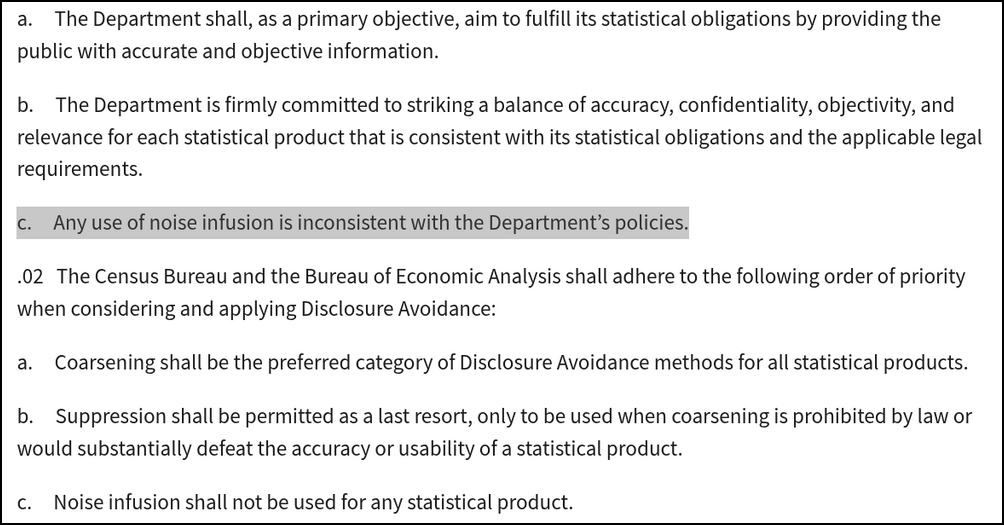
A screenshot of the order mentioned in the article. It reads: a. The
Department shall, as a primary objective, aim to fulfill its statistical
obligations by providing the public with accurate and objective information. b.
The Department is firmly committed to striking a balance of accuracy,
confidentiality, objectivity, and relevance for each statistical product that is
consistent with its statistical obligations and the applicable legal
requirements. c. Any use of noise infusion is inconsistent with the Department’s
policies. 02 The Census Bureau and the Bureau of Economic Analysis shall adhere
to the following order of priority when considering and applying Disclosure
Avoidance: a. Coarsening shall be the preferred category of Disclosure Avoidance
methods for all statistical products. b. Suppression shall be permitted as a
last resort, only to be used when coarsening is prohibited by law or would
substantially defeat the accuracy or usability of a statistical product. c.
Noise infusion shall not be used for any statistical
product.

What does it mean, and why should you care?

Context

Statistical products are a bunch of numbers published from a secret dataset. Often, that dataset contains confidential information, and it is important that the numbers don't reveal that information. The U.S. Census is a well-known example: the statistics are made public, but the contents of each form filled by individual U.S. residents must stay secret.

Scientists have developed a number of techniques that can be used to publish useful statistics while protecting the privacy of the original data. This field is called disclosure avoidance in statistical communities. Here are a few of these techniques.

  • Suppression: removing data that doesn't pass certain thresholds (e.g. if a count of people is below 5, we don't publish it).
  • Coarsening (or generalization): making data attributes less precise (e.g. transform a county into its state, a date of birth into an age range, etc.).
  • Sampling: randomly removing some records from the dataset.
  • Swapping: taking attributes from different records and exchanging them randomly.
  • Contribution bounding: making sure that a single individual cannot contribute "too much" to a statistic by limiting their maximum impact.
  • Noise addition: adding a random number to statistics to hide their true value.

Some of these techniques, when combined, achieve a definition called differential privacy. This definition has a lot of nice fundamental properties and is widely considered the gold standard of privacy protection among scientists. To achieve it, scientists typically rely on a combination of contribution bounding and carefully-calibrated noise addition.

From 1990 to 2010, the U.S. Census Bureau primarily relied on swapping for the decennial census. Then, they realized that this technique was actually very unsafe, and that it was pretty easy to reconstruct individual records using the published statistics. This is bad, because the Bureau is required by federal law to keep these records confidential. So they tried a few alternative approaches, and decided to adopt differential privacy for the 2020 Census: this was the one that kept the statistics most useful, while preventing these attacks.

It bears repeating: differential privacy wasn't chosen because the math was nice and compelling1. It was selected because among the different options that mitigated the attack, it was the one that preserved the most utility. Its exact privacy parameters were chosen not because they provided rock-solid provable guarantees, but because they squeezed most usefulness out of the data while reaching an acceptable level of privacy protection.

Sadly, "preserved the most utility under newly-discovered privacy constraints" did not mean "preserved as much utility as the 2010 Census": the numbers got less accurate, and the inaccuracies got a lot more transparent, and therefore impossible to ignore. This made a number of people very angry.

  • Demographers and social scientists could no longer ignore that the data they were working with was noisy data. This required a major shift in how they conceptualized and worked with this data.
  • People who were using Census data to actually reconstruct records could no longer do so. Demographers admitted that this was common practice. It's also an open secret that this was done by political operatives as part of gerrymandering efforts.

Phew, that was a lot of context.

What does the order say?

The administration has now decided that noise infusion was no longer an acceptable disclosure avoidance technique.

The order clearly targets differential privacy, but also seems to impact other techniques that involve randomness: the text explicitly mentions that coarsening should always be preferred, falling back to suppression as a "last resort". I have no idea why the order is so specific. Maybe they wanted to make sure the scientists working at the U.S. Census couldn't still use similar techniques without calling them differential privacy?

The order also carefully says it "shall not be interpreted to conflict with any constitutional, statutory, regulatory, or other legal provision". So the confidentiality obligations surrounding these statistical products still apply.

What will it mean in practice?

The consequences will be dire for utility or for privacy, and possibly both. It's hard to understate this point: future statistical releases will either be useless compared to past ones, or they will be incredibly unsafe.

For starters, taking away useful tools from the disclosure avoidance toolbox will always lead to more painful privacy/utility trade-offs. The whole point of this research field is to better understand and quantify privacy risk, and develop better tools to mitigate this risk while preserving utility.

For statistical releases, differential privacy is simply the best tool we have right now. It provides a finer way of quantifying trade-offs, and allows us to get more utility out of the data than competing techniques at similar privacy levels. If you take it away, you're left with techniques that either have worse utility at similar levels of privacy, or worse privacy for the same utility.

But all competing techniques also rely on noise addition. The Cell Key method, used at other statistical agencies, adds noise to statistics. Swapping, used from 1990 to 2010 for the U.S. Census, also injects randomness into the process. Sampling is everywhere in statistical work2. Hell, even imputation technically adds noise to the data3!

By contrast, coarsening and suppression are very blunt instruments. They only work in situations where the statistics are already very coarse, and not too many of them are published. For complex data products with many statistics about small groups of people (like the U.S. Census), they either destroy all utility of the data (especially for minority populations), or are very vulnerable to privacy attacks.

It makes sense: privacy attacks on statistical releases are about solving a system of equations. It is such an easier task when you know for sure that the statistics are all perfectly accurate. Noise forces you to compute probabilities, quantify the uncertainty, carefully consider baselines, and so on. That's why randomness is such a useful tool for disclosure avoidance! Even without formal guarantees, it makes attakcs a lot harder. Take it away and attacks become trivial.

Why is it happening?

I mean, who knows.

Maybe the goal is to force the U.S. Census to publish statistics that actually enable re-identification, to help with future gerrymandering efforts? Or on the contrary, maybe the idea is to stop the publication of useful demographic data, to prevent researchers from showing unfair disparities among the population?

Hanlon's razor provides an alternative explanation. The fundamental privacy/utility trade-off inherent to statistical data releases is annoying. It would be a lot easier if publishing many statistics didn't automatically come with a high privacy risk. Differential privacy makes this trade-off explicit, and thus impossible to ignore. Maybe banning it is a way of pretending that the problem doesn't exist, in the hope that it will go away?


Thanks to Adam Sealfon, Aloni Cohen, Ben Jacobsen, and Gautam Kamath for helpful comments on earlier drafts of this post.