


惯性聚合 高效追踪和阅读你感兴趣的博客、新闻、科技资讯
阅读原文 在惯性聚合中打开

推荐订阅源

N
News and Events Feed by Topic
S
Security @ Cisco Blogs
S
Secure Thoughts
Attack and Defense Labs
cs.AI updates on arXiv.org
Hacker News - Newest:
Hacker News - Newest: "LLM"
Recent Commits to openclaw:main
H
Hacker News: Front Page
博客园 - 叶小钗
H
Heimdal Security Blog
Microsoft Security Blog
Forbes - Security
Forbes - Security
AI
AI
cs.CV updates on arXiv.org
T
Troy Hunt's Blog
罗磊的独立博客
Application and Cybersecurity Blog
爱范儿
爱范儿
GbyAI
GbyAI
The Last Watchdog
The Last Watchdog
TaoSecurity Blog
TaoSecurity Blog
C
CXSECURITY Database RSS Feed - CXSecurity.com
D
DataBreaches.Net
Recent Announcements
Schneier on Security
C
Cisco Blogs
美团技术团队
D
Docker
让小产品的独立变现更简单 - ezindie.com
WordPress大学
WordPress大学
月光博客
月光博客
雷峰网
雷峰网
Threat Intelligence Blog | Flashpoint
H
Hackread – Cybersecurity News, Data Breaches, AI and More
A
Arctic Wolf
B
Blog RSS Feed
Cisco Talos Blog
Cisco Talos Blog
C
Cybersecurity and Infrastructure Security Agency CISA
V
Vulnerabilities – Threatpost
V2EX - 技术
V2EX - 技术
Y
Y Combinator Blog
N
News and Events Feed by Topic
www.infosecurity-magazine.com
W
WeLiveSecurity
Security Archives - TechRepublic
G
GRAHAM CLULEY
Jina AI
Jina AI
Hugging Face - Blog
Hugging Face - Blog
酷 壳 – CoolShell
酷 壳 – CoolShell
The Hacker News
The Hacker News

Hacker News

Introducing Claude Opus 4.7 Qwen Studio The Future of Everything is Lies, I Guess: Where Do We Go From Here? GitHub - SeanFDZ/macmind: Single-layer transformer in HyperTalk for the classic Macintosh Show HN: Agent-cache – Multi-tier LLM/tool/session caching for Valkey and Redis Moving a large-scale metrics pipeline from StatsD to OpenTelemetry / Prometheus GitHub - Nightmare-Eclipse/RedSun: The Red Sun vulnerability repository GitHub - SethPyle376/hiraeth: Local AWS emulator focused on fast integration testing, with SQS support, SQLite-backed state, and a debug-friendly web UI. GitHub - macOS26/Agent: Any AI, replaces Claude Code, Cursor, OpenClaw. Over 18 LLM providers (Claude, OpenAI, Gemini, Ollama, Zai, HF, Qwen) wired into a native Mac app that writes code, builds Xcode projects, bumps versions, manages git, automates Safari, use AppleScript, JS or Accessibility, extend Agent! w/ MCP Servers, run tasks from your iPhone via Messages. YouTube now lets you turn off Shorts I Made a Terminal Pager Burgers | マクドナルド公式 Commands — HackerNews CLI documentation ChatGPT for Excel PiCore - Raspberry Pi Port of Tiny Core Linux Live Nation illegally monopolized ticketing market, jury finds Google Broke Its Promise to Me. Now ICE Has My Data. Founding Engineer at Adaptional | Y Combinator CRISPR takes important step toward silencing Down syndrome’s extra chromosome GitHub - saffron-health/libretto: The AI toolkit for building reliable browser automations US v. Heppner (S.D.N.Y. 2026) no attorney-client privilege for AI chats [pdf] Unexpected €54k billing spike in 13 hours: Firebase browser key without API restrictions used for Gemini requests Retrofitting JIT Compilers into C Interpreters IPv6 – Google The Accursèd Alphabetical Clock Cybersecurity Looks Like Proof of Work Now Fragments: April 14 Cal.com Goes Closed Source: Why AI Security Is Forcing Our Decision | Cal.com - Scheduling Software for Online Bookings Laravel raised money and now injects ads directly into your agent When moving fast, talking is the first thing to break Too much Discussion of the XOR swap trick – Heather Cafe Introduction to Spherical Harmonics for Graphics Programmers The Grand Line Building a Z-Machine in the worst possible language High-Level Rust: Getting 80% of the Benefits with 20% of the Pain GitHub - duguyue100/midnight-captain: Inspired by Midnight Commander, tailored to my taste. How to build a `git diff` driver · Jamie Tanna | Software Engineer Center for Responsible, Decentralized Intelligence at Berkeley The Local Universe’s Expansion Rate Is Clearer Than Ever, but Still Doesn’t Add Up - A new synthesis of astronomical measurements confirms a persistent mismatch that could point to physics beyond current models The air throughout our homes is infused with microplastics. But there are things you can do to breathe less of them The disturbing white paper Red Hat is trying to erase from the internet – OSnews The Future of Everything is Lies, I Guess: Annoyances ‘Abhorrent’: the inside story of the Polymarket gamblers betting millions on war Productive procrastination — Max van IJsselmuiden maps, territory and LMs 447 Terabytes per Square Centimetre at Zero Retention Energy: Non-Volatile Memory at the Atomic Scale on Fluorographane Show HN: Pardonned.com – A searchable database of US Pardons 20 Years on AWS and Never Not My Job The Seasons are Wrong Artemis II crew splashes down near San Diego after historic moon mission We gave an AI a 3 year retail lease in SF and asked it to make a profit | Andon Labs How a dancer with ALS used brainwaves to perform live On filing the corners off my MacBooks Installing every* Firefox extension OpenClaw’s memory is unreliable, and you don’t know when it will break Steve Blank Nowhere Is Safe Chimpanzees in Uganda locked in vicious 'civil war', say researchers watgo - a WebAssembly Toolkit for Go linux/Documentation/process/coding-assistants.rst at master · torvalds/linux GitHub - callumlocke/json-formatter: Makes JSON easy to read. Founding Product Engineer at Bild AI | Y Combinator A compelling title that is cryptic enough to get you to take action on it GitHub - Keychron/Keychron-Keyboards-Hardware-Design: Industrial design files for Keychron keyboards and mice. 100+ models with CAD assets in STEP, DXF, DWG, and PDF. Source-available, with commercial use allowed for original compatible accessories within the license terms. [ANNOUNCE] WireGuardNT v0.11 and WireGuard for Windows v0.6 Released 1D-Chess Helium Is Hard to Replace Cooperative Vectors Introduction | Evolve Keeping a Postgres queue healthy — PlanetScale Our response to the Axios developer tool compromise Do Americans read print books, e-books or audiobooks more? The Zettelkasten Method in Obsidian: A Practical Setup Guide Artemis II Is Competency Porn and We Are Starving For It WeakC4 Flight Viz — Cockpit View A Mexican surveillance giant you’ve never heard of is now watching the U.S. border Surelock: Deadlock-Free Mutexes for Rust RISC-V 101 – what is it and what does it mean for Canonical? | Ubuntu The Problem That Built an Industry How Much Linear Memory Access Is Enough? | Solidean Investigating Split Locks on x86-64 Simplest hash functions Sybilproof reputation mechanisms (2005) [pdf] What is a property? How Complex is my Code? Static code analysis in Kotlin — tools overview Toffoli gates are all you need PGLite evangelism dcmake: a new CMake debugger UI Clojure on Fennel part one: Persistent Data Structures Fragments: April 2 Python Release Python install manager 26.1 The Life and Death of the Book Review - Liberties Introducing Database Traffic Control — PlanetScale Bitcoin miners are losing $19,000 on every BTC produced as difficulty drops 7.8% God sleeps in the minerals Building slogbox Apple Silicon and Virtual Machines: Beating the 2 VM Limit Who was “Not Even Wrong” first? Pokemon Evolution Vs Darwinian Evolution The APL Programming Language Source Code
The Serial TTL connector we deserve
2026-05-07 · via Hacker News

If you experimented with embedded devices like a Raspberry Pi or had a failed OpenWrt router firmware update, you know the drill: connect a USB-Serial TTL adapter to the three magic pins on the motherboard, labeled RX, TX and GND.

This opens up the gates to a new, otherwise undiscovered universe — the world of early stage bootloaders, built-in diagnostics, low-level recovery, etc. There is a good reason this is not exposed to the average customer: this domain is not for them. It’s a dangerous place, one can do serious damage when let loose.
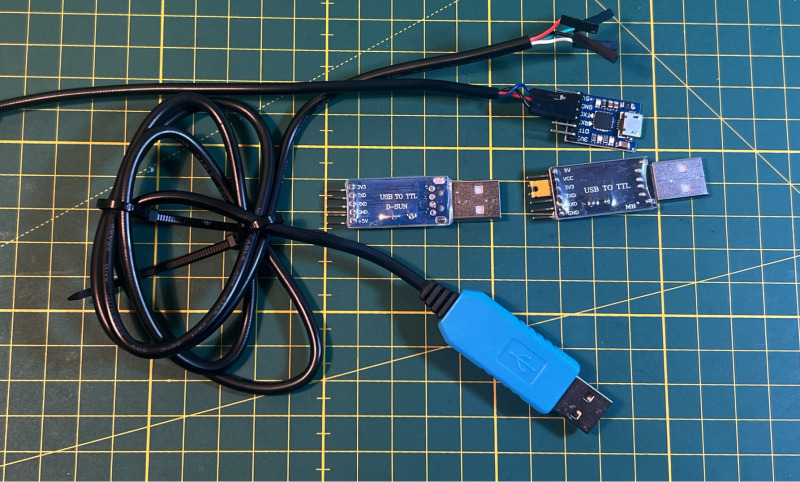
Gordian knot, 21st century edition, and some USB to TTL adapters

But we’re no average customers, are we? No, we unceremoniously keep a strand of unprotected Dupont-style breadboard jumper cables connected to these three UART TTL pins, dangling out through a little hole we drilled in the device enclosure. Because — duh — you never know when you’re going to need to connect to them again, right?

This is not only unseemly, it is also neither reliable nor safe. These wires are not meant to be bent often, which I learned the hard way in the case of my trusty NanoPi R4S, which would no longer accept inputs.

Also what do you connect the jumper cable to? Normally a USB-TTL adapter, which either comes in the cheap short and PCB-only shape or in the “keep me directly connected even if you stumble over my long cable” variant, and either way, you keep them connected because — duh — you don’t want to unnecessarily strain the Dupont wires…

Neither solution is appealing: you shouldn’t keep something permanently connected unless necessary (from my own experience, the USB adapters get back-fed some current from the RX/GND pins even when not connected on the USB end), and you shouldn’t keep a rather unprotected PCB hanging from three tiny wires. We can do better than that!
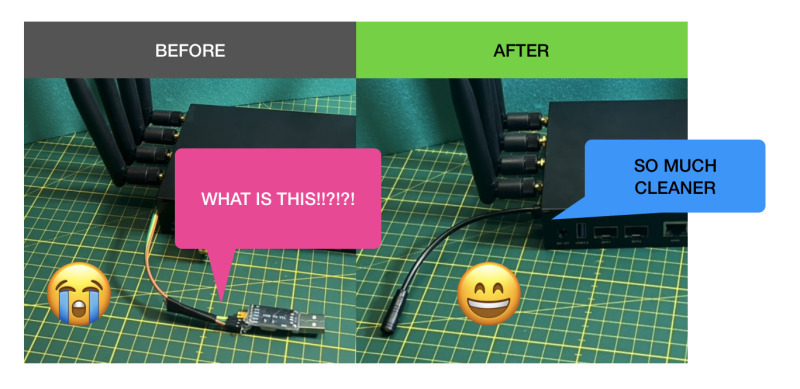
Before: TTL wires and USB serial adapter dangling out of an OpenWRT router — After: a clean, beautiful Juliet connector

I have now found my favorite solution to the problem, and I’m therefore proposing a new standard (obligatory xkcd 927 reference), which hopefully catches on: Julet connectors.
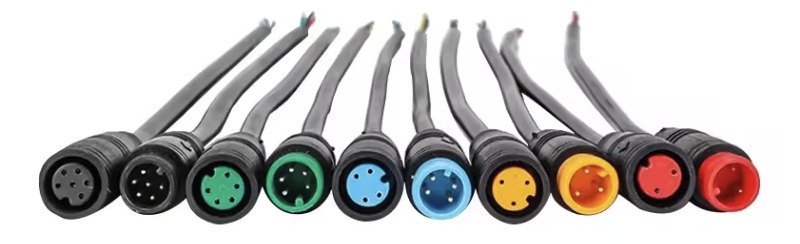
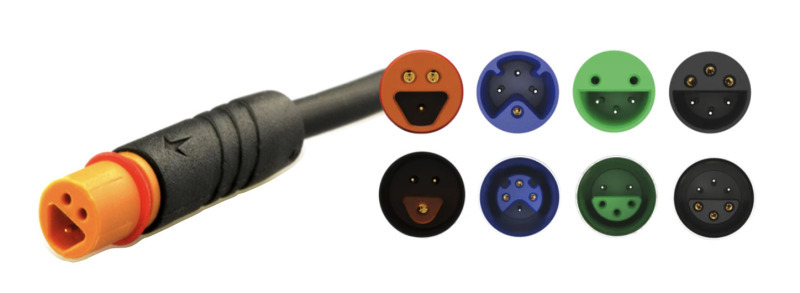
Variety of Julet connectors (source: AliExpress)

These sturdy connectors are typically used on E-Bikes, and are actually already being used for serial TTL (to configure the e-bike controller, trip computer, etc.), along with carrying 48V!

Julet cables can readily be found on places like AliExpress, commonly in sizes M6 and M8, although other sizes are available. AliExpress Wiki has a good overview page.

In a sense, they remind me of “PS/2” Mini-DIN. I guess what’s old is new. The Julet connectors come in many varieties, both in pin count, size and even shape (see the manufacturer catalog).

I’ve opted for the M6 variant, mostly because they are relatively small, cheap and readily available. The ones I ordered were actually made by yczxf; also note the similar HiGo connectors.

The yczxf cables are rated for 3A 0-24V DC and IP68, which is nice.

What is convenient is that these connectors come in ready-made 20cm pigtails, with pre-tinned wires ready for crimping, which means fully-working adapter cables can be made in a matter of minutes. For that I used the PEBA crimping pliers/Dupont/JST-XH connector toolkit available on Amazon. AliExpress also has full extension cables up to 1m long, for what it’s worth.

I found it effective (and inexpensive) to use zip ties around the cable as strain relief inside the enclosure, and optionally outside as well.
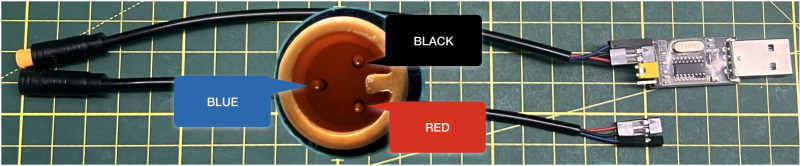
Pin to wire color mapping on the male Julet M6 3-pin connector; RX/TX/GND mapping - note the arrow on the Dupont connector

The setup is very robust and foolproof — no polarity guessing: simple plug and play.

This extends to the assembly phase, if you follow my suggestions:

In my three-pin setup, the pigtails came with wires in three colors: blue, black and red. The black and red ones correspond to the pins next to the notch (see the picture above), which is why I assign them to RX and TX, leaving the blue wire for GND (ground).

The 2-pin dupont plastic header housings in my crimping toolkit came with an embossed arrow. By my convention, this indicates the receiving pin (RX). For TTL serial communication, RX and TX must be crossed, therefore I follow this practice: Female Julet connectors (sockets), which I use on the device-end, have the red wire with the arrow. Male Julet connectors (plugs), which I use on the USB-TTL side, have the black wire with the arrow.

The ground pin (blue wire) is carried on a separate, 1-pin Dupont header. This is allows for easy switching of the RX/TX orientation without having to disassemble the plastic housing, and also makes it easier to fumble pre-assembled cables through small holes than with a single three-pin Dupont header.

For future expansion: the 5-pin (green) and 6-pin (black) Julet sockets are compatible with the 3-pin plug, which means we can have a device expose additional (passive-wire) functionality with backwards compatibility for simple USB-TTL adapters. The colors of the wires in these variants differ slightly, but with the conventions above there should be little confusion.

Notably, in my setup I assume that all connections use 3.3V signal levels. Should I ever come across 5V signals, I would probably use a larger Julet M8 for differentiation. OpenWrt writes that some routers already ship with incompatible 1.8V or 2.5V logic. Should the time arrive that I need to work with those, I would probably use this little fella called Micro Q:
HG-F.S-Z*06Q-B , that's a mouthful (source: HiGo)

There you have it. So much cleaner 😄