


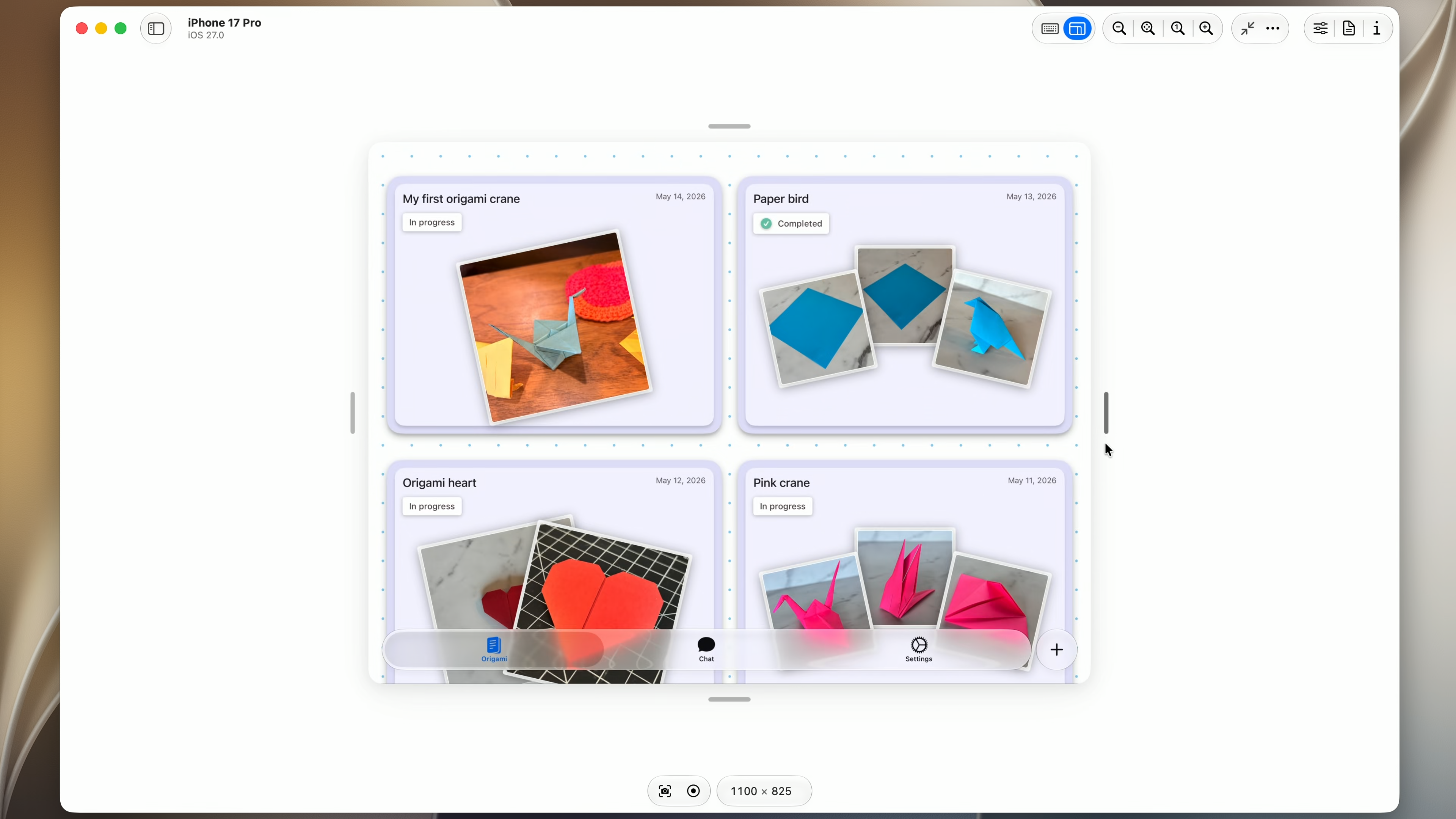
The sample app at this year’s Platform State of the Union was a place to relax. An origami app. A place, as Maribeth from the Foundation Models team put it, “to unwind and get creative with paper.” The demo involved generating paper craft projects from photos and producing step-by-step folding tutorials. The whole thing was warm and unhurried and thoroughly charming. It was also, almost certainly, not chosen by accident.
The art of the fold.
At the same time those demos were being presented, developers with access to the iOS 27 beta were already looking elsewhere. Sam Gold, a developer who reads Apple’s framework strings, found two terms that had not appeared in iOS 26: foldState and angleDegrees. A third discovery was arguably more specific: a new system key that returns the total count of built-in displays on a device. On every iPhone Apple has ever shipped, that number is one. An API that queries whether the answer might be something other than one has a fairly obvious use case.
In the Platform State of the Union, the resizability push was also unusually insistent. Apple announced that iOS apps will now support resizing in iPhone Mirroring on Mac, and for the first time, the mirrored window can be extended horizontally, stretching to a landscape aspect ratio that no current iPhone produces natively. The Resizable iOS Simulator was introduced, allowing developers to test layouts across what Apple described as “a dynamic range of sizes and aspect ratios.” The phrase “design for a dynamic range of sizes and aspect ratios” appeared more than once in the session.
On the other side of the pond, Android foldable owners have spent seven years discovering which of their apps work and which ones don’t. That is not an experience Apple intends to repeat. In Apple’s turf, it is building the requirement into how developers work before the device exists. This is the PSOTU’s message, which states clearly and plainly: stop thinking about creating software for a specific piece of hardware. Design software to be adaptable across a range of screen sizes and aspect ratios. It is doing what it does best, which is leveraging the period between announcing and shipping the device to prepare the whole developer community for it.
The hardware picture has been clear for months. The iPhone Ultra, the apparent name for this new form factor iPhone, is a book-style foldable, reportedly featuring a 7.7- to 7.8-inch inner display and a 5.3- to 5.5-inch cover screen, unfolding to a 4:3 ratio closer to an iPad mini than a widescreen display. Starting price reportedly around $2,000. Announced alongside the iPhone 18 Pro in September, with production at Foxconn targeting a July mass production ramp. John Ternus, who takes the CEO chair on September 1, will walk out and present it as his first major act in the role. He oversaw its development. He is, in that sense, both the new CEO and the device’s architect.
The paper craft demo at the State of the Union ended with a tutorial. The app walked users through each step: crease, fold, shape. There is something almost too neat about choosing that as the year’s sample app. Apple showed developers how to handle a fold, then shipped the code to prove it was real, then asked every developer in the ecosystem to redesign their apps for a surface that changes shape. Smart play.