


copy markdown
tl;dr: Interfaze is a new model architecture that outperforms models like Gemini-3-Flash, Claude-Sonnet-4.6, GPT-5.4-Mini, and Grok-4.3 across 9 head-to-head benchmarks in OCR, vision, STT, and structured output.
Humans are inefficient at computer-level tasks. We make mistakes, but we're great at decision-making and understanding nuance.
Imagine telling a human to read a 50-page PDF, map every word to another document with its XY position, and translate the whole thing into Chinese. You'd get tons of mistakes, pay a lot to keep that human on payroll, and wait a long time for the result.
Transformer models are similar. They're amazing at nuance and human-level tasks, and they make mistakes like a human, but that's also what keeps them creative.
We've been using the wrong models for the wrong tasks.
CNNs/DNNs have existed since the early 90s, from LeNet-5 to ResNet, and more recently CRNN-CTC.
These are deep neural network architectures that are task-specific for things like OCR, translation, or GUI detection. The way they consume and see data is trained to be task specific, which makes them up to 100x more accurate at their specific task. They also produce useful metadata like bounding boxes and confidence scores, letting developers build predictable workflows they can rely on.
So why do so many of us still go for transformers/LLMs for deterministic tasks?
DNNs are not flexible. They're only as good as their training data, and they aren't great at human-level nuance.
They might be cheap to serve but expensive to maintain and retrain for new tasks. Take a passport: a CNN can extract the date of birth with bounding boxes and a confidence score, but it can't calculate the person's age.
A new model architecture that merges the specialization of DNN/CNN models with omni-transformers, giving you the best of both worlds.

That means high accuracy and low cost on deterministic tasks:
| Feature | Value |
|---|---|
| Context window | 1M tokens |
| Max output tokens | 32k tokens |
| Input modalities | Text, Images, Audio, File |
| Reasoning | Available (default: disabled) |
While Pro tier models like Claude Opus 4.7 and GPT 5.5 are the best generalist models in the market today for things like coding and complex reasoning tasks, they aren't commonly used for high volume tasks like OCR or translation due to high cost and slow response times.
Interfaze is benchmarked against models in similar pricing tiers and feature sets that are optimized to squeeze the most performance out of the model at the fastest speed, while keeping cost low at scale.
Today, most people reach for two model categories for deterministic developer tasks:
| Benchmark | Interfaze | Gemini-3-Flash | Claude-Sonnet-4.6 | GPT-5.4-Mini | Grok-4.3 |
|---|---|---|---|---|---|
| OCRBench V2 | 70.7% | 55.8% | 54.7% | 52.7% | 54.7% |
| olmOCR | 85.7% | 75.3% | 73.9% | 80.1% | 81.9% |
| RefCOCO | 82.1% | 75.2% | 75.5% | 67.0% | 25.0% |
| VoxPopuli (WER) ↓ | 2.4% | 4.0% | — | — | — |
| Spider 2.0-Lite | 52.9% | 45.2% | 49.6% | 26.7% | 45.9% |
| GPQA Diamond | 89.9% | 88.5% | 89.9% | 82.8% | 73.6% |
| MMMLU | 90.9% | 88.7% | 84.9% | 75.3% | 89.7% |
| MMMU-Pro | 71.1% | 67.6% | 46.3% | 40.4% | 68.7% |
| SOB Value Acc | 79.5% | 77.3% | 77.9% | 75.1% | 78.4% |
↓ = lower is better (word error rate). — = not scored (model has no native audio input). All other rows: higher is better.
Each model is compared head-to-head across nine benchmarks: OCRBench V2, olmOCR, RefCOCO, VoxPopuli-Cleaned-AA, SOB Value, Spider-2.0-Lite, GPQA Diamond, MMMLU, and MMMU-Pro.
Interfaze leads in almost every benchmark, against both specialized models in each category and the generalist flash/mini models.
Our goal isn't to replace LLMs. It's to specialize in deterministic tasks. The benchmarks focus on categories like OCR, object detection, and structured output, with a few general benchmarks like GPQA Diamond to show the level of problem-solving and understanding you'd expect from any transformer model.
Interfaze is priced in a similar range as Gemini-3-Flash, at $1.50 per million input tokens and $3.50 per million output tokens.
Our number one use case from users has been OCR for images and complex, long PDFs.
Interfaze outperforms OCR providers like Chandra OCR and Reducto, and generalist models like Gemini-3-Flash and GPT-5.4-Mini.
It isn't just the task-specific CNN encoder doing a good job. It's the ability to lean on object detection for figures and graphics, or lean on the translation layers of the transformer all in a shared vector space.
Most LLMs today are great at following a JSON schema, but pretty bad at filling it with accurate values. No public benchmark measures the accuracy of those values, so we released SOB (the Structured Output Benchmark) last week.
TL;DR: SOB gives the model the correct answer in its context, then asks it to generate a JSON output with data it already has. We measure who is the most accurate, with the fewest mistakes and hallucinations, across text, image, and audio modalities (all normalized to text).
Compared against the same flash/mini set used throughout this post. See the full SOB leaderboard for all 28 models, including frontier Pro-tier models like Gemini-3.1-Pro, GPT-5.5, and Claude-Opus-4.7.
There's still huge room for improving structured output without raising cost or compute. Follow us on X or LinkedIn to follow our research journey.
Interfaze has great multilingual performance across a wide range of languages.
On VoxPopuli-Cleaned-AA, Interfaze comes in second on word error rate.
Interfaze transcribes 209 seconds of audio per second of compute, ~1.5× faster than Deepgram Nova-3, ~8× faster than Scribe v2, and over 11× faster than Gemini-3-Flash.
View full VoxPopuli benchmarks →
Interfaze speaks the Chat Completions API standard, so any AI SDK that supports OpenAI works out of the box: just point it at https://api.interfaze.ai/v1. Grab your API key from the Interfaze dashboard and drop it in.
OpenAI SDK
Vercel AI SDK
LangChain SDK
import OpenAI from "openai";

const interfaze = new OpenAI({
	baseURL: "https://api.interfaze.ai/v1",
	apiKey: "<your-api-key>",
});
The same interfaze client is reused in every example below.
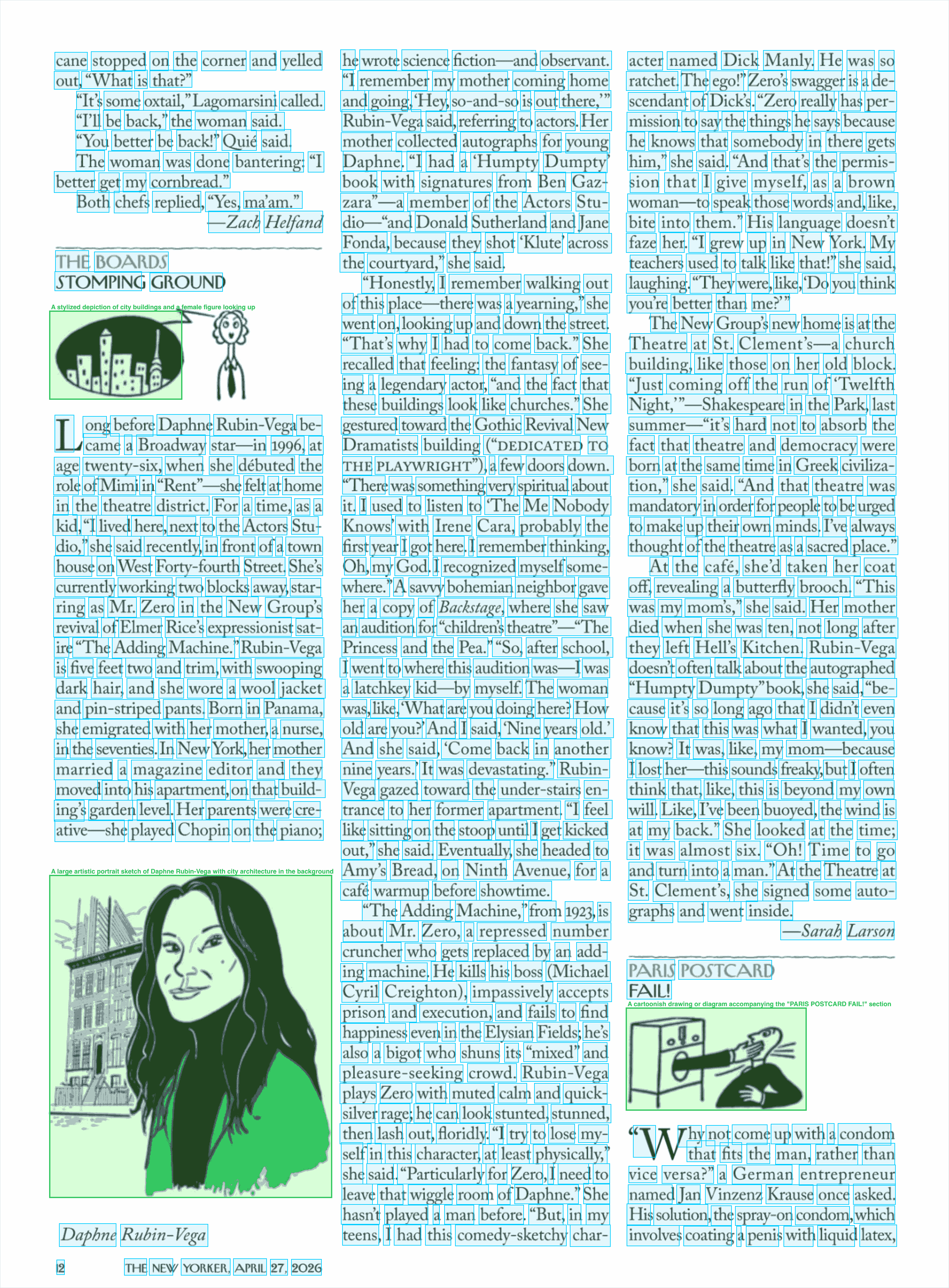
A magazine page with dense multi-column text and three illustrations. Interfaze runs OCR and object detection on the same image in one request, returning the full text plus pixel-coordinates for every figure, all under your schema.
OpenAI SDK
Vercel AI SDK
LangChain SDK
import { z } from "zod";
import { zodResponseFormat } from "openai/helpers/zod";

const OCRObjectDetectionSchema = z.object({
	text: z.string().describe("all text in the image"),
	graphic_objects: z
		.array(
			z.object({
				description: z.string(),
				top_left_x: z.number(),
				top_left_y: z.number(),
				bottom_right_x: z.number(),
				bottom_right_y: z.number(),
			})
		)
		.describe("graphics objects found in the image"),
});

const response = await interfaze.chat.completions.create({
	model: "interfaze-beta",
	messages: [
		{
			role: "user",
			content: [
				{ type: "text", text: "Extract the text and graphics from the image based on the schema." },
				{
					type: "image_url",
					image_url: {
						url: "https://r2public.jigsawstack.com/interfaze/examples/dense_text_ocr_figures.png",
					},
				},
			],
		},
	],
	response_format: zodResponseFormat(OCRObjectDetectionSchema, "ocr_object_detection_schema"),
});

console.log(response.choices[0].message.content);

//@ts-expect-error precontext is not typed
const precontext = response.precontext;
console.log("OCR bounding boxes + confidence:", precontext[0]?.result);
JSON output
object carries the schema response: full page text plus a graphic_objects array with a description and pixel coordinates for each illustration. precontext carries the raw OCR (per-line and per-word bounding boxes, confidence scores) on the same response.
{
  "object": {
    "text": "cane stopped on the corner and yelled... acter named Dick Manly. He was so observant... STOMPING GROUND ... \"The Adding Machine,\" from 1923, is about Mr. Zero, a repressed number cruncher who gets replaced by an adding machine... 12 THE NEW YORKER, APRIL 27, 2026",
    "graphic_objects": [
      {
        "description": "A drawing located at the top left under the \"STOMPING GROUND\" heading, featuring a cityscape with a moon and a whimsical character.",
        "top_left_x": 84,
        "top_left_y": 484,
        "bottom_right_x": 394,
        "bottom_right_y": 630
      },
      {
        "description": "A detailed line drawing of Daphne Rubin-Vega in front of a building facade, matching the main profile story.",
        "top_left_x": 77,
        "top_left_y": 1367,
        "bottom_right_x": 517,
        "bottom_right_y": 1878
      },
      {
        "description": "A drawing in the bottom right corner depicting a person interacting with a device, situated above the spray-on condom text.",
        "top_left_x": 985,
        "top_left_y": 1581,
        "bottom_right_x": 1264,
        "bottom_right_y": 1737
      }
    ]
  },
  "precontext": [
    {
      "name": "ocr",
      "result": {
        "extracted_text": "cane stopped on the corner and yelled he wrote science fiction-and observant. acter named Dick Manly. He was so\nout, \"What is that?\" \"I remember my mother coming home...",
        "sections": [
          {
            "lines": [
              {
                "text": "cane stopped on the corner and yelled he wrote science fiction-and observant. acter named Dick Manly. He was so",
                "bounds": {
                  "top_left": { "x": 83, "y": 80 },
                  "top_right": { "x": 1406, "y": 78 },
                  "bottom_right": { "x": 1406, "y": 111 },
                  "bottom_left": { "x": 83, "y": 110 },
                  "width": 1323,
                  "height": 30
                },
                "average_confidence": 0.99
              }
              // ... hundreds more lines with per-word boxes and confidences
            ]
          }
        ]
      }
    }
  ]
}With our hybrid architecture, you can activate parts of the model to run a specific task without using the full weights.
It's faster and cheaper, with some tradeoffs, you get a fixed structured output that's deterministic and consistent on every run, and you can only run one task per request.
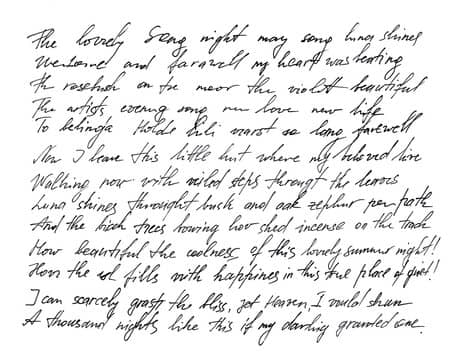
Using the <task> tag in the system prompt, you control which part of the model activates. Below, we run pure OCR on a handwritten poem.
OpenAI SDK
Vercel AI SDK
LangChain SDK
import { z } from "zod";
import { zodResponseFormat } from "openai/helpers/zod";

const response = await interfaze.chat.completions.create({
	model: "interfaze-beta",
	messages: [
		{ role: "system", content: "<task>ocr</task>" },
		{
			role: "user",
			content: [
				{ type: "text", text: "Extract all text from this image" },
				{
					type: "image_url",
					image_url: {
						url: "https://r2public.jigsawstack.com/interfaze/examples/handwriting.jpeg",
					},
				},
			],
		},
	],
	response_format: zodResponseFormat(z.any(), "empty_schema"),
});

console.log(response.choices[0].message.content);
JSON output
The response is the raw task result with name and result, ready to consume directly.
{
  "name": "ocr",
  "result": {
    "extracted_text": "The lovely Song night may song linen shined\nWelcome and faint wei my heart was beating\nthe reseach on the moon the violet beautifull\nThe artist's evening song our love new life\n...",
    "sections": [
      {
        "lines": [
          {
            "text": "The lovely Song night may song linen shined",
            "bounds": {
              "top_left": { "x": 27, "y": 22 },
              "top_right": { "x": 422, "y": 21 },
              "bottom_right": { "x": 423, "y": 47 },
              "bottom_left": { "x": 27, "y": 51 },
              "width": 395.5,
              "height": 27.5
            },
            "average_confidence": 0.78
          }
          // ... more lines with per-word boxes and confidences
        ]
      }
    ]
  }
}
Learn more about running tasks →
Interfaze comes built in with its own web index from scraping multiple SERP indexes and our own crawler.
OpenAI SDK
Vercel AI SDK
LangChain SDK
import { z } from "zod";
import { zodResponseFormat } from "openai/helpers/zod";

const GarryTanSchema = z.object({
	linkedin_url: z.string(),
	x_url: z.string(),
	first_name: z.string(),
	last_name: z.string(),
	location: z.string(),
	latest_education: z.string(),
	current_job: z.string(),
	followers: z.number(),
	experience: z.array(
		z.object({
			company: z.string(),
			title: z.string(),
			start_date: z.string(),
			end_date: z.string(),
		})
	),
});

const response = await interfaze.chat.completions.create({
	model: "interfaze-beta",
	messages: [{ role: "user", content: "Enrichment information of Garry Tan, Y Combinator" }],
	response_format: zodResponseFormat(GarryTanSchema, "garry_tan_enrichment_schema"),
});

console.log(response.choices[0].message.content);

//@ts-expect-error precontext is not typed
const precontext = response.precontext;
console.log("Web search results:", precontext[0]?.result);
JSON output
object returns the enriched profile typed exactly to the schema, while precontext includes the raw web search results Interfaze pulled in to ground the answer.
{
  "object": {
    "linkedin_url": "https://linkedin.com/in/garrytan",
    "x_url": "https://x.com/garrytan",
    "first_name": "Garry",
    "last_name": "Tan",
    "location": "San Francisco, California, United States",
    "latest_education": "Stanford University (1999-2003), BS in Computer Systems Engineering",
    "current_job": "President & CEO at Y Combinator, Founder at Garry's List, Board Partner & Advisor at Initialized Capital",
    "followers": 319863,
    "experience": [
      {
        "company": "Garry's List",
        "title": "Founder",
        "start_date": "Jan 2026",
        "end_date": "Present"
      },
      {
        "company": "Y Combinator",
        "title": "President & CEO",
        "start_date": "Jan 2023",
        "end_date": "Present"
      },
      {
        "company": "Initialized Capital",
        "title": "Founder & Managing Partner",
        "start_date": "Jan 2012",
        "end_date": "Dec 2022"
      },
      {
        "company": "Posterous.com",
        "title": "Cofounder",
        "start_date": "Jan 2008",
        "end_date": "Jan 2011"
      },
      {
        "company": "Palantir Technologies",
        "title": "Lead Engineer, Designer",
        "start_date": "Sep 2005",
        "end_date": "Oct 2007"
      }
      // ... more roles
    ]
  },
  "precontext": [
    {
      "name": "search",
      "result": [
        {
          "title": "Garry Tan - President & CEO, Y Combinator - LinkedIn",
          "description": "President & CEO of Y Combinator. Y Combinator funds hundreds of companies per year...",
          "url": "https://www.linkedin.com/in/garrytan"
        }
        // ... more search results
      ]
    }
  ]
}The clip below is 1 hour 35 minutes of a podcast episode. Interfaze transcribes it in ~50 seconds with per-chunk timestamps.
OpenAI SDK
Vercel AI SDK
LangChain SDK
import { z } from "zod";
import { zodResponseFormat } from "openai/helpers/zod";

const response = await interfaze.chat.completions.create({
	model: "interfaze-beta",
	messages: [
		{ role: "system", content: "<task>speech_to_text</task>" },
		{
			role: "user",
			content: [
				{ type: "text", text: "Transcribe the audio file https://r2public.jigsawstack.com/interfaze/examples/stt_long_audio_sample_3.mp3" },
			],
		},
	],
	response_format: zodResponseFormat(z.any(), "empty_schema"),
});

console.log(response.choices[0].message.content);
JSON output
The response is the raw task result as shown below.
{
  "name": "speech_to_text",
  "result": {
    "text": "We don't teach leaders how to have uncomfortable conversations. We don't teach students how to have uncomfortable conversations. You tell me which is going to be more valuable for the rest of your life. How to have a difficult conversation or trigonometry?...",
    "chunks": [
      { "timestamp": [0, 3.39], "text": "We don't teach leaders how to have uncomfortable conversations. We don't teach students how" },
      { "timestamp": [3.39, 6.79], "text": "to have uncomfortable conversations. You tell me which is going to be more valuable" },
      { "timestamp": [6.79, 10.18], "text": "for the rest of your life. How to have a difficult conversation or trigonometry?" }
      // ... thousands more timestamped chunks across the full 1h 35m
    ]
  }
}We're excited to keep experimenting, growing and discovering new research that makes deterministic AI more efficient and accessible to all developers!
Get started for free and try it on your own documents, images and prompts. We're excited to see what you build!
此内容由惯性聚合(RSS阅读器)自动聚合整理,仅供阅读参考。 原文来自 — 版权归原作者所有。