

惯性聚合 高效追踪和阅读你感兴趣的博客、新闻、科技资讯
阅读原文 在惯性聚合中打开

推荐订阅源

Forbes - Security
Forbes - Security
H
Hackread – Cybersecurity News, Data Breaches, AI and More
N
Netflix TechBlog - Medium
Engineering at Meta
Engineering at Meta
CTFtime.org: upcoming CTF events
F
Fortinet All Blogs
P
Privacy & Cybersecurity Law Blog
The Hacker News
The Hacker News
博客园 - 司徒正美
博客园 - 聂微东
T
The Blog of Author Tim Ferriss
I
Intezer
WordPress大学
WordPress大学
Security Archives - TechRepublic
Scott Helme
Scott Helme
T
Threat Research - Cisco Blogs
T
Tailwind CSS Blog
月光博客
月光博客
Recent Announcements
博客园 - 叶小钗
J
Java Code Geeks
cs.CL updates on arXiv.org
L
LINUX DO - 热门话题
Google DeepMind News
C
Cyber Attacks, Cyber Crime and Cyber Security
cs.AI updates on arXiv.org
N
News and Events Feed by Topic
A
Arctic Wolf
B
Blog RSS Feed
Recorded Future
Recorded Future
D
DataBreaches.Net
有赞技术团队
有赞技术团队
Project Zero
Project Zero
U
Unit 42
T
Tor Project blog
The GitHub Blog
The GitHub Blog
Hacker News - Newest:
Hacker News - Newest: "LLM"
C
CERT Recently Published Vulnerability Notes
博客园 - Franky
博客园 - 【当耐特】
Microsoft Security Blog
C
Cybersecurity and Infrastructure Security Agency CISA
Security Latest
Security Latest
C
Cisco Blogs
Threat Intelligence Blog | Flashpoint
Blog — PlanetScale
Blog — PlanetScale
H
Heimdal Security Blog
Vercel News
Vercel News
Stack Overflow Blog
Stack Overflow Blog
S
Securelist

Hacker News

Introducing Claude Opus 4.7 Qwen Studio The Future of Everything is Lies, I Guess: Where Do We Go From Here? GitHub - SeanFDZ/macmind: Single-layer transformer in HyperTalk for the classic Macintosh Show HN: Agent-cache – Multi-tier LLM/tool/session caching for Valkey and Redis Bonsai 1-bit WebGPU - a Hugging Face Space by webml-community Moving a large-scale metrics pipeline from StatsD to OpenTelemetry / Prometheus GitHub - Nightmare-Eclipse/RedSun: The Red Sun vulnerability repository GitHub - SethPyle376/hiraeth: Local AWS emulator focused on fast integration testing, with SQS support, SQLite-backed state, and a debug-friendly web UI. GitHub - macOS26/Agent: Any AI, replaces Claude Code, Cursor, OpenClaw. Over 18 LLM providers (Claude, OpenAI, Gemini, Ollama, Zai, HF, Qwen) wired into a native Mac app that writes code, builds Xcode projects, bumps versions, manages git, automates Safari, use AppleScript, JS or Accessibility, extend Agent! w/ MCP Servers, run tasks from your iPhone via Messages. YouTube now lets you turn off Shorts I Made a Terminal Pager Burgers | マクドナルド公式 Commands — HackerNews CLI documentation ChatGPT for Excel PiCore - Raspberry Pi Port of Tiny Core Linux Live Nation illegally monopolized ticketing market, jury finds Google Broke Its Promise to Me. Now ICE Has My Data. Founding Engineer at Adaptional | Y Combinator CRISPR takes important step toward silencing Down syndrome’s extra chromosome GitHub - saffron-health/libretto: The AI toolkit for building reliable browser automations US v. Heppner (S.D.N.Y. 2026) no attorney-client privilege for AI chats [pdf] Retrofitting JIT Compilers into C Interpreters IPv6 – Google The Accursèd Alphabetical Clock Cybersecurity Looks Like Proof of Work Now Fragments: April 14 Cal.com Goes Closed Source: Why AI Security Is Forcing Our Decision | Cal.com - Scheduling Software for Online Bookings Laravel raised money and now injects ads directly into your agent When moving fast, talking is the first thing to break Too much Discussion of the XOR swap trick – Heather Cafe Introduction to Spherical Harmonics for Graphics Programmers The Grand Line Building a Z-Machine in the worst possible language High-Level Rust: Getting 80% of the Benefits with 20% of the Pain GitHub - duguyue100/midnight-captain: Inspired by Midnight Commander, tailored to my taste. How to build a `git diff` driver · Jamie Tanna | Software Engineer Center for Responsible, Decentralized Intelligence at Berkeley The Local Universe’s Expansion Rate Is Clearer Than Ever, but Still Doesn’t Add Up - A new synthesis of astronomical measurements confirms a persistent mismatch that could point to physics beyond current models The air throughout our homes is infused with microplastics. But there are things you can do to breathe less of them The disturbing white paper Red Hat is trying to erase from the internet – OSnews The Future of Everything is Lies, I Guess: Annoyances ‘Abhorrent’: the inside story of the Polymarket gamblers betting millions on war Productive procrastination — Max van IJsselmuiden maps, territory and LMs 447 Terabytes per Square Centimetre at Zero Retention Energy: Non-Volatile Memory at the Atomic Scale on Fluorographane Show HN: Pardonned.com – A searchable database of US Pardons 20 Years on AWS and Never Not My Job The Seasons are Wrong Artemis II crew splashes down near San Diego after historic moon mission We gave an AI a 3 year retail lease in SF and asked it to make a profit | Andon Labs How a dancer with ALS used brainwaves to perform live On filing the corners off my MacBooks Installing every* Firefox extension OpenClaw’s memory is unreliable, and you don’t know when it will break Steve Blank Nowhere Is Safe Chimpanzees in Uganda locked in vicious 'civil war', say researchers watgo - a WebAssembly Toolkit for Go linux/Documentation/process/coding-assistants.rst at master · torvalds/linux GitHub - callumlocke/json-formatter: Makes JSON easy to read. Founding Product Engineer at Bild AI | Y Combinator A compelling title that is cryptic enough to get you to take action on it GitHub - Keychron/Keychron-Keyboards-Hardware-Design: Industrial design files for Keychron keyboards and mice. 100+ models with CAD assets in STEP, DXF, DWG, and PDF. Source-available, with commercial use allowed for original compatible accessories within the license terms. [ANNOUNCE] WireGuardNT v0.11 and WireGuard for Windows v0.6 Released 1D-Chess Helium Is Hard to Replace Cooperative Vectors Introduction | Evolve Keeping a Postgres queue healthy — PlanetScale Our response to the Axios developer tool compromise Do Americans read print books, e-books or audiobooks more? The Zettelkasten Method in Obsidian: A Practical Setup Guide Artemis II Is Competency Porn and We Are Starving For It WeakC4 Flight Viz — Cockpit View A Mexican surveillance giant you’ve never heard of is now watching the U.S. border Surelock: Deadlock-Free Mutexes for Rust RISC-V 101 – what is it and what does it mean for Canonical? | Ubuntu The Problem That Built an Industry How Much Linear Memory Access Is Enough? | Solidean Investigating Split Locks on x86-64 Simplest hash functions Sybilproof reputation mechanisms (2005) [pdf] What is a property? How Complex is my Code? Static code analysis in Kotlin — tools overview Toffoli gates are all you need PGLite evangelism dcmake: a new CMake debugger UI Clojure on Fennel part one: Persistent Data Structures Fragments: April 2 Python Release Python install manager 26.1 The Life and Death of the Book Review - Liberties Introducing Database Traffic Control — PlanetScale Bitcoin miners are losing $19,000 on every BTC produced as difficulty drops 7.8% God sleeps in the minerals Building slogbox Apple Silicon and Virtual Machines: Beating the 2 VM Limit Who was “Not Even Wrong” first? Pokemon Evolution Vs Darwinian Evolution The APL Programming Language Source Code
Any Color You Like: NIST Scientists Create ‘Any Wavelength’ Lasers in Tiny Circuits for Light
2026-04-19 · via Hacker News

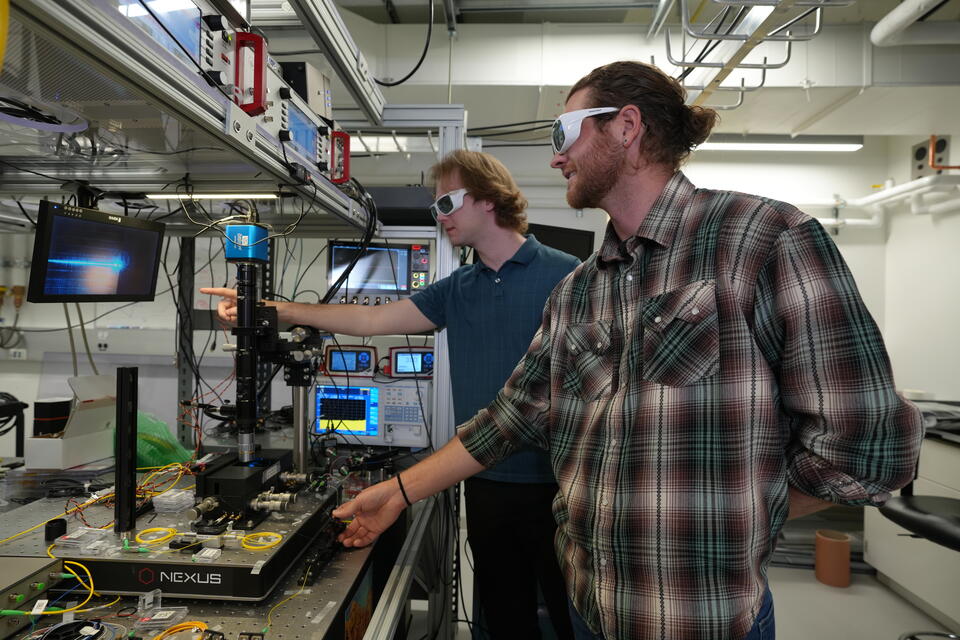
Two male researchers in casual clothes and protective eyewear stand in the lab, pointing at a screen hooked up to a laser science instrument.

Lindell Williams (left) and Grant Brodnik align an optical fiber with the edge of an integrated photonics chip. Optical fibers act as pipes for light, enabling the light generated on these chips to be collected and routed off the chip for use in experiments and applications.

Credit: R. Jacobson/NIST

Computer chips that cram billions of electronic devices into a few square inches have powered the digital economy and transformed the world. Scientists may be on the cusp of launching a similar technological revolution — this time using light.

In a significant advance toward that goal, National Institute of Standards and Technology (NIST) scientists and collaborators have pioneered a way to make integrated circuits for light by depositing complex patterns of specialized materials onto silicon wafers. These so-called photonics chips use optical devices such as lasers, waveguides, filters and switches to shuttle light around and process information. The new advance could provide a big boost for emerging technologies such as artificial intelligence, quantum computers and optical atomic clocks.

Making circuitry for light as powerful and ubiquitous as circuitry for electrons is one of today’s technological frontiers, says Scott Papp, a NIST physicist whose group led the research, published this week in Nature. “We’re learning to make complex circuits with many functions, cutting across many application areas.”

Light Speed

When it comes to information transfer and processing, light can do things that electricity can’t. Photons — particles of light — are far zippier than electrons at working their way through circuits.

Laser light is also essential for controlling powerful, emerging quantum technologies such as optical atomic clocks and quantum computers.

But several hurdles remain before integrated photonics can truly hit its stride. One involves lasers. High-quality, compact and efficient lasers exist in only a few wavelengths, or colors, of light. For example, semiconductor lasers are very good at generating infrared light with a wavelength of 980 nanometers, or billionths of a meter — a color just outside the range of human vision. 

Emerging technologies such as optical atomic clocks and quantum computers need laser light in many other colors as well. The lasers that produce those colors are big, costly and power-hungry, effectively confining these quantum technologies to a handful of special-purpose labs. 

By integrating lasers into circuits on chips, scientists hope to help quantum technologies become cheaper and more portable, so they can start to fulfill their vast promise.
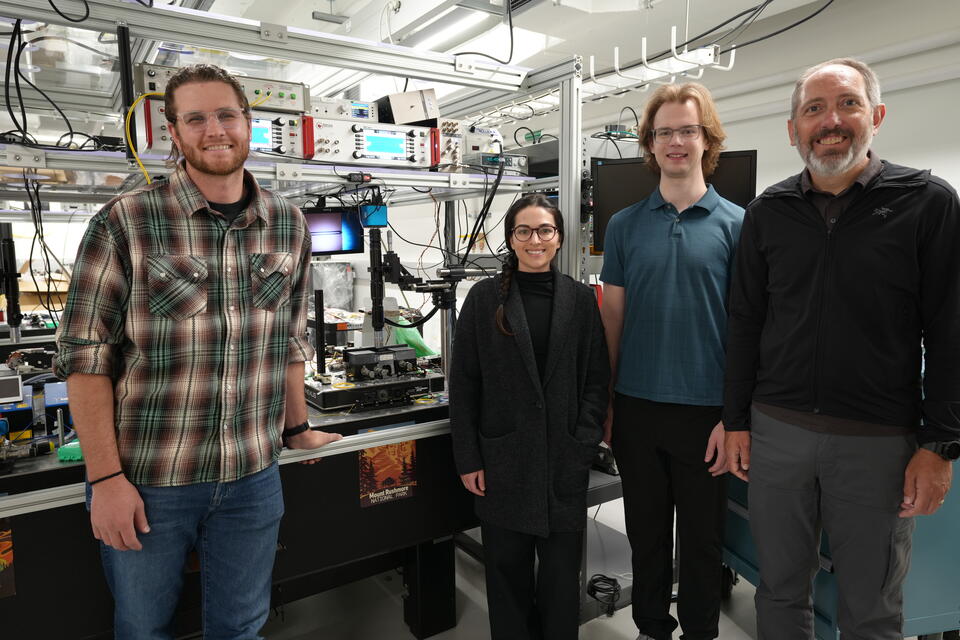
Four researchers pose smiling around a laser device on a lab table.

NIST researchers Grant Brodnik, Alexa Carollo, Lindell Williams and Scott Papp, among others, worked to make integrated circuits for light by depositing complex patterns of specialized materials onto silicon wafers. 

Credit: R. Jacobson/NIST

A Multilayered Approach

The new NIST photonics chip is a bit like a layer cake. NIST physicists Papp and Grant Brodnik, along with colleagues, started with a standard wafer of silicon coated with silicon dioxide (glass) and lithium niobate, a so-called nonlinear material that can change the color of light coming into it. 

The researchers then added pieces of metal to electrically control how the circuits convert one color of light to others. The scientists also created other metal-lithium niobate interfaces that allowed them to rapidly turn light on and off within the circuits — a crucial ability for data processing and high-speed routing.

The icing on the cake, so to speak, was a second nonlinear material called tantalum pentoxide, or tantala. Tantala can transform light in ways that feel like magic, taking in a single laser color and putting out the full rainbow of visible light colors plus a wide range of infrared wavelengths. Papp and colleagues have spent years developing techniques to fabricate circuits out of tantala without heating it up, allowing the material to be deposited onto other materials without damaging them. 
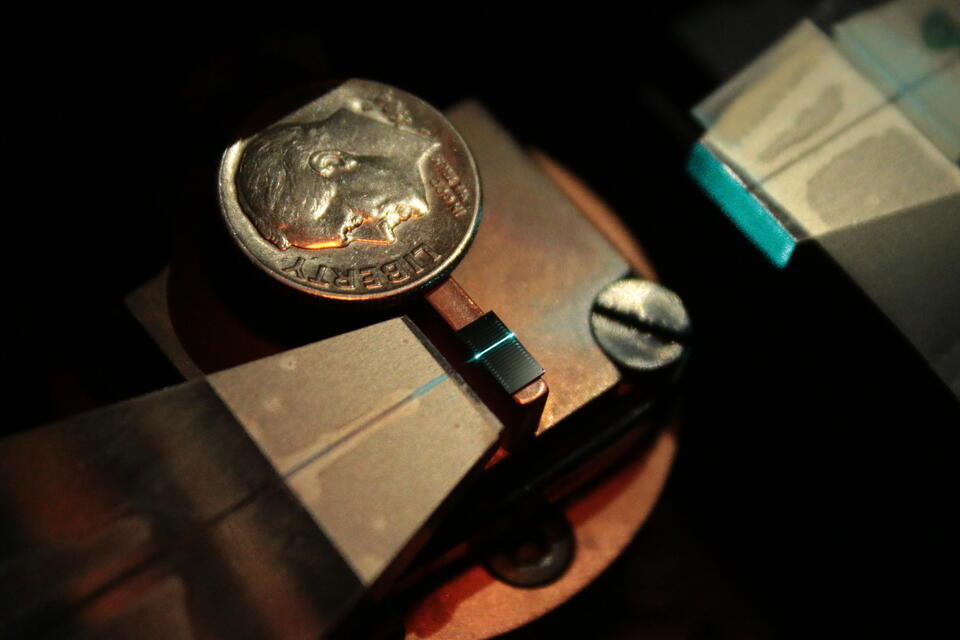
A dime for scale rests on metal base with a tiny black chip showing a bright blue laser line.

This small rectangular chip has been fabricated with numerous circuits designed to change the color of laser light. In the photo, one of these circuits is shown converting invisible infrared light into visible blue light. (A dime provides a size comparison.)

Credit: R. Jacobson/NIST

By patterning the different materials on top of each other in a three-dimensional stack, the researchers produced a single chip that efficiently routes light between layers. That allowed them to merge the light-manipulating wizardry of tantala with the controllability of lithium niobate. The new technique “allows seamless integration,” says Brodnik. “The real power is that tantala can be added to existing circuitry.”

Ultimately, the researchers were able to fit roughly 50 fingernail-sized chips containing 10,000 photonic circuits, each outputting a unique color, onto a wafer roughly the size of a beer coaster. “We can create all these different colors, just by designing circuits,” says Papp.

One Chip, Many Potential Uses

Quantum technologies such as clocks and computers could be among the biggest beneficiaries of integrated photonics. These devices often use arrays of atoms to store and process information. For each type of atom, physicists need lasers tailored to the atom’s internal quantum energy levels. For example, rubidium atoms, commonly used in quantum computers and clocks, respond to red light with a wavelength of 780 nanometers. Strontium atoms, another popular choice, “see” blue light at 461 nanometers. Shine other colors on the atoms and nothing happens.

The bulky, costly and complicated lasers needed to produce these bespoke colors have been a major hindrance to getting quantum computers and optical clocks out of the lab and into the field, where they could have big impacts. Cheap, low-power, portable optical clocks, for example, could help predict volcanic eruptions and earthquakes, offer an alternative to GPS for positioning and navigation, and help scientists investigate scientific mysteries such as the nature of dark matter. Quantum computers could offer new ways to study the physics and chemistry of drugs and materials.

Black disk has multicolored squares and triangles on its surface.

A chip based on nonlinear optics contains lasers in several dozen colors.

Credit: S. Papp/NIST

Integrated photonic circuits aren’t just for quantum. Papp believes NIST’s photonics chips could help efficiently shuttle signals between the specialized chips used by tech firms, potentially making AI-based tools more powerful and efficient. Tech companies are also interested in using photonics to improve virtual reality displays.

While NIST’s chips aren’t yet ready for mass production, the technique used to create them provides a path forward, Papp and Brodnik say. The NIST scientists collaborated with experts at Octave Photonics, a Louisville, Colorado-based startup company founded by former NIST researchers that’s now working to scale up the technology.

“When you see the chip glowing in the lab, taking in invisible light and making all this visible light in one integrated chip — it’s obvious how many potential applications there could be,” says Papp.

Paper: Grant M. Brodnik, Grisha Spektor, Lindell M. Williams, Jizhao Zang, Alexa R. Carollo, Atasi Dan, Jennifer A. Black, David R. Carlson and Scott B. Papp. Monolithic 3D integration of tantalum pentoxide nonlinear photonics. Nature. Published online April 15, 2026. DOI: 10.1038/s41586-026-10379-w