


惯性聚合 高效追踪和阅读你感兴趣的博客、新闻、科技资讯
阅读原文 在惯性聚合中打开

推荐订阅源

N
Netflix TechBlog - Medium
V
Vulnerabilities – Threatpost
Last Week in AI
Last Week in AI
I
InfoQ
酷 壳 – CoolShell
酷 壳 – CoolShell
H
Help Net Security
D
Docker
www.infosecurity-magazine.com
B
Blog RSS Feed
Forbes - Security
Forbes - Security
Application and Cybersecurity Blog
Latest news
Latest news
S
SegmentFault 最新的问题
J
Java Code Geeks
C
CXSECURITY Database RSS Feed - CXSecurity.com
MongoDB | Blog
MongoDB | Blog
量子位
奇客Solidot–传递最新科技情报
奇客Solidot–传递最新科技情报
F
Full Disclosure
Engineering at Meta
Engineering at Meta
AWS News Blog
AWS News Blog
月光博客
月光博客
Cisco Talos Blog
Cisco Talos Blog
V
Visual Studio Blog
雷峰网
雷峰网
博客园_首页
Project Zero
Project Zero
美团技术团队
Google DeepMind News
IT之家
IT之家
P
Palo Alto Networks Blog
有赞技术团队
有赞技术团队
S
Security @ Cisco Blogs
U
Unit 42
C
Cisco Blogs
Hugging Face - Blog
Hugging Face - Blog
cs.CV updates on arXiv.org
Security Archives - TechRepublic
GbyAI
GbyAI
Stack Overflow Blog
Stack Overflow Blog
S
Schneier on Security
TaoSecurity Blog
TaoSecurity Blog
The Register - Security
WordPress大学
WordPress大学
T
Threat Research - Cisco Blogs
Threat Intelligence Blog | Flashpoint
I
Intezer
The Last Watchdog
The Last Watchdog
Cloudbric
Cloudbric
Help Net Security
Help Net Security

Hacker News

Introducing Claude Opus 4.7 Qwen Studio The Future of Everything is Lies, I Guess: Where Do We Go From Here? GitHub - SeanFDZ/macmind: Single-layer transformer in HyperTalk for the classic Macintosh Show HN: Agent-cache – Multi-tier LLM/tool/session caching for Valkey and Redis Bonsai 1-bit WebGPU - a Hugging Face Space by webml-community Moving a large-scale metrics pipeline from StatsD to OpenTelemetry / Prometheus GitHub - Nightmare-Eclipse/RedSun: The Red Sun vulnerability repository GitHub - SethPyle376/hiraeth: Local AWS emulator focused on fast integration testing, with SQS support, SQLite-backed state, and a debug-friendly web UI. GitHub - macOS26/Agent: Any AI, replaces Claude Code, Cursor, OpenClaw. Over 18 LLM providers (Claude, OpenAI, Gemini, Ollama, Zai, HF, Qwen) wired into a native Mac app that writes code, builds Xcode projects, bumps versions, manages git, automates Safari, use AppleScript, JS or Accessibility, extend Agent! w/ MCP Servers, run tasks from your iPhone via Messages. YouTube now lets you turn off Shorts I Made a Terminal Pager Burgers | マクドナルド公式 Commands — HackerNews CLI documentation ChatGPT for Excel PiCore - Raspberry Pi Port of Tiny Core Linux Live Nation illegally monopolized ticketing market, jury finds Google Broke Its Promise to Me. Now ICE Has My Data. Founding Engineer at Adaptional | Y Combinator CRISPR takes important step toward silencing Down syndrome’s extra chromosome GitHub - saffron-health/libretto: The AI toolkit for building reliable browser automations US v. Heppner (S.D.N.Y. 2026) no attorney-client privilege for AI chats [pdf] Unexpected €54k billing spike in 13 hours: Firebase browser key without API restrictions used for Gemini requests Retrofitting JIT Compilers into C Interpreters IPv6 – Google The Accursèd Alphabetical Clock Cybersecurity Looks Like Proof of Work Now Fragments: April 14 Cal.com Goes Closed Source: Why AI Security Is Forcing Our Decision | Cal.com - Scheduling Software for Online Bookings Laravel raised money and now injects ads directly into your agent When moving fast, talking is the first thing to break Too much Discussion of the XOR swap trick – Heather Cafe Introduction to Spherical Harmonics for Graphics Programmers The Grand Line Building a Z-Machine in the worst possible language GitHub - duguyue100/midnight-captain: Inspired by Midnight Commander, tailored to my taste. How to build a `git diff` driver · Jamie Tanna | Software Engineer Center for Responsible, Decentralized Intelligence at Berkeley The Local Universe’s Expansion Rate Is Clearer Than Ever, but Still Doesn’t Add Up - A new synthesis of astronomical measurements confirms a persistent mismatch that could point to physics beyond current models The air throughout our homes is infused with microplastics. But there are things you can do to breathe less of them The disturbing white paper Red Hat is trying to erase from the internet – OSnews The Future of Everything is Lies, I Guess: Annoyances ‘Abhorrent’: the inside story of the Polymarket gamblers betting millions on war Productive procrastination — Max van IJsselmuiden maps, territory and LMs 447 Terabytes per Square Centimetre at Zero Retention Energy: Non-Volatile Memory at the Atomic Scale on Fluorographane Show HN: Pardonned.com – A searchable database of US Pardons 20 Years on AWS and Never Not My Job The Seasons are Wrong Artemis II crew splashes down near San Diego after historic moon mission We gave an AI a 3 year retail lease in SF and asked it to make a profit | Andon Labs How a dancer with ALS used brainwaves to perform live On filing the corners off my MacBooks Installing every* Firefox extension OpenClaw’s memory is unreliable, and you don’t know when it will break Steve Blank Nowhere Is Safe Chimpanzees in Uganda locked in vicious 'civil war', say researchers watgo - a WebAssembly Toolkit for Go linux/Documentation/process/coding-assistants.rst at master · torvalds/linux GitHub - callumlocke/json-formatter: Makes JSON easy to read. Founding Product Engineer at Bild AI | Y Combinator A compelling title that is cryptic enough to get you to take action on it GitHub - Keychron/Keychron-Keyboards-Hardware-Design: Industrial design files for Keychron keyboards and mice. 100+ models with CAD assets in STEP, DXF, DWG, and PDF. Source-available, with commercial use allowed for original compatible accessories within the license terms. [ANNOUNCE] WireGuardNT v0.11 and WireGuard for Windows v0.6 Released 1D-Chess Helium Is Hard to Replace Cooperative Vectors Introduction | Evolve Keeping a Postgres queue healthy — PlanetScale Our response to the Axios developer tool compromise Do Americans read print books, e-books or audiobooks more? The Zettelkasten Method in Obsidian: A Practical Setup Guide Artemis II Is Competency Porn and We Are Starving For It WeakC4 Flight Viz — Cockpit View A Mexican surveillance giant you’ve never heard of is now watching the U.S. border Surelock: Deadlock-Free Mutexes for Rust RISC-V 101 – what is it and what does it mean for Canonical? | Ubuntu The Problem That Built an Industry How Much Linear Memory Access Is Enough? | Solidean Investigating Split Locks on x86-64 Simplest hash functions Sybilproof reputation mechanisms (2005) [pdf] What is a property? How Complex is my Code? Static code analysis in Kotlin — tools overview Toffoli gates are all you need PGLite evangelism dcmake: a new CMake debugger UI Clojure on Fennel part one: Persistent Data Structures Fragments: April 2 Python Release Python install manager 26.1 The Life and Death of the Book Review - Liberties Introducing Database Traffic Control — PlanetScale Bitcoin miners are losing $19,000 on every BTC produced as difficulty drops 7.8% God sleeps in the minerals Building slogbox Apple Silicon and Virtual Machines: Beating the 2 VM Limit Who was “Not Even Wrong” first? Pokemon Evolution Vs Darwinian Evolution The APL Programming Language Source Code
High-Level Rust: Getting 80% of the Benefits with 20% of the Pain
2026-04-12 · via Hacker News

DISCLOSURE: If you buy through affiliate links, I may earn a small commission. (disclosures)

I've been searching for the perfect programming language for years and my conclusion thus far is that it's missing.
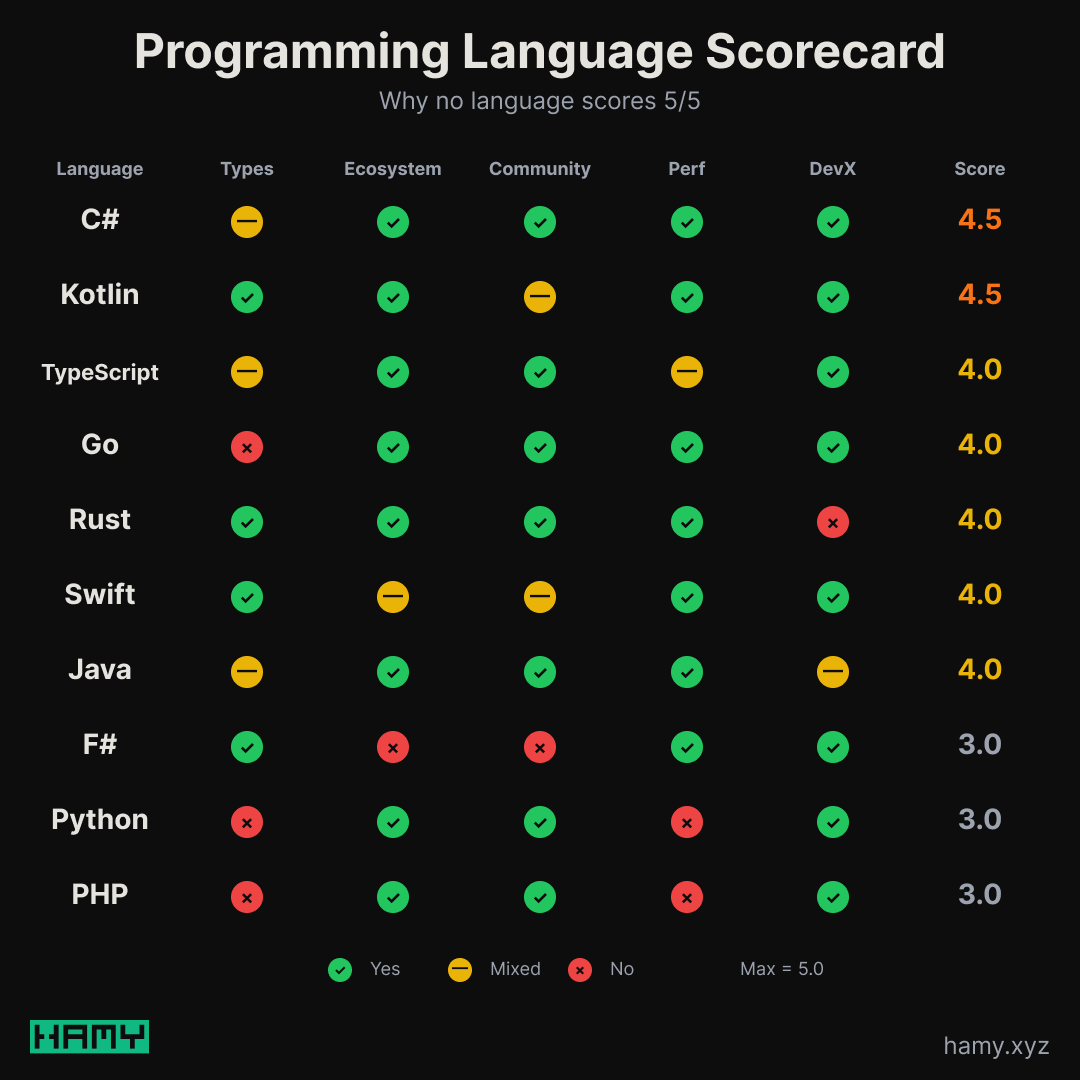
Programming Language Scores

There is no programming language that has it all:

  • Expressive types
  • Good Community
  • Good ecosystem
  • Good perf
  • Good devx

Several get close, but they're all missing something.

For the past couple years, my languages of choice have been F#, TypeScript, and C#. They are all solid languages but I always felt like I was settling in some dimension.

  • F# - Has great types and bones but I think the syntax is too minimal to be readable, the ecosystem is tiny with many abandoned packages or you build wrappers to interop with C#, and AIs aren't very good at idiomatic F# because there's so little training data and is overshadowed by OO C#.
  • TypeScript - Is ubiquitious with the biggest ecosystem in the world but the types are lies and the ecosystem is constantly undergoing largescale thrash
  • C# - Is a solid OO language but it's full of boilerplate and has yet to get native unions and exhaustive pattern matching (maybe this year?).

Related: 7 Reasons F# Sucks

So I found myself bouncing back and forth year after year and bending each language further towards what I wanted:

They all got closer but just weren't quite there.

Rust is perfect, except for the productivity

I've known about Rust for a long time but have only seriously considered it a few times and never really built anything with it - largely because I didn't think the learning curve was worth the gains. After all I'm not a systems-level programmer, so why use a systems-level language?

But it's popular at Recurse Center where I've spent the last several weeks building stuff and someone mentioned that Rust was a good language even if you just chose it for the types. That was interesting to me because I often do choose the language for its types (its one of the biggest differentiators) and then hope that there's an ecosystem to support it.

So I went and researched / reported on the missing language and sure enough Rust is a strong contender - except for its devx.

But I got to thinking - with AI so good at writing standard code, is this learning curve now much lower? Can we move about as fast with Rust as we would another language? And if we could do that, what would we gain?

The Pros and Cons of Rust

The pros and cons of Rust basically shake out to:

Pros:

  • Fast - Approaching C which is about as fast as you can get in a readable language
  • Great types - truly expressive (see: my definition of expressive types)
  • Runs ~anywhere - Is so low level it can plug into most things
  • Large and growing ecosystem - ~10th in size w ~15% of devs using it and growing at ~30% per year according to Stack Overflow Dev survey 2025
  • Super stable - Goes to great lengths to have solid crates that don't break over time (though the lang has had its share of thrash like with async runtimes)

Cons:

  • Learning curve - ownership, borrowing, lifetimes, async runtimes and gotchas
  • Lower velocity - vs high level languages

So the pros are really really good. In fact, if you could remove the cons Rust looks a lot like the type of language I've been searching for.
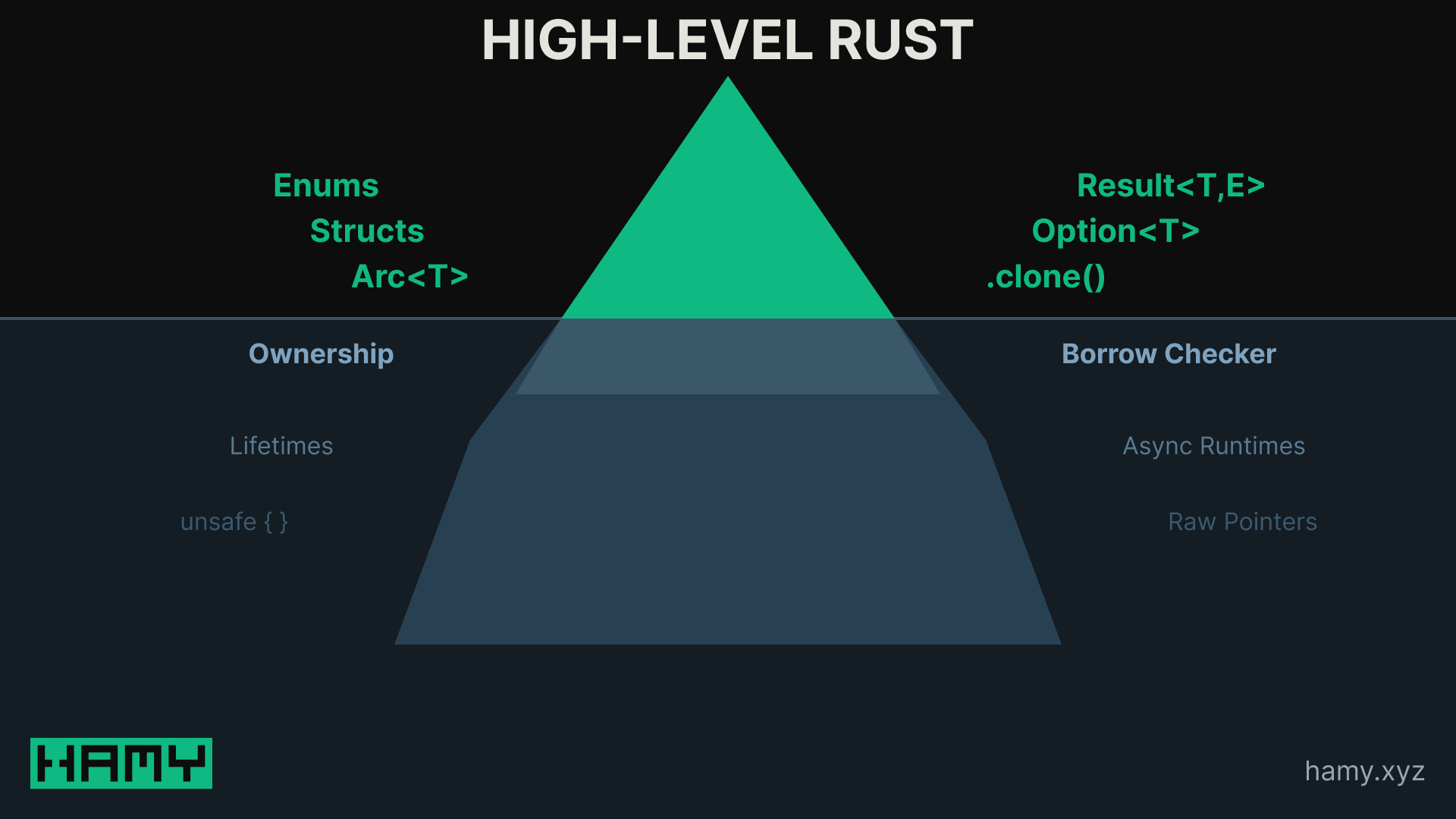
High Level Rust

High Level Rust

So I had this idea - what if you could just write Rust as a high-level language? If you can just get that devx to approach that of C#, F#, TS then you get basically all upside.

So I started doing research and reading the Rust book and building little prototypes.

What I came up with was an approach that gets us ~80% of benefits of Rust for only ~20% of the pain. And in most cases the only drawbacks are a 10-20% hit on perf which isn't that bad when we consider how fast Rust is out of the box and how it compares to other languages we'd build in the same way.

The approach is:

  • Type-first domain modeling - Use enums and structs to model your domain. Make invalid states unrepresentable.
  • Functionalish logic - This means immutable by default, pure functions, ImPureIm sandwiches, generous cloning instead of mutations. Rust's type system already pushes you towards this so we're working with the system but if you also allow yourself to take the perf hit on clones you can avoid most painful borrow checker / lifetime / async edge cases. Note: there be dragons in cloning perf since this is not a Garbage Collected language, you likely need to use Arc on non primitives and structs and immutable collection crates to keep clone cost down.
  • Domain Driven Design - Domains encapsulated behind services. Use traits as interfaces to help with DI, testing. Create these services at the app root and use Arc<dyn TRAIT> to allow for shared references.

We do lose some perf from this approach but it's in the ballpark of 10-30% depending on how frequently you're doing these clones. If you do have a hot path / perf critical area, you can typically optimize those away by switching them over to mutations.

I'll note that this approach adds in some extra mental overhead in terms of remembering to use immutable structures / primitives / Arc everywhere you can to allow for less expensive clones. That's a real cost you don't typically pay in GC languages (other than limit data / clones in frequency / size) and not something Rust's type system is currently helping with (both expensive and cheap clones are just .clone()). And expensive clones are very bad in Rust because they're all deep clones so some inefficient ones in hot paths can easily tank your perf down below that of other compiled languages like F# / C#. (I see there are some alias proposals to help with this and I'm putting together a package to allow the type system to point these out to prevent myself from repeatedly making this mistake).

So this approach works for most general high level computing tasks but is not universally effective.

When High Level Rust Makes Sense

I think this is a good fit when you care more about logic than performance. But if performance is a concern / you have logic in a hot path then mutations likely makes more sense as it's much faster.

Good fit:

  • Web APIs, CRUD services
  • Business logic heavy applications
  • Projects where correctness > raw performance
  • Teams coming from functional languages

Not a fit:

  • Hot paths, game engines, OS kernels
  • Complex concurrent systems with shared mutable state
  • When you need every bit of performance
  • When you have time to learn / use "proper" Rust - I'm sure experienced Rustaceans will see this proposal as overly restrictive and ineffective for leveraging the language for what it's capable of

Next

Rust really feels like an excellent language on paper but it has some scary edge cases that make it hard to onboard onto. I think this approach can help soften those edges and make it an excellent high level language that happens to be able to produce near-metal performance if and when you need it.

But we'll see - I just started this journey a few weeks ago and am actively exploring this approach through demo web services, games, and CLIs so maybe my view will change.

I'm actively working on LightClone - the package to enforce cheap clones. If you're interested in this / want to see it happen please star it on GitHub and shoot me any feedback you might have. This would let me know it's smth people want, is worth investing in, and help me make it more generally useful!

If you liked this post you might also like: