












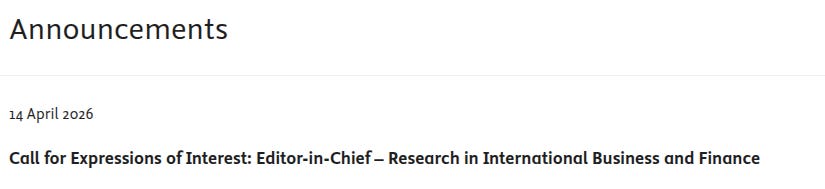
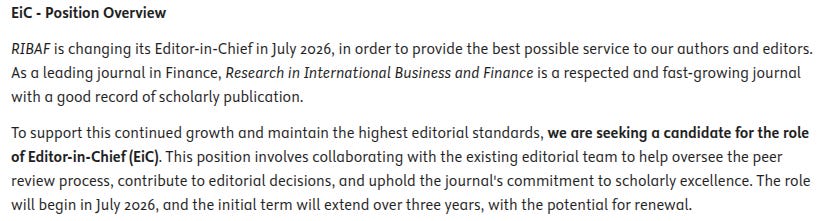
Two weeks ago, Elsevier announced that they were hiring a new Editor-in-Chief at Research in International Business and Finance (RIBAF):

Mushtaq Bilal, PhD@MushtaqBilalPhD
> be elsevier > make PDFs of publicly-funded research > pay researchers exactly $0 > instead ask researchers to pay $11,000 to get their papers published > put those papers behind a paywall > sell subscriptions to universities for $1M > make $4 billion in annual revenue > add

10:29 AM · Apr 28, 2026 · 5.66K Views
8 Replies · 34 Reposts · 135 Likes
RIBAF’s previous Editor-in-Chief, John Goodell—a Professor of Finance at the University of Akron—was not due to have his term expire until 2027.
So, what happened?
I reached out to Goodell and Elsevier for comment, but did not receive a reply.

According to my sources, Goodell’s departure is directly due to the citation cartel I exposed 2 months ago that resulted in Elsevier firing of 2 other finance professors, Brian Lucey and Samuel Vigne—both are co-authors of Goodell.
This post is public so feel free to share it.
Goodell has been a professor since 2008.
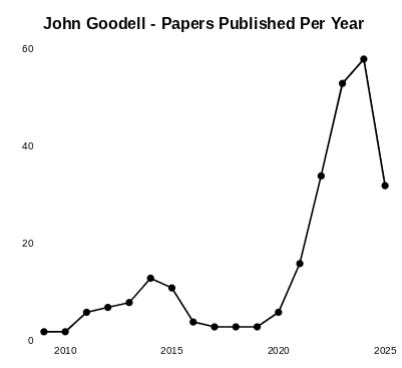
For the first decade, his publication output was steady and within the normal range: 2, 2, 6, 7, 8, 13, 11, 4, 3, 3, 3, 6 papers per year.
Then something changed.
From 2021 to 2025, his annual output exploded: 16, 34, 53, 58, and 32 papers.
How did he accomplish this amazing feat?
Simple: he was gifted 100+ papers by the now-fired Brian Lucey and Sam Vigne.
Lucey, as I described in my earlier articles, was fired as an editor or editor-in-chief at 5 journals: International Review of Financial Analysis, the International Review of Economics & Finance, Finance Research Letters, Financial Management, & Energy Finance.
Samuel Vigne was fired as the editor-in-chief of International Review of Financial Analysis and Finance Research Letters.
John Goodell published:
47 papers in International Review of Financial Analysis
12 papers in International Review of Economics & Finance
66 papers in Finance Research Letters alone
For a total of 125 papers in their corrupt journals!
If each of these 125 papers contains a modest 50 references, this generates roughly 6,250 citations to spread around his cronies. This obviously isn’t legitimate research; it is a citation-farming operation—a practice that has already prompted Elsevier to retract dozens of his cronies’ papers for “citation stacking.”
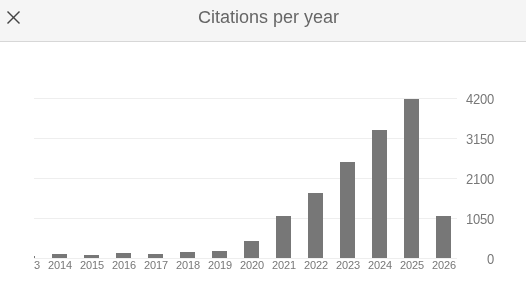
These hundreds of fraudulent publications have resulted in an explosion of Goodell’s citations, now at 15,663. In 2025 alone, he earned 4,203 citations, resulting in his citation profile exhibiting an exponential “J-curve”, a hallmark of citation rings.
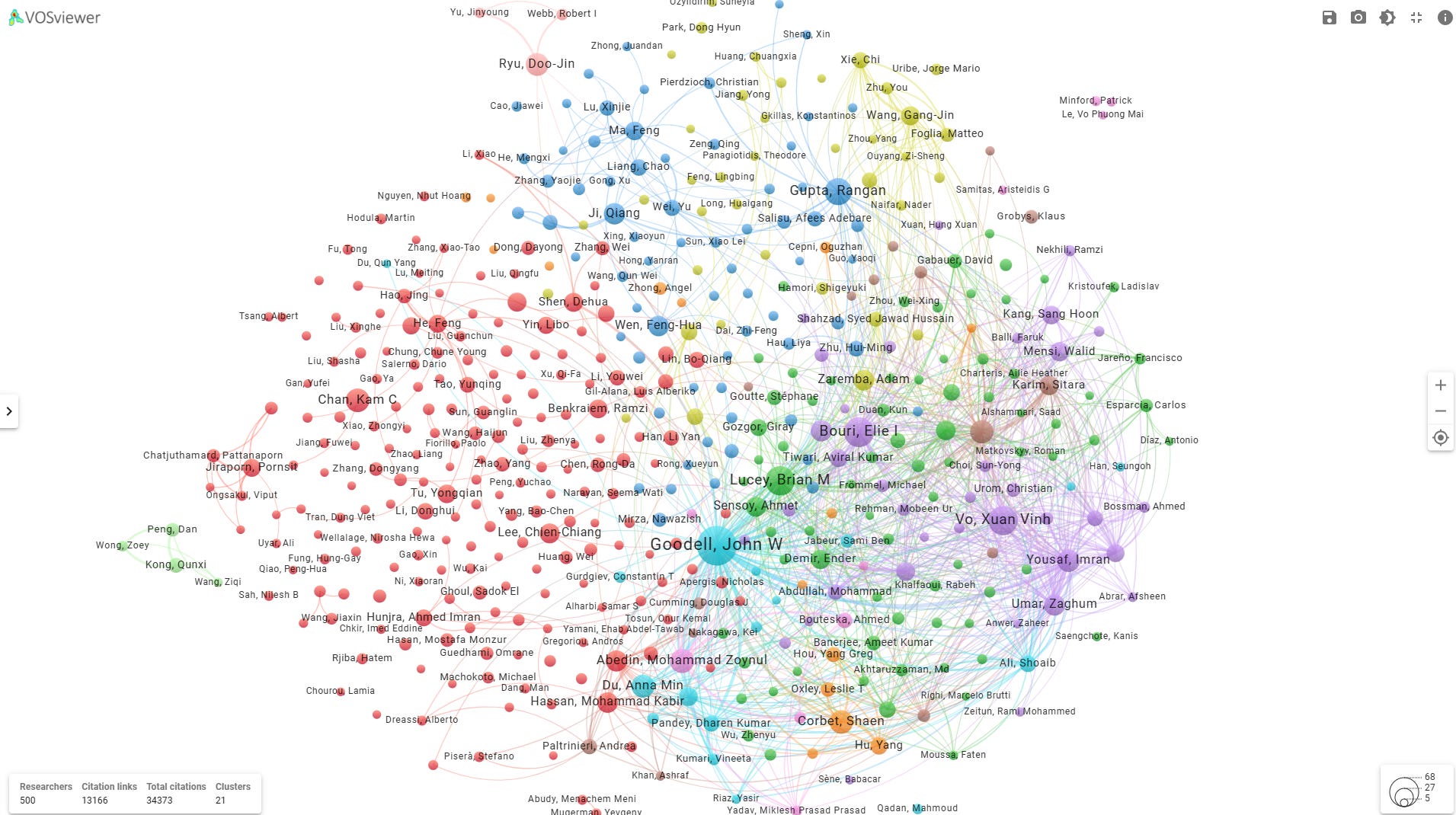
According to an analysis published at PubPeer mapping the 500 top Finance Professors in the Elsevier ecosystem, the biggest blue dot in the middle of this graph of influence (below) is John Goodell. Despite working at a terrible school and producing terrible research, through corruption, he has made himself the single most influential researcher at the biggest academic publisher in the world.
He is the gatekeeper through whom the entire network must pass.
According to my sources, Goodell was widely-known to be running a gift-authorship and citation cartel with RIBAF for years in which he makes junior scholars work for him and he adds his name — “you add me on your paper - I get you a few guaranteed RIBAFs” deal, which is a retraction reason at Elsevier.
Elsevier’s guidelines are clear: if an editor receives a manuscript from a co-author and no independent editor is available at the journal, the paper is supposed to be transferred to another journal.
Because John Goodell handled some hundreds of such papers at his journal, Elsevier seems more interested in containing the scandal than confronting it directly. A full mea culpa would likely require retracting a vast number of articles, which would turn this into a major and deeply embarrassing story.
In an honest world, this journal should be shut down altogether, not reformed.

In RIBAF’s case, we are talking about hundreds of compromised papers. By my rough estimate, the number is around 200 retractable papers if you count active co-authors alone, and well above 350 if former collaborators are included.
Please share my article widely to hold Elsevier to account:
Here is a straightforward example of how this paper trading scheme could work.
In January 2025 and March 2025, Emmanuel Abakah, Senior Lecturer in Finance at the University of Ghana, published two papers at Goodell’s RIBAF:
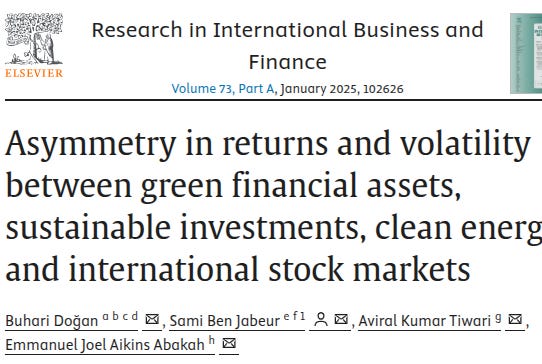

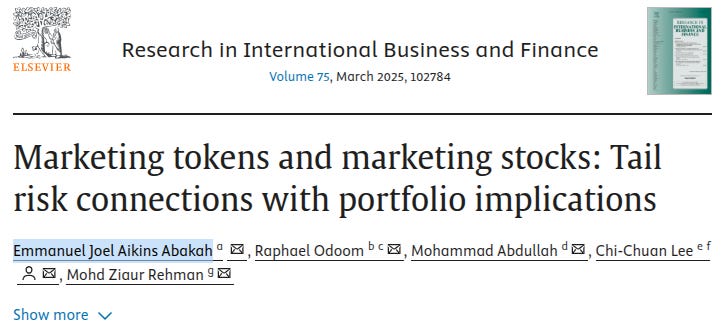
While these papers was under review by John Goodell, Emmanuel Abakah added Goodell as a co-author to 2 publication in Brian Lucey’s other journal, where Goodell was credited with “Supervision” co-author credits.
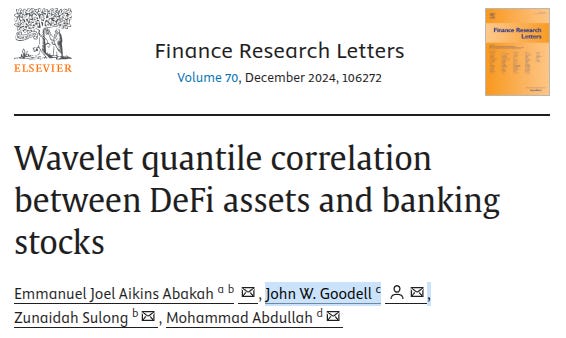
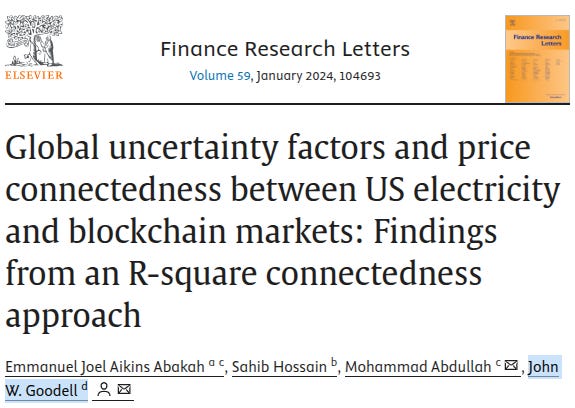
This pattern repeats hundreds of times:
Goodell receives a submission for review at RIBAF
Goodell is added as a co-author to that submitter’s paper at a different journal
The submitter’s RIBAF submission is accepted
Perhaps the most prolific example in this scheme is Dr. Anna Min Du, a Professor of Finance at Edinburgh Napier University and a fellow at both the University of Cambridge and Peking University.


She is an editor at 6 Elsevier journals:
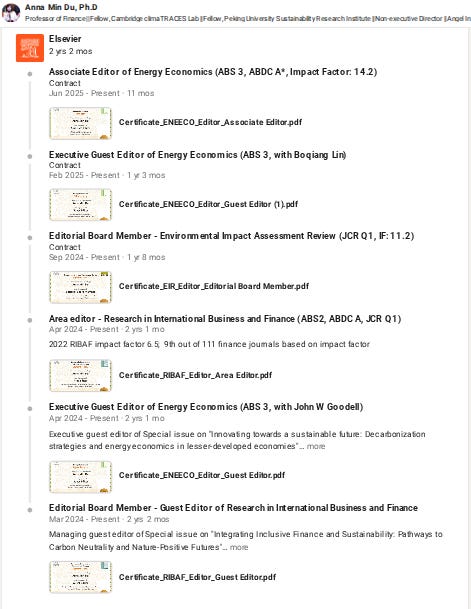
She published at least 22 RIBAFs (!!) in 2024-2025:
- 4 in Volume 70, Part B, June 2024, 102386
- 3 in Volume 71, August 2024, 102436
- 2 in Volume 72, Part B, October 2024, 102544
- 6 in Volume 73, Part A, January 2025, 102541
- 2 in Volume 75, March 2025, 102755
- 2 in Volume 76, April 2025, 102819
- 2 in Volume 77, Part A, May 2025, 102886
- 1 in Volume 79, July 2025, 103029
While Du painstakingly lists all of her other publications on her personal website, she conspicuously omits any mention of RIBAF:
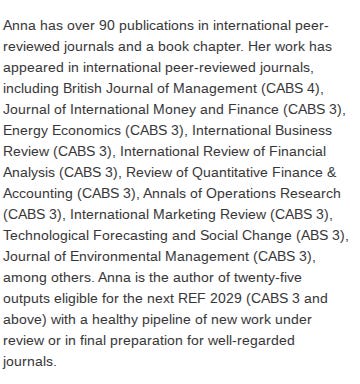
She allegedly had all her RIBAFs listed on her Google Scholar at one point, but then removed them all. When I checked, they were not there.

Sadly, I made the amateur mistake of not archiving it, so I can’t prove it.
I emailed her to ask about these papers scrubbed from her Google Scholar.
She denied ever removing them:
Thank you for your email. My Google Scholar remains the same. I didn’t scrub any of my publications or add them back. I didn’t check messages on LinkedIn either. I believe you can tell whether messages were read or not on LinkedIn. You might want to check it carefully.
Then, after emailing her, when I checked her Google Scholar again, most of them magically reappeared. However, these 4 are still not listed on her Google Scholar:
But then when I emailed her again to press her on how she published at least 22 papers in 2024-2025 all in one journal, she stopped responding.
Sure, she could just be a really productive and well-connected author who submitted 22 papers to this journal that year.
Or……. it’s possible that John Goodell gifted her 20+ RIBAF publications in one year, and she returned the favor by adding his name to 14 of her papers at other journals that same year:
Artificial intelligence as a catalyst for sustainable tourism growth and economic cycles AB Siddik, MS Forid, L Yong, AM Du, JW Goodell - Technological Forecasting and Social Change, 2025
Internal business process governance and external regulation: How does AI technology empower financial performance? X Cheng, AM Du, C Yan, JW Goodell - International Review of Financial Analysis, 2025
Ecological risk and corporate sustainability: Examining ESG performance, risk management, and productivity Q Du, Z Sun, JW Goodell, AM Du, T Yang - International Review of Financial Analysis, 2024
Ecological risk management: Effects of carbon risk on firm innovation investment F Li, JW Goodell, AM Du, T Yang - International Review of Financial Analysis, 2024
Modeling climate policy uncertainty into cryptocurrency volatilities S Ding, X Wu, T Cui, JW Goodell, AM Du - International Review of Financial Analysis, 2025
Vulnerability of energy firms to climate risk: Does fintech development help?
K Abbasi, A Alam, JW Goodell, AM Du, NA Brohi - Energy Economics, 2025
Carbon emission trading policies and energy transition: Perspective from natural gas consumption in China L Cai, AM Du, Q Du, JW Goodell, Z Li - Energy Economics, 2025
Exploring AI-driven digital banking platforms: Implications for Business model innovation and sustainability in the financial sector AB Siddik, L Yong, AM Du, JW Goodell - IEEE Transactions on Engineering Management, 2025
Digital credit and insurance: Improving economic well-being for rural households J Zhang, S Chen, JW Goodell, AM Du - International Review of Economics & Finance, 2025
Disentangling and hedging global warming risk: A machine learning approach S Ding, T Cui, AM Du, JW Goodell, N Du - Environmental Impact Assessment Review, 2025
Innovating towards a sustainable future: decarbonization strategies and energy economics in lesser-developed economies JW Goodell, AM Du - Energy Economics, 2024
Impact of bank-affiliation on liquidity seeking of foreign mutual funds during adverse shocks: Evidence from China J Zhang, R Mao, JW Goodell, AM Du, Y Xu - International Review of Financial Analysis, 2024
Impact of Chinese foreign direct investment on energy demand and stability: The Belt-Road Initiative as conditioner R Shinwari, AM Du, JW Goodell - Journal of Environmental Management, 2025
Internal business process governance and external regulation: How does AI technology empower financial performance? JW Goodell, X Cheng, AM Du, C Yan International Review of Financial Analysis 99, 1
This is blatantly a reciprocal exchange where Goodell provides the platform (RIBAF) and Du provides the co-authorship credits to boost Goodell’s H-index.
Also, it’s worth noting 6 of these 14 publications were in the International Review of Financial Analysis, a journal ran by the now-fired Brian Lucey and Samuel Vigne.
Again, this pattern repeats hundreds of times, with hundreds of authors.
In the extensive sample of his 100+ papers I analyzed, I found a perfect correlation between co-authorship on Goodell’s CV and subsequent publication in his journal, RIBAF. This is not a series of coincidences; it is a blatant, industrial-scale quid pro quo. Goodell has effectively turned the peer-review process into a private brokerage.
Elsevier has replaced the man, but they haven’t addressed the rot. If hundreds of authors participated in this scheme, why are their papers still standing? Someone is still protecting the house. The only question left is: Who, and why?
Thanks for reading Chris Brunet! This post is public so feel free to share it.