








The roughly 12-mile (19km) drive along Wilshire Boulevard from Los Angeles’s downtown core to its Westside region can be a soul-crushing experience. The road is among the busiest in Los Angeles, winding through Westlake, Koreatown, the famed Miracle Mile, Beverly Hills, Century City, Westwood and Santa Monica before ending at the bluffs overlooking the Pacific coast highway, a journey that can take an hour or even two at rush hour.
For decades, Angelenos accepted this time-eating crawl as fate. But this week, traversing this bustling corridor reached another level – about 50-70ft underground to be precise. How about Union Station to Beverly Hills in 21 minutes?
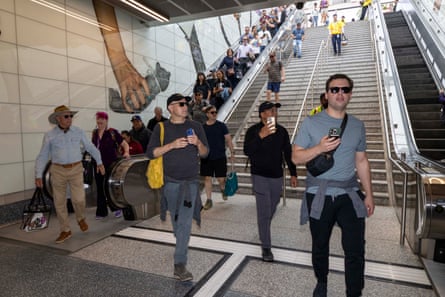
That’s the travel time that LA Metro, the regional transit authority, is flaunting as it unveils the city’s first new subway stations in more than a quarter century. The first section of the long-awaited D line extension opened on Friday, a project Metro officials, transportation experts and transit advocates say marks a “game changer” for the car-clogged region.
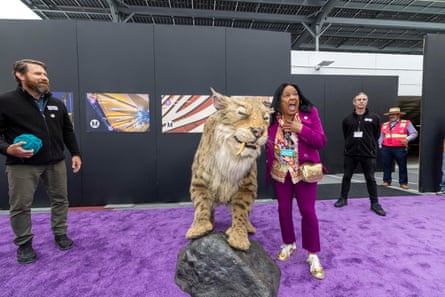
Friday’s grand opening was full of fanfare and big D energy. Like any major LA premiere, there were Hollywood celebrities, flashing news cameras and a purple carpet to walk. There was even a life-sized saber-toothed tiger puppet, made by the Jim Henson creature shop, and the entire Metro system was free to ride through the weekend.
The four fresh miles of subway service arrive as the region prepares to host marquee global events: World Cup matches this summer, then the Olympic and Paralympic games in 2028. After decades of delays and years of bad headlines about falling ridership, rising crime and service struggles, some Angelenos are ready to celebrate good transit news, donning cheeky “Ride the D” T-shirts to show their excitement.
It’s all part of a slow-moving yet potentially seismic shift to reshape car-dependent LA into the kind of a transportation ecosystem that’s readily available in other major cities around the globe. But the timeline of this rail project – plans for which can be traced back to the 1960s – offers a stark reminder for those eagerly awaiting LA’s transformation: pace yourselves.
Still, Tim Lindholm, chief program management officer for LA Metro, said “breaking this east-west divide” marks a major milestone that residents may have to experience to believe.
“[For] your average Angeleno, it hasn’t really struck them yet that you could get from Union Station to Beverly Hills in 21 minutes, or that when section three is done … you can go from downtown to UCLA in 25 minutes,” Lindholm said. “That’s a game changer.”
‘Subway to the sea’
The project is the realization of what was pitched by local leaders decades ago as a “subway to the sea”. It will bring seven stations in three phases along Wilshire. This first phase adds three stations, ferrying riders to (and under) LA’s Miracle Mile, home to renowned museums including the Los Angeles County Museum of Art (Lacma), the Academy Museum of Motion Pictures, the Petersen Automotive Museum and the La Brea tar pits – and walking distance to the Grove mall. Further west, the Wilshire/La Cienega station provides access to the eastern edge of Beverly Hills, home to the dining hub of “restaurant row” and the Beverly Center mall.
Metro says the next two sections will open next year, adding four more stops in Beverly Hills, Century City, Westwood and the West LA Veterans Affairs Medical Center – not quite “to the sea”, but within a few miles.
Los Angeles’s trademark sprawl has made it a challenge to build the kind of rail system that’s made other major metropolises so easy and intuitive to get around. But Angelenos yearn for better – so much so that majorities voted to tax themselves more four times in as many decades to generate funding for transit projects.
Despite how lanky and sad Metro’s rail network looks on a map, the system has its loyal superfans who are excited about the subway extension – and LA Metro is leaning in with not-so-subtle T-shirts urging the public to “Ride the D”.
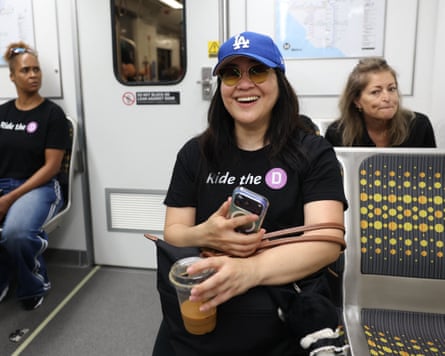
Missy Colman, a Metro spokesperson, chuckled as she explained how Metro’s social media team embraced the sassy and successful marketing. Turns out it was not cooked up by middle schoolers at a lunch table.
“We were just really excited by how it blew up,” Colman said.
The initial shirts sold out, then the restocks. As of Friday, a third batch was still available online, along with “Ride the D” hats.
“If the kids think it’s cool, it’s cool with me,” Lindholm added.
Clearly, Los Angeles is thirsty for better transit options in a city with infrastructure and social norms long cemented to center the automobile.
There’s an argument that LA’s push for a rail revolution is actually a return to form. Los Angeles’s basin-spanning streetcar system was once the public transit envy of the world. But the rise of the automobile, along with degraded service and local power grabs by oil and automotive companies, sealed the streetcars’ fate and buried most traces of their existence – literally.

“It sure would make my job a lot easier if they hadn’t torn out the old rail system,” Lindholm said. “It’s not lost on me that [with] some projects … we’re building right on top of old historic railways.”
The D line extension, which broke ground in 2014, was hampered by layers of challenges so thick, LA Metro needed a serious drill to break through. Luckily, they had two. The agency used twin tunnel-boring machines, dubbed Elsie and Soyeon through a school naming contest, which have been munching through the earth beneath Wilshire since 2018.
The D line project was first conceptualized in the 1960s, and local officials then studied, planned and prepared to break ground in the 1980s. Those plans were derailed when a methane explosion blew the literal roof off a Ross clothing store in the Fairfax district, injuring 23 people. The fear that tunneling in the area would risk similar hazards led to a ban on tunneling in that part of the city. It would be 20 years until a panel of tunneling experts determined that Metro could safely dig under that stretch of Wilshire thanks to technological advancements.
In those intervening years, Metro’s red line (now called the B line after a 2020 naming overhaul to reflect the growing system) had expanded into central LA, Hollywood and the San Fernando valley. The purple line (now the D) lingered as a sad stub of the subway it could have been.
If there’s one perfect place to put a subway in Los Angeles, it’s under Wilshire Boulevard. The world-class entertainment, cultural and economic draws here provide a civic corridor “where the benefits of transit in London, Tokyo and Paris can be felt”, said Brian Taylor, a professor of urban planning and public policy at the University of California, Los Angeles’s Institute of Transportation Studies. But the factors that make it optimal also make it “the most expensive and complicated place to build a new subway”, Taylor explained, adding: “Subway builder’s dilemma.”
There is generations’ worth of infrastructure buried under these neighborhoods – sewer lines, water pipes, electric wiring and fiberoptic cables – which tunnelers had to avoid or safely reroute, Taylor noted. And before this was busy Mid-City, it was an oil field.
“There are thousands of capped oil wells – not all of them were mapped accurately – that the engineers had to cope with … as they worked their way underground through this literally volatile environment,” Taylor said.
Given the proximity to the famous La Brea tar pits, tunneling was halted multiple times as crews uncovered hundreds of fossilized animals, some dating back to the ice age (no, they didn’t die waiting for the new subway to open). More than 500 fossils were recovered during Metro’s tunneling process, Colman said, including wooly mammoths, camel, bison, otters, dire wolves and giant sloths.
‘Customers for life’
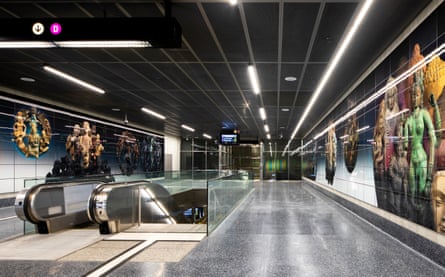
What can riders expect to see when they descend below Wilshire? Colman and Lindholm pointed to spacious stations and platforms built without the need for columns, providing an open, well-lit experience for riders. Each station also features public art installations from artists including Todd Gray, Eamon Ore-Giron and Fran Siegel.
In the coming decades, Metro aims to open hundreds more miles of subway, light rail and rapid bus routes to provide a more viable solution for millions of Angelenos who either don’t have access to a car or don’t want to deal with the hazards and hassles of driving one.
Alfonso Directo Jr is advocacy director for the Alliance for Community Transit – Los Angeles (Act-LA), a coalition of community groups across the region that champion equitable transit and dense, affordable housing near it.
He said the D line extension should be celebrated as one step toward “leveling the playing field” for LA’s transit riders – the majority of whom are lower-income and rely on Metro to get to work and make other essential trips – but more work is crucial.
“Rail investments, bus investments, bike infrastructure is all very well-needed to bring some semblance of justice to LA,” he said.
The community groups that make up Act-LA also hope the growing transit network will boost the ranks of Metro’s transit ambassadors – unarmed staff members who help people find their trains and buses, deter crime by being visible at stations and even spring into action to reverse drug overdoses. The program has been well-received by Metro riders and credited with saving more than 300 lives since 2022.
Transportation officials and experts say there’s no better selling point for the benefits of public transit than hopping on a clean, safe bus or train and getting where you need to go in a timely fashion.
With a global gaze on LA when the World Cup and Olympics come to town, Lindholm says Metro has an opportunity to sell the resurgent system to the world but, most importantly, to locals who will still need to get around after those mega-events end.
“That’s the biggest thing we’re doing,” Lindholm said. “Obviously, the game plan is to provide mobility service to everyone that visits Los Angeles, but the real game plan is to get customers for life.”
Will enough people buy in? Angelenos may have to ride the D to find out. And hopefully we won’t feel like fossils ourselves by the time LA’s mass transit renaissance arrives.