

惯性聚合 高效追踪和阅读你感兴趣的博客、新闻、科技资讯
阅读原文 在惯性聚合中打开

推荐订阅源

罗磊的独立博客
OSCHINA 社区最新新闻
OSCHINA 社区最新新闻
美团技术团队
Engineering at Meta
Engineering at Meta
Microsoft Security Blog
I
InfoQ
云风的 BLOG
云风的 BLOG
C
Cisco Blogs
G
Google Developers Blog
cs.AI updates on arXiv.org
Recorded Future
Recorded Future
V
V2EX
Martin Fowler
Martin Fowler
The Last Watchdog
The Last Watchdog
Help Net Security
Help Net Security
S
SegmentFault 最新的问题
W
WeLiveSecurity
L
LINUX DO - 热门话题
C
CERT Recently Published Vulnerability Notes
J
Java Code Geeks
The Cloudflare Blog
AI
AI
NISL@THU
NISL@THU
Schneier on Security
D
Darknet – Hacking Tools, Hacker News & Cyber Security
H
Help Net Security
V
Vulnerabilities – Threatpost
N
News and Events Feed by Topic
U
Unit 42
P
Proofpoint News Feed
T
The Blog of Author Tim Ferriss
C
CXSECURITY Database RSS Feed - CXSecurity.com
S
Security Affairs
D
Docker
P
Privacy & Cybersecurity Law Blog
Spread Privacy
Spread Privacy
阮一峰的网络日志
阮一峰的网络日志
B
Blog RSS Feed
SecWiki News
SecWiki News
Stack Overflow Blog
Stack Overflow Blog
MongoDB | Blog
MongoDB | Blog
G
GRAHAM CLULEY
S
Schneier on Security
量子位
The GitHub Blog
The GitHub Blog
奇客Solidot–传递最新科技情报
奇客Solidot–传递最新科技情报
cs.CL updates on arXiv.org
小众软件
小众软件
Hugging Face - Blog
Hugging Face - Blog
博客园 - 司徒正美

Hacker News

Introducing Claude Opus 4.7 Qwen Studio The Future of Everything is Lies, I Guess: Where Do We Go From Here? GitHub - SeanFDZ/macmind: Single-layer transformer in HyperTalk for the classic Macintosh Show HN: Agent-cache – Multi-tier LLM/tool/session caching for Valkey and Redis Ancient DNA reveals pervasive directional selection across West Eurasia [pdf] Moving a large-scale metrics pipeline from StatsD to OpenTelemetry / Prometheus GitHub - Nightmare-Eclipse/RedSun: The Red Sun vulnerability repository GitHub - SethPyle376/hiraeth: Local AWS emulator focused on fast integration testing, with SQS support, SQLite-backed state, and a debug-friendly web UI. GitHub - macOS26/Agent: Any AI, replaces Claude Code, Cursor, OpenClaw. Over 18 LLM providers (Claude, OpenAI, Gemini, Ollama, Zai, HF, Qwen) wired into a native Mac app that writes code, builds Xcode projects, bumps versions, manages git, automates Safari, use AppleScript, JS or Accessibility, extend Agent! w/ MCP Servers, run tasks from your iPhone via Messages. YouTube now lets you turn off Shorts I Made a Terminal Pager Burgers | マクドナルド公式 Commands — HackerNews CLI documentation ChatGPT for Excel PiCore - Raspberry Pi Port of Tiny Core Linux Live Nation illegally monopolized ticketing market, jury finds Google Broke Its Promise to Me. Now ICE Has My Data. Founding Engineer at Adaptional | Y Combinator CRISPR takes important step toward silencing Down syndrome’s extra chromosome GitHub - saffron-health/libretto: The AI toolkit for building reliable browser automations US v. Heppner (S.D.N.Y. 2026) no attorney-client privilege for AI chats [pdf] Unexpected €54k billing spike in 13 hours: Firebase browser key without API restrictions used for Gemini requests Retrofitting JIT Compilers into C Interpreters IPv6 – Google The Accursèd Alphabetical Clock Cybersecurity Looks Like Proof of Work Now Fragments: April 14 Cal.com Goes Closed Source: Why AI Security Is Forcing Our Decision | Cal.com - Scheduling Software for Online Bookings Laravel raised money and now injects ads directly into your agent When moving fast, talking is the first thing to break Too much Discussion of the XOR swap trick – Heather Cafe Introduction to Spherical Harmonics for Graphics Programmers The Grand Line Building a Z-Machine in the worst possible language High-Level Rust: Getting 80% of the Benefits with 20% of the Pain GitHub - duguyue100/midnight-captain: Inspired by Midnight Commander, tailored to my taste. How to build a `git diff` driver · Jamie Tanna | Software Engineer Center for Responsible, Decentralized Intelligence at Berkeley The Local Universe’s Expansion Rate Is Clearer Than Ever, but Still Doesn’t Add Up - A new synthesis of astronomical measurements confirms a persistent mismatch that could point to physics beyond current models The air throughout our homes is infused with microplastics. But there are things you can do to breathe less of them The disturbing white paper Red Hat is trying to erase from the internet – OSnews The Future of Everything is Lies, I Guess: Annoyances ‘Abhorrent’: the inside story of the Polymarket gamblers betting millions on war Productive procrastination — Max van IJsselmuiden maps, territory and LMs 447 Terabytes per Square Centimetre at Zero Retention Energy: Non-Volatile Memory at the Atomic Scale on Fluorographane Show HN: Pardonned.com – A searchable database of US Pardons 20 Years on AWS and Never Not My Job The Seasons are Wrong Artemis II crew splashes down near San Diego after historic moon mission We gave an AI a 3 year retail lease in SF and asked it to make a profit | Andon Labs How a dancer with ALS used brainwaves to perform live On filing the corners off my MacBooks Installing every* Firefox extension OpenClaw’s memory is unreliable, and you don’t know when it will break Steve Blank Nowhere Is Safe Chimpanzees in Uganda locked in vicious 'civil war', say researchers watgo - a WebAssembly Toolkit for Go linux/Documentation/process/coding-assistants.rst at master · torvalds/linux GitHub - callumlocke/json-formatter: Makes JSON easy to read. Founding Product Engineer at Bild AI | Y Combinator A compelling title that is cryptic enough to get you to take action on it GitHub - Keychron/Keychron-Keyboards-Hardware-Design: Industrial design files for Keychron keyboards and mice. 100+ models with CAD assets in STEP, DXF, DWG, and PDF. Source-available, with commercial use allowed for original compatible accessories within the license terms. [ANNOUNCE] WireGuardNT v0.11 and WireGuard for Windows v0.6 Released 1D-Chess Helium Is Hard to Replace Cooperative Vectors Introduction | Evolve Keeping a Postgres queue healthy — PlanetScale Our response to the Axios developer tool compromise Do Americans read print books, e-books or audiobooks more? The Zettelkasten Method in Obsidian: A Practical Setup Guide Artemis II Is Competency Porn and We Are Starving For It WeakC4 Flight Viz — Cockpit View A Mexican surveillance giant you’ve never heard of is now watching the U.S. border Surelock: Deadlock-Free Mutexes for Rust RISC-V 101 – what is it and what does it mean for Canonical? | Ubuntu The Problem That Built an Industry How Much Linear Memory Access Is Enough? | Solidean Investigating Split Locks on x86-64 Simplest hash functions Sybilproof reputation mechanisms (2005) [pdf] What is a property? How Complex is my Code? Static code analysis in Kotlin — tools overview Toffoli gates are all you need PGLite evangelism dcmake: a new CMake debugger UI Clojure on Fennel part one: Persistent Data Structures Fragments: April 2 Python Release Python install manager 26.1 The Life and Death of the Book Review - Liberties Bitcoin miners are losing $19,000 on every BTC produced as difficulty drops 7.8% God sleeps in the minerals Building slogbox Apple Silicon and Virtual Machines: Beating the 2 VM Limit Who was “Not Even Wrong” first? Pokemon Evolution Vs Darwinian Evolution The APL Programming Language Source Code
From Shipwreck to Startup: Resurrecting a Salt‑Soaked Commodore SX‑64
Jerry L. Parker · 2026-06-11 · via Hacker News

Why I didn't walk away

I picked up the SX‑64 at the 2025 VCFSW show in Dallas, thinking the classic line: "How bad could it be?"

The gentleman who brought it to me mentioned it might have some water damage, but on the outside it looked pretty respectable, certainly no worse than others I'd seen. The aluminum alloy case and plastics had held up with just minor scuffs and scratches, which made it easy to believe the machine wasn't too far gone. However, the unsettling noise inside (like sand moving in a jar) told me there was more to the story.

I didn't dare power it on, but I also didn't yet realize how deep the damage went. I made an offer, the deal was done, and I slid it under my table for the rest of the show before bringing it home and shelving it until a couple of weeks ago.

First look: deceptive condition

Once home, I cracked it open and the story changed instantly. All that rattling was rust flakes from the inside. The internal chassis was almost completely rotted away, screws were hopelessly fused to the frame, boards carried deposits and corrosion, and metal shields were badly eaten away. What looked like a slightly dirty portable at the show turned out to be what appeared to be a salt‑water survivor in far worse condition than I imagined.
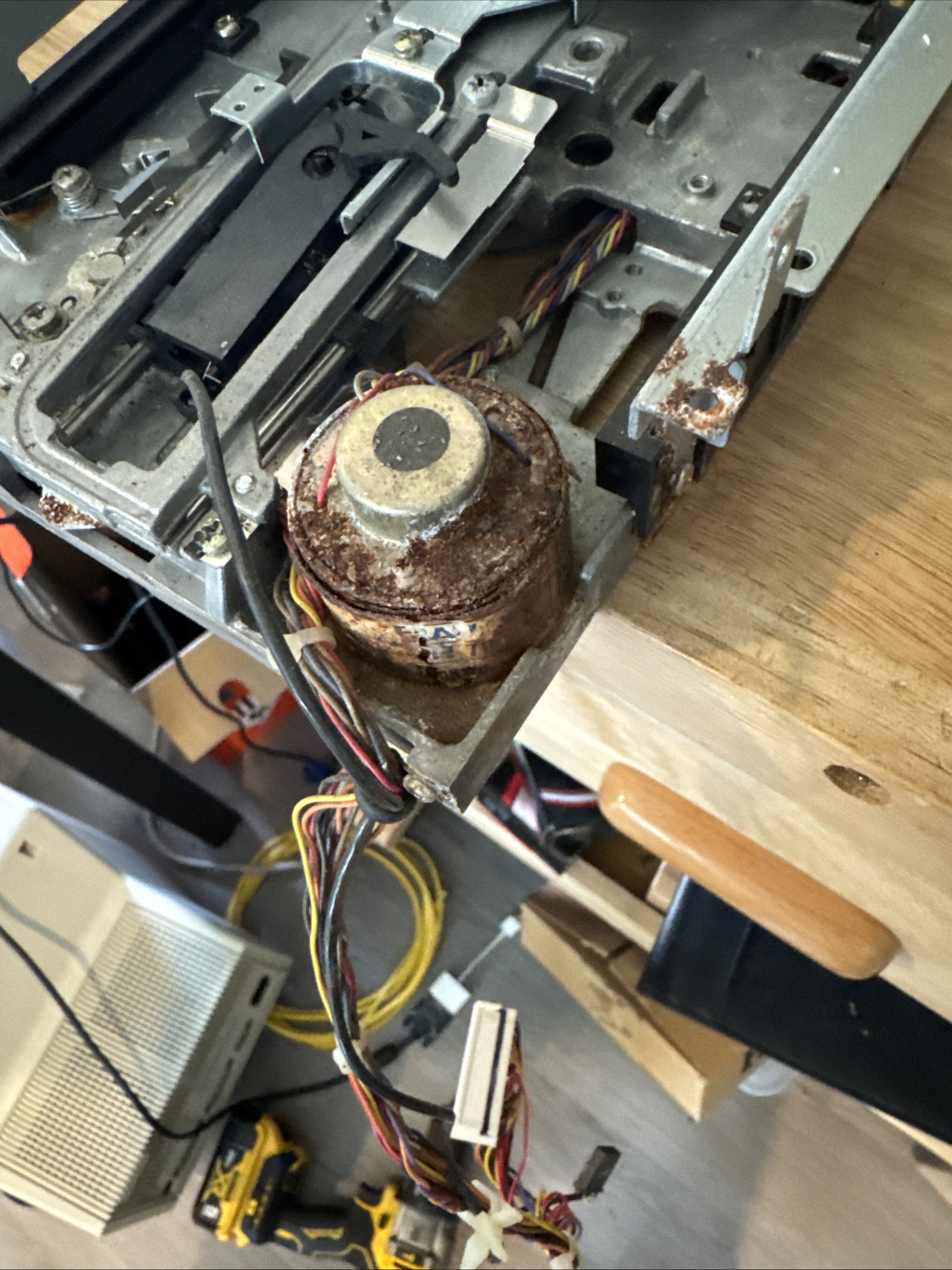
Close‑up of a rusted SX‑64 floppy drive motor
The drive motor told the real story: inside, this machine looked more like shipwreck salvage.

Problem #1: the fasteners were effectively welded in place. Penetrating oil and patience weren't enough.

Teardown: drilling, soaking, freeing the fused screws.

The only way forward was mechanical. I carefully drilled out several seized screws, starting small and stepping up, keeping chips clear of the boards. Brackets and shields went into rust‑removal baths where possible. In some instances, replacement was the only option, so off to eBay looking for someone selling parts. Fortunately, I found a seller parting out some boards, so I emailed asking if he had any metal parts. Quick negotiations and a replacement chassis was on its way! Other metal parts required attention with wire brushes and rustoleum paint to keep the rust at bay!
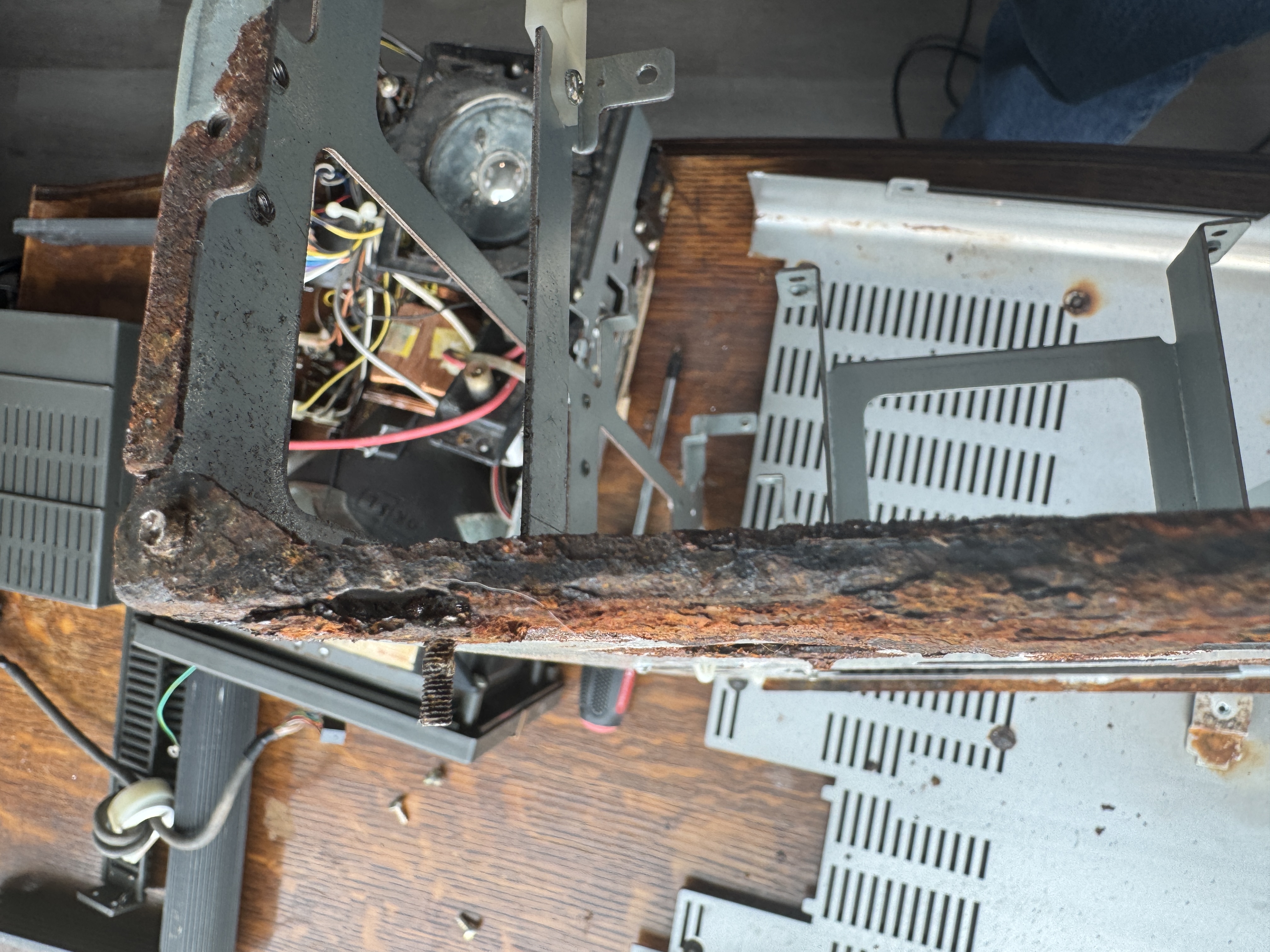
Close‑up of a drilled screw head to free the chassis
When chemistry fails, precision drilling wins. One screw at a time. You can see two drilled out screws here.

Plastics got a different treatment: gentle cleaning, no harsh solvents. The keyboard switches were flushed, the keycaps soaked and brushed. The drive mechanism was disassembled and cleaned - but the drive motor was beyond help; anything that didn't respond to love was earmarked for replacement.
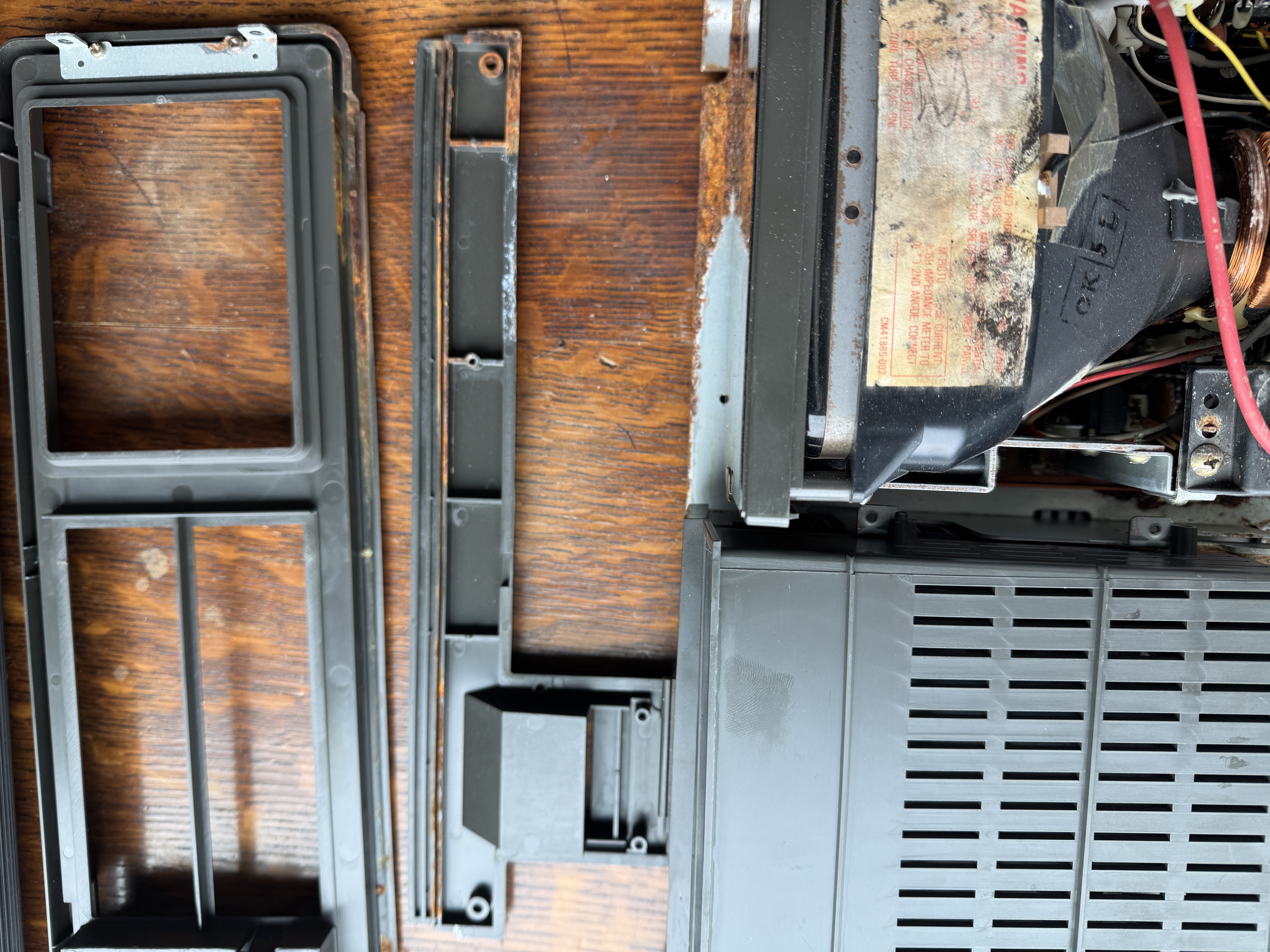
Can Plastics Rust?
Can Plastic Rust? It certainly looked like it.

Electronics: what survived and what didn't

Corrosion on this scale is ruthless, but not everything was lost. After a careful board wash (in my dishwasher), dry (for two days), and inspection, it didn't look that bad. I removed all chips from sockets, applied carefully measured doses of DeoxIT (I literally saturated the sockets and connectors with the stuff), and inspected each board carefully. I was beginning to become cautiously optimistic!

Unusual step: Dishwashing the electronics.
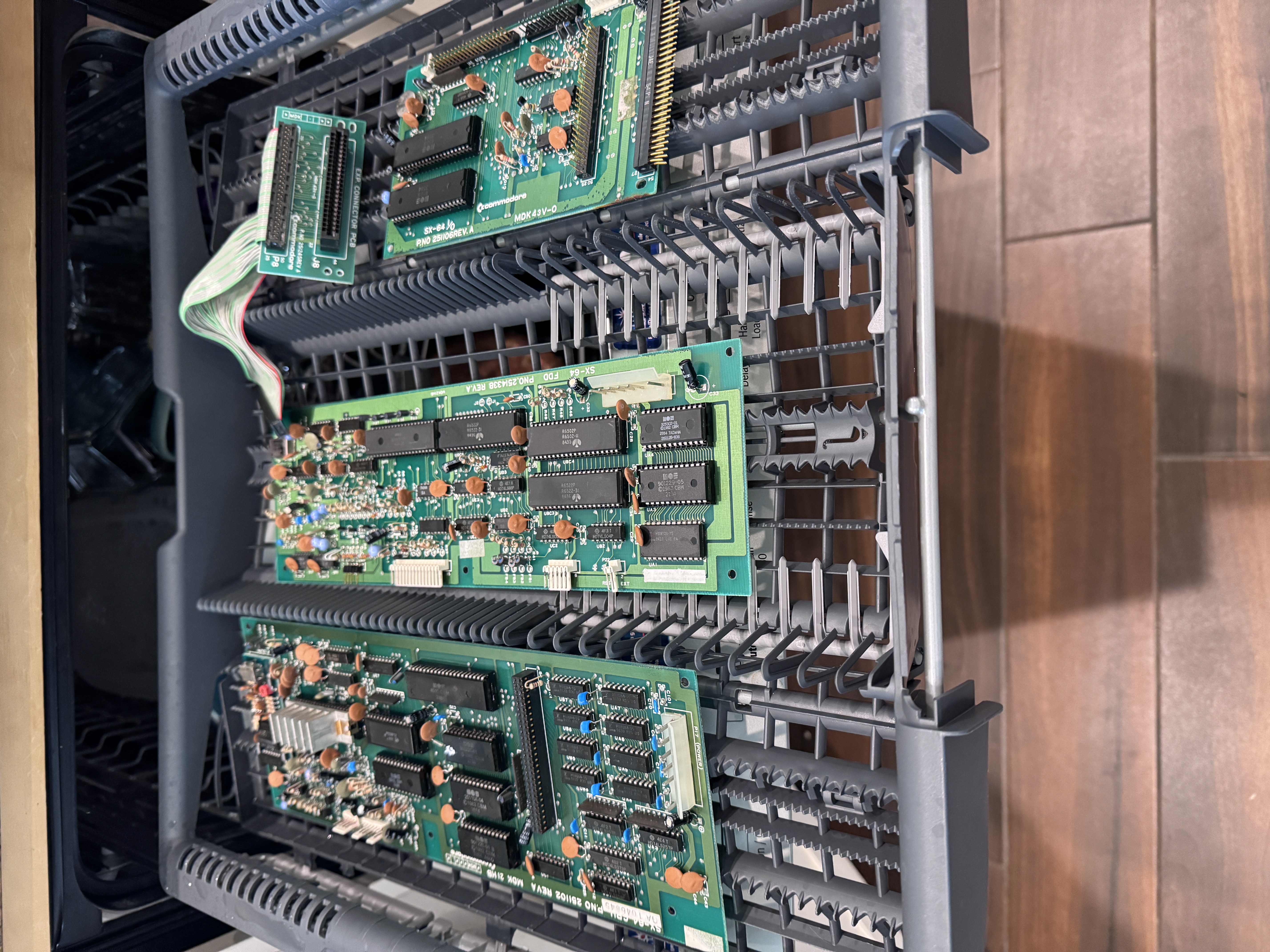
Boards in dishwasher. Yes, Dishwasher!
I put the boards (and the plastics) in my dishwasher.

Reassembly

Many fasteners and screws were destroyed, so I made do with replacements from around my shop. While they aren't original, they certainly work. I suspect that somewhere down the line someone will open this thing up and perhaps wonder why they are all so much different, but that's for another day.

Having secured a replacement chassis and floppy, the reassembly was relatively simple, with no surprises. It was during this process I started worrying about the electronics. I hadn't tested them yet, and really didn't have any idea of what I was getting into with them. After all, the work done so far had certainly been a surprise. What other surprises might be in store?
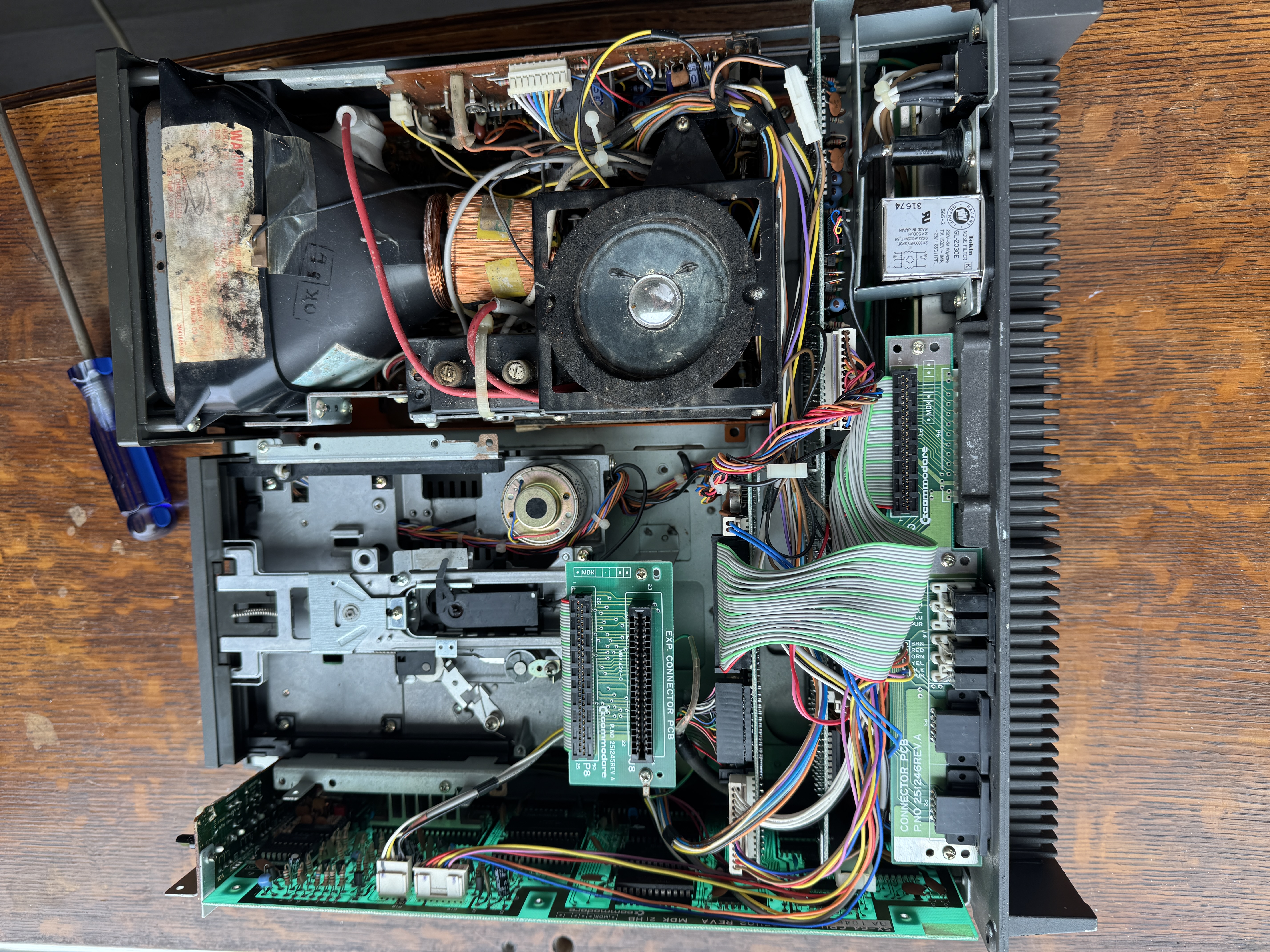
Internal Assembly complete
The internal assembly is complete.

Pre-Power On Testing

First, I applied mains to the power supply to test voltages.

They all measured fine so next I applied power to the monitor and watched carefully. After a few seconds, the filament warmed, and the screen lit up! Cabling the power connectors to the CPU and FDD board, I flipped on the power with more than a little excitement.

The floppy disk spun, and the red light came on..... and it didn't stop. The screen came up blank white. Whomp-Whomp, it wasn't running. But, I had my dead-test cartridge with me so I plugged it in to see what it told me.
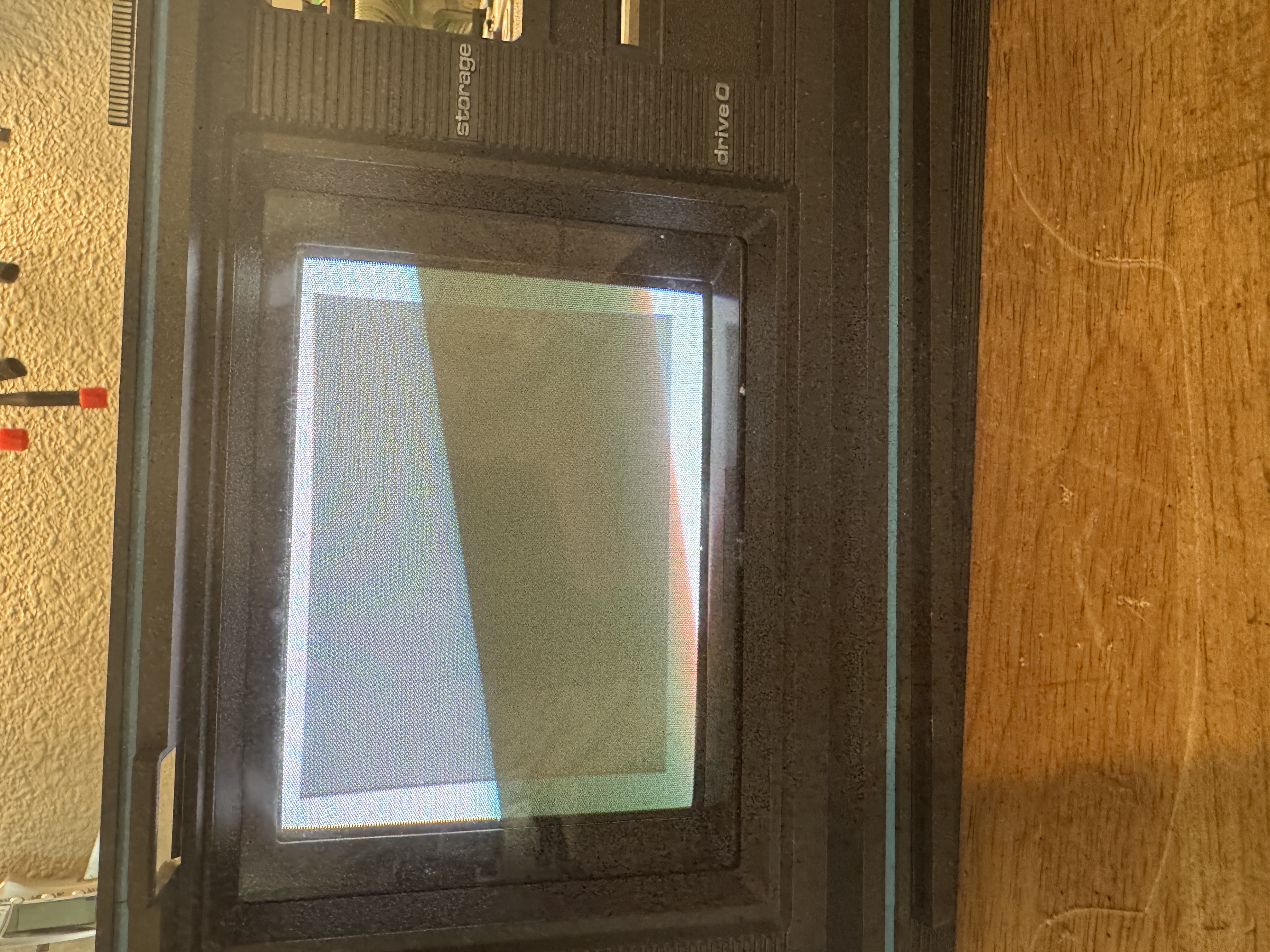
Dead Test
Dead Test on a dead system.

Moment of truth

Actually, I had seen this before. One of the most common failures on an SX-64 is the PLA. It always should have had a heat-sink on it to protect it, so it is a very common failure point, often resulting in spinning drive and white (or black) screens. I popped it out and a replacement in and...

...I re-applied power.

The screen I wasn't sure I'd ever see.

Reflections

This wasn't a repair so much as an excavation with a soldering iron. I learned again that patience beats panic, that corrosion hides beneath every clean exterior, and that old machines, like old people, can still surprise you. I also learned that even the toughest life lived is a life worth living, scars and all. Now, when I flip the switch, I don't just see a computer; I see a machine that fooled me with a decent shell and still came roaring back after being hollowed by salt and time. There is more to do. It still needs full reassembly and a proper burn in. By the next VCFSW, I plan to pass it on, not as a trophy, but as a relay baton. I hope whoever takes it home appreciates the journey and adds the next chapter.