惯性聚合 高效追踪和阅读你感兴趣的博客、新闻、科技资讯
阅读原文 在惯性聚合中打开

推荐订阅源

Threat Intelligence Blog | Flashpoint
量子位
M
MIT News - Artificial intelligence
Y
Y Combinator Blog
钛媒体:引领未来商业与生活新知
钛媒体:引领未来商业与生活新知
Google DeepMind News
Hugging Face - Blog
Hugging Face - Blog
博客园_首页
雷峰网
雷峰网
I
InfoQ
罗磊的独立博客
博客园 - 聂微东
酷 壳 – CoolShell
酷 壳 – CoolShell
大猫的无限游戏
大猫的无限游戏
D
Docker
H
Hackread – Cybersecurity News, Data Breaches, AI and More
腾讯CDC
博客园 - 三生石上(FineUI控件)
The GitHub Blog
The GitHub Blog
K
Kaspersky official blog
P
Privacy & Cybersecurity Law Blog
S
SegmentFault 最新的问题
T
Threat Research - Cisco Blogs
H
Help Net Security
小众软件
小众软件
Cyber Security Advisories - MS-ISAC
C
CERT Recently Published Vulnerability Notes
WordPress大学
WordPress大学
T
Tenable Blog
T
The Blog of Author Tim Ferriss
C
Cisco Blogs
Simon Willison's Weblog
博客园 - Franky
A
Arctic Wolf
T
Threatpost
Scott Helme
Scott Helme
C
Cybersecurity and Infrastructure Security Agency CISA
D
Darknet – Hacking Tools, Hacker News & Cyber Security
T
The Exploit Database - CXSecurity.com
G
GRAHAM CLULEY
Security Latest
Security Latest
Spread Privacy
Spread Privacy
L
LINUX DO - 热门话题
V
Vulnerabilities – Threatpost
P
Privacy International News Feed
S
Schneier on Security
Latest news
Latest news
cs.CL updates on arXiv.org
C
Cyber Attacks, Cyber Crime and Cyber Security
C
CXSECURITY Database RSS Feed - CXSecurity.com

Hacker News

Introducing Claude Opus 4.7 Qwen Studio The Future of Everything is Lies, I Guess: Where Do We Go From Here? GitHub - SeanFDZ/macmind: Single-layer transformer in HyperTalk for the classic Macintosh Show HN: Agent-cache – Multi-tier LLM/tool/session caching for Valkey and Redis Moving a large-scale metrics pipeline from StatsD to OpenTelemetry / Prometheus GitHub - Nightmare-Eclipse/RedSun: The Red Sun vulnerability repository GitHub - SethPyle376/hiraeth: Local AWS emulator focused on fast integration testing, with SQS support, SQLite-backed state, and a debug-friendly web UI. GitHub - macOS26/Agent: Any AI, replaces Claude Code, Cursor, OpenClaw. Over 18 LLM providers (Claude, OpenAI, Gemini, Ollama, Zai, HF, Qwen) wired into a native Mac app that writes code, builds Xcode projects, bumps versions, manages git, automates Safari, use AppleScript, JS or Accessibility, extend Agent! w/ MCP Servers, run tasks from your iPhone via Messages. YouTube now lets you turn off Shorts I Made a Terminal Pager Burgers | マクドナルド公式 Commands — HackerNews CLI documentation ChatGPT for Excel PiCore - Raspberry Pi Port of Tiny Core Linux Live Nation illegally monopolized ticketing market, jury finds Google Broke Its Promise to Me. Now ICE Has My Data. Founding Engineer at Adaptional | Y Combinator CRISPR takes important step toward silencing Down syndrome’s extra chromosome GitHub - saffron-health/libretto: The AI toolkit for building reliable browser automations US v. Heppner (S.D.N.Y. 2026) no attorney-client privilege for AI chats [pdf] Unexpected €54k billing spike in 13 hours: Firebase browser key without API restrictions used for Gemini requests Retrofitting JIT Compilers into C Interpreters IPv6 – Google The Accursèd Alphabetical Clock Cybersecurity Looks Like Proof of Work Now Fragments: April 14 Cal.com Goes Closed Source: Why AI Security Is Forcing Our Decision | Cal.com - Scheduling Software for Online Bookings Laravel raised money and now injects ads directly into your agent When moving fast, talking is the first thing to break Too much Discussion of the XOR swap trick – Heather Cafe Introduction to Spherical Harmonics for Graphics Programmers The Grand Line Building a Z-Machine in the worst possible language High-Level Rust: Getting 80% of the Benefits with 20% of the Pain GitHub - duguyue100/midnight-captain: Inspired by Midnight Commander, tailored to my taste. How to build a `git diff` driver · Jamie Tanna | Software Engineer Center for Responsible, Decentralized Intelligence at Berkeley The Local Universe’s Expansion Rate Is Clearer Than Ever, but Still Doesn’t Add Up - A new synthesis of astronomical measurements confirms a persistent mismatch that could point to physics beyond current models The air throughout our homes is infused with microplastics. But there are things you can do to breathe less of them The disturbing white paper Red Hat is trying to erase from the internet – OSnews The Future of Everything is Lies, I Guess: Annoyances ‘Abhorrent’: the inside story of the Polymarket gamblers betting millions on war Productive procrastination — Max van IJsselmuiden maps, territory and LMs 447 Terabytes per Square Centimetre at Zero Retention Energy: Non-Volatile Memory at the Atomic Scale on Fluorographane Show HN: Pardonned.com – A searchable database of US Pardons 20 Years on AWS and Never Not My Job The Seasons are Wrong Artemis II crew splashes down near San Diego after historic moon mission We gave an AI a 3 year retail lease in SF and asked it to make a profit | Andon Labs How a dancer with ALS used brainwaves to perform live On filing the corners off my MacBooks Installing every* Firefox extension OpenClaw’s memory is unreliable, and you don’t know when it will break Steve Blank Nowhere Is Safe Chimpanzees in Uganda locked in vicious 'civil war', say researchers watgo - a WebAssembly Toolkit for Go linux/Documentation/process/coding-assistants.rst at master · torvalds/linux GitHub - callumlocke/json-formatter: Makes JSON easy to read. Founding Product Engineer at Bild AI | Y Combinator A compelling title that is cryptic enough to get you to take action on it GitHub - Keychron/Keychron-Keyboards-Hardware-Design: Industrial design files for Keychron keyboards and mice. 100+ models with CAD assets in STEP, DXF, DWG, and PDF. Source-available, with commercial use allowed for original compatible accessories within the license terms. [ANNOUNCE] WireGuardNT v0.11 and WireGuard for Windows v0.6 Released 1D-Chess Helium Is Hard to Replace Cooperative Vectors Introduction | Evolve Keeping a Postgres queue healthy — PlanetScale Our response to the Axios developer tool compromise Do Americans read print books, e-books or audiobooks more? The Zettelkasten Method in Obsidian: A Practical Setup Guide Artemis II Is Competency Porn and We Are Starving For It WeakC4 Flight Viz — Cockpit View A Mexican surveillance giant you’ve never heard of is now watching the U.S. border Surelock: Deadlock-Free Mutexes for Rust RISC-V 101 – what is it and what does it mean for Canonical? | Ubuntu The Problem That Built an Industry How Much Linear Memory Access Is Enough? | Solidean Investigating Split Locks on x86-64 Simplest hash functions Sybilproof reputation mechanisms (2005) [pdf] What is a property? How Complex is my Code? Static code analysis in Kotlin — tools overview Toffoli gates are all you need PGLite evangelism dcmake: a new CMake debugger UI Clojure on Fennel part one: Persistent Data Structures Fragments: April 2 Python Release Python install manager 26.1 The Life and Death of the Book Review - Liberties Introducing Database Traffic Control — PlanetScale Bitcoin miners are losing $19,000 on every BTC produced as difficulty drops 7.8% God sleeps in the minerals Building slogbox Apple Silicon and Virtual Machines: Beating the 2 VM Limit Who was “Not Even Wrong” first? Pokemon Evolution Vs Darwinian Evolution The APL Programming Language Source Code
How I
2026-06-27 · via Hacker News

Related to RIP software hackathons. Long live the hardware hackathon., I agree most software hackathons are busted, this is how I’m running one anyway.

Running a hackathon, software jam, or some assorted code adjacent competition has gotten significantly more awkward as of late. Stop me if you’ve ever heard of of the story of the AI B2B SAAS winning the competition, as the judges starry eyed fell in love with a ChatGPT wrapper. This sucks, but I still wake up every day and love software. There’s a craft to it, there’s still passion & people pouring hours of their life into making high quality software. I still want to write code. If you work in any field barring webdev it’s clear that software is not a solved problem. You still can’t one shot a good compiler, despite what Anthropic wants you to believe. Game jams still work, why don’t software jams work?

Even if we solve the “How to make software jams not suck?” huge massive problem. We still have have an auxiliary problem of funding prizes, giving people an actual motivation to participate, compete, and try to win. The typical pipeline of a hackathon is: beg enough local companies until they end up giving you money. I don’t know if that pipeline has changed post vibecoding heat death of the tech industry, because I can’t go that route. For some context I work for a charity Hack Club, which is a “nonprofit movement of teenagers making cool projects.” This makes securing funding for jams easier, you would think. Well it’s complicated.

Hack Club works on an hour based funding scheme. To maximize efficiency in running programs, every Hack Club program gets $8.5 per hour to spend on prizes; buy participants things, encourage them to engineer more. How do you find out how long someone’s spending coding? Well in years past it was a self report, give a ballpark estimate of how long you spent. When more hours means more money you can start to see an incentive to lie about time. Hack Club needed a better solution, that solution at least for coding (hardware is a separate mess of it’s own) was Hackatime. A server for wakatime that tracks how long you’re physically typing on your keyboard, then use that data to determine funding.

So the obvious model of a program run with this funding scheme acts like a hip and cool job. You work for X amount of hours on a project of your choosing, and the charity gives you that value as prizes. Sometimes those prizes are flights and events, which are great but you begin to notice another perverse incentive here. In an ideal world a participant would work on projects they’re interested in, those projects would be projects that improve their skill, and Hack Club is paying you to improve your coding. This dream sometimes is reality, but ugly incentives still rear their head. Why not just grind out lazy project after lazy project, rake in cash, learn nothing, and be happy? Yes you can augment hours with voting on a normal curve, so that on average it’s still $8.5/hr but penalize the lowest half and reward the top half. Again this is another solution that does improve things, but still sucks. You still make money working on lazy project after lazy project, and thus cost Hack Club money they’d rather not spend but can’t justify not giving you.

So what’s the solution? You’ve followed the map to this point, now you are here. I don’t know, but we’re trying to kill two birds with a software jam shaped stone. Here’s how:

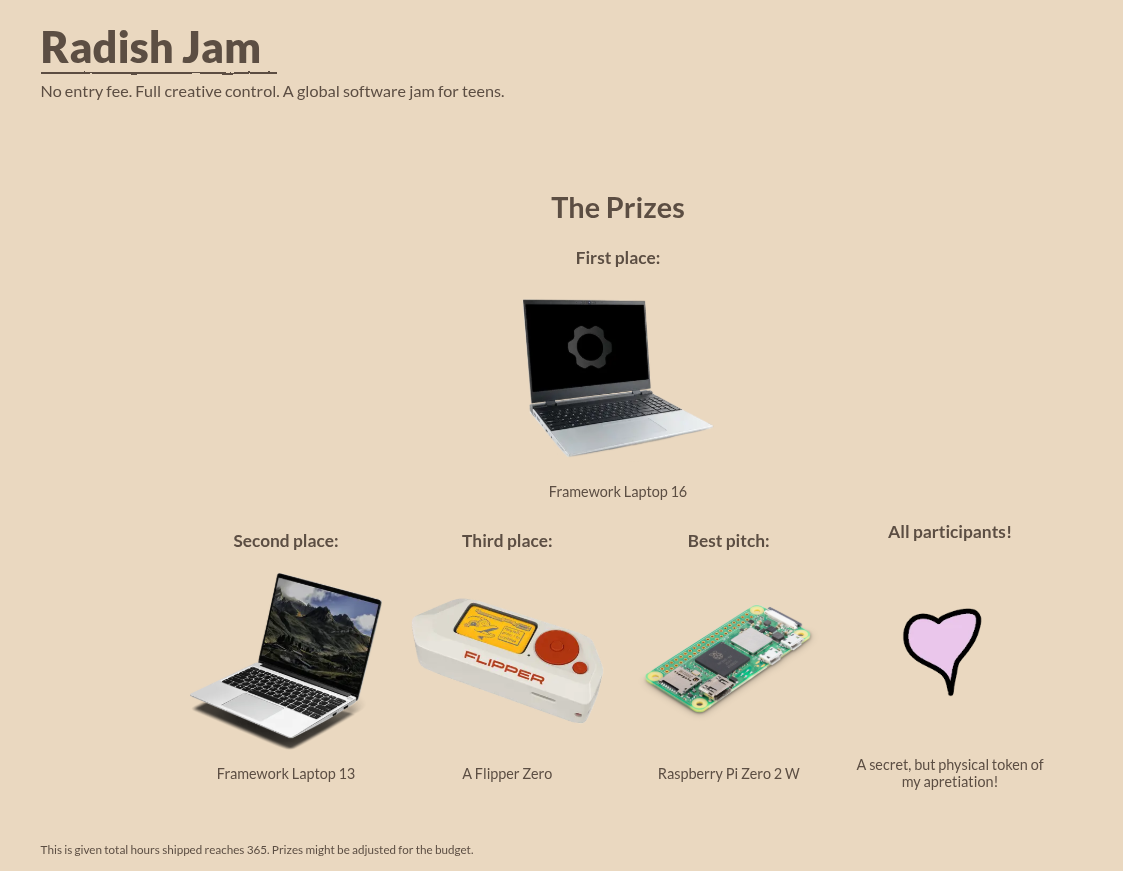
If you just want to cut to the chase you can see the website right now, radish.hackclub.com.

Why don’t people submit low effort games to game jams on mass, if it’s bad there’s still clearly a lot of heart and soul that made it there to the end. Why? Because you get nothing for making a bad game jam game. You get bodied in voting and all you are left with is the game, and you don’t like your own work, or you didn’t learn anything from the experience you wasted your time.

So we can use the jam solution to solve the Hack Club problem, but we’ve come full circle. We still have problems however with making software jams not suck. How do we fix that? Pretty easy, get better judges, be very clear with expectations (ie. Here’s some project ideas, notice none of them involve LLMs!), and the most crucial part, give people time to make nice code. Where we once had spaghetti we now have AI slop, no one wants to write either. We Stockholm syndrome ourselves into being okay with our captors with the sweet sweet phrase, “we’ll fix it later.” Write it good enough from the beginning and you’ll have jumpstarted a real project, something to build a success off of.

The last kink, I hand waived the Hack Club model’s connection to game jams, but now I shall explain. To make the hour model work, you need scaling prizes, the more people participate, the bigger the prizes. The only part of this that’s slightly awkward is that you have to advertise a rough ballpark estimate of the prizes, with a disclaimer that they change based on the budget of the program.

I’m still not quite happy with this, it’s really clunky and without a backing or a loan of hours, it means participants have to engage it a little bit of risky behavior. Ultimately, this is a fine price to pay in my eyes for a significantly better both software jam experience and as well as a more effective Hack Club program.

If you are a teen and have an interest in joining my software jam, you can find more info at radish.hackclub.com.

Feel free to email me at foxmoss@hackclub.com if you need any help getting in the Hack Club system :)