





In the first four months of 2026, the average wholesale electricity price in Spain was €44 per megawatt-hour. In Italy, it was €127. In Germany, €96. In the UK, €103. Spain is now cheaper than France, well below the central-European bloc, and within striking distance of the Nordic hydro-and-nuclear heavyweights that have always topped the cheap-power league.
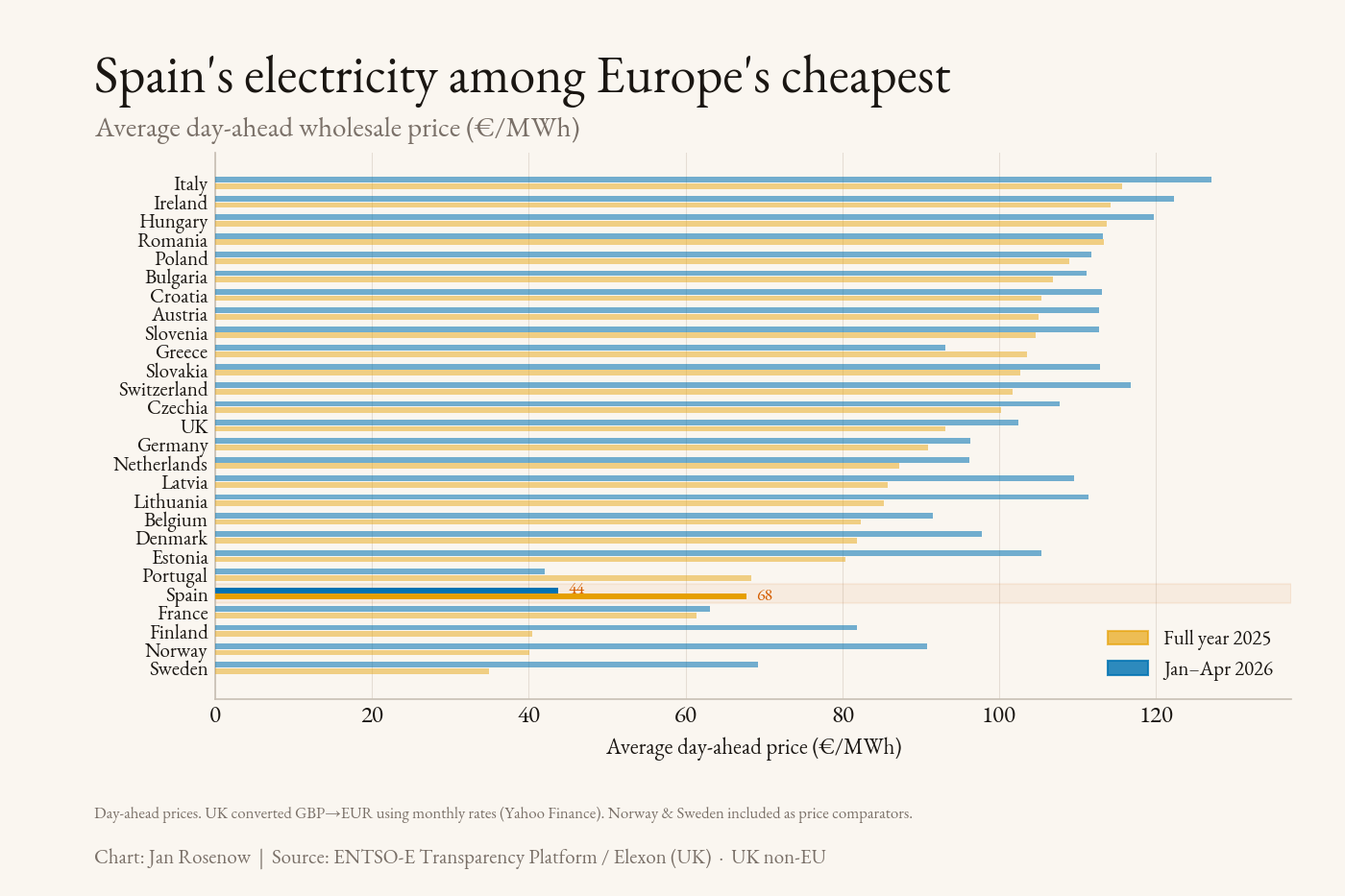
This is not where most observers expected Spain to be. A decade ago, Spain was a cautionary tale of stranded solar investment and one of Europe’s more expensive power markets. Today it sits near the bottom of the price table, and the gap is widening.
The story behind that ranking is, on its surface, simple. Spain increasingly pushed gas increasingly out of its electricity supply, and the price of electricity followed.
The mix has changed beyond recognition
Twenty-five years ago, a third of Spain’s electricity came from coal. Today, coal is effectively gone. Gas, which surged in the 2000s as the replacement, peaked above 30% of generation in the late 2000s and has since been pushed back to roughly 19%. Nuclear has held steady around 19%, hydro and bioenergy together around 14%, and the remaining capacity has been steadily filled by wind and solar.
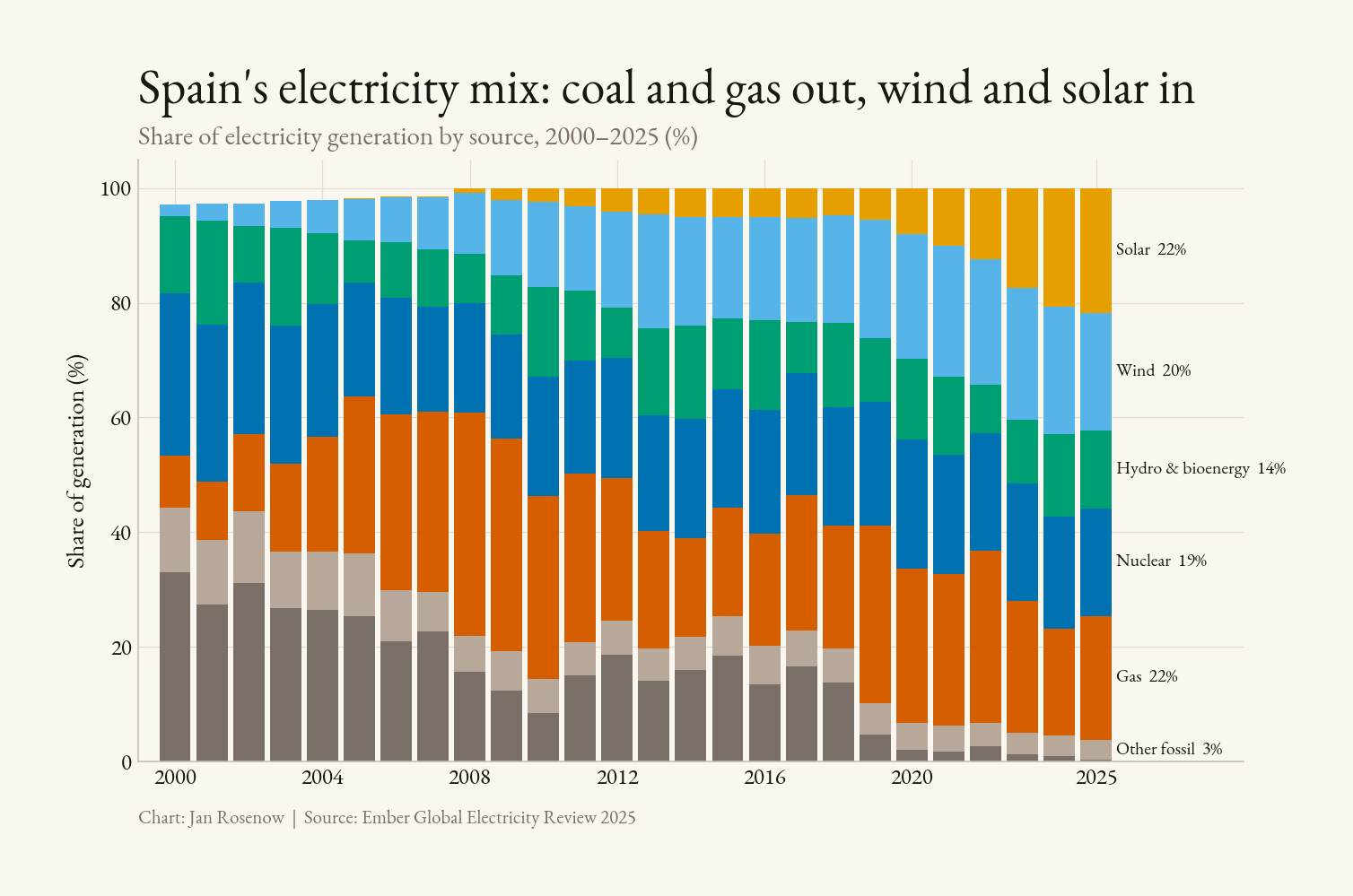
Wind alone supplied 20% of Spanish generation in 2025. Solar, which barely existed at scale in the early 2010s, hit 22%. Between them, those two technologies now generate more electricity than any other single category in the system, including the nuclear fleet that was once Spain’s reliable workhorse.
2022 was the turning point
If you stack solar and wind against all fossil generation (gas plus the last embers of coal and oil), the lines crossed in 2022. That was the first year wind plus solar generated more electricity than every fossil source combined. Through the first quarter of 2026, the gap has widened further. Solar and wind delivered 44% of generation, fossil fuels 17%.
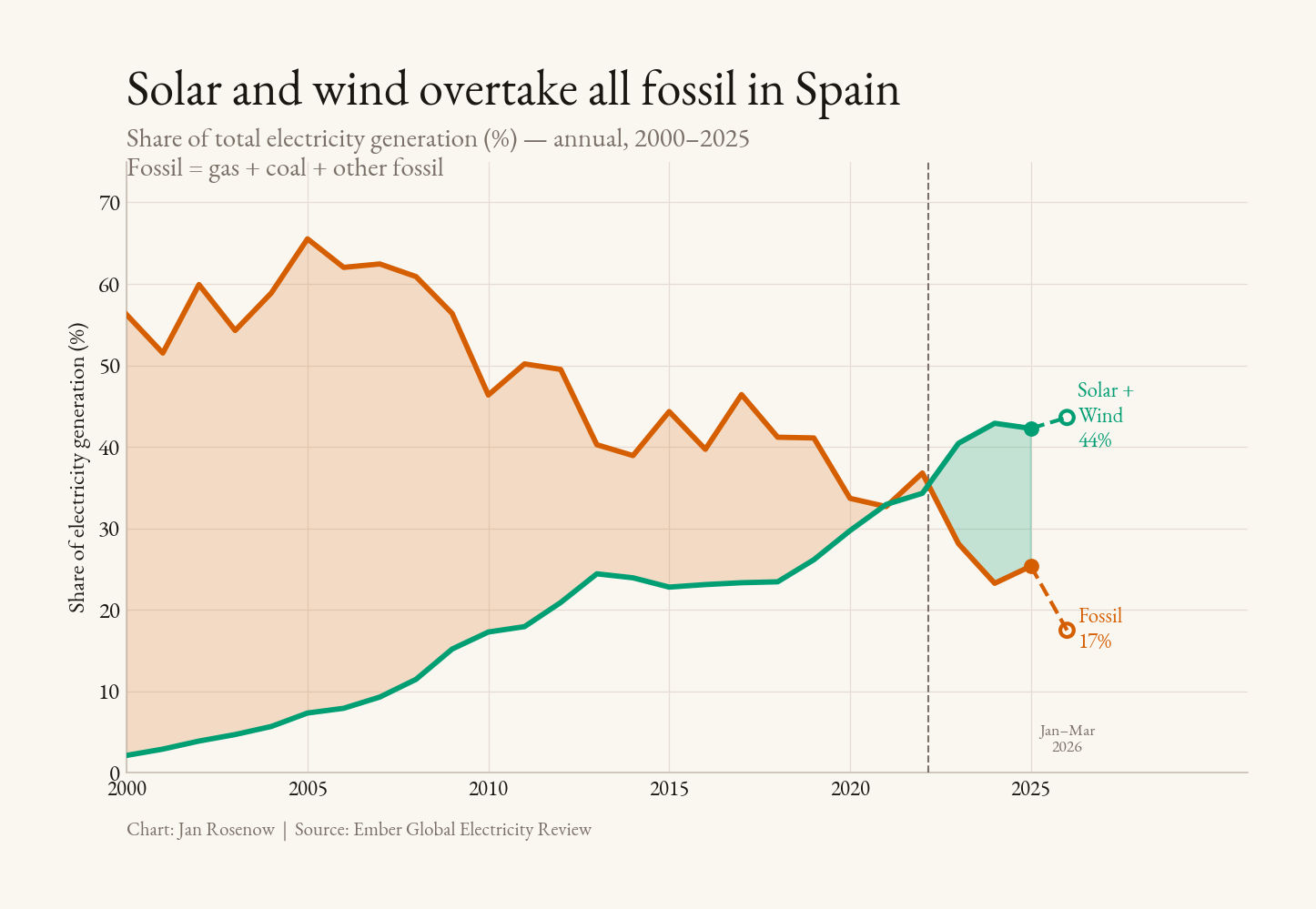
This is the structural story that many arguments about energy policy circle around. Spain did not just add renewables on top of a fossil base. It substituted. The fossil curve has been falling, year after year, while the renewable curve has been climbing.
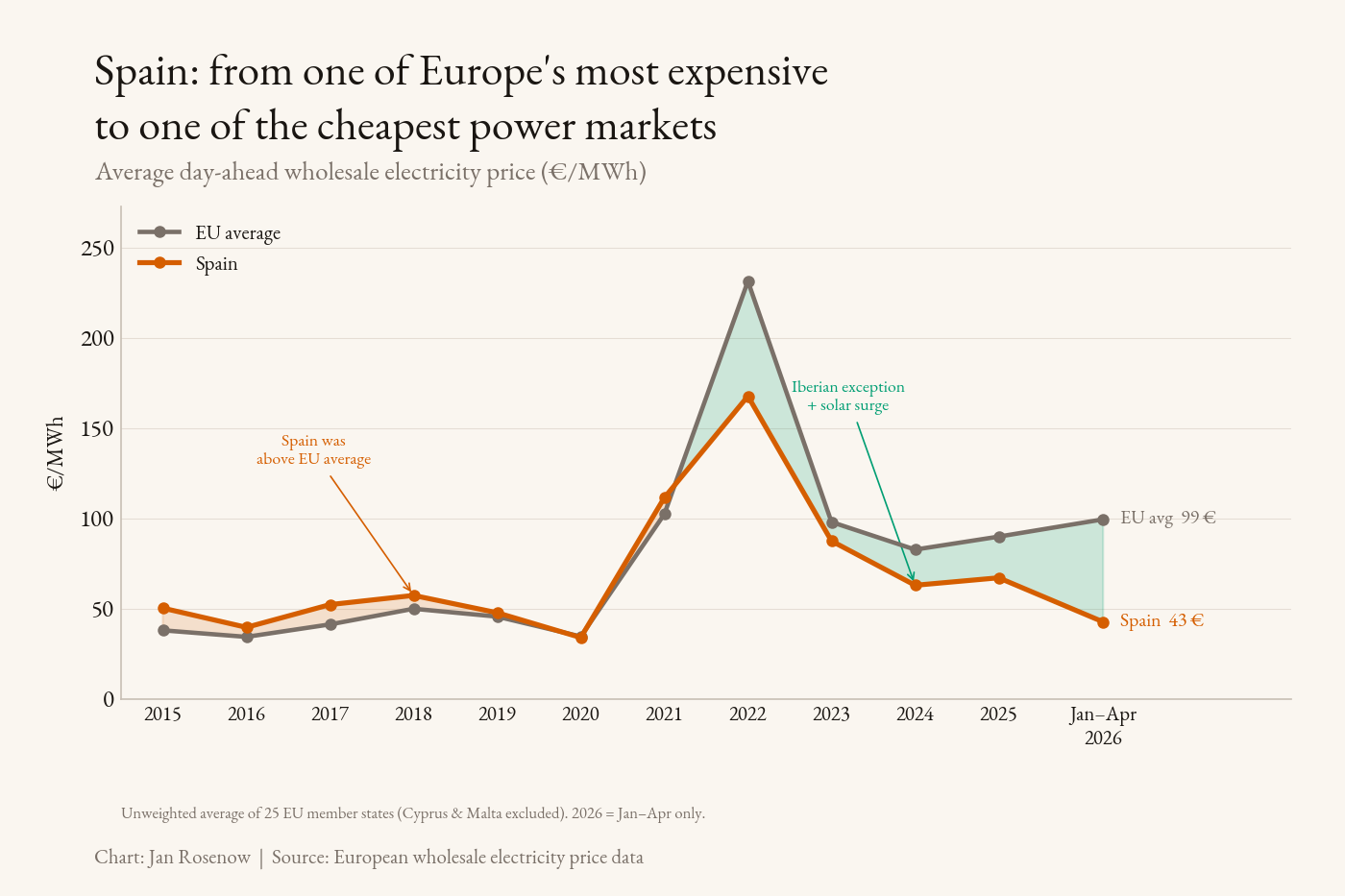
2022 also a turning point for wholesale electricity prices in Spain: The Iberian exception capped electricity prices initially to below EU27 average prices but even after the mechanism ended Spain widened the price gap further.
Why this shows up in the price
In a wholesale electricity market, the price in any given hour is set by the most expensive plant that needs to run to meet demand. For most of Europe, for most of the last decade, that has been a gas plant. The merit-order link from gas prices to power prices is the reason European households got an electricity bill shock when Russian pipeline gas collapsed in 2022.
What has quietly happened in Spain is that gas now sets the price far less often. In 2022, gas was the marginal plant in roughly 55% of all hours. In 2024 it had fallen to 27%. By the first four months of 2026, it was just 9%.
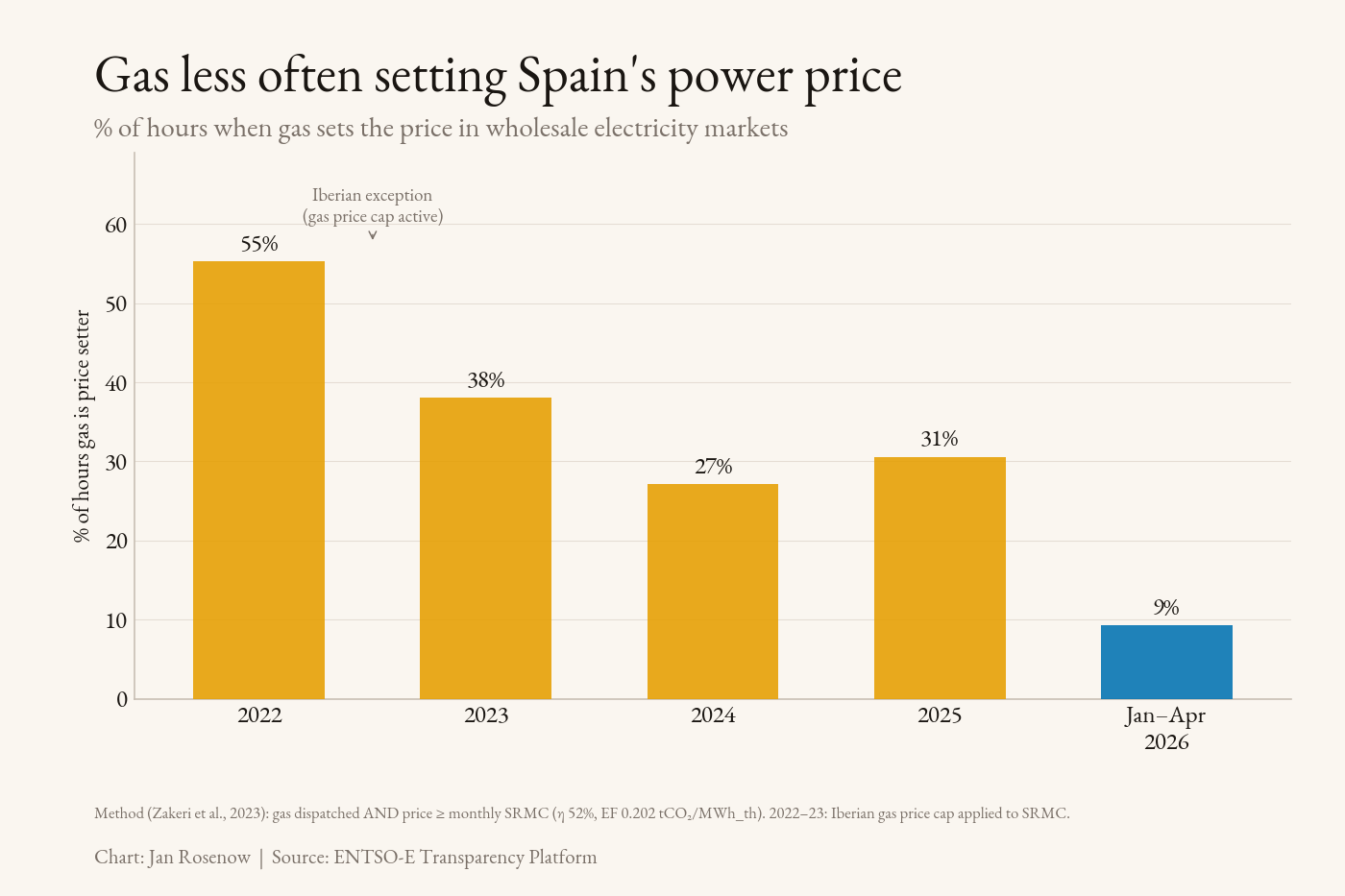
A note on methodology: The gas price-setter share is estimated using the method of Zakeri et al. (2023). For each hour, two conditions are checked: is gas actually generating, and is the market price at or above the calculated short-run marginal cost of running a gas plant? If both are true, gas is counted as the likely price setter. The marginal cost is calculated from monthly TTF and EU ETS prices, assuming a modern combined-cycle gas turbine with 52% efficiency. The chart counts hours where gas is directly dispatched and the market price reaches the calculated short-run marginal cost of gas generation, and likely understates the true influence of gas prices on the Spanish market. Feedback I have received on the analysis above suggests that two effects are not captured: hydro generators often bid not at their near-zero running costs but at the opportunity cost - essentially what they could earn when prices are high, which are usually set by gas. And cogeneration plants burn gas but have their costs calculated under a specific Spanish regulatory formula rather than the spot gas price, so they don't show up in the standard test the methodology uses. Gas is genuinely setting the price in those hours, but the method doesn't count it. The more precise claim is that gas generation at the margin is declining fast but gas price influence on the market remains broader than the headline figure suggests.
What this is not
Four things this story is not.
It is not a claim that gas has gone away. Gas still supplies around 1/5 of Spanish electricity, roughly the same share as nuclear. Its role on the margin (the price-setting bit) has shrunk faster than its role in the energy mix (the megawatt-hours-burned bit).
It is only the wholesale price. The €44/MWh figure is what generators are paid in the day-ahead market. It is not what households pay. Network charges, system costs, suppliers’ margins, taxes and policy levies sit on top, and they can easily double or treble the underlying figure by the time it reaches a domestic bill. Wholesale moving cheaper is necessary for retail bills to fall, but it is not sufficient.
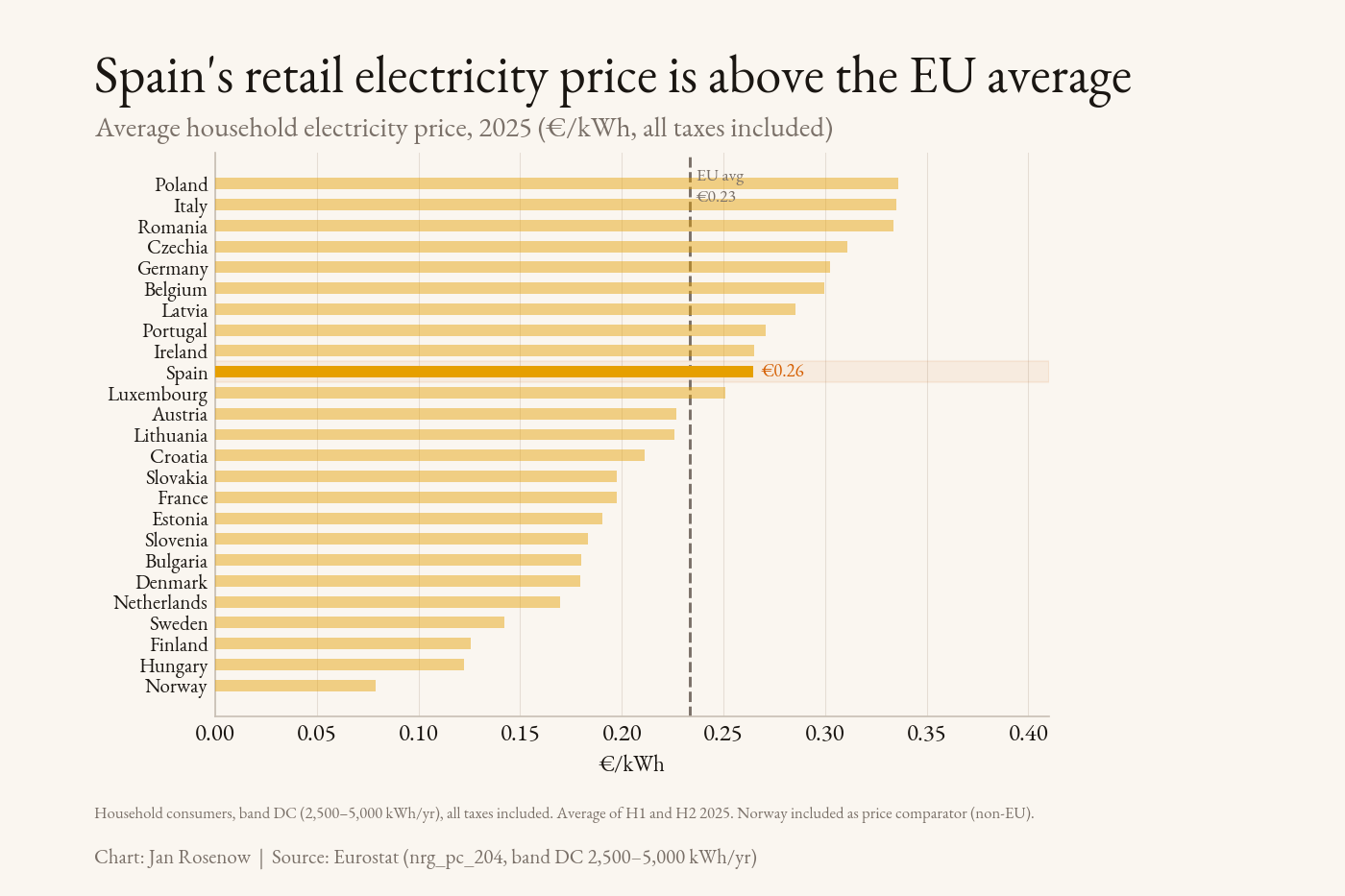
Despite having Europe’s cheapest wholesale electricity, Spanish households pay above the EU average €0.265/kWh in 2025, ranking 16th out of 25 countries. That puts Spain more expensive than France, the Netherlands, Denmark, and most of Central and Eastern Europe. Some of this is to do with the amount of taxes and levies put on electricity
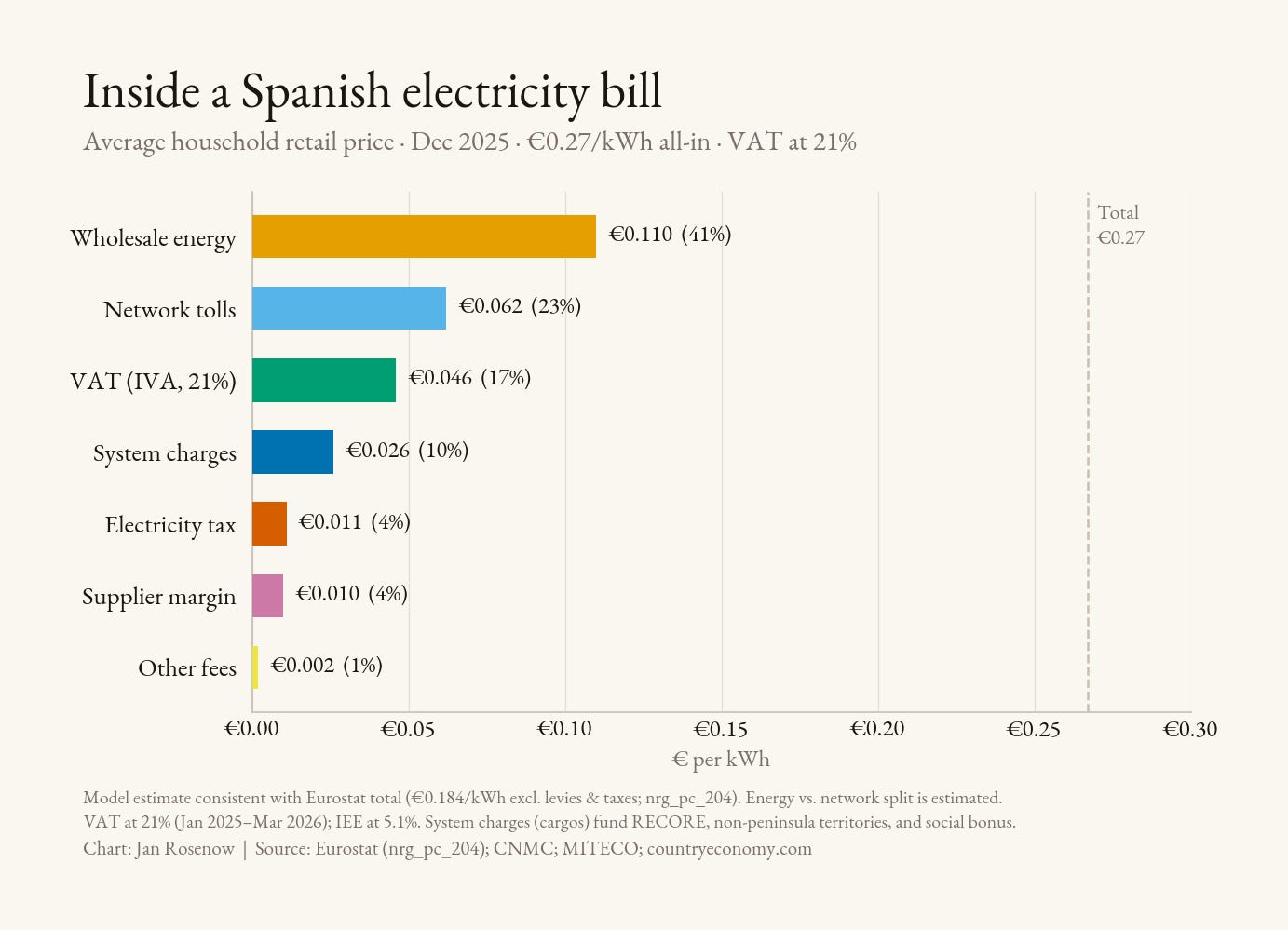
The chart below decomposes a typical Spanish household electricity bill into its main cost components. The total (€0.27/kWh, Eurostat, December 2025) and the broad tax-and-levy share (~31%) are anchored in official data; the sub-breakdown between energy, network charges, and system costs is a model estimate consistent with that total rather than a figure drawn from any single source.
Three caveats are worth keeping in mind:
First, the wholesale energy component - the largest slice - moves daily with the power market, so the share shown reflects a December 2025 average and can swing well beyond that range across the year.
Second, Spain has adjusted electricity taxes repeatedly in recent years: VAT fell from 21% to 5% during the 2022 energy crisis before being fully restored to 21% by January 2025 - the rate shown here - while the electricity excise tax (IEE) was cut again to 0.5% in March 2026. A chart drawn for a different month can look meaningfully different.
Third, free-market and regulated tariffs present the same underlying costs differently: on a commercial fixed-price contract, network tolls are typically bundled into the energy rate rather than shown separately, so the relative slices shift even though the underlying economics are identical.
One further simplification: part of every Spanish bill is a fixed daily charge based on contracted capacity in kilowatts, independent of energy consumed. Expressing this as a per-kWh figure - as the chart necessarily does - overstates the unit cost for low-consumption households and understates it for high-consumption ones.
Other system costs are rising. The flip side of getting energy cheap is paying more elsewhere to keep the system stable. Spain is procuring more balancing services, more reactive power and voltage support, and ultimately more transmission to move wind and solar from where the resources are good to where the demand is. Those costs land on consumers through network and policy charges rather than the wholesale price. They are not yet large enough to offset the wholesale gains, but they are climbing.
Nuclear is still doing the work, and the policy is to switch it off. About a fifth of Spanish electricity comes from a fleet of reactors scheduled to retire between 2027 and 2035. If those reactors come off the system without an equivalent low-carbon replacement, gas will move back up the merit order and the gas-setter share will climb again.
What it is
For all those caveats, this is the clearest example in Europe of the price effect that renewable advocates have been describing for years finally arriving in the data. More wind and solar on the grid means fewer hours when gas is the marginal plant. Fewer of those hours means a wholesale price that is decoupled from the gas market for most of the day. And a wholesale price decoupled from gas, in 2026, is a cheap one.
Spain is now a working demonstration that you can take an electricity system that was 33% coal a generation ago, 30%-plus gas a decade ago, and run it on roughly 44% wind-and-solar with the resulting wholesale prices among the lowest in Europe. The remaining questions are about resilience, about who actually captures the savings, and about how far the substitution can go before nuclear retirements reopen the gap. Another key question is also whether rising energy system costs (grids, balancing etc.) will be offset by lower wholesale prices.
The April 2025 blackout was not what the headlines said it was
On 28 April 2025 the entire Iberian peninsula went dark for most of a working day, and nearly 60 million people lost power. On the day, several high-reach outlets immediately blamed renewables with no evidence. The final ENTSO-E investigation, out nearly a year later, finds the opposite. Damian Cortinas, chair of ENTSO-E’s board, told the Financial Times that “the issue is not about renewables” but about the grid’s ability to manage “fast voltage variations” that can destabilise the system. Unusual oscillations triggered a cascade of plant disconnections, and grid managers lost control. The real lesson is not that Spain has gone too far on wind and solar, but that every country in Europe needs to modernise how it handles voltage stability. Spain, in Cortinas’s framing, is “a pioneer” encountering things “everyone else could encounter at some point”. The fixes exist today, statcoms (voltage shock absorbers), better disconnection protocols, and voltage control capabilities required of all generators rather than only renewables. “There is nothing in the recommendations that cannot be done tomorrow,” Cortinas told the FT. The open question is who pays for upgrading the existing fleet, and that, he said, “will need to be looked at in every country”.