









I. The Boneyard
Through the heat haze, airplane tails rose from the desert. As I steered off the interstate toward Pinal Airpark, in Marana, Arizona, I got my first view of a corpse in full: a stark-white Boeing 747, its wings sheared off, its passenger doors open to the dust and wind, a rickety set of airstairs inviting no one aboard. The plane was a memory, a ruin, but its swooping, humped nose was still striking—a visage that signaled the freedom of movement in the Jet Age.
Check out more from this issue and find your next story to read.
I was arriving at this desolate site north of Tucson, where airplanes go to die, to mourn the 747, the original jumbo jet—a.k.a. the Whale, the Longreach, the Sky Cruiser, the Mother of All Airliners, the Queen of the Skies. For 50 years, the aircraft was the principal host of Important Journeys: a young student’s trip to study abroad in Paris, a first-generation American’s pilgrimage to their ancestral home in Hungary, an Iranian family fleeing the 1979 revolution. Combining the immensity of an ocean liner and the elegance of a swan, the 747 is the only commercial jet that deserves to be called beautiful. Over the past two decades, airlines have stopped using it as a passenger plane and replaced it with smaller aircraft that are more efficient, but far less majestic and memorable. The 747 was once a symbol of American might, invention, progress, and populism. Now it embodies the decline of all of those values.
Jim Petty, the airpark’s manager, led me out the back door of his small office to his truck, and we peeled out toward the long rows of forsaken aircraft. I had been calling Pinal a boneyard, but Petty told me that he doesn’t like the term. Some planes get brought here for a checkup, others for intensive care or storage. Some ailing vessels are delivered here with every intention of flying again, like an elderly relative sent to a short-term-care facility. But if rehabilitation proves impossible, Pinal becomes their final destination.
Sign up for Ordinary Extraordinary, Ian Bogost’s guide to making everyday life vivid again. You’ll receive the first edition of the limited-run newsletter course in early July.
Petty parked us under a TWA 747 that had been sitting there for almost 30 years. Its enormity eclipsed the hot desert sun. The tires alone were more than four feet tall, a memorial to outsize ambitions. From 1970, when the first 747 entered service, to 2023, when Boeing stopped building the plane, the company manufactured 1,574 of them, including the two that still serve as Air Force One. Most 747 routes spanned oceans and continents, giving travelers a speedier option than the Queen Mary had across the Atlantic, or the California Zephyr across the West. For generations, these jumbo jets flew to London, to Osaka, to San Francisco. But more recently, 747s have been flying to Pinal—drawn here by their own obsolescence.
“Some day,” Petty said, “there’s just going to be one left.”
II. Birth of an Icon
Starting the engines brings a sudden hush followed by a smooth roar. At 300-some metric tons, fully loaded, and with a wingspan that would cover two-thirds of a football field, the plane could be tricky to drive but was supple to fly. On the ground and about three stories up, pilots were aware of all they couldn’t see. Once airborne, though, a sense of infinity dawned out the cockpit windows, and of sheer mass behind the pilots. In the cabin, the heft makes the plane feel almost still, even at 500 miles an hour and 35,000 feet; it is the only plane I have ever flown in whose takeoff and landing were imperceptible to the senses. Paul Gallaher, a longtime 747 captain, told me he couldn’t remember a hard landing. He said that it was the plane every pilot wanted to fly, the top rung of a commercial-aviation career.
Like most technological innovations of the 20th century, the 747 project was catalyzed by the military. In the early 1960s, Boeing produced designs in response to a government request for a large military transport aircraft. Lockheed won that job and produced the C‑5 Galaxy. Boeing’s loss steeled its resolve and freed up engineers to work on the biggest airplane ever built for commercial service. Boeing acquired 780 acres of land in Everett, Washington, just north of Seattle, and erected an assembly complex that included the largest building in the world by volume—at a cost of $200 million ($2 billion in today’s dollars)—to house up to eight 747s under construction. About 2,700 engineers labored on the project.
Aviation executives called a risk like this the “sporty game”—a shameless mid-century, flannel-suit euphemism for staking an entire company on a single long-odds bet. Had the 747 project faltered, Boeing would likely have gone down with it.
Thomas Gray, who joined Boeing in 1961 as an electrical engineer, calls himself the “first passenger on the first 747,” responsible for in-flight testing. “Whether it was strain, arrows, airspeed, whatever,” he told me, “we had to measure all that data onto a tape machine.” Gray, a lanky man with a gray mustache, volunteers as a docent at the Museum of Flight in Seattle, just across from Boeing Field. For 17 years, the 747 served as his office. This was the Wild West of commercial aviation, after planes had been proven but when the Jet Age was still new and exciting.
Watching the plane’s first flight from the blast fence, in 1969, Gray remembers telling a fellow engineer beside him, “One of these days, there are going to be 747s lined up to take off.” He was right. Boeing’s earlier jets—the 707, 727, and 737—carried fewer than 200 souls. The 747 could carry north of 490 passengers, plus a massive amount of cargo, and still fly thousands of miles farther than most existing jets. Juan Trippe, who ordered 25 747s for Pan Am in 1966 at a cost of $5 billion in today’s dollars, saw the plane as an instrument of human flourishing. “The new era of mass travel between nations may well prove more significant to human destiny than the atom bomb,” he said at the time, calling the aircraft “a great weapon for peace.”
The jumbo jet would make the world smaller in the same way that railroads and ocean liners had in the century prior. This was the age of seemingly impossible endeavors undertaken and accomplished despite extreme risk; five months after the 747 first took flight, Neil Armstrong set foot on the moon. This spirit of rarefied American invention, fueled by both government investment and private capital, was meant to serve all humankind.
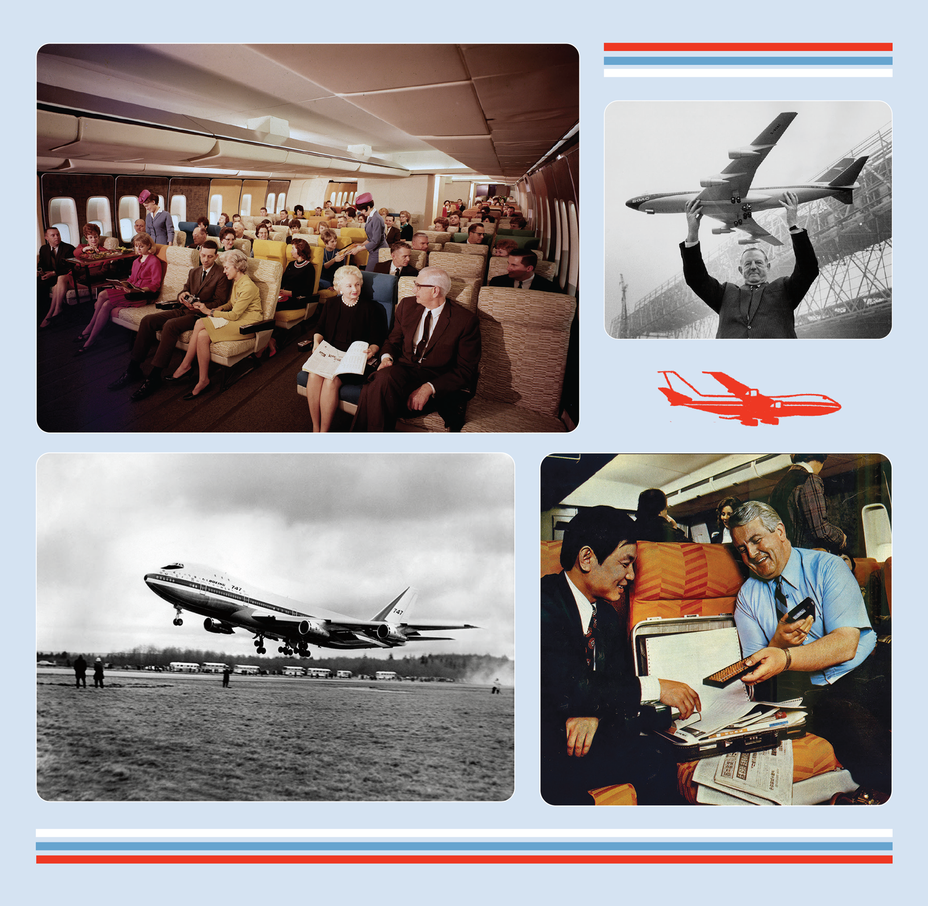
It worked. From 1969 to 1979, the number of people flying every year more than doubled, to 640 million. Flying was glamorous—in part because it was expensive, but also because the 747 was built for human comfort as well as fuel efficiency.
Speed was expected to supplant comfort, eventually. In anticipation of supersonic flight, the 747 was designed to shift into cargo duty sometime by the end of the ’70s; its cygnine hump allowed containers to be loaded through its nose, which opens like the mouth of a cartoon shark. But the supersonic passenger jet was a bust, and the 747 persisted. Its accidental longevity defined an era.
III. Legroom and Caviar
The British architect Norman Foster once called the 747 his favorite building of the 20th century. Like the ocean liners and railcars it replaced, the 747 is more than a vehicle. It is also a dwelling.
The upper-deck lounge became the first and most important room in this building—though somewhat incidentally. The charge to make the plane capable of loading cargo through its nose required the flight deck to be situated above the main section. Once the flight deck was placed high, over the cargo slot, the plane needed to sweep back accordingly for aerodynamics, one retired Boeing engineer told me. What to put in that space?
A cocktail bar, obviously. Air France and United installed lounges with rotating seats to allow passengers to mingle. Air India put in bright-red carpeting and sofas, with images of apsaras on the bulkhead behind them. Qantas offered the nautical-themed Captain Cook Lounge, with lantern sconces, intricate woodwork, and rope-wrapped swivel seats and cocktail tables.
Boeing named its first 747 the City of Everett, after its birthplace, and painted it in Boeing’s corporate color scheme: white with a red cheatline, a gray belly, and a black glare panel. Gray and his colleagues used the City of Everett for testing; it was never outfitted with an interior. The aircraft now lives at the Museum of Flight. Visitors can take a tour inside but are generally not allowed up the spiral staircase to the upper deck and cockpit.
I negotiated an exception. When I ascended the tight stairwell, I was surprised to see it decorated as a lounge, complete with antiqued mirrors on the rear bulkhead, blue carpeting, and vivid, mod-printed seating. At some point in the City of Everett’s long life, an upholstery shop had redone the upper-deck seating with old Braniff Airways fabric.
Peggy Verger and Cheryl Grimm, two former United flight attendants, met me in the lounge to share memories of service on early 747s. For Verger, luxury wasn’t really the point of the plane’s interior design. “We’ve lost the personality of flying,” she said. At first I thought she was talking about the style—the Pucci-designed Braniff uniforms, or Eero Saarinen’s modernist terminals. But she meant personalities. She meant people. “We loved talking to the people,” Verger said. “The lounges, the wide aisles. We were tight with the passengers. ‘So how’s your dog?’ We were much more social.”
Travelers turned in their seats to their neighbors. They stood up and chatted with someone across the aisle. They moved through the cabin to a lounge, or to ask for a coffee. Sometimes, after giving children pin-on airline wings, the stewardesses—as they were called at the time—would recruit them to help pass out nuts or matches. “It just was all so different,” Verger added. “The passenger was a person.”
The food in first class was rich: hand-carved meats, lobster, caviar. Even fliers in the back ate like royalty; on a 1970 Pan Am flight from JFK to Heathrow, a coach-class passenger would have enjoyed filet mignon. Small sofa lounges were tucked into the front or rear of some aircraft. One Continental Airlines 747, called the Proud Bird of the Pacific, had a spacious Polynesian Pub in the coach cabin, with floral-print seats around low-slung pedestal tables. American Airlines built a coach lounge with black-and-white geometric carpet and red upholstered seating that anyone might mistake for a hotel lobby. American installed a piano bar there, too, although it used an electric organ (pianos are hard to keep in tune when subjected to the forces of takeoff and landing).
Features like these inspired Continental, in 1971, to advertise its 747 flights as “Air Cruises.” Grimm recalled constant activities and contests. Passengers celebrating a birthday or an anniversary could order a cake or a bottle of champagne. “It was just a nice party,” she said.
The cabin’s ceilings rose to eight feet—even at the window seats—and the exterior walls stood nearly straight up and down, allowing even the tallest passengers to stand upright, like a human instead of a sardine.
Use of the whole space was encouraged. Why make a building for people to remain seated in? A TWA pamphlet about 747 service from the early 1970s encouraged passengers to exercise on their flight: “Walk 13 times up and down the cabin and you’ve actually covered one mile.” Continental once boasted of removing 41 seats for four extra inches of legroom in coach. Even on a three-hour domestic flight, the experience of the airborne building was deemed as important as the transportation itself.
Wide-body airliners made global flight accessible to many people, but industry growth slowed by the mid-1970s. The 1973 oil shock made fuel more expensive, altering the fundamentals of the airline business. Hijackings surged, leading to the invention of airport security. In 1978, deregulation transformed the economics of the domestic airline industry. Fares dropped dramatically, and more people began to fly. As the clientele became more pedestrian, flying felt less cosmopolitan.
And the comforts started to vanish. The social spaces and coach lounges began disappearing so the airlines could cram in more passengers—including into the upper deck, which became certified for passenger seating during taxi, takeoff, and landing. The new hub-and-spoke model of air service started displacing milk-run paths. Domestic flights on the 747, such as the Chicago-L.A. leg of the Proud Bird of the Pacific, became rarer. Instead, the aircraft mostly flew people over oceans. The most beautiful building of the 20th century was becoming just another vehicle.
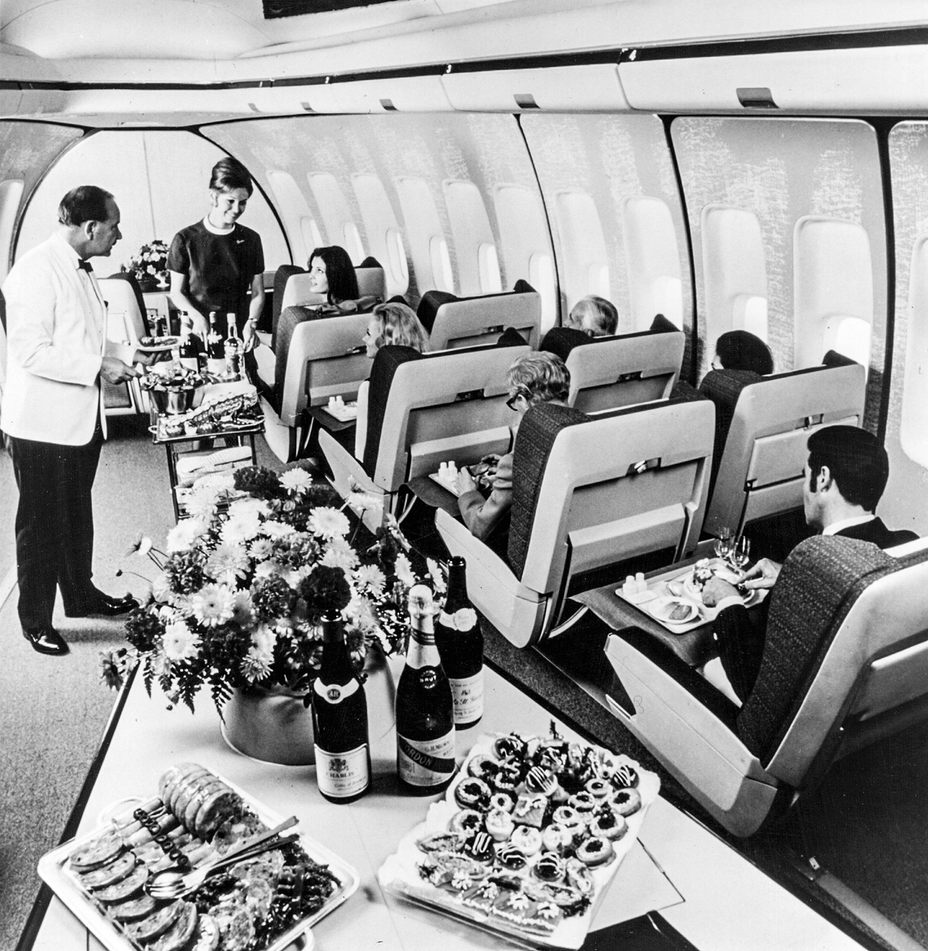
Fox Photos / Getty
A first-class lunch served in the nose of a Boeing 747, 1970
IV. Metal Tubes With Wings
Before the September 11 attacks closed terminals to the unticketed, anyone could pass through the metal detectors and go right up to the gate. You could do this to welcome or send off a loved one. You could meet up with a friend on a layover. Or you could just see the planes.
Cheryl Grimm remembers passengers bringing their friends to the gate, just to see her 747 taxiing. Pilots remember it too. Mark Vanhoenacker flew 747s for British Airways out of London until 2019, just before the airline removed the plane from service. He told me about disembarking at his favorite destinations—Cape Town, Tokyo, Vancouver—and looking over his shoulder in childlike wonder. I can’t believe I flew that airplane a third of the way around the world, he’d think to himself.
The aircraft began service in the middle of the Vietnam War. In 1975, after the tragic crash of a C‑5 Galaxy military transport aircraft meant to evacuate Vietnamese orphans, two chartered Pan Am 747s stepped in as a part of Operation Babylift. That effort was accused of both propagandism and abduction. But many citizens were desperate to leave Vietnam, and they did so voluntarily, in the bosom of the Mother of All Airliners.
For that reason, Peggy Verger understood crewing the 747 as a patriotic act. She remembered a group of Vietnamese refugees boarding a flight of hers in Tokyo. “And when they got off—they were doctors and lawyers, and a lot of them spoke English—they would say things like Thank you for letting me come into your country,” she said, stopping to press her heart. “Tears coming down.” Grimm remembers similar scenes, on flights to Vancouver before Hong Kong reverted to Chinese rule. Or Russian immigrants on flights to New York: a whole family, from the grandmother to the children, taking up an entire row of the airplane, each with just a little sack of belongings. Grimm would think to herself: Thank you, Lord, for letting me be born in America.
The 747’s fusion of aeronautical ability and symbolic power earned it many roles beyond passenger liner and freighter. By 1977, Thomas Gray, the Boeing engineer, was running test flights for a heavily modified Whale to carry the space shuttle Enterprise atop it. NASA used the plane to shuttle the shuttle from its landing sites back to the Kennedy Space Center, in Florida. One icon of America had settled the global skies, and on its shoulders sat another, set to conquer the cosmos. The sight of the pair mated together suggested that the 20th century’s progress would never end.
It did, of course. The shuttle program closed in 2011, as 747s were already disappearing from the skies. Today, beholding a 747 in person has become harder, especially in the United States. The charter carrier Atlas Air flies some, as does the freight operator Kalitta, but even their numbers are dwindling as companies move to more efficient two-engine aircraft. Lufthansa flies the most scheduled passenger flights on the 747—between Frankfurt and destinations that include Chicago, Los Angeles, and Washington, D.C.—and Korean Air also still runs the plane overseas. But the 747 has moved downmarket: China, Iran, and Russia use them for bus-like domestic routes. Even when foreign carriers fly 747s, though, the sight of one of their planes invokes American ingenuity, because the aircraft was designed and built by America.
When the 747 is gone, other aircraft will service high-capacity, long-haul routes: the Boeing 777, for example, and the Airbus A350. But none of those planes will symbolize global access and renewal, because nothing about any other plane is symbolic. They all look and feel the same. They are just metal tubes with wings. When we are on a plane these days, we are really inside our headphones, sewn into our seats, yearning for it to end. The miracle of flight itself goes unnoticed, as even daytime travelers draw their shades. They do so to sleep, or to increase the contrast on their screen. Striking up a conversation is taboo. Six miles aboveground, you feel buried rather than aloft.
V. The Flying Oval Office
The last 747 on Americans’ radar is the one carrying Donald Trump. Air Force One has been a 747 for nearly 36 years, since George H. W. Bush first ascended its staircase on September 6, 1990, to fly from Andrews Air Force Base to Topeka, Kansas, for a fundraising luncheon.
Air Force One is heavily modified and highly customized—its 4,000 square feet of interior space include a medical facility and two kitchens that can serve 100 gourmet meals—but from the outside, it still looks the same as any other 747, from Pan Am onward, apart from the color scheme and presidential seal. In previous eras, the most powerful person in the world boarded the same equipment that you might use to take a Hawaiian vacation. But there was something regal about a president descending those steps, or waving from the top of them, on foreign soil. The plane is a literal ship of state. On September 11, 2001, amid a nationwide ground stop while the country was under attack, Air Force One was George W. Bush’s “flying Oval Office,” to borrow Boeing’s phrase. Trump loves to do domestic flyovers—of his rallies, of a Washington Commanders game in November—and show off the sheer size of the plane at low altitudes.
But Air Force One has aged. The two 747s that currently share the duty are the same ones that Bush 41 flew on. In 2018, the first Trump administration struck a $3.9 billion deal with Boeing to make two new planes, based on the 747-8, the aircraft’s final variation. The planes were meant to be delivered by 2024, but they have not arrived. The project has been plagued by technical issues, supplier disputes, and alleged tomfoolery—empty mini tequila bottles were reportedly discovered on one of the airplanes under construction. Boeing has absorbed more than $2 billion in cost overruns on the project. (“We continue to make steady progress” on the project, a Boeing spokesperson told me.)
The stumble couldn’t have come at a worse moment for the company. Around the same time that Trump ordered the new Air Force Ones, Boeing 737 Max 8 aircraft began experiencing software problems that eventually led to disaster, including two accidents that killed 346 people. All planes in the fleet were grounded. Boeing paid large penalties and settlements in the ensuing years, and faced increased competition from Airbus, its European rival. In January 2024, an Alaska Airlines 737 Max 9 suffered a door-plug blowout due to improper installation. The company that once played the sporty game to invent the jumbo jet couldn’t seem to make new versions of its bread-and-butter mid-range aircraft.
By spring 2025, still without his new Air Force One, Trump began to consider accepting a luxury-appointed Boeing 747-8 as a gift from Qatar instead. Despite concerns about corruption and national security, the government took the gift, valued at $400 million. Only a “stupid person” would decline a “free, very expensive airplane,” Trump said at the time. The cost of modifying the plane for presidential use is classified; “probably less than $400 million” is what Air Force Secretary Troy Meink told Congress last year. The Air Force announced on May 1, 2026, that the aircraft is scheduled to fly this summer, with a new red, white, and blue livery. Will the American taxpayer end up paying for both the retrofitting and the new planes? “Yes,” an Air Force spokesperson told me.
Another problem plagues a presidential 747, whether or not an emir delivers it: It is not a plane of the people anymore. It is a rarity, more often an opulent private palace than an instrument of common carriage. The likeliest way for me to fly on a 747 in the United States, at this moment, would be in a press seat on the president’s plane.
A common route for Air Force One these days is from Andrews Air Force Base to Palm Beach International Airport, for Trump’s weekends at Mar-a-Lago. I figured that the White House, and even the president himself, might welcome me aboard, to experience the greatest passenger plane in the sky over the greatest country in the world. The White House nearly gave me a seat in late January, but then the trip filled up. On one of the flights I was not aboard that weekend, Trump told reporters that he had opened airspace in South America so that some immigrants could “go back to Venezuela and stay, perhaps.” America has traveled a long way from Peggy Verger’s huddled masses yearning to fly free.
In recent years, the 747 has amounted to an old plane for an old-man president. What will its next iteration symbolize? If a new Air Force One finally rolls off the beleaguered Boeing line, it will still be a fully American lodestar, however faded its shine. If instead Trump flies on a gift from a foreign power, it won’t matter how American its bones are.
VI. Farewell Tour
Flying is more a part of life than ever, but it feels disappointing at best, and inhumane at worst. This year, a Homeland Security shutdown created hours-long security lines; an elective war with Iran spiked the cost of fuel and ticket prices. Old dreams were forgotten too. The possibility of supersonic passenger travel has been abandoned in favor of trim-tab adjustments, such as Boeing’s 787 Dreamliner, with its bigger windows and less arid cabins. The competition that deregulation once spurred has all but dried up. The few airlines that are left, having been allowed to consolidate into oligopoly, have abandoned the medium-size cities that were their former hubs, such as Cincinnati, St. Louis, Pittsburgh, and Memphis. The big four U.S. carriers—United, Delta, American, and Southwest—have effectively become banks: The difference between profit and loss comes down to the loyalty points they sell to their credit-card partners each year. Cramped passengers are ruled not by bonhomie but by hair-trigger aggression, while flight crews seek compliance rather than kinship. No frills are left to entice or distract passengers. The main benefit of sitting in first class is that you might still be served free cocktails, while a coach passenger is left with a puny bag of carbs, one cup of soda, and complimentary (for now) trash collection. Forget about power and freedom. Commercial airplanes no longer symbolize anything except a desire to be anywhere else. Nobody cares what kind of plane they fly in anymore, so long as they are on it as little as possible.
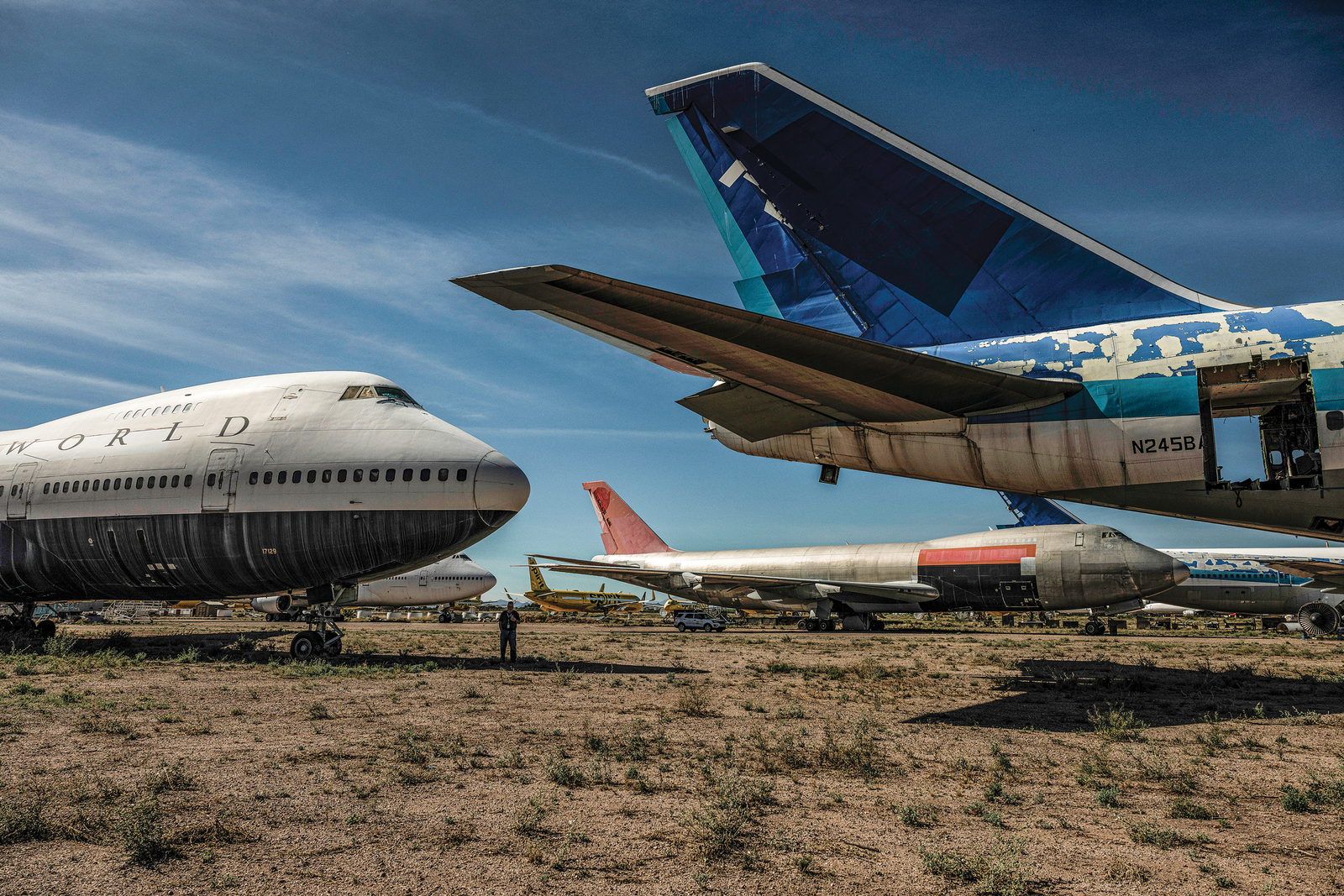
Adriana Zehbrauskas For The Atlantic
Planes sent to Pinal Airpark, in Marana, Arizona, for repair, storage, or scrapping
A quarter of the 21st century has now elapsed, but the 20th century, its engines cut, has managed to stay aloft. It is now finally landing, at Pinal Airpark in Arizona. “I flew the last passenger U.S. airplane to the desert,” Captain Steve Hanlon told me by phone from Atlanta, where he works for Delta as a flight-simulator pilot instructor. In 2017, Delta retired the aircraft (Ship 6314) and the rest of its 747 fleet for the same reason every other airline did and will: A four-engine jumbo jet is more expensive to operate than newer, if less striking, alternatives. Ship 6314 went on a farewell tour of former Northwest and Delta hubs, including hangar parties in Seattle, Detroit, Atlanta, and Minneapolis and a more somber affair in L.A. “Don’t say it’s ‘sad,’ ” Hanlon remembers the Delta corporate reps telling him. They also changed how he referred to the vessel—“she,” as sailors have done since antiquity—in an interview for a corporate press release. “Instead they put ‘it,’ ” he said, scoffing.
The scene aboard Ship 6314 was celebratory. A pilot and a flight attendant, who had met on a 747 military charter years earlier, were married in the air. But Hanlon, who had been flying 747s for 20 years, felt the pull of an ending as he held the Whale’s yoke, setting the aircraft down gently on the Pinal runway, with his co-captain, Paul Gallaher, by his side. “It was sad,” Hanlon told me. “Like putting my favorite dog down.” It was the last time either man would fly a 747.
Ship 6314’s phantom neighbors include the 747 that once transported the Ohio televangelist Ernest Angley, who used the plane to spread the good word before financial issues brought him back to Earth. Japan’s equivalent to Air Force One is also here. So is a 747 that was intended for Saudi Crown Prince Sultan bin Abdul Aziz and cost $300 million; it flew for less than 50 hours and is now being scrapped at Pinal—the aviation equivalent of parting out a brand-new Bugatti.
When Jim Petty, Pinal’s manager, parked us under the long-forsaken TWA 747, he pointed out the grid of missing skin where aluminum from the fuselage had been cut in tidy rows to make plane tags, a type of aviation collectible. Nearby, a former Korean Air vessel’s nose cone had been removed clean, as if seared off with a hot knife. A galley intercom phone hung from a chasm in the tail of another 747, swinging as if dropped from a phone booth in a film noir. Just above it, Petty pointed out a hawk roost. “For five years they came here,” he said. “I always thought it was cool that a bird made its nest in a plane.”
When all of the useful parts have been claimed from a corpse, industrial scavengers tug the remains to a cement pad, where excavators tear the vessel into bits of metal, Petty explained. The scrap gets loaded onto 18-wheelers and hauled away for recycling. “It’s never used again to make an aircraft,” he said, “but it goes into wheels for cars, or beer cans.” Pointing at the Diet Coke he gave me upon arrival to quench my desert thirst, Petty noted that it might once have been a small piece of the Queen of the Skies.
Almost all of the engines had been harvested from these planes. Removing the weight can cause the planes to tip upward, and point their noses to the sky. The blades of one abandoned engine, lying at Pinal since 2014, issued a tinny clatter as they spun in the breeze. “It makes me think that the plane wants to head out,” Petty said. “It wants to go.” But both of us knew better. It was a death rattle, and for more than just a type of airplane.
In the faux–Braniff lounge aboard that first 747, at the Museum of Flight, I had asked Cheryl Grimm and Peggy Verger for their best memory of the aircraft. The former flight attendants couldn’t summon a story, and instead fell back on a feeling. “You were just happy to be there,” Verger said. Grimm could only echo that bygone affection: “You were just happy to be there.”
*Illustration source images: Adsr / Alamy; Jim Gray / Keystone / Getty; Diana Walker / Getty; Gene Glover / Agentur Focus / OSTKREUZ Archiv / Redux; Francois Pages / Paris Match / Getty; © SAS Museum Oslo Norway.
This article appears in the July 2026 print edition with the headline “Queen of the Skies.”
此内容由惯性聚合(RSS阅读器)自动聚合整理,仅供阅读参考。 原文来自 — 版权归原作者所有。