


惯性聚合 高效追踪和阅读你感兴趣的博客、新闻、科技资讯
阅读原文 在惯性聚合中打开

推荐订阅源

GbyAI
GbyAI
T
Tenable Blog
Webroot Blog
Webroot Blog
L
Lohrmann on Cybersecurity
S
Securelist
S
Schneier on Security
NISL@THU
NISL@THU
Know Your Adversary
Know Your Adversary
C
Cybersecurity and Infrastructure Security Agency CISA
T
The Exploit Database - CXSecurity.com
L
LINUX DO - 热门话题
C
CXSECURITY Database RSS Feed - CXSecurity.com
O
OpenAI News
I
Intezer
Threat Intelligence Blog | Flashpoint
TaoSecurity Blog
TaoSecurity Blog
S
Secure Thoughts
Application and Cybersecurity Blog
P
Privacy International News Feed
H
Hacker News: Front Page
N
Netflix TechBlog - Medium
M
MIT News - Artificial intelligence
博客园 - Franky
PCI Perspectives
PCI Perspectives
OSCHINA 社区最新新闻
OSCHINA 社区最新新闻
Microsoft Azure Blog
MongoDB | Blog
MongoDB | Blog
L
LangChain Blog
P
Proofpoint News Feed
S
Security Affairs
WordPress大学
WordPress大学
The Last Watchdog
The Last Watchdog
S
SegmentFault 最新的问题
小众软件
小众软件
F
Full Disclosure
博客园 - 叶小钗
cs.AI updates on arXiv.org
T
The Blog of Author Tim Ferriss
Simon Willison's Weblog
P
Palo Alto Networks Blog
Security Latest
Security Latest
P
Proofpoint News Feed
月光博客
月光博客
T
Tailwind CSS Blog
Scott Helme
Scott Helme
Hacker News - Newest:
Hacker News - Newest: "LLM"
Google Online Security Blog
T
Threat Research - Cisco Blogs
Help Net Security
Help Net Security
Project Zero
Project Zero

Hacker News

Introducing Claude Opus 4.7 Qwen Studio The Future of Everything is Lies, I Guess: Where Do We Go From Here? GitHub - SeanFDZ/macmind: Single-layer transformer in HyperTalk for the classic Macintosh Show HN: Agent-cache – Multi-tier LLM/tool/session caching for Valkey and Redis Ancient DNA reveals pervasive directional selection across West Eurasia [pdf] Moving a large-scale metrics pipeline from StatsD to OpenTelemetry / Prometheus GitHub - Nightmare-Eclipse/RedSun: The Red Sun vulnerability repository GitHub - SethPyle376/hiraeth: Local AWS emulator focused on fast integration testing, with SQS support, SQLite-backed state, and a debug-friendly web UI. GitHub - macOS26/Agent: Any AI, replaces Claude Code, Cursor, OpenClaw. Over 18 LLM providers (Claude, OpenAI, Gemini, Ollama, Zai, HF, Qwen) wired into a native Mac app that writes code, builds Xcode projects, bumps versions, manages git, automates Safari, use AppleScript, JS or Accessibility, extend Agent! w/ MCP Servers, run tasks from your iPhone via Messages. YouTube now lets you turn off Shorts I Made a Terminal Pager Burgers | マクドナルド公式 Commands — HackerNews CLI documentation ChatGPT for Excel PiCore - Raspberry Pi Port of Tiny Core Linux Live Nation illegally monopolized ticketing market, jury finds Google Broke Its Promise to Me. Now ICE Has My Data. Founding Engineer at Adaptional | Y Combinator CRISPR takes important step toward silencing Down syndrome’s extra chromosome GitHub - saffron-health/libretto: The AI toolkit for building reliable browser automations US v. Heppner (S.D.N.Y. 2026) no attorney-client privilege for AI chats [pdf] Unexpected €54k billing spike in 13 hours: Firebase browser key without API restrictions used for Gemini requests Retrofitting JIT Compilers into C Interpreters IPv6 – Google The Accursèd Alphabetical Clock Cybersecurity Looks Like Proof of Work Now Fragments: April 14 Cal.com Goes Closed Source: Why AI Security Is Forcing Our Decision | Cal.com - Scheduling Software for Online Bookings Laravel raised money and now injects ads directly into your agent When moving fast, talking is the first thing to break Too much Discussion of the XOR swap trick – Heather Cafe Introduction to Spherical Harmonics for Graphics Programmers The Grand Line Building a Z-Machine in the worst possible language High-Level Rust: Getting 80% of the Benefits with 20% of the Pain GitHub - duguyue100/midnight-captain: Inspired by Midnight Commander, tailored to my taste. How to build a `git diff` driver · Jamie Tanna | Software Engineer Center for Responsible, Decentralized Intelligence at Berkeley The Local Universe’s Expansion Rate Is Clearer Than Ever, but Still Doesn’t Add Up - A new synthesis of astronomical measurements confirms a persistent mismatch that could point to physics beyond current models The air throughout our homes is infused with microplastics. But there are things you can do to breathe less of them The disturbing white paper Red Hat is trying to erase from the internet – OSnews The Future of Everything is Lies, I Guess: Annoyances ‘Abhorrent’: the inside story of the Polymarket gamblers betting millions on war Productive procrastination — Max van IJsselmuiden maps, territory and LMs 447 Terabytes per Square Centimetre at Zero Retention Energy: Non-Volatile Memory at the Atomic Scale on Fluorographane Show HN: Pardonned.com – A searchable database of US Pardons 20 Years on AWS and Never Not My Job The Seasons are Wrong Artemis II crew splashes down near San Diego after historic moon mission We gave an AI a 3 year retail lease in SF and asked it to make a profit | Andon Labs How a dancer with ALS used brainwaves to perform live On filing the corners off my MacBooks Installing every* Firefox extension OpenClaw’s memory is unreliable, and you don’t know when it will break Steve Blank Nowhere Is Safe Chimpanzees in Uganda locked in vicious 'civil war', say researchers watgo - a WebAssembly Toolkit for Go linux/Documentation/process/coding-assistants.rst at master · torvalds/linux GitHub - callumlocke/json-formatter: Makes JSON easy to read. Founding Product Engineer at Bild AI | Y Combinator A compelling title that is cryptic enough to get you to take action on it GitHub - Keychron/Keychron-Keyboards-Hardware-Design: Industrial design files for Keychron keyboards and mice. 100+ models with CAD assets in STEP, DXF, DWG, and PDF. Source-available, with commercial use allowed for original compatible accessories within the license terms. [ANNOUNCE] WireGuardNT v0.11 and WireGuard for Windows v0.6 Released 1D-Chess Helium Is Hard to Replace Cooperative Vectors Introduction | Evolve Keeping a Postgres queue healthy — PlanetScale Our response to the Axios developer tool compromise Do Americans read print books, e-books or audiobooks more? The Zettelkasten Method in Obsidian: A Practical Setup Guide Artemis II Is Competency Porn and We Are Starving For It WeakC4 Flight Viz — Cockpit View A Mexican surveillance giant you’ve never heard of is now watching the U.S. border Surelock: Deadlock-Free Mutexes for Rust RISC-V 101 – what is it and what does it mean for Canonical? | Ubuntu The Problem That Built an Industry How Much Linear Memory Access Is Enough? | Solidean Investigating Split Locks on x86-64 Simplest hash functions Sybilproof reputation mechanisms (2005) [pdf] What is a property? How Complex is my Code? Static code analysis in Kotlin — tools overview Toffoli gates are all you need PGLite evangelism dcmake: a new CMake debugger UI Clojure on Fennel part one: Persistent Data Structures Fragments: April 2 Python Release Python install manager 26.1 The Life and Death of the Book Review - Liberties Bitcoin miners are losing $19,000 on every BTC produced as difficulty drops 7.8% God sleeps in the minerals Building slogbox Apple Silicon and Virtual Machines: Beating the 2 VM Limit Who was “Not Even Wrong” first? Pokemon Evolution Vs Darwinian Evolution The APL Programming Language Source Code
You should read Programming as Theory Building
birdculture · 2026-05-09 · via Hacker News

When I finished reading Peter Naur’s Programming as Theory Building my first thought was “How come nobody ever told me to read this?” I ended up reading it multiple times, as I attempted to collect my thoughts on why it makes so much sense.

Have you ever had a situation where you’re trying to explain something or say something, and you’re looking for a suitable word or term, but no matter how much you look for it, you can’t find it? I think Naur’s “theory” is that term when it comes to writing good code and creating maintainable software. I’ve had many ideas and thoughts on those topics, but they were all disparate concepts, which even when grouped together didn’t really answer the question “why is writing good software hard?” Viewing programming as “theory building”, as Naur puts it, is the missing piece that pulls all of it together and answers the question.

In summary, Programming as Theory Building suggests that the program code, documentation and other products are secondary to what programming really is about: Building an understanding, or a mental model, of the program, its requirements, and how they relate to everything around it. That is, your primary goal as a programmer is to learn, understand, retain, improve and share this “theory” of the program.
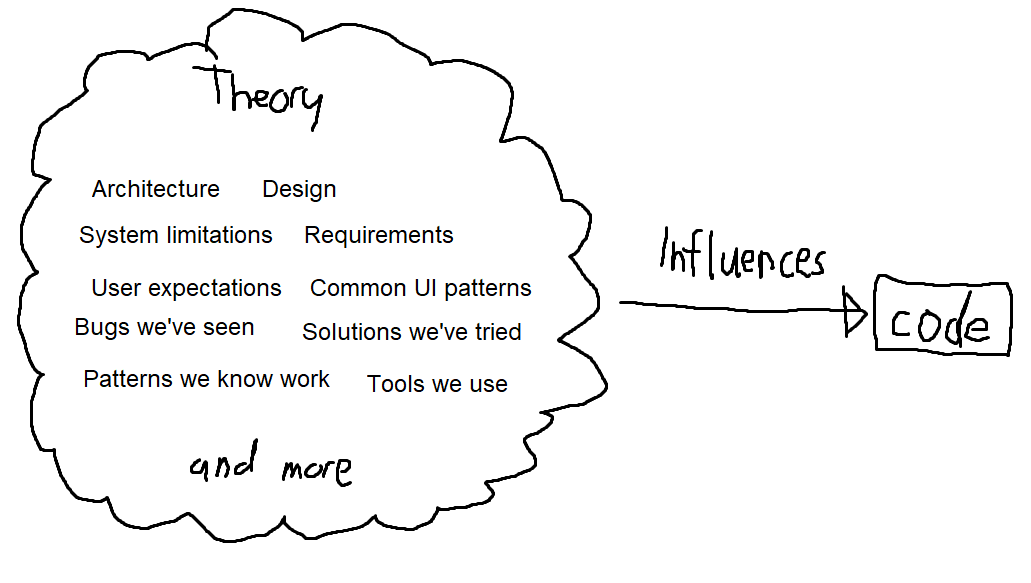
All the aspects of the theory influence the program code
I cheated and used the text tool in this drawing

If you think of things like “good code” or “maintainable code”, what is it that comes to mind? It’s probably things that make code easier to understand, like following good conventions, writing “clean” code, having a good architecture, and so on. You might also think of documentation and diagrams. Perhaps automated tests.

If you think about it, the goal with everything that relates to writing maintainable code is actually about communicating the design intention of the code. You write clean code because it’s easy to understand what it does, you architect code so it’s easy to understand its structure and purpose of the structure, you add documentation to help explain what the code does, and draw diagrams for similar purposes as well. But at least in my experience, developers treat the different aspects of this as separate activities - eg. writing tests is its own activity with its own goals, writing documentation is its own activity, and so forth.

If you look at programming as theory building in the way Naur suggests, you can see these activities as part of a larger whole: Communicating the theory of the program. When seen as part of a larger whole, you can start using the separate activities to achieve the shared goal better. And communicating the theory of the program is important: If you try to modify a program without having an understanding of the theory, you won’t be able to do it in a way that isn’t hacky. Similarly, if you need to evaluate the feasibility of some change to the code, such as a new feature, you cannot do this unless you have an understanding of the theory.

In this sense, programming is theory building.

If you think of it in this way, suddenly many more things connect together. For example, what do design patterns and Domain-Driven Design have in common? They help you communicate ideas and mental models used in your code - that is, they help communicate the theory of the program. Similarly, others have suggested concepts like Intellectual Control - having a mental model of the program, allowing you to confirm it works correctly, and reason about changes to it and so forth - which could also be seen as a form of “theory building”.

Hopefully I’ve managed to convey at least some of the value of reading Peter Naur’s essay. There’s more to it, so I highly recommend reading the original “Programming as Theory Building” text. It isn’t too long, and you can find it pretty easily on Google - I would link it, but it’s a bit of a gray area copyright-wise, and I’d have to deep link it from someone’s website. If you have read it, I’d love to hear your thoughts on it.