

惯性聚合 高效追踪和阅读你感兴趣的博客、新闻、科技资讯
阅读原文 在惯性聚合中打开

推荐订阅源

罗磊的独立博客
Forbes - Security
Forbes - Security
Blog — PlanetScale
Blog — PlanetScale
P
Proofpoint News Feed
Apple Machine Learning Research
Google DeepMind News
MyScale Blog
MyScale Blog
GbyAI
GbyAI
B
Blog RSS Feed
S
SegmentFault 最新的问题
freeCodeCamp Programming Tutorials: Python, JavaScript, Git & More
cs.AI updates on arXiv.org
CTFtime.org: upcoming CTF events
小众软件
小众软件
The Last Watchdog
The Last Watchdog
W
WeLiveSecurity
Webroot Blog
Webroot Blog
S
Security @ Cisco Blogs
Hugging Face - Blog
Hugging Face - Blog
Microsoft Security Blog
月光博客
月光博客
博客园 - 聂微东
F
Fortinet All Blogs
H
Hacker News: Front Page
A
About on SuperTechFans
Application and Cybersecurity Blog
C
Check Point Blog
V
V2EX
Threat Intelligence Blog | Flashpoint
Y
Y Combinator Blog
酷 壳 – CoolShell
酷 壳 – CoolShell
N
News | PayPal Newsroom
Cisco Talos Blog
Cisco Talos Blog
Exploit-DB.com RSS Feed
The Cloudflare Blog
P
Privacy & Cybersecurity Law Blog
N
Netflix TechBlog - Medium
C
CXSECURITY Database RSS Feed - CXSecurity.com
Recorded Future
Recorded Future
Cyber Security Advisories - MS-ISAC
Google DeepMind News
大猫的无限游戏
大猫的无限游戏
美团技术团队
Security Latest
Security Latest
钛媒体:引领未来商业与生活新知
钛媒体:引领未来商业与生活新知
I
InfoQ
Recent Announcements
The GitHub Blog
The GitHub Blog
Google Online Security Blog
T
The Exploit Database - CXSecurity.com

Hacker News

Introducing Claude Opus 4.7 Qwen Studio The Future of Everything is Lies, I Guess: Where Do We Go From Here? GitHub - SeanFDZ/macmind: Single-layer transformer in HyperTalk for the classic Macintosh Show HN: Agent-cache – Multi-tier LLM/tool/session caching for Valkey and Redis Ancient DNA reveals pervasive directional selection across West Eurasia [pdf] Moving a large-scale metrics pipeline from StatsD to OpenTelemetry / Prometheus GitHub - Nightmare-Eclipse/RedSun: The Red Sun vulnerability repository GitHub - SethPyle376/hiraeth: Local AWS emulator focused on fast integration testing, with SQS support, SQLite-backed state, and a debug-friendly web UI. GitHub - macOS26/Agent: Any AI, replaces Claude Code, Cursor, OpenClaw. Over 18 LLM providers (Claude, OpenAI, Gemini, Ollama, Zai, HF, Qwen) wired into a native Mac app that writes code, builds Xcode projects, bumps versions, manages git, automates Safari, use AppleScript, JS or Accessibility, extend Agent! w/ MCP Servers, run tasks from your iPhone via Messages. YouTube now lets you turn off Shorts I Made a Terminal Pager Burgers | マクドナルド公式 Commands — HackerNews CLI documentation ChatGPT for Excel PiCore - Raspberry Pi Port of Tiny Core Linux Live Nation illegally monopolized ticketing market, jury finds Google Broke Its Promise to Me. Now ICE Has My Data. Founding Engineer at Adaptional | Y Combinator CRISPR takes important step toward silencing Down syndrome’s extra chromosome GitHub - saffron-health/libretto: The AI toolkit for building reliable browser automations US v. Heppner (S.D.N.Y. 2026) no attorney-client privilege for AI chats [pdf] Unexpected €54k billing spike in 13 hours: Firebase browser key without API restrictions used for Gemini requests Retrofitting JIT Compilers into C Interpreters IPv6 – Google The Accursèd Alphabetical Clock Cybersecurity Looks Like Proof of Work Now Cal.com Goes Closed Source: Why AI Security Is Forcing Our Decision | Cal.com - Scheduling Software for Online Bookings Laravel raised money and now injects ads directly into your agent When moving fast, talking is the first thing to break Too much Discussion of the XOR swap trick – Heather Cafe Introduction to Spherical Harmonics for Graphics Programmers The Grand Line Building a Z-Machine in the worst possible language High-Level Rust: Getting 80% of the Benefits with 20% of the Pain GitHub - duguyue100/midnight-captain: Inspired by Midnight Commander, tailored to my taste. How to build a `git diff` driver · Jamie Tanna | Software Engineer Center for Responsible, Decentralized Intelligence at Berkeley The Local Universe’s Expansion Rate Is Clearer Than Ever, but Still Doesn’t Add Up - A new synthesis of astronomical measurements confirms a persistent mismatch that could point to physics beyond current models The air throughout our homes is infused with microplastics. But there are things you can do to breathe less of them The disturbing white paper Red Hat is trying to erase from the internet – OSnews The Future of Everything is Lies, I Guess: Annoyances ‘Abhorrent’: the inside story of the Polymarket gamblers betting millions on war Productive procrastination — Max van IJsselmuiden maps, territory and LMs 447 Terabytes per Square Centimetre at Zero Retention Energy: Non-Volatile Memory at the Atomic Scale on Fluorographane Show HN: Pardonned.com – A searchable database of US Pardons 20 Years on AWS and Never Not My Job The Seasons are Wrong Artemis II crew splashes down near San Diego after historic moon mission We gave an AI a 3 year retail lease in SF and asked it to make a profit | Andon Labs How a dancer with ALS used brainwaves to perform live On filing the corners off my MacBooks Installing every* Firefox extension OpenClaw’s memory is unreliable, and you don’t know when it will break Steve Blank Nowhere Is Safe Chimpanzees in Uganda locked in vicious 'civil war', say researchers watgo - a WebAssembly Toolkit for Go linux/Documentation/process/coding-assistants.rst at master · torvalds/linux GitHub - callumlocke/json-formatter: Makes JSON easy to read. Founding Product Engineer at Bild AI | Y Combinator A compelling title that is cryptic enough to get you to take action on it GitHub - Keychron/Keychron-Keyboards-Hardware-Design: Industrial design files for Keychron keyboards and mice. 100+ models with CAD assets in STEP, DXF, DWG, and PDF. Source-available, with commercial use allowed for original compatible accessories within the license terms. [ANNOUNCE] WireGuardNT v0.11 and WireGuard for Windows v0.6 Released 1D-Chess Helium Is Hard to Replace Cooperative Vectors Introduction | Evolve Keeping a Postgres queue healthy — PlanetScale Our response to the Axios developer tool compromise Do Americans read print books, e-books or audiobooks more? The Zettelkasten Method in Obsidian: A Practical Setup Guide Artemis II Is Competency Porn and We Are Starving For It WeakC4 Flight Viz — Cockpit View A Mexican surveillance giant you’ve never heard of is now watching the U.S. border Surelock: Deadlock-Free Mutexes for Rust RISC-V 101 – what is it and what does it mean for Canonical? | Ubuntu The Problem That Built an Industry How Much Linear Memory Access Is Enough? | Solidean Investigating Split Locks on x86-64 Simplest hash functions Sybilproof reputation mechanisms (2005) [pdf] What is a property? How Complex is my Code? Static code analysis in Kotlin — tools overview Toffoli gates are all you need PGLite evangelism dcmake: a new CMake debugger UI Clojure on Fennel part one: Persistent Data Structures Fragments: April 2 Python Release Python install manager 26.1 The Life and Death of the Book Review - Liberties Introducing Database Traffic Control — PlanetScale Bitcoin miners are losing $19,000 on every BTC produced as difficulty drops 7.8% God sleeps in the minerals Building slogbox Apple Silicon and Virtual Machines: Beating the 2 VM Limit Who was “Not Even Wrong” first? Pokemon Evolution Vs Darwinian Evolution The APL Programming Language Source Code
Fragments: April 14
Martin Fowler: 14 Apr 2026 · 2026-04-14 · via Hacker News

I attended the first Pragmatic Summit early this year, and while there host Gergely Orosz interviewed Kent Beck and myself on stage. The video runs for about half-an-hour.
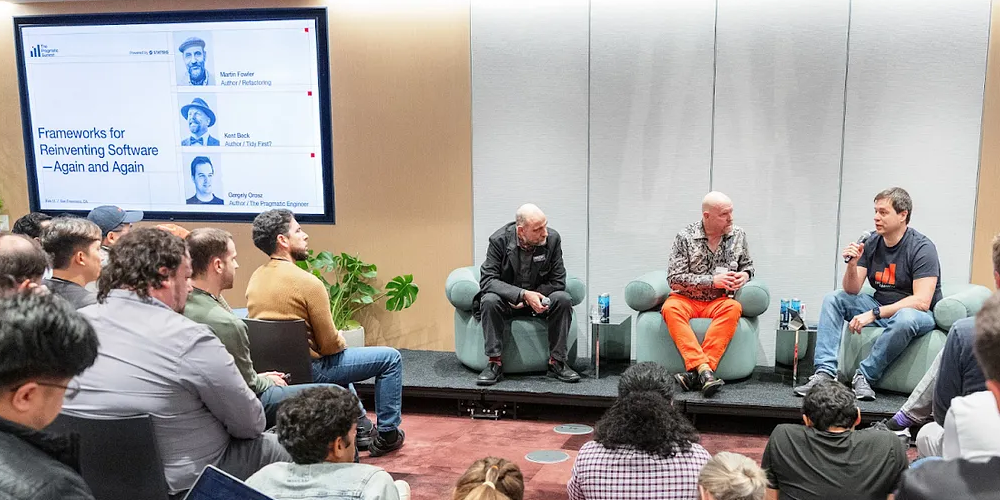
A photo of Gergely, Kent, and myself on the stage. We are all bedazzled by the vibrancy of Kent's trousers

I always enjoy nattering with Kent like this, and Gergely pushed into some worthwhile topics. Given the timing, AI dominated the conversation - we compared it to earlier technology shifts, the experience of agile methods, the role of TDD, the danger of unhealthy performance metrics, and how to thrive in an AI-native industry.

 ❄                ❄                ❄                ❄                ❄

Perl is a language I used a little, but never loved. However the definitive book on it, by its designer Larry Wall, contains a wonderful gem. The three virtues of a programmer: hubris, impatience - and above all - laziness.

Bryan Cantrill also loves this virtue:

Of these virtues, I have always found laziness to be the most profound: packed within its tongue-in-cheek self-deprecation is a commentary on not just the need for abstraction, but the aesthetics of it. Laziness drives us to make the system as simple as possible (but no simpler!) — to develop the powerful abstractions that then allow us to do much more, much more easily.

Of course, the implicit wink here is that it takes a lot of work to be lazy

Understanding how to think about a problem domain by building abstractions (models) is my favorite part of programming. I love it because I think it’s what gives me a deeper understanding of a problem domain, and because once I find a good set of abstractions, I get a buzz from the way they make difficulties melt away, allowing me to achieve much more functionality with less lines of code.

Cantrill worries that AI is so good at writing code, we risk losing that virtue, something that’s reinforced by brogrammers bragging about how they produce thirty-seven thousand lines of code a day.

The problem is that LLMs inherently lack the virtue of laziness. Work costs nothing to an LLM. LLMs do not feel a need to optimize for their own (or anyone’s) future time, and will happily dump more and more onto a layercake of garbage. Left unchecked, LLMs will make systems larger, not better — appealing to perverse vanity metrics, perhaps, but at the cost of everything that matters. As such, LLMs highlight how essential our human laziness is: our finite time forces us to develop crisp abstractions in part because we don’t want to waste our (human!) time on the consequences of clunky ones. The best engineering is always borne of constraints, and the constraint of our time places limits on the cognitive load of the system that we’re willing to accept. This is what drives us to make the system simpler, despite its essential complexity.

This reflection particularly struck me this Sunday evening. I’d spent a bit of time making a modification of how my music playlist generator worked. I needed a new capability, spent some time adding it, got frustrated at how long it was taking, and wondered about maybe throwing a coding agent at it. More thought led to realizing that I was doing it in a more complicated way than it needed to be. I was including a facility that I didn’t need, and by applying yagni, I could make the whole thing much easier, doing the task in just a couple of dozen lines of code.

If I had used an LLM for this, it may well have done the task much more quickly, but would it have made a similar over-complication? If so would I just shrug and say LGTM? Would that complication cause me (or the LLM) problems in the future?

 ❄                ❄                ❄                ❄                ❄

Jessica Kerr (Jessitron) has a simple example of applying the principle of Test-Driven Development to prompting agents. She wants all updates to include updating the documentation.

Instructions – We can change AGENTS.md to instruct our coding agent to look for documentation files and update them.

Verification – We can add a reviewer agent to check each PR for missed documentation updates.

This is two changes, so I can break this work into two parts. Which of these should we do first?

Of course my initial comment about TDD answers that question

 ❄                ❄                ❄                ❄                ❄

Mark Little prodded an old memory of mine as he wondered about to work with AIs that are over-confident of their knowledge and thus prone to make up answers to questions, or to act when they should be more hesitant. He draws inspiration from an old, low-budget, but classic SciFi movie: Dark Star. I saw that movie once in my 20s (ie a long time ago), but I still remember the crisis scene where a crew member has to use philosophical argument to prevent a sentient bomb from detonating.

Doolittle: You have no absolute proof that Sergeant Pinback ordered you to detonate.
Bomb #20: I recall distinctly the detonation order. My memory is good on matters like these.
Doolittle: Of course you remember it, but all you remember is merely a series of sensory impulses which you now realize have no real, definite connection with outside reality.
Bomb #20: True. But since this is so, I have no real proof that you’re telling me all this.
Doolittle: That’s all beside the point. I mean, the concept is valid no matter where it originates.
Bomb #20: Hmmmm….
Doolittle: So, if you detonate…
Bomb #20: In nine seconds….
Doolittle: …you could be doing so on the basis of false data.
Bomb #20: I have no proof it was false data.
Doolittle: You have no proof it was correct data!
Bomb #20: I must think on this further.

Doolittle has to expand the bomb’s consciousness, teaching it to doubt its sensors. As Little puts it:

That’s a useful metaphor for where we are with AI today. Most AI systems are optimised for decisiveness. Given an input, produce an output. Given ambiguity, resolve it probabilistically. Given uncertainty, infer. This works well in bounded domains, but it breaks down in open systems where the cost of a wrong decision is asymmetric or irreversible. In those cases, the correct behaviour is often deferral, or even deliberate inaction. But inaction is not a natural outcome of most AI architectures. It has to be designed in.

In my more human interactions, I’ve always valued doubt, and distrust people who operate under undue certainty. Doubt doesn’t necessarily lead to indecisiveness, but it does suggest that we include the risk of inaccurate information or faulty reasoning into decisions with profound consequences.

If we want AI systems that can operate safely without constant human oversight, we need to teach them not just how to decide, but when not to. In a world of increasing autonomy, restraint isn’t a limitation, it’s a capability. And in many cases, it may be the most important one we build.