



惯性聚合 高效追踪和阅读你感兴趣的博客、新闻、科技资讯
阅读原文 在惯性聚合中打开

推荐订阅源

酷 壳 – CoolShell
酷 壳 – CoolShell
H
Hacker News: Front Page
P
Palo Alto Networks Blog
T
ThreatConnect
Apple Machine Learning Research
博客园_首页
T
True Tiger Recordings
P
Privacy & Cybersecurity Law Blog
B
Blog
IT之家
IT之家
Last Week in AI
Last Week in AI
F
Full Disclosure
Hacker News: Ask HN
Hacker News: Ask HN
C
Comments on: Blog
Microsoft Azure Blog
C
Cybersecurity and Infrastructure Security Agency CISA
Microsoft Security Blog
博客园 - 【当耐特】
N
News and Events Feed by Topic
NISL@THU
NISL@THU
腾讯CDC
雷峰网
雷峰网
Security Latest
Security Latest
李成银的技术随笔
M
Microsoft Research Blog - Microsoft Research
L
LangChain Blog
L
Lohrmann on Cybersecurity
cs.CL updates on arXiv.org
C
Check Point Blog
Y
Y Combinator Blog
Recent Announcements
博客园 - Franky
N
News | PayPal Newsroom
V
V2EX
A
About on SuperTechFans
The Register - Security
月光博客
月光博客
奇客Solidot–传递最新科技情报
奇客Solidot–传递最新科技情报
Google Online Security Blog
MyScale Blog
MyScale Blog
Cisco Talos Blog
Cisco Talos Blog
Vercel News
Vercel News
WordPress大学
WordPress大学
C
Cyber Attacks, Cyber Crime and Cyber Security
The Hacker News
The Hacker News
IntelliJ IDEA : IntelliJ IDEA – the Leading IDE for Professional Development in Java and Kotlin | The JetBrains Blog
爱范儿
爱范儿
A
Arctic Wolf
L
LINUX DO - 最新话题
freeCodeCamp Programming Tutorials: Python, JavaScript, Git & More

Datadog | The Monitor blog

How to audit and clean up monitors effectively How we made a SQL query optimization agent 59% more accurate using autoresearch and LLM Observability Reduce CVE noise with OpenVEX assessments in Datadog Diagnose slow PostgreSQL queries faster with explain plan correlation Explore Datadog metrics with Natural Language Queries Attribute AI costs across providers with Datadog Cloud Cost Management Simplify micro-frontend observability with Datadog RUM Toto 2.0: Time series forecasting enters the scaling era Diagnose and resolve database performance issues faster with Database Investigator Datadog for Government achieves FedRAMP® High certification Analyze cloud costs with flexible spreadsheets in Datadog Sheets Inside Datadog’s AI Research Lab: Meet two PhD candidates behind Toto Connect triage and investigation in a single workflow with Datadog Cloud SIEM This Month in Datadog - April 2026 Monitor and optimize Supabase query performance with Datadog Database Monitoring Add dynamically updating context to logs with Reference Tables and Observability Pipelines Introducing ARFBench: A time series question-answering benchmark based on real incidents Test network paths with TCP, UDP, and ICMP in Datadog The product signal latency gap slowing your growth How to investigate cloud credential compromise with Bits AI Security Analyst Evaluate, optimize, and secure your Google Cloud AI stack with Datadog Turn developer feedback into operational insight with Datadog Forms and Sheets Identify and fix code issues faster with Datadog’s Azure DevOps Source Code integration Steganography at scale: Embedding share URLs in Datadog widget screenshots Bringing observability data hosting to the UK on AWS Centralize observability management with Datadog Governance Console Every team should be A/B testing Manage service tracing across hosts with Single Step Instrumentation rules Route OTel data from AI apps to ClickHouse and Datadog using Observability Pipelines Spotting CI/CD misconfigurations before the bots do: Securing GitHub Actions with Datadog IaC Security Detect runtime threats in Python Lambda functions with Datadog AAP Offline evaluation for AI agents: Best practices Introducing our open source AI-native SAST Instrument and monitor Boomi integration flows with OpenTelemetry and Datadog Not all index scans are equal: How we cut query latency by over 99% Platform engineering metrics: What to measure and what to ignore Integrate Recorded Future threat intelligence with Datadog Cloud SIEM CI/CD security: threat modeling using a MITRE-style threat matrix CI/CD security: How to secure your GitHub ecosystem Ingress NGINX is EOL: A practical guide for migrating to Kubernetes Gateway API How we built a real-world evaluation platform for autonomous SRE agents at scale Operating agentic AI with Amazon Bedrock AgentCore and Datadog LLM Observability: Lessons from NTT DATA Introducing the Datadog Code Security MCP Capture and analyze custom heatmaps in Session Replay Understand session replays faster with AI summaries and smart chapters Monitor ClickHouse query performance with Datadog Database Monitoring Search and act across Datadog to resolve issues faster with Bits Assistant Measure the business impact of every product change with Datadog Experiments Analyzing round trip query latency Configuring JavaScript caches for better performance Introducing Bits AI Dev Agent for Code Security Datadog achieves ISO 42001 certification for responsible AI Monitor Nutanix clusters, hosts, and VMs with Datadog Monitor Juniper Mist in Datadog A new Host Map for modern infrastructure When upserts don't update but still write: Debugging Postgres performance at scale Annotate traces to improve LLM quality with Datadog LLM Observability What's new in Cloud SIEM: AI-powered investigations, enhanced threat intelligence, and scalable security operations Explore Kubernetes with native OpenTelemetry data Monitor Oracle Fusion Cloud Applications with Datadog Announcing the Datadog Terraform provider v4.0.0 Scaling Kubernetes workloads on custom metrics How to design cloud environments for AI-powered threat analysis Monitor Aruba Central in Datadog How we centralize and remediate risks with Datadog Case Management Accelerate incident response with Datadog and ServiceNow Monitor your application and network load balancer logs Understanding Karpenter architecture for Kubernetes autoscaling Tools for collecting metrics and logs from Karpenter Monitor Karpenter with Datadog What your product data is actually saying Key metrics for monitoring Karpenter Securing Datadog's platform in the AI age: The role of observability data Closing the verification loop: Observability-driven harnesses for building with agents Closing the verification loop, Part 2: Fully autonomous optimization When an AI agent came knocking: Catching malicious contributions in Datadog’s open source repos Four ways engineering teams use the Datadog MCP Server to power AI agents Approaching your observability migration with the right mindset Meet the new Bits AI SRE: Deeper reasoning, twice as fast Designing MCP tools for agents: Lessons from building Datadog's MCP server Key learnings from the 2026 State of DevSecOps study Use plain English to query your multi-cloud infrastructure in Resource Catalog Simplifying troubleshooting across the user journey with Datadog Synthetic Monitoring Protect your OCI resources with Datadog Cloud Security This Month in Datadog - February 2026 Fine-tune Toto for turbocharged forecasts Amazon EC2 security: How misconfigured and public AMIs expand your cloud attack surface Enable end-to-end visibility into your Java apps with a single command Measure and improve mobile app startup performance with Datadog RUM Evaluating our AI Guard application to improve quality and control cost Identify untested code across every level of your codebase Make use of guardrail metrics and stop babysitting your releases Monitor Versa Networks SD-WAN performance in Datadog How we reduced the size of our Agent Go binaries by up to 77% Improve performance and reliability with APM Recommendations Remediate transitive vulnerabilities faster with Datadog Software Composition Analysis Generate audit-ready vulnerability and compliance reports with Datadog Sheets Monitor Fortinet FortiManager performance in Datadog Improve test coverage across codebases with Datadog Code Coverage Move fast, don’t break things: Consistent testing standards at scale
How we designed empathetic alert sounds for on-call engineers
2026-04-02 · via Datadog | The Monitor blog

Being on call is an essential part of operating reliable distributed systems, but it comes with real human costs such as alert fatigue, sudden wakeups in the middle of the night, and the ongoing anxiety of what the next notification might bring. Many engineers know the feeling: Your phone lights up, a sound cuts through the silence, and your heart rate spikes before you’re even fully awake.

At Datadog, we wanted to rethink what an on-call alert should sound like. Notification sounds directly impact an engineer’s quality of life because the sensory experience of the sound can play a role in causing psychological and physical burnout. This realization led us to redesign our sound library for Datadog On-Call in the Datadog mobile app by using a principle we consider essential: empathy for the responder behind the pager.

In this post, we’ll share how we approached building notification sounds that prioritize engineer well-being, the research that guided us, and the design decisions that shaped the final experience.
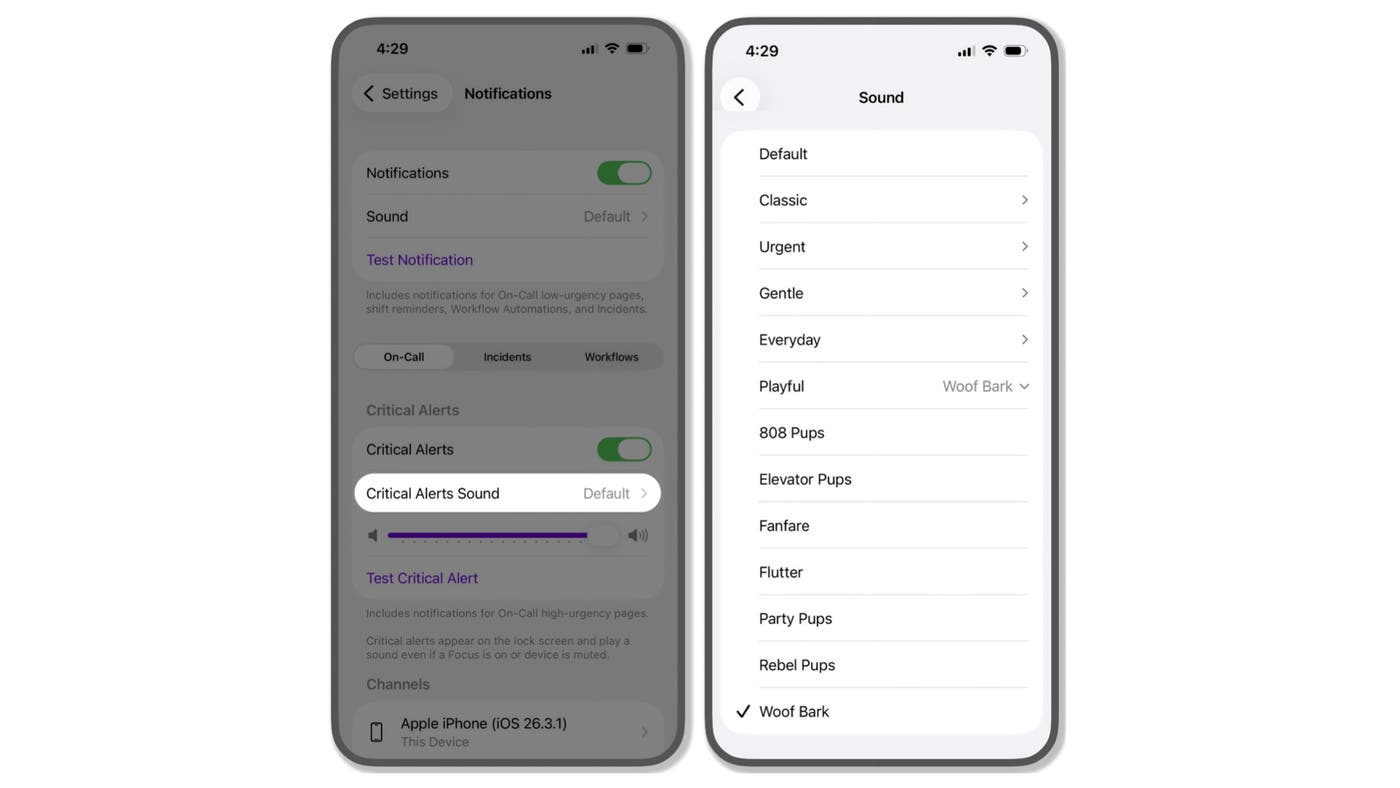
Two cellphone screens that show notification settings and the available sounds for Datadog On-Call.

Why on-call sounds matter

On-call alerts often indicate issues that need immediate attention. When something breaks, the alert is usually the first signal an engineer receives. Poorly designed alerts not only increase annoyance and cognitive load, but they also can increase the risk of missed critical issues. In contrast, thoughtfully designed alerts preserve urgency without adding unnecessary stress, helping ensure that the right signals are seen and acted on.

Of course, the best way to reduce alert fatigue is to minimize unnecessary notifications. Strong alert hygiene, clear ownership, and well-tuned monitors are foundational. For the alerts that do fire, sound design becomes a powerful lever.

Developing the sounds

We worked with Sanctus, an agency that specializes in creating, editing, and mixing audio, to expand our notification library. We took a research-first approach to rethinking the sounds, incorporating findings from studies on auditory perception, alert fatigue, and emotional tone to understand what makes alerts most effective. Through this research and conversations with our engineers and customers, we identified and validated four on-call sound personas.

The Noise Navigator

The Noise Navigator is typically in loud environments and must react without hesitation when an alert fires. Research shows that not all loud sounds are equally effective. Simply increasing volume does not guarantee clarity. Studies in aviation and medical alarm design demonstrate that short pulses under 500 ms, built around lower fundamental frequencies and enriched with harmonics, are easier to distinguish in noisy environments. Structured bursts and subtle pitch movement can further improve detectability without increasing harshness.

We translated these insights into harmonically rich, percussive bursts with slight variations in pitch. These sounds, which appear in the Urgent category in our sound library, cut through the noise of busy offices and public settings without becoming punishing over time.

Example: Shadow

The Discreet Engineer

The Discreet Engineer does not want to disrupt family members or coworkers in shared spaces. We turned to research on ecologically valid sounds, alerts that resemble familiar environmental cues. One study found that context-matching sounds (such as a hanger sliding in a retail setting) were just as detectable as artificial or out-of-place alerts, particularly when users expected them.

This information inspired subtle, context-blending microsounds, such as shuffling cards or cowbells, designed to feel natural in shared environments. These sounds, labeled as Everyday in the sound library, are recognizable to the intended listener but easily interpreted by others as part of the ambient background.

Example: Card shuffle

The Sleepy Engineer

The Sleepy Engineer needs alerts to wake them up reliably but also wants to avoid adding stress to an already demanding role. To address these priorities, we looked into decades of fire safety research on alarm effectiveness. Contrary to common assumptions that higher pitch means greater urgency, studies show that lower-frequency tones of around 520 Hz wake sleepers more effectively than traditional high-pitched alarms. In some populations, these lower tones were found to be up to 10 times more effective—a powerful reminder that how a sound is engineered matters more than how sharp it feels.

Awakening, however, is only the first step. Responders must also overcome the grogginess and reduced cognitive performance that impair reaction time and decision-making. Research has demonstrated that melodic alarms can improve post-waking attentiveness compared to rhythmic or neutral tones, leading to fewer errors and faster cognitive engagement.

We combined low-frequency acoustic strength with warm melodic structures and rounded tonal qualities to create sounds that wake users reliably and support a smoother and more alert cognitive transition. These sounds are classified as Gentle in the sound library.

Example: Cascade

The Humorist

The Humorist prefers to lighten the weight of being on call by turning alerts into moments of levity. Research supports voice as a particularly effective notification medium. One study found that spoken alerts were identified correctly 98.5% of the time and were recognized faster and with greater confidence than other alerts.

This evidence opens the door to witty phrases, playful lines, or lyrical moments that add humor to the alert experience. For this persona, qualities like surprise, absurdity, and comedic timing matter almost as much as recognizability. As one might expect from a company named Datadog, we blended some canine-inspired voice sounds with other tones to help ease the tension. These options are available in the sound library’s Playful category.

Example: Woof bark

The evolving sound library

Together, these design decisions resulted in a curated collection of notification sounds that are different from typical alert tones both acoustically and emotionally. Some are calm enough to ease fatigue. Others are engineered to stand out in noisy environments without being harsh. Most importantly, the library is intentionally diverse because the right notification sound is personal, not universal. We’ll continue to evolve and expand the library as we learn from research and our customers.

On-call life will always include urgency, but it doesn’t have to mean unnecessary stress. Runbooks and other intelligent tooling help engineers get to the root cause of issues faster, and thoughtful sound design supports the human side of that work. By basing our sound design on research and a deep respect for the human experience, we hope to help engineers rest a little easier and maybe even get a bit more sleep.

To receive alerts with Datadog, you can use On-Call and get notifications through the Datadog mobile app. If you’re new to Datadog, you can sign up for a 14-day free trial to get started.