
惯性聚合 高效追踪和阅读你感兴趣的博客、新闻、科技资讯
阅读原文 在惯性聚合中打开

推荐订阅源

V
Vulnerabilities – Threatpost
T
The Blog of Author Tim Ferriss
S
SegmentFault 最新的问题
D
DataBreaches.Net
博客园_首页
罗磊的独立博客
B
Blog
T
Threat Research - Cisco Blogs
C
Cisco Blogs
GbyAI
GbyAI
Engineering at Meta
Engineering at Meta
WordPress大学
WordPress大学
G
GRAHAM CLULEY
H
Help Net Security
酷 壳 – CoolShell
酷 壳 – CoolShell
Cyber Security Advisories - MS-ISAC
爱范儿
爱范儿
SecWiki News
SecWiki News
T
Threatpost
钛媒体:引领未来商业与生活新知
钛媒体:引领未来商业与生活新知
Schneier on Security
T
The Exploit Database - CXSecurity.com
Google Online Security Blog
T
Tor Project blog
小众软件
小众软件
让小产品的独立变现更简单 - ezindie.com
Y
Y Combinator Blog
H
Hacker News: Front Page
V
V2EX
Security Latest
Security Latest
Cloudbric
Cloudbric
Simon Willison's Weblog
Attack and Defense Labs
D
Darknet – Hacking Tools, Hacker News & Cyber Security
P
Proofpoint News Feed
博客园 - 三生石上(FineUI控件)
NISL@THU
NISL@THU
S
Secure Thoughts
Blog — PlanetScale
Blog — PlanetScale
博客园 - 司徒正美
V2EX - 技术
V2EX - 技术
Vercel News
Vercel News
P
Palo Alto Networks Blog
IT之家
IT之家
MyScale Blog
MyScale Blog
有赞技术团队
有赞技术团队
Application and Cybersecurity Blog
D
Docker
Google DeepMind News
Webroot Blog
Webroot Blog

Datadog | The Monitor blog

Introducing our open source AI-native SAST Instrument and monitor Boomi integration flows with OpenTelemetry and Datadog Not all index scans are equal: How we cut query latency by over 99% Platform engineering metrics: What to measure and what to ignore Integrate Recorded Future threat intelligence with Datadog Cloud SIEM CI/CD security: threat modeling using a MITRE-style threat matrix CI/CD security: How to secure your GitHub ecosystem Ingress NGINX is EOL: A practical guide for migrating to Kubernetes Gateway API Operating agentic AI with Amazon Bedrock AgentCore and Datadog LLM Observability: Lessons from NTT DATA Introducing the Datadog Code Security MCP Capture and analyze custom heatmaps in Session Replay Understand session replays faster with AI summaries and smart chapters Monitor ClickHouse query performance with Datadog Database Monitoring How we designed empathetic alert sounds for on-call engineers Search and act across Datadog to resolve issues faster with Bits Assistant Measure the business impact of every product change with Datadog Experiments Analyzing round trip query latency Configuring JavaScript caches for better performance Introducing Bits AI Dev Agent for Code Security Datadog achieves ISO 42001 certification for responsible AI Monitor Nutanix clusters, hosts, and VMs with Datadog Monitor Juniper Mist in Datadog A new Host Map for modern infrastructure Annotate traces to improve LLM quality with Datadog LLM Observability What’s new in Cloud SIEM: AI-powered investigations, enhanced threat intelligence, and scalable security operations Explore Kubernetes with native OpenTelemetry data Monitor Oracle Fusion Cloud Applications with Datadog Announcing the Datadog Terraform provider v4.0.0 Scaling Kubernetes workloads on custom metrics How to design cloud environments for AI-powered threat analysis Monitor Aruba Central in Datadog How we centralize and remediate risks with Datadog Case Management Accelerate incident response with Datadog and ServiceNow Monitor your application and network load balancer logs Understanding Karpenter architecture for Kubernetes autoscaling Tools for collecting metrics and logs from Karpenter Monitor Karpenter with Datadog What your product data is actually saying Key metrics for monitoring Karpenter Securing Datadog’s platform in the AI age: The role of observability data Four ways engineering teams use the Datadog MCP Server to power AI agents Approaching your observability migration with the right mindset Meet the new Bits AI SRE: Deeper reasoning, twice as fast Key learnings from the 2026 State of DevSecOps study Use plain English to query your multi-cloud infrastructure in Resource Catalog Simplifying troubleshooting across the user journey with Datadog Synthetic Monitoring Protect your OCI resources with Datadog Cloud Security This Month in Datadog - February 2026 Amazon EC2 security: How misconfigured and public AMIs expand your cloud attack surface Enable end-to-end visibility into your Java apps with a single command Measure and improve mobile app startup performance with Datadog RUM Evaluating our AI Guard application to improve quality and control cost Identify untested code across every level of your codebase Make use of guardrail metrics and stop babysitting your releases Monitor Versa Networks SD-WAN performance in Datadog Improve performance and reliability with APM Recommendations Remediate transitive vulnerabilities faster with Datadog Software Composition Analysis Generate audit-ready vulnerability and compliance reports with Datadog Sheets Monitor Fortinet FortiManager performance in Datadog Improve test coverage across codebases with Datadog Code Coverage Move fast, don’t break things: Consistent testing standards at scale Enrich logs with ServiceNow CMDB context before routing to any SIEM or logging tool Monitor Lustre with Datadog Make faster, better product decisions with Datadog Product Analytics Surface and remediate runtime posture issues with Workload Protection Findings Protect agentic AI applications with Datadog AI Guard How to optimize JavaScript code with CSS Trace Google Pub/Sub workloads in Cloud Run with Datadog Detect human names in logs with ML in Sensitive Data Scanner How we cut our NLQ agent debugging time from hours to minutes with LLM Observability Debug PostgreSQL query latency faster with EXPLAIN ANALYZE in Datadog Database Monitoring Datadog acquires Propolis Unify and correlate frontend and backend data with retention filters Scale compliance across global frameworks with Datadog Cloud Security Monitor Arista VeloCloud SD-WAN performance with Datadog Building reliable dashboard agents with Datadog LLM Observability Simplify log collection and aggregation for MSSPs with Datadog Observability Pipelines Mitigation for Node.js denial-of-service vulnerability affecting Datadog APM Automate flaky test fixes with the Bits AI Dev Agent and Test Optimization How we built an AI SRE agent that investigates like a team of engineers Datadog integrations 2025 recap: Observability for AI, security, and hybrid cloud Design effective executive dashboards with Datadog Implement dbt data quality checks with dbt-expectations Bring faster visibility into AWS Lambda functions with remote instrumentation Troubleshoot faster with the GitLab Source Code integration in Datadog How Cambia Health Solutions saved $30,000 monthly with Cloud Cost Management and the Datadog Resource Catalog Normalize any logs for Cloud SIEM with Datadog's OCSF processor Optimizing Datadog at scale: Cost-efficient observability at Zendesk Detect, diagnose, and resolve network issues easily with CNM Network Health Connect engineering errors to user impact in early-stage products Cilium configuration for Kubernetes operations at scale Designing feedback loops for progressive delivery Ship features faster and safer with Datadog Feature Flags Choosing the right OpenTelemetry Collector distribution Route your monitor alerts with Datadog monitor notification rules Automate Cloud SIEM investigations with Bits AI Security Analyst Cloud threat detection: How to identify risky activity across control and data planes Collecting Kafka performance metrics Monitoring Kafka with Datadog Monitoring Kafka performance metrics
Detect source code attacks with Datadog Code Threat Detection
Kassen Qian, Daniel Blazquez, Christoph Hamsen · 2026-06-09 · via Datadog | The Monitor blog

Automated developer workflows and AI coding assistants have changed what a pull request (PR) can do. PRs can now modify CI configuration, trigger jobs, access secrets, and initiate release workflows before code ever reaches production. That reach makes them a critical and increasingly targeted part of the supply chain. In supply chain incidents such as tj-actions, Nx s1ngularity, and Shai-Hulud, attackers bypassed production applications to target the systems that created them, including source code repositories, CI/CD pipelines, and dependency caches. 

Datadog Code Threat Detection detects GitHub PRs that are attempting to compromise your CI pipeline or inject malicious code into your codebase. It uses AI-assisted analysis to examine a PR’s full diff alongside repository metadata, dependency context, and actor information to surface behavior that traditional scanners and manual review may miss. 

In this post, we’ll look at how teams can detect malicious code changes and investigate and escalate Code Threat signals in Datadog.

Detect malicious code changes, not just vulnerable code

Most application security tools focus on vulnerabilities, which are unintended flaws in code that an attacker can exploit once the application is running. Unlike a vulnerability, a malicious code change takes advantage of the trusted workflows that teams depend on to ship software—the contributors, CI systems, package registries, and release pipelines that form the path to production. Attackers target that trust directly, and a single malicious PR can compromise downstream systems before anyone reviews it. In the HackerBot Claw campaign, for example, attackers targeted GitHub Actions and LLM-powered workflows through PRs in public repositories.

AI-assisted development expands this attack surface further. Coding agents and repository automation systems can now generate code, open PRs, respond to issues, and interact with CI/CD workflows with limited human oversight. As more PRs come from bots, agents, and external contributors, the volume can outpace manual review. Addressing both problems requires visibility into vulnerable code and code changes that abuse the development process itself. 

Datadog Code Threat Detection brings source code attack detection to PRs monitored by Datadog Code Security so teams can verify trust at the code level, regardless of whether a change comes from a human contributor or a coding agent. It evaluates PRs for obfuscated code and suspicious dependency changes, as well as other behaviors associated with source code attacks, such as typo-squatting, credential exfiltration attempts, and CI/CD workflow tampering. Because these detections indicate active attacks, findings bypass the PR comment thread and raise a security signal in Datadog instead. 
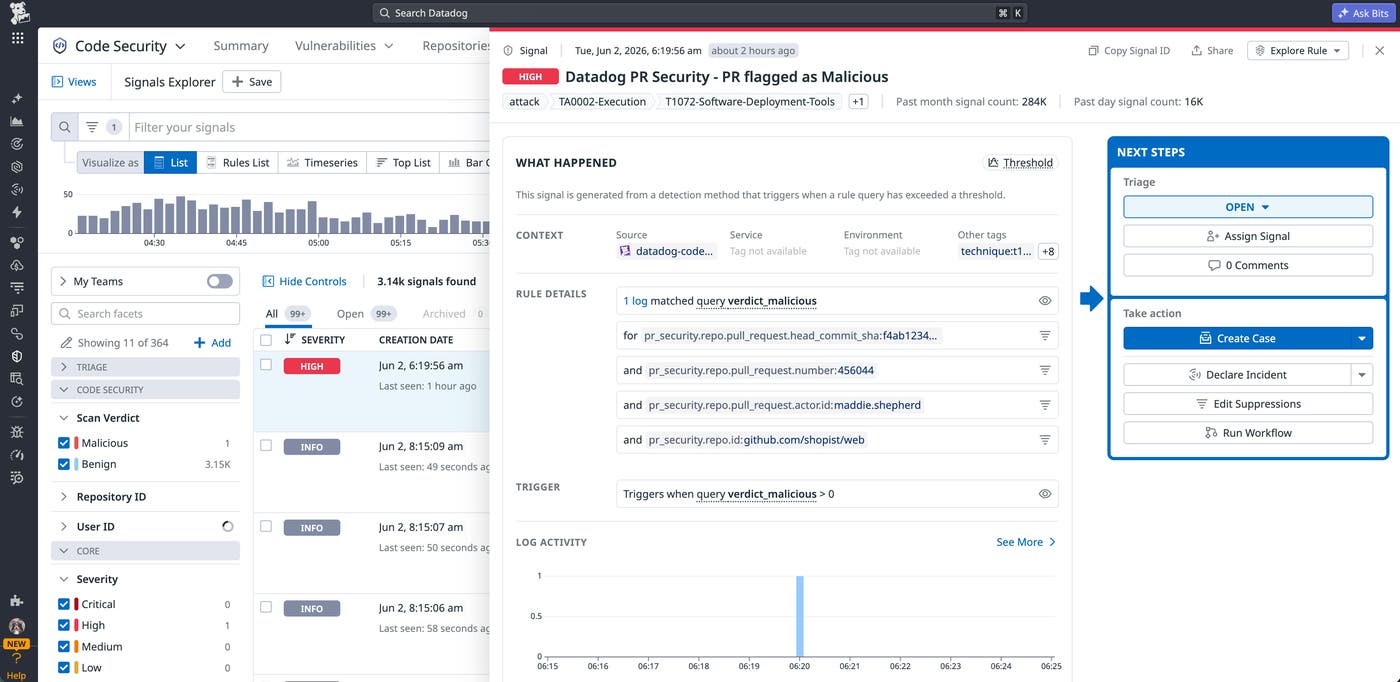
Code Threat Detection signal in Datadog Signals Explorer showing a pull request flagged as malicious with high severity.

Datadog routinely evaluates Code Threat findings against a labeled dataset of threats that are built from internal testing, public incident reports, GitHub threat modeling, and software supply chain security research. This ongoing tuning improves detection probability of real attacks while keeping the number of false positives low.

Investigate and escalate Code Threat signals in Datadog

Code Threat Detection generates signals directly in Datadog’s Signals Explorer, where security and engineering teams can investigate suspicious PRs alongside other security signals. Each signal includes context about the detected behavior—whether a PR is attempting to tamper with CI/CD systems, exfiltrate credentials, abuse dependencies, or manipulate release workflows—so teams can investigate without switching tools.

With each signal, teams can open a case, archive it as a false positive, or escalate the issue to an incident.
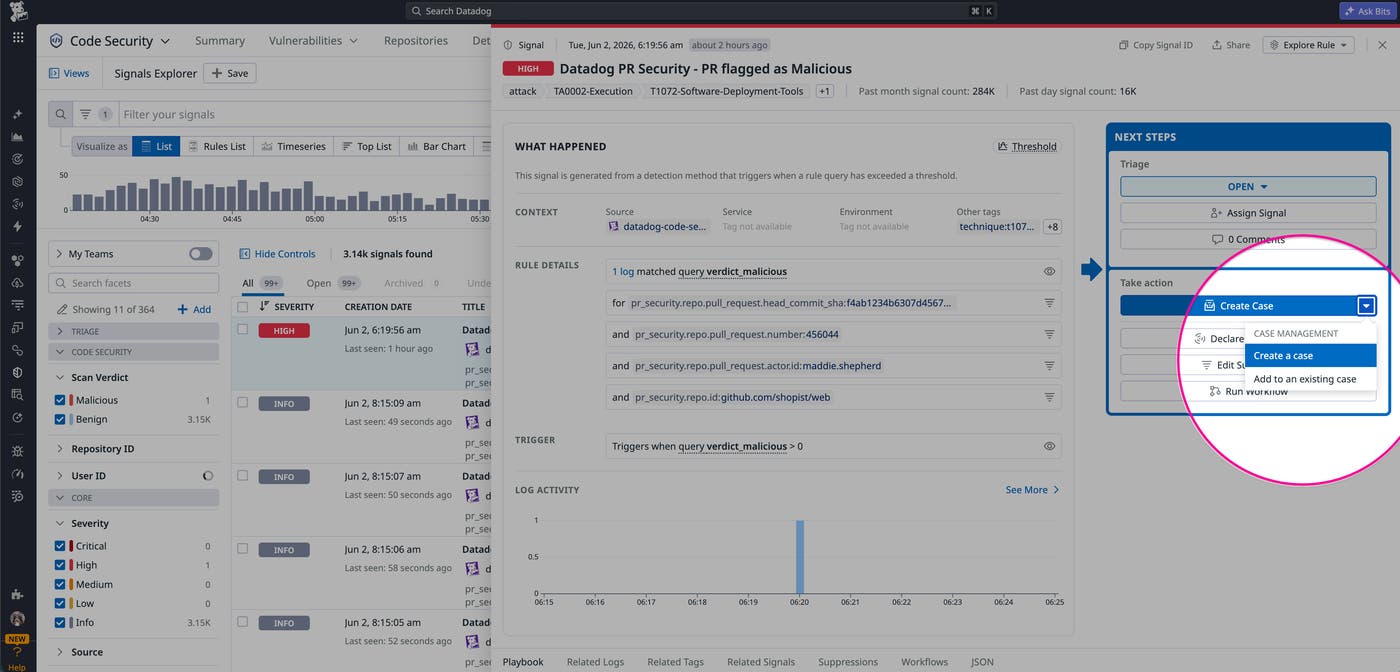
Datadog Signals Explorer showing a Code Threat Detection signal with the case creation panel open for incident escalation.

Code Threat Detection is integrated with Datadog’s Workflow Automation, so teams can route signals into the tools and workflows they already use. For example, a signal can trigger a workflow that automatically notifies owners via third-party systems such as Slack and PagerDuty. They can also create custom workflows that interact directly with GitHub for automated remediation. 

Get started with Code Threat Detection

Code Threat Detection extends Datadog Code Security to the PR level, giving teams a way to detect source code attacks before they reach the CI/CD pipeline or production environment. By evaluating PRs for obfuscated code, dependency abuse, credential exfiltration attempts, and CI/CD workflow tampering, Code Threat Detection addresses the part of the supply chain that vulnerability scanners don’t cover. It complements Secret Scanning, Software Composition Analysis, and Infrastructure as Code Security to give you detection across the full path to production. 

Datadog Code Threat Detection is available in Preview for Datadog Code Security customers. To learn more, read our Code Security documentation. For a deeper look at the engineering approach behind Code Threats, read our post about detecting malicious code at scale with LLMs.

If you don’t already have a Datadog account, you can sign up for a free 14-day trialto get started.