



惯性聚合 高效追踪和阅读你感兴趣的博客、新闻、科技资讯
阅读原文 在惯性聚合中打开

推荐订阅源

C
Check Point Blog
GbyAI
GbyAI
奇客Solidot–传递最新科技情报
奇客Solidot–传递最新科技情报
U
Unit 42
美团技术团队
NISL@THU
NISL@THU
C
Cisco Blogs
SecWiki News
SecWiki News
N
Netflix TechBlog - Medium
Forbes - Security
Forbes - Security
Cloudbric
Cloudbric
雷峰网
雷峰网
T
Tailwind CSS Blog
博客园 - 司徒正美
The Register - Security
L
LangChain Blog
S
Security Affairs
Hacker News - Newest:
Hacker News - Newest: "LLM"
B
Blog
OSCHINA 社区最新新闻
OSCHINA 社区最新新闻
T
Threat Research - Cisco Blogs
I
InfoQ
S
Schneier on Security
L
Lohrmann on Cybersecurity
量子位
cs.CL updates on arXiv.org
Martin Fowler
Martin Fowler
Schneier on Security
F
Fortinet All Blogs
TaoSecurity Blog
TaoSecurity Blog
K
Kaspersky official blog
Google DeepMind News
Cisco Talos Blog
Cisco Talos Blog
PCI Perspectives
PCI Perspectives
Attack and Defense Labs
WordPress大学
WordPress大学
Microsoft Azure Blog
H
Help Net Security
Project Zero
Project Zero
The GitHub Blog
The GitHub Blog
D
Docker
N
News | PayPal Newsroom
K
KPMG report finds enterprise disconnect between AI and its ROI | CIO
H
Hacker News: Front Page
云风的 BLOG
云风的 BLOG
Microsoft Security Blog
freeCodeCamp Programming Tutorials: Python, JavaScript, Git & More
博客园 - 聂微东
Webroot Blog
Webroot Blog
MongoDB | Blog
MongoDB | Blog

Datadog | The Monitor blog

Introducing our open source AI-native SAST Instrument and monitor Boomi integration flows with OpenTelemetry and Datadog Not all index scans are equal: How we cut query latency by over 99% Platform engineering metrics: What to measure and what to ignore Integrate Recorded Future threat intelligence with Datadog Cloud SIEM CI/CD security: threat modeling using a MITRE-style threat matrix CI/CD security: How to secure your GitHub ecosystem Ingress NGINX is EOL: A practical guide for migrating to Kubernetes Gateway API Operating agentic AI with Amazon Bedrock AgentCore and Datadog LLM Observability: Lessons from NTT DATA Introducing the Datadog Code Security MCP Capture and analyze custom heatmaps in Session Replay Understand session replays faster with AI summaries and smart chapters Monitor ClickHouse query performance with Datadog Database Monitoring How we designed empathetic alert sounds for on-call engineers Search and act across Datadog to resolve issues faster with Bits Assistant Measure the business impact of every product change with Datadog Experiments Analyzing round trip query latency Configuring JavaScript caches for better performance Introducing Bits AI Dev Agent for Code Security Datadog achieves ISO 42001 certification for responsible AI Monitor Nutanix clusters, hosts, and VMs with Datadog Monitor Juniper Mist in Datadog A new Host Map for modern infrastructure Annotate traces to improve LLM quality with Datadog LLM Observability What’s new in Cloud SIEM: AI-powered investigations, enhanced threat intelligence, and scalable security operations Explore Kubernetes with native OpenTelemetry data Monitor Oracle Fusion Cloud Applications with Datadog Announcing the Datadog Terraform provider v4.0.0 Scaling Kubernetes workloads on custom metrics How to design cloud environments for AI-powered threat analysis Monitor Aruba Central in Datadog How we centralize and remediate risks with Datadog Case Management Accelerate incident response with Datadog and ServiceNow Monitor your application and network load balancer logs Understanding Karpenter architecture for Kubernetes autoscaling Tools for collecting metrics and logs from Karpenter Monitor Karpenter with Datadog What your product data is actually saying Key metrics for monitoring Karpenter Securing Datadog’s platform in the AI age: The role of observability data Four ways engineering teams use the Datadog MCP Server to power AI agents Approaching your observability migration with the right mindset Meet the new Bits AI SRE: Deeper reasoning, twice as fast Key learnings from the 2026 State of DevSecOps study Use plain English to query your multi-cloud infrastructure in Resource Catalog Simplifying troubleshooting across the user journey with Datadog Synthetic Monitoring Protect your OCI resources with Datadog Cloud Security This Month in Datadog - February 2026 Amazon EC2 security: How misconfigured and public AMIs expand your cloud attack surface Enable end-to-end visibility into your Java apps with a single command Measure and improve mobile app startup performance with Datadog RUM Evaluating our AI Guard application to improve quality and control cost Identify untested code across every level of your codebase Make use of guardrail metrics and stop babysitting your releases Monitor Versa Networks SD-WAN performance in Datadog Improve performance and reliability with APM Recommendations Remediate transitive vulnerabilities faster with Datadog Software Composition Analysis Generate audit-ready vulnerability and compliance reports with Datadog Sheets Monitor Fortinet FortiManager performance in Datadog Improve test coverage across codebases with Datadog Code Coverage Move fast, don’t break things: Consistent testing standards at scale Enrich logs with ServiceNow CMDB context before routing to any SIEM or logging tool Monitor Lustre with Datadog Make faster, better product decisions with Datadog Product Analytics Surface and remediate runtime posture issues with Workload Protection Findings Protect agentic AI applications with Datadog AI Guard How to optimize JavaScript code with CSS Trace Google Pub/Sub workloads in Cloud Run with Datadog Detect human names in logs with ML in Sensitive Data Scanner How we cut our NLQ agent debugging time from hours to minutes with LLM Observability Debug PostgreSQL query latency faster with EXPLAIN ANALYZE in Datadog Database Monitoring Datadog acquires Propolis Unify and correlate frontend and backend data with retention filters Scale compliance across global frameworks with Datadog Cloud Security Monitor Arista VeloCloud SD-WAN performance with Datadog Building reliable dashboard agents with Datadog LLM Observability Simplify log collection and aggregation for MSSPs with Datadog Observability Pipelines Mitigation for Node.js denial-of-service vulnerability affecting Datadog APM Automate flaky test fixes with the Bits AI Dev Agent and Test Optimization How we built an AI SRE agent that investigates like a team of engineers Datadog integrations 2025 recap: Observability for AI, security, and hybrid cloud Design effective executive dashboards with Datadog Implement dbt data quality checks with dbt-expectations Bring faster visibility into AWS Lambda functions with remote instrumentation Troubleshoot faster with the GitLab Source Code integration in Datadog How Cambia Health Solutions saved $30,000 monthly with Cloud Cost Management and the Datadog Resource Catalog Normalize any logs for Cloud SIEM with Datadog's OCSF processor Optimizing Datadog at scale: Cost-efficient observability at Zendesk Detect, diagnose, and resolve network issues easily with CNM Network Health Connect engineering errors to user impact in early-stage products Cilium configuration for Kubernetes operations at scale Designing feedback loops for progressive delivery Ship features faster and safer with Datadog Feature Flags Choosing the right OpenTelemetry Collector distribution Route your monitor alerts with Datadog monitor notification rules Automate Cloud SIEM investigations with Bits AI Security Analyst Cloud threat detection: How to identify risky activity across control and data planes Collecting Kafka performance metrics Monitoring Kafka with Datadog Monitoring Kafka performance metrics
Automate synthetic test coverage with Bits Testing
Younes Berradia, Marc Papazian, Natasha Silva · 2026-06-09 · via Datadog | The Monitor blog
Younes Berradia

Younes Berradia

Product Manager

Marc Papazian

Marc Papazian

Natasha Silva

Natasha Silva

Writing test scenarios and keeping them up to date can be time-consuming. When new user journeys or interface changes ship, test scripts can break and leave gaps in coverage. Critical flows such as checkout, signup, login, and booking can then reach production unvalidated.

Bits Testing, now available in Preview, automates synthetic test generation and maintenance. To generate tests, all you need to do is provide a URL or describe a goal in natural language. The agent explores the application, identifies critical user journeys, and creates test suites for them. 

This post covers how Bits Testing helps you:

  • Discover and generate synthetic tests automatically

  • Create Goal-Based tests for dynamic applications

  • Combine deterministic and nondeterministic testing strategies

Discover and generate synthetic tests automatically

Bits Testing uses discovery runs to explore applications autonomously and generates synthetic tests for critical user journeys. Instead of requiring you to define every click, form submission, or navigation event manually, the agent interacts with the application directly and records viable user paths as runnable test suites.
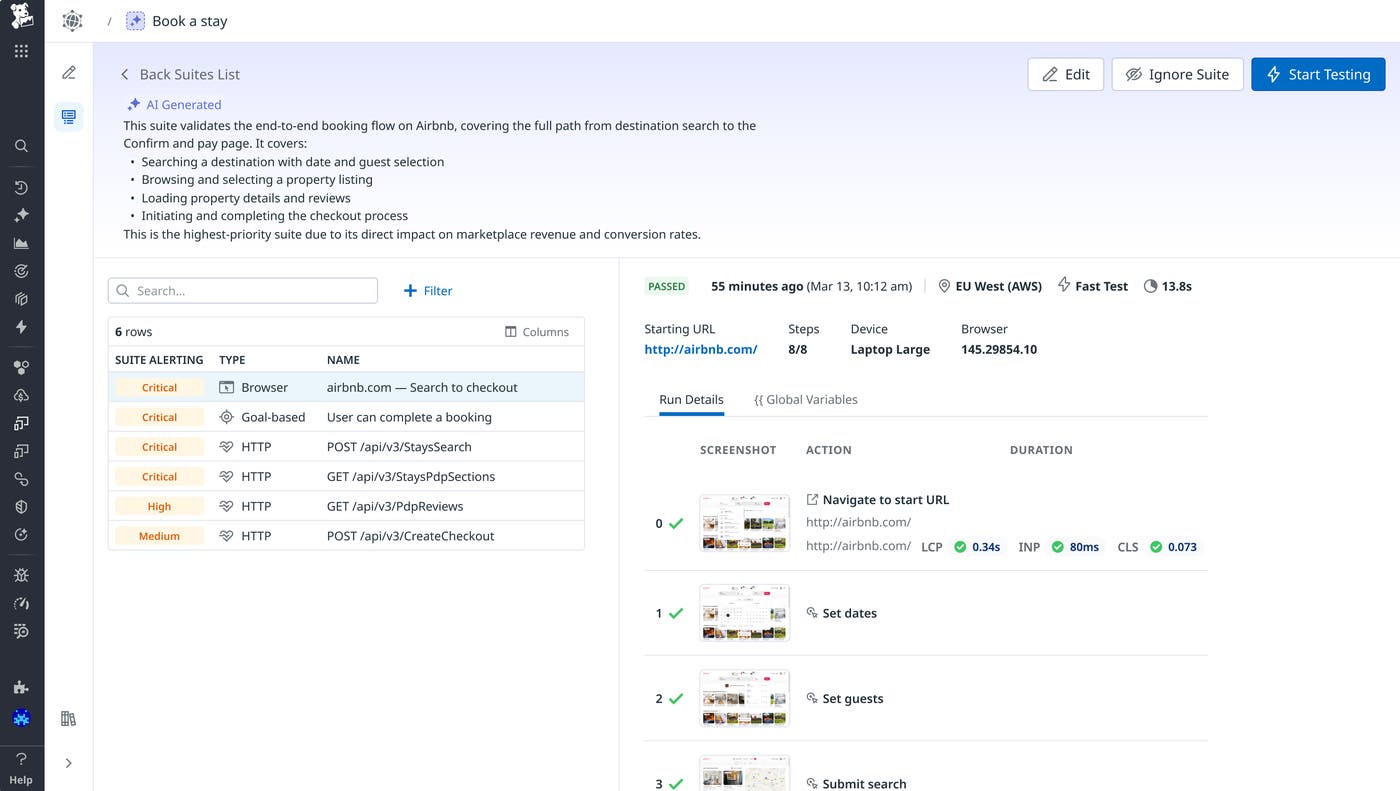
Datadog interface showing a test suite generated by Bits Testing, listing goal-based, browser, and HTTP tests alongside run details.

For example, you can point the agent at an ecommerce application and ask it to identify purchase-related workflows. The agent explores the site, navigates product listings, adds items to a cart, and proceeds through checkout flows to generate a collection of tests that represent real customer journeys. You can then review, accept, and schedule the generated tests like any other Synthetic Monitoring test. This expands coverage without the engineering time needed for manually scripting and testing updates.

Create Goal-Based tests for dynamic applications

Traditional tests are deterministic. They define an exact sequence of actions that must occur during every run. Deterministic tests work well for workflows where the precise execution path matters, such as validating API contracts, testing checkout sequences, or verifying authentication flows. These tests provide consistent coverage for known application flows and infrastructure dependencies.

Some workflows do not follow one fixed path. AI-powered applications, recommendation systems, inventory-based workflows, and conversational interfaces can produce multiple valid ways to reach the same outcome. In these cases, deterministic scripting becomes fragile because even minor interface updates can invalidate tests.

Bits Testing introduces Goal-Based tests for these dynamic environments. Instead of storing a fixed sequence of steps, a Goal-Based test stores the intended outcome in natural language. During execution, the agent determines viable paths to achieve that goal.
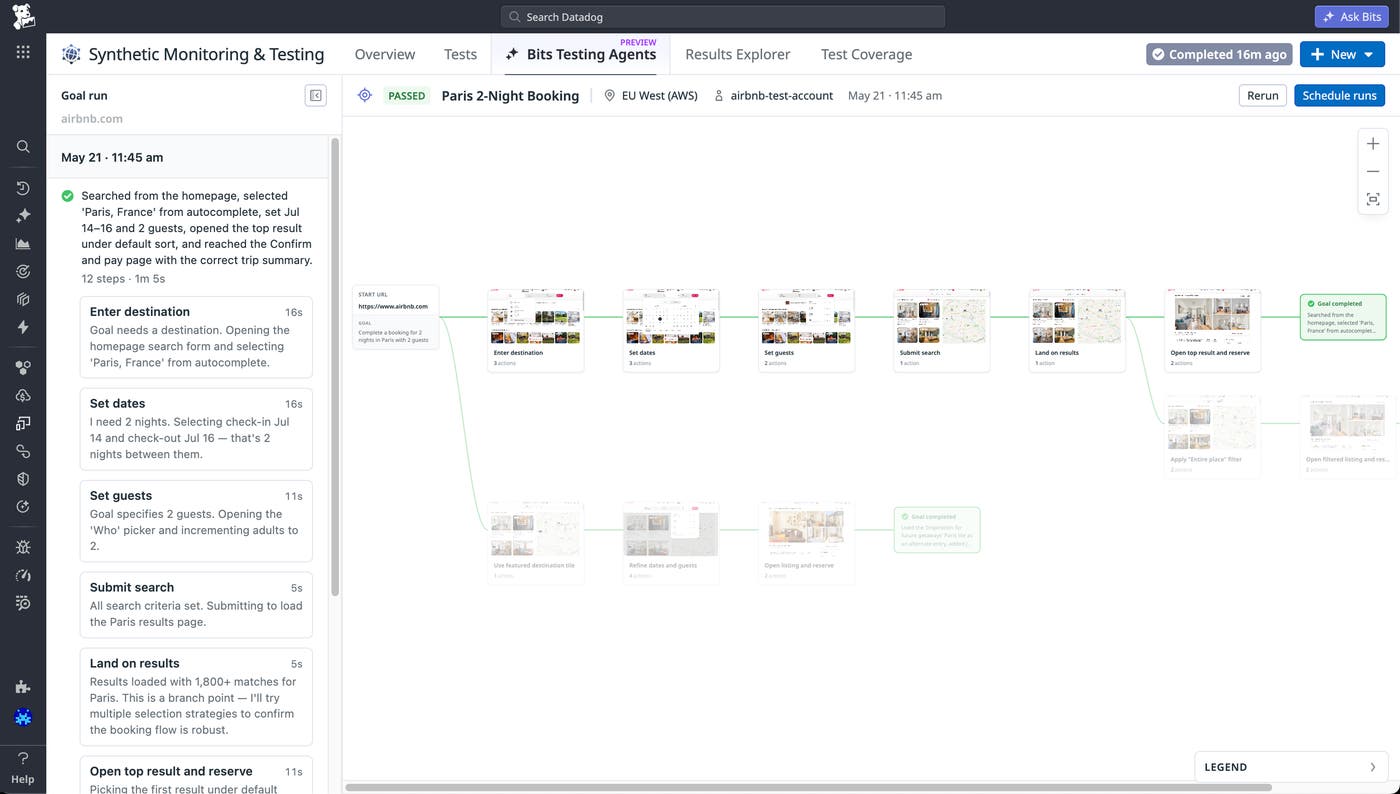
Datadog Bits Testing Agent interface showing a passed synthetic test, with a step-by-step flow diagram and action log covering destination entry, date selection, guest configuration, and search submission.

For example, you can define a goal such as “Complete a flight booking for a round-trip itinerary” or “Generate a support answer from the AI assistant.” At runtime, the agent navigates the application and adapts dynamically to accomplish the goal.

Goal-Based tests are especially useful for AI-powered applications where outputs and navigation paths may vary between runs. Rather than failing because a button moved or the interface changed slightly, the agent finds a new path while still validating the intended user experience.

Combine deterministic and nondeterministic testing strategies

Deterministic and nondeterministic testing approaches solve different problems. Most teams can benefit from using both. Deterministic browser, API, and network tests generated via discovery runs validate workflows where execution order and exact behavior matter.

Goal-Based tests complement those workflows by handling scenarios where interfaces or execution paths change frequently. For example, a retail platform can use deterministic tests to validate payment processing APIs and transaction workflows, while using goal-based tests to verify that customers can still complete purchases after frontend redesigns or via utilization of a chat or recommendation engine.

Using both test types together helps teams maintain stable coverage for critical backend workflows while also testing evolving and nondeterministic experiences that would otherwise require constant maintenance.

Get started with Bits Testing

Bits Testing automates synthetic test coverage for both stable and dynamic user journeys. Scheduled discovery runs and Goal-Based tests reduce manual maintenance and extend coverage to AI-powered and frequently updated interfaces.

To start automating your test coverage, join the Bits Testing Preview.

If you’re new to Datadog, sign up for a free 14-day trial.