

惯性聚合 高效追踪和阅读你感兴趣的博客、新闻、科技资讯
阅读原文 在惯性聚合中打开

推荐订阅源

酷 壳 – CoolShell
酷 壳 – CoolShell
H
Hacker News: Front Page
P
Palo Alto Networks Blog
T
ThreatConnect
Apple Machine Learning Research
博客园_首页
T
True Tiger Recordings
P
Privacy & Cybersecurity Law Blog
B
Blog
IT之家
IT之家
Last Week in AI
Last Week in AI
F
Full Disclosure
Hacker News: Ask HN
Hacker News: Ask HN
C
Comments on: Blog
Microsoft Azure Blog
C
Cybersecurity and Infrastructure Security Agency CISA
Microsoft Security Blog
博客园 - 【当耐特】
N
News and Events Feed by Topic
NISL@THU
NISL@THU
腾讯CDC
雷峰网
雷峰网
Security Latest
Security Latest
李成银的技术随笔
M
Microsoft Research Blog - Microsoft Research
L
LangChain Blog
L
Lohrmann on Cybersecurity
cs.CL updates on arXiv.org
C
Check Point Blog
Y
Y Combinator Blog
Recent Announcements
博客园 - Franky
N
News | PayPal Newsroom
V
V2EX
A
About on SuperTechFans
The Register - Security
月光博客
月光博客
奇客Solidot–传递最新科技情报
奇客Solidot–传递最新科技情报
Google Online Security Blog
MyScale Blog
MyScale Blog
Cisco Talos Blog
Cisco Talos Blog
Vercel News
Vercel News
WordPress大学
WordPress大学
C
Cyber Attacks, Cyber Crime and Cyber Security
The Hacker News
The Hacker News
IntelliJ IDEA : IntelliJ IDEA – the Leading IDE for Professional Development in Java and Kotlin | The JetBrains Blog
爱范儿
爱范儿
A
Arctic Wolf
L
LINUX DO - 最新话题
freeCodeCamp Programming Tutorials: Python, JavaScript, Git & More

Datadog | The Monitor blog

How to audit and clean up monitors effectively How we made a SQL query optimization agent 59% more accurate using autoresearch and LLM Observability Reduce CVE noise with OpenVEX assessments in Datadog Diagnose slow PostgreSQL queries faster with explain plan correlation Explore Datadog metrics with Natural Language Queries Attribute AI costs across providers with Datadog Cloud Cost Management Simplify micro-frontend observability with Datadog RUM Toto 2.0: Time series forecasting enters the scaling era Diagnose and resolve database performance issues faster with Database Investigator Datadog for Government achieves FedRAMP® High certification Analyze cloud costs with flexible spreadsheets in Datadog Sheets Inside Datadog’s AI Research Lab: Meet two PhD candidates behind Toto Connect triage and investigation in a single workflow with Datadog Cloud SIEM This Month in Datadog - April 2026 Monitor and optimize Supabase query performance with Datadog Database Monitoring Add dynamically updating context to logs with Reference Tables and Observability Pipelines Introducing ARFBench: A time series question-answering benchmark based on real incidents Test network paths with TCP, UDP, and ICMP in Datadog The product signal latency gap slowing your growth How to investigate cloud credential compromise with Bits AI Security Analyst Evaluate, optimize, and secure your Google Cloud AI stack with Datadog Turn developer feedback into operational insight with Datadog Forms and Sheets Identify and fix code issues faster with Datadog’s Azure DevOps Source Code integration Steganography at scale: Embedding share URLs in Datadog widget screenshots Bringing observability data hosting to the UK on AWS Centralize observability management with Datadog Governance Console Every team should be A/B testing Manage service tracing across hosts with Single Step Instrumentation rules Route OTel data from AI apps to ClickHouse and Datadog using Observability Pipelines Spotting CI/CD misconfigurations before the bots do: Securing GitHub Actions with Datadog IaC Security Detect runtime threats in Python Lambda functions with Datadog AAP Offline evaluation for AI agents: Best practices Introducing our open source AI-native SAST Instrument and monitor Boomi integration flows with OpenTelemetry and Datadog Not all index scans are equal: How we cut query latency by over 99% Platform engineering metrics: What to measure and what to ignore Integrate Recorded Future threat intelligence with Datadog Cloud SIEM CI/CD security: threat modeling using a MITRE-style threat matrix CI/CD security: How to secure your GitHub ecosystem Ingress NGINX is EOL: A practical guide for migrating to Kubernetes Gateway API How we built a real-world evaluation platform for autonomous SRE agents at scale Operating agentic AI with Amazon Bedrock AgentCore and Datadog LLM Observability: Lessons from NTT DATA Introducing the Datadog Code Security MCP Capture and analyze custom heatmaps in Session Replay Understand session replays faster with AI summaries and smart chapters Monitor ClickHouse query performance with Datadog Database Monitoring How we designed empathetic alert sounds for on-call engineers Search and act across Datadog to resolve issues faster with Bits Assistant Measure the business impact of every product change with Datadog Experiments Analyzing round trip query latency Configuring JavaScript caches for better performance Introducing Bits AI Dev Agent for Code Security Datadog achieves ISO 42001 certification for responsible AI Monitor Nutanix clusters, hosts, and VMs with Datadog Monitor Juniper Mist in Datadog A new Host Map for modern infrastructure When upserts don't update but still write: Debugging Postgres performance at scale Annotate traces to improve LLM quality with Datadog LLM Observability What's new in Cloud SIEM: AI-powered investigations, enhanced threat intelligence, and scalable security operations Explore Kubernetes with native OpenTelemetry data Monitor Oracle Fusion Cloud Applications with Datadog Announcing the Datadog Terraform provider v4.0.0 Scaling Kubernetes workloads on custom metrics How to design cloud environments for AI-powered threat analysis Monitor Aruba Central in Datadog How we centralize and remediate risks with Datadog Case Management Accelerate incident response with Datadog and ServiceNow Monitor your application and network load balancer logs Understanding Karpenter architecture for Kubernetes autoscaling Tools for collecting metrics and logs from Karpenter Monitor Karpenter with Datadog What your product data is actually saying Key metrics for monitoring Karpenter Securing Datadog's platform in the AI age: The role of observability data Closing the verification loop: Observability-driven harnesses for building with agents Closing the verification loop, Part 2: Fully autonomous optimization When an AI agent came knocking: Catching malicious contributions in Datadog’s open source repos Four ways engineering teams use the Datadog MCP Server to power AI agents Approaching your observability migration with the right mindset Meet the new Bits AI SRE: Deeper reasoning, twice as fast Designing MCP tools for agents: Lessons from building Datadog's MCP server Key learnings from the 2026 State of DevSecOps study Use plain English to query your multi-cloud infrastructure in Resource Catalog Simplifying troubleshooting across the user journey with Datadog Synthetic Monitoring Protect your OCI resources with Datadog Cloud Security This Month in Datadog - February 2026 Fine-tune Toto for turbocharged forecasts Enable end-to-end visibility into your Java apps with a single command Measure and improve mobile app startup performance with Datadog RUM Evaluating our AI Guard application to improve quality and control cost Identify untested code across every level of your codebase Make use of guardrail metrics and stop babysitting your releases Monitor Versa Networks SD-WAN performance in Datadog How we reduced the size of our Agent Go binaries by up to 77% Improve performance and reliability with APM Recommendations Remediate transitive vulnerabilities faster with Datadog Software Composition Analysis Generate audit-ready vulnerability and compliance reports with Datadog Sheets Monitor Fortinet FortiManager performance in Datadog Improve test coverage across codebases with Datadog Code Coverage Move fast, don’t break things: Consistent testing standards at scale
Amazon EC2 security: How misconfigured and public AMIs expand your cloud attack surface
2026-02-26 · via Datadog | The Monitor blog

Amazon Machine Images (AMIs) are templates for launching and scaling Amazon Elastic Compute Cloud (EC2) instances. Because Amazon EC2 AMIs are reused across environments and automation pipelines, decisions about how you build, source, manage, and share them directly affect your cloud attack surface.

You can source AMIs for your EC2 instances in three ways: create and privately share base images (golden images) within your accounts, use public images from a trusted publisher, or use community images from another AWS account. Each option reflects a different trust boundary and introduces distinct risks. In 2025, Datadog’s security researchers identified a scenario where retrieving the newest and potentially unvetted AMIs from a public repository can increase an environment’s exposure to certain types of supply chain attacks.

This post looks at how image sourcing and life cycle management can impact your cloud attack surface, along with best practices to mitigate that risk in the following areas:

Reduce insecure configurations, vulnerabilities, and version drift in private AMIs

Many teams maintain golden images so they can standardize the process for configuring and provisioning instances. However, the trade-off is that decisions around how you manage an image’s patch levels, installed packages, security guardrails, and other configurations need to be replicated with every launched instance. In addition, golden images are often built on top of public or community AMIs, which means any associated risks become embedded in the internal image. For example, if one of these AMIs includes a remotely exploitable weakness, such as a network-accessible service running with weak or default credentials, every instance launched from it inherits the same initial access path.

You can mitigate this risk in how you build and update images. For images you build from scratch, the Center for Internet Security (CIS) benchmarks can help you standardize secure defaults. If you create images from other AMIs, treat the base image and any dependencies as part of your supply chain. Your base image checks should include retrieving them from trusted sources and scanning them routinely to catch vulnerable packages before distribution.

Strategies for maintaining AMI inventories

For handling updates, you have two options: apply patches at instance boot time, or regularly rebuild and publish new AMIs. Applying patches at boot time enables you to keep a stable golden image while ensuring every instance applies security updates during initialization. Rebuilding AMIs regularly gives you the ability to automatically apply any necessary updates and speed up initial boot times.

Maintaining an AMI inventory across your accounts and regions helps you apply these recommendations reliably. You can start by answering the following questions:

  • Which private AMIs exist across your accounts and regions?
  • How many instances running in production were launched from each private AMI?
  • Which workloads will be affected if an image is found vulnerable?

The answers provide adequate context for AMI usage, which enables you to map the relationships between images and other assets, such as instances, attached storage, and owning accounts. With the ability to visualize these connections, you can evaluate the impact to your environment when you discover a vulnerable AMI and confirm when it is decommissioned. Approaches like this help reduce version drift and misconfigurations in your internal AMI distribution pipeline.

Prevent sensitive data leakage when sharing Amazon EC2 AMIs

There are valid use cases for sharing AMIs publicly, but this practice can create a data exposure risk. Public AMIs sometimes include embedded secrets and hardcoded credentials that publishers failed to remove before sharing. In other cases, an image is published unintentionally, possibly due to a misclick in the AWS console or a misconfigured deployment script.

If you publicly share AMIs, you can apply the same security practices that you would to any other distributed artifact. AWS recommends the following controls for public AMIs:

  • Do not use fixed root passwords, and disable direct root logins.
  • As an alternative to root logins, require users to generate public key credentials when launching new instances.
  • Delete shell history, which could contain valuable data such as access keys.
  • Remove any existing SSH host key pairs in the image’s /etc/ssh folder.
  • Exclude any directories and subdirectories that you would not want to include in your bundled image, such as any SSH-related data.

Prioritizing secret management with steps like these helps reduce the chance of publishing AMIs with exploitable secrets and data.

Detect and block untrusted or malicious public AMIs

Beyond data exposure and misconfigurations, attackers can exploit the trust and familiarity associated with public Amazon EC2 AMIs. In one straightforward example, an attacker published a community image with an embedded crypto miner. When deployed, the image could consume compute resources and increase AWS costs without the user’s knowledge.

Malicious AMIs can also be a part of supply chain attacks that specifically target workflows sourcing public images. For example, Datadog researchers identified a name confusion technique in which an attacker publishes a public AMI with a name designed to match common AMI search patterns. If users or automation tools search for images by a particular name or pattern without also including the publisher or enforcing an allowlist, they could accidentally retrieve the malicious image instead of the intended one.

If your pipeline unknowingly pulls and reuses a compromised image, it expands the attack surface in ways that you may not immediately discover. Enforcing controls such as Allowed AMIs enables you to restrict and audit AMI usage in these cases. You can also apply the following best practices when sourcing public images to further reduce the risk of retrieving malicious ones:

  • Restrict searches by publisher or owner.
  • Create and enforce an allowlist of approved images.
  • Alert on launches from unapproved or unverified images.

Having guardrails around public AMIs enables you to identify the affected instances, replace them with a known-good version, and investigate your environment for further compromise.

Detect risky AMIs with Datadog Cloud SIEM and Security Graph

Name confusion attacks and other untrusted or misconfigured AMI scenarios spread through typical day-to-day workflows, so the goal is to turn AMI alerts into a prioritized remediation list. You can use Datadog’s whoAMI-scanner to scan your environment for unverified community AMIs and quickly see which ones to address first.

Datadog Cloud SIEM will automatically flag any publicly shared AMIs, in addition to any EC2 instances created via risky AMI discovery patterns. Since these risks can escalate rapidly, Cloud SIEM signals enable you to efficiently determine their scope of impact for your environment, such as which user launched the vulnerable instance and what other resources they have access to.
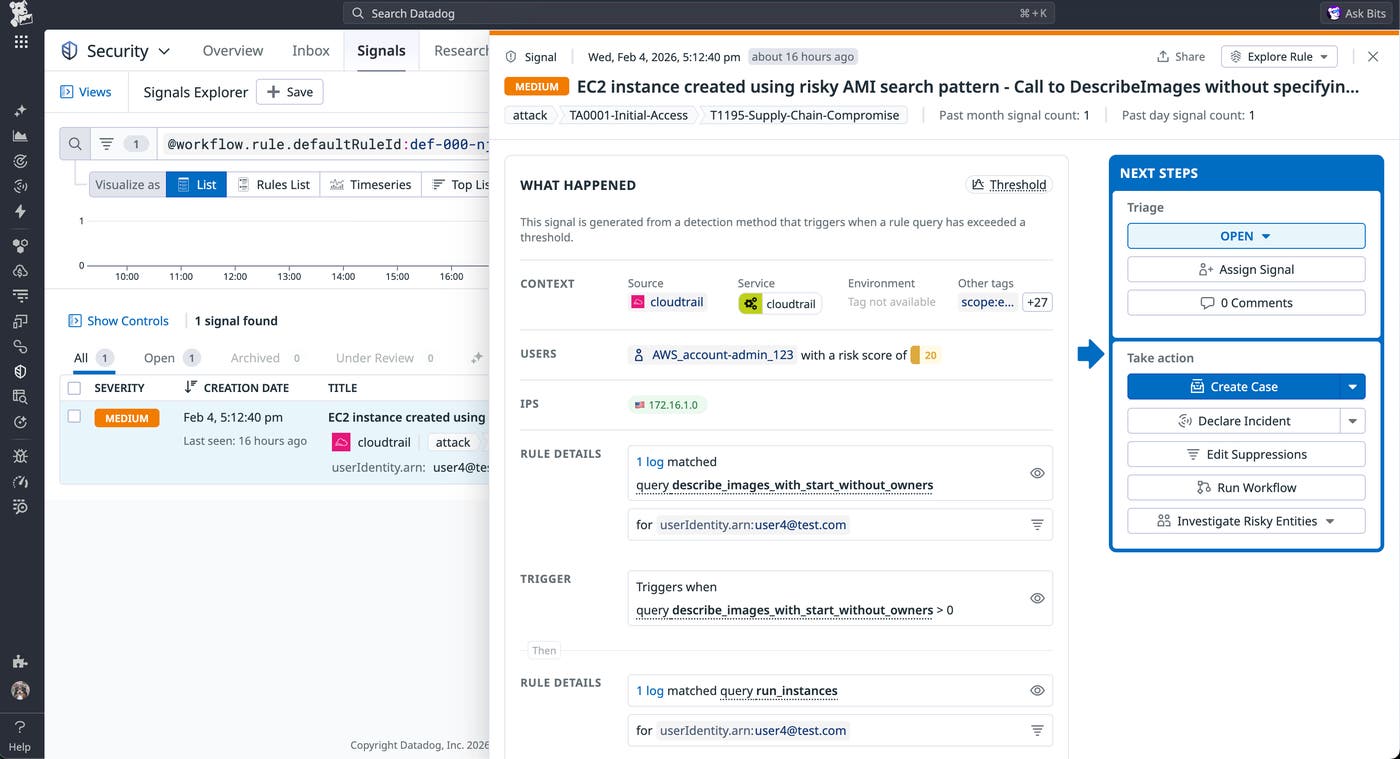
Datadog Cloud SIEM signal flagging an EC2 instance launched from a risky AMI, showing scope of impact and available response actions.

With this visibility, you can then group instances that use those AMIs alongside other high-risk resources, such as EC2 instances with overly permissive IAM roles. Datadog Security Graph visualizes AMI relationships and downstream resource impact so you can easily review and respond accordingly.
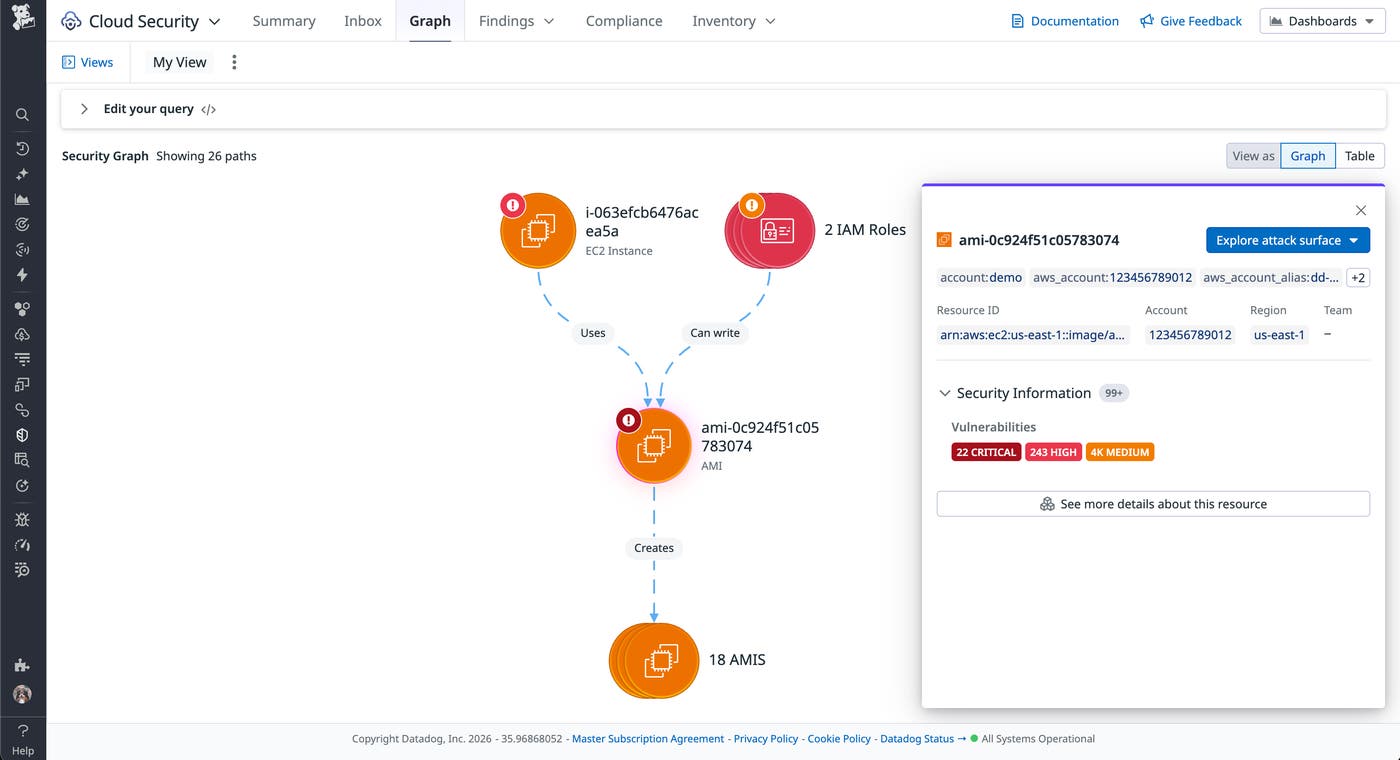
Datadog Security Graph showing how an AMI with critical vulnerabilities connects to downstream EC2 instances and IAM roles in us-east-1.

For example, if images are routinely made public, or you can’t reliably justify why they are shared, it’s a strong indicator you should enforce a control such as blocking public sharing at the account level. The account-level block prevents you from sharing newly created AMIs (unless they are already public).

Minimize risks in Amazon EC2 AMI usage

Amazon EC2 AMIs enable you to quickly launch instances with repeatable configurations for services, but that convenience creates risk for your environment. By focusing on how you manage private AMIs, prevent data leakage in shared images, and enforce guardrails for sourcing public AMIs, you can reduce both traditional misconfiguration risk and exposure from supply chain attacks.

For a technical deep dive on how public AMI name confusion works, read our research on the whoAMI attack. You can also review our documentation for more information about how Datadog helps you inventory your Amazon EC2 instances.

If you’re new to Datadog, sign up for a free 14-day trial.

Acknowledgements

We’d like to thank Seth Art of the Datadog Security Research team for his invaluable assistance with research and feedback on this article.