


惯性聚合 高效追踪和阅读你感兴趣的博客、新闻、科技资讯
阅读原文 在惯性聚合中打开

推荐订阅源

爱范儿
爱范儿
Know Your Adversary
Know Your Adversary
Google DeepMind News
A
Arctic Wolf
P
Privacy & Cybersecurity Law Blog
云风的 BLOG
云风的 BLOG
Stack Overflow Blog
Stack Overflow Blog
V
Visual Studio Blog
Project Zero
Project Zero
L
LangChain Blog
N
News and Events Feed by Topic
博客园 - Franky
Last Week in AI
Last Week in AI
cs.AI updates on arXiv.org
T
The Blog of Author Tim Ferriss
宝玉的分享
宝玉的分享
Scott Helme
Scott Helme
T
The Exploit Database - CXSecurity.com
P
Proofpoint News Feed
Blog — PlanetScale
Blog — PlanetScale
www.infosecurity-magazine.com
W
WeLiveSecurity
月光博客
月光博客
博客园_首页
美团技术团队
CTFtime.org: upcoming CTF events
freeCodeCamp Programming Tutorials: Python, JavaScript, Git & More
腾讯CDC
Latest news
Latest news
WordPress大学
WordPress大学
cs.CV updates on arXiv.org
Spread Privacy
Spread Privacy
Attack and Defense Labs
量子位
L
LINUX DO - 热门话题
C
CERT Recently Published Vulnerability Notes
Webroot Blog
Webroot Blog
L
Lohrmann on Cybersecurity
aimingoo的专栏
aimingoo的专栏
T
Troy Hunt's Blog
Security Latest
Security Latest
小众软件
小众软件
Cloudbric
Cloudbric
Hacker News: Ask HN
Hacker News: Ask HN
S
Secure Thoughts
雷峰网
雷峰网
T
Threat Research - Cisco Blogs
H
Hacker News: Front Page
IT之家
IT之家
Simon Willison's Weblog

Datadog | The Monitor blog

Introducing our open source AI-native SAST Instrument and monitor Boomi integration flows with OpenTelemetry and Datadog Not all index scans are equal: How we cut query latency by over 99% Platform engineering metrics: What to measure and what to ignore Integrate Recorded Future threat intelligence with Datadog Cloud SIEM CI/CD security: threat modeling using a MITRE-style threat matrix CI/CD security: How to secure your GitHub ecosystem Ingress NGINX is EOL: A practical guide for migrating to Kubernetes Gateway API Operating agentic AI with Amazon Bedrock AgentCore and Datadog LLM Observability: Lessons from NTT DATA Introducing the Datadog Code Security MCP Capture and analyze custom heatmaps in Session Replay Understand session replays faster with AI summaries and smart chapters Monitor ClickHouse query performance with Datadog Database Monitoring How we designed empathetic alert sounds for on-call engineers Search and act across Datadog to resolve issues faster with Bits Assistant Measure the business impact of every product change with Datadog Experiments Analyzing round trip query latency Configuring JavaScript caches for better performance Introducing Bits AI Dev Agent for Code Security Datadog achieves ISO 42001 certification for responsible AI Monitor Nutanix clusters, hosts, and VMs with Datadog Monitor Juniper Mist in Datadog A new Host Map for modern infrastructure Annotate traces to improve LLM quality with Datadog LLM Observability What’s new in Cloud SIEM: AI-powered investigations, enhanced threat intelligence, and scalable security operations Explore Kubernetes with native OpenTelemetry data Monitor Oracle Fusion Cloud Applications with Datadog Announcing the Datadog Terraform provider v4.0.0 Scaling Kubernetes workloads on custom metrics How to design cloud environments for AI-powered threat analysis Monitor Aruba Central in Datadog How we centralize and remediate risks with Datadog Case Management Accelerate incident response with Datadog and ServiceNow Monitor your application and network load balancer logs Understanding Karpenter architecture for Kubernetes autoscaling Tools for collecting metrics and logs from Karpenter Monitor Karpenter with Datadog What your product data is actually saying Key metrics for monitoring Karpenter Securing Datadog’s platform in the AI age: The role of observability data Four ways engineering teams use the Datadog MCP Server to power AI agents Approaching your observability migration with the right mindset Meet the new Bits AI SRE: Deeper reasoning, twice as fast Key learnings from the 2026 State of DevSecOps study Use plain English to query your multi-cloud infrastructure in Resource Catalog Simplifying troubleshooting across the user journey with Datadog Synthetic Monitoring Protect your OCI resources with Datadog Cloud Security This Month in Datadog - February 2026 Amazon EC2 security: How misconfigured and public AMIs expand your cloud attack surface Enable end-to-end visibility into your Java apps with a single command Measure and improve mobile app startup performance with Datadog RUM Evaluating our AI Guard application to improve quality and control cost Identify untested code across every level of your codebase Make use of guardrail metrics and stop babysitting your releases Monitor Versa Networks SD-WAN performance in Datadog Improve performance and reliability with APM Recommendations Remediate transitive vulnerabilities faster with Datadog Software Composition Analysis Generate audit-ready vulnerability and compliance reports with Datadog Sheets Monitor Fortinet FortiManager performance in Datadog Improve test coverage across codebases with Datadog Code Coverage Move fast, don’t break things: Consistent testing standards at scale Enrich logs with ServiceNow CMDB context before routing to any SIEM or logging tool Monitor Lustre with Datadog Make faster, better product decisions with Datadog Product Analytics Surface and remediate runtime posture issues with Workload Protection Findings Protect agentic AI applications with Datadog AI Guard How to optimize JavaScript code with CSS Trace Google Pub/Sub workloads in Cloud Run with Datadog Detect human names in logs with ML in Sensitive Data Scanner How we cut our NLQ agent debugging time from hours to minutes with LLM Observability Debug PostgreSQL query latency faster with EXPLAIN ANALYZE in Datadog Database Monitoring Datadog acquires Propolis Unify and correlate frontend and backend data with retention filters Scale compliance across global frameworks with Datadog Cloud Security Monitor Arista VeloCloud SD-WAN performance with Datadog Building reliable dashboard agents with Datadog LLM Observability Simplify log collection and aggregation for MSSPs with Datadog Observability Pipelines Mitigation for Node.js denial-of-service vulnerability affecting Datadog APM Automate flaky test fixes with the Bits AI Dev Agent and Test Optimization How we built an AI SRE agent that investigates like a team of engineers Datadog integrations 2025 recap: Observability for AI, security, and hybrid cloud Design effective executive dashboards with Datadog Implement dbt data quality checks with dbt-expectations Bring faster visibility into AWS Lambda functions with remote instrumentation Troubleshoot faster with the GitLab Source Code integration in Datadog How Cambia Health Solutions saved $30,000 monthly with Cloud Cost Management and the Datadog Resource Catalog Normalize any logs for Cloud SIEM with Datadog's OCSF processor Optimizing Datadog at scale: Cost-efficient observability at Zendesk Detect, diagnose, and resolve network issues easily with CNM Network Health Connect engineering errors to user impact in early-stage products Cilium configuration for Kubernetes operations at scale Designing feedback loops for progressive delivery Ship features faster and safer with Datadog Feature Flags Choosing the right OpenTelemetry Collector distribution Route your monitor alerts with Datadog monitor notification rules Automate Cloud SIEM investigations with Bits AI Security Analyst Cloud threat detection: How to identify risky activity across control and data planes Collecting Kafka performance metrics Monitoring Kafka with Datadog Monitoring Kafka performance metrics
Automate common security tasks and stay ahead of threats with Datadog Workflows and Cloud SIEM
Nicholas Thomson, Andy Giron, Arjun Katragadda, Partha Naidu · 2023-04-18 · via Datadog | The Monitor blog

Detecting and remediating security threats is a constantly evolving concern for modern DevSecOps and security operations center (SOC) teams. Moreover, manually investigating and responding to vulnerabilities and threats is time-consuming, laborious, and knowledge-intensive. Datadog Workflows, which is now available in the Service Management and Integrations menus, can be used in concert with Cloud SIEM to automate repetitive security tasks—such as triaging security signals or detecting emerging vulnerabilities.

Using Datadog Cloud SIEM and Workflows together reduces the burden on security engineers, allowing them to focus on more complex tasks, and helps teams stay ahead of novel threats by automating the classification of emerging vulnerabilities. Cloud SIEM and Workflows also integrate with Datadog Case Management—which allows you to create a centralized, easily accessible workspace for investigating your security signals—so that you can streamline triage and troubleshooting. These integrations help teams reduce tool sprawl and security spend. Rather than maintaining separate automation, case management, and SIEM tools, you can unify these capabilities in a single pane of glass. Additionally, workflow blueprints that can be used in conjunction with Cloud SIEM detection rules are formulated in consultation with Datadog’s dedicated security research team and detection engineers, whose insights can help you prepare for unforeseen threats.

In this post, we’ll show you how to:

  • Automate security signal triage with Workflows and Case Management

  • Identify, retro-hunt, and create detection rules for emerging vulnerabilities using a workflow

Automate security signal triage with Workflows and Case Management

A Datadog workflow orchestrates an automated series of actions in response to an alert or security signal. You can chain together Datadog-specific actions in a workflow, or actions from integrations such as AWS, CircleCI, Okta, PagerDuty, and more. You can configure your workflows to automate important security tasks, such as rolling back a code deployment that introduces a vulnerability, performing tier 1 triage (i.e., reviewing and adding context to threats detected by Cloud SIEM), or blocking a suspicious IP address.

As an example, the workflow below automates the data collection step of using Datadog Case Management to triage a security signal.

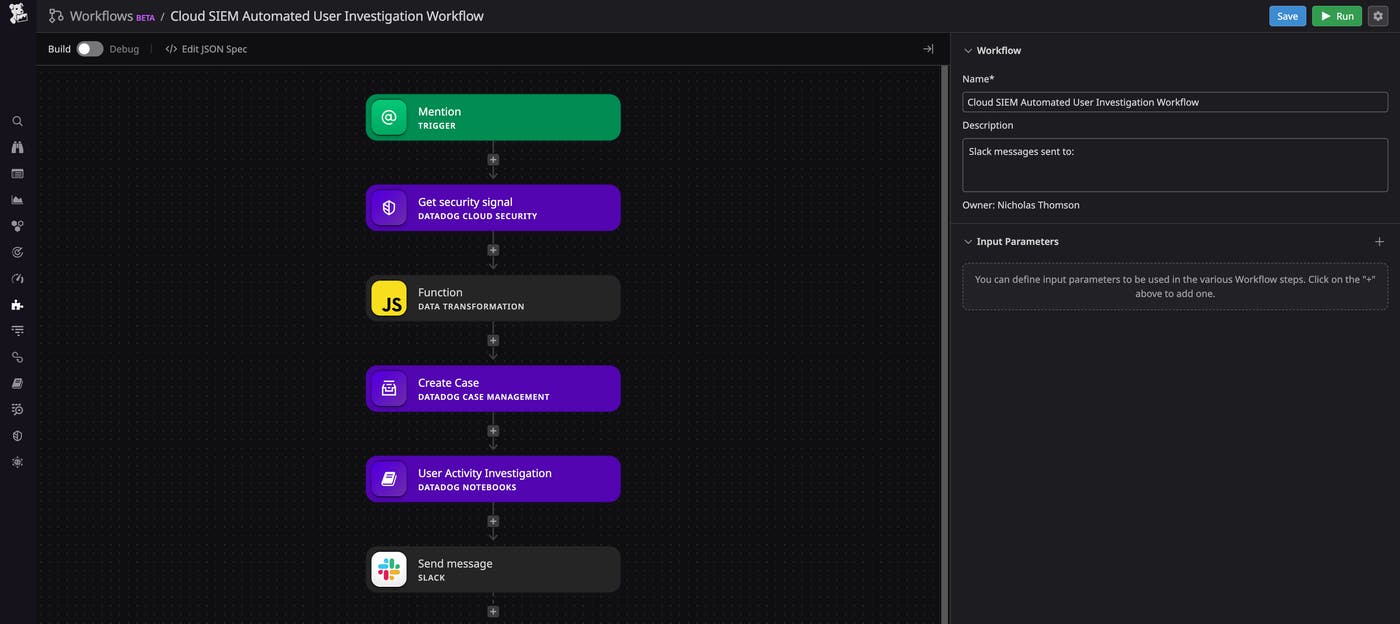
This workflwo automates the data collection step of triaging a security signal

Security signals provide a lot of information, but not necessarily enough to determine whether an alert warrants further investigation or is a false positive. This workflow, when applied to a detection rule of your choosing, will trigger a series of subsequent actions every time the rule is triggered and a new signal is generated. This starts with creating a new case in Case Management, which provides a centralized ticketing system for all issues in your application, enabling your team to track, automate the triage process, and assign issues proactively. By enriching cases with relevant context from your observability data, you can investigate more efficiently, identify and eliminate false positives, and declare an incident if you determine that a security signal is in fact a malicious event.

Next, the workflow will trigger a search in Datadog for activity related to the user identified in the signal. This can provide additional context on why the signal was triggered and surface other areas of your environment that may have been compromised. Then, the workflow will update Datadog Notebooks within the case with the relevant data about this signal—such as logs, key metrics on the volume and on the timing of suspicious requests, and IP addresses of potential attackers. This will help you kick-start your investigation and set your response and remediation process in motion as quickly as possible.

Identify, retro-hunt, and create detection rules for emerging vulnerabilities using a workflow

Workflow blueprints are out-of-the-box sequences of actions provided by Datadog. The blueprints are organized by use case, and there are a number covering essential security processes. These include notifying your team on Slack if S3 buckets are not encrypted, disabling or deleting an AWS IAM user, blocking an IP with Cloudflare, and other security actions.

A helpful workflow used internally by our security research team is the Detect Emerging Vulnerabilities workflow, which searches the internet for references to a specific vulnerability and determines whether the vulnerability is emerging.

This workflow begins with the user setting an input parameter, which would be a common vulnerability and exposure (CVE) number or the name of vulnerability (such as “Dirty Pipe”). If the input is a CVE number, the workflow will query the National Vulnerability Database for metadata related to the vulnerability. The workflow then proceeds to search for open source intelligence on Twitter, GitHub, and the Infosec Exchange Mastodon community to gauge the number of instances of or references to the vulnerability in the wild, identify potential proof-of-concept exploits, and check the vulnerability’s zero-day status. Based on the results of these queries, the workflow yields a score to determine the severity of the vulnerability.

If, based on this score, the vulnerability is determined to be a critical threat, the the Detect Emerging Vulnerabilities workflow will automatically send a Slack message to the relevant parties and provide detailed information on the vulnerability, remediation steps, and the option to create an incident with the click of a button.

If the workflow discovers indicators of compromise (IoCs) on Twitter or Infosec Exchange that are associated with an emerging vulnerability, the workflow will initiate a 30-day retro-hunt query on your logs, searching for evidence of these IoCs in your environment. The workflow will then alert the analyst if this search discovers signs of compromise in your logs and update the Notebooks with the relevant data about this retro-hunt—enabling your team to further investigate these events.

Finally, the workflow will trigger the creation of a detection rule in Cloud SIEM that will generate a security signal for this vulnerability based on the specific IoCs that were discovered. Going forward, this enables you to detect if an attacker is attempting to exploit the vulnerability in your environment.

Automate common security tasks with Workflows and Cloud SIEM

Datadog Cloud SIEM’s new integration with Workflows helps you automate the triage and analysis of security data, expedite issue resolution, and ease coordination across teams by consolidating incident response processes in a single pane of glass. By automating common security tasks, your team can focus on the most critical security issues and leverage Datadog’s wealth of security research experience to detect and defend against unforeseen threats.

Workflows and Case Management can be accessed from the Service Management menu and directly from Cloud SIEM’s Signal side panel. Users who also have Cloud SIEM can start adding workflows to their security and threat detection processes. If you’re new to Datadog, sign up for 14-day free trial.