







Getty
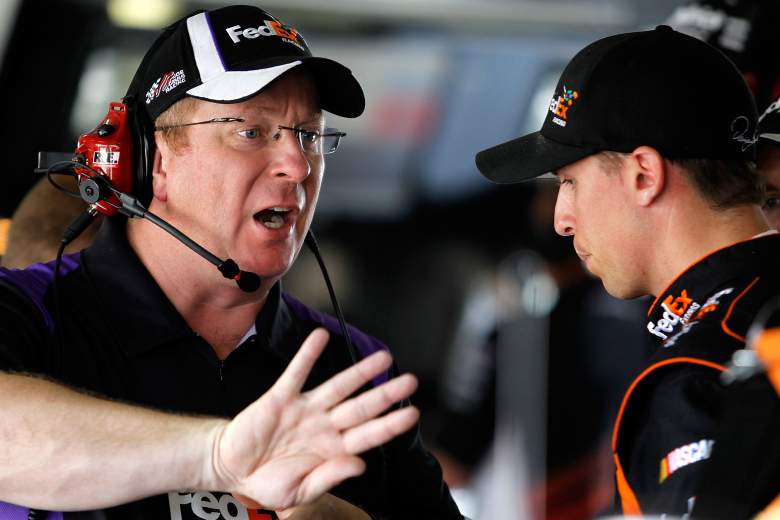
HOMESTEAD, FL - NOVEMBER 20: Denny Hamlin (R), driver of the #11 FedEx Toyota, talks with crew chief Mike Ford in the garage during practice for the NASCAR Sprint Cup Series Ford 400 at Homestead-Miami Speedway on November 20, 2010 in Homestead, Florida. (Photo by Todd Warshaw/Getty Images for NASCAR)
The finish at Kansas Speedway on April 20, 2026, put NASCAR Cup Series race control under sharp focus. What looked like a routine closing stretch quickly turned into chaos when a late caution erased Denny Hamlin’s path to victory.
The trigger came from Cody Ware, who spun while running multiple laps down, forcing overtime and changing the outcome.
Hamlin had managed the race from the front and appeared set to close it out clean. The caution reset the field and handed others a shot on the restart. That sequence has now reignited a familiar issue in NASCAR: how lapped cars impact the finish without crossing the line into a penalty.
On the “Hauler Talk” podcast, NASCAR executives Mike Forde and Amanda Ellis laid out how officials approach these situations. The message to drivers outside contention is clear, even if it is not enforced with penalties.
“In so many words, it’s ‘Don’t be part of this outcome, be aware that there are leaders battling for the win here, so don’t be part of the story, Mike said.”
That philosophy leans heavily on awareness rather than punishment. NASCAR expects drivers to recognize when they are not in the fight and avoid interfering, but it stops short of penalizing every incident.
“If they do become part of the story, nothing will happen to them. Mike added. We’re not going to lay down any penalties unless they do something intentional, in our opinion. But as far as what Cody did, it’s kind of a racing deal, as they say.”
Officials combine traditional tools with modern communication. The blue flag still signals slower cars when leaders approach, but NASCAR now also uses a Microsoft Teams system to send direct notes during races.
“It was used a couple of times this past weekend at Kansas just to send a note,” Amanda said. “Friendly reminders that we’re watching and what the expectation is.”
When the tension builds late in a race, race director Tim Bermann may step in on the public radio channel. His role is not to control the race but to prevent situations from escalating.
“That’s Tim using his 40 years of race directing experience and having a gut feeling that something bad may happen, so let me just say something so something bad doesn’t happen.”
Those moments usually come when traffic stacks up, and the risk increases. The message stays simple and direct.
“If it’s pretty tight and there’s a lot of lapped traffic, he’ll just remind everyone to mind their P’s and Q’s.”
Kansas showed that even with those reminders, the outcome can still swing in seconds when one incident changes the race.
NASCAR’s response does not always end on the track. Forde confirmed that officials will call teams in for post-race discussions if decisions fall into the realm of poor judgment.
“There are times where we have called people to the hauler, spotters, crew chiefs, drivers, if they’ve done something that we consider unintelligent.”
He pointed to strategy calls that leave cars on worn tires at the front, leading to unstable restarts and disrupting the flow of the race.
“There’s been examples of guys who have stayed out on a crazy amount of tires and are in the lead, and then the restart is a disaster area. Sometimes we’d call them into the hauler and say, ‘Hey, next time, let’s be a little bit smarter here.’ You’re just not going to win a race with that strategy that you just tried to employ. All you’re going to do is really piss off everyone else in the garage. And that’s just not something you want to do if you want to have any success in the sport.”
The Kansas finish now stands as another case study in how NASCAR Cup Series officials balance fairness and competition. No penalty was issued for Ware, and the result holds. Still, the scrutiny is not going away, especially as more races come down to tight finishes shaped by traffic.
Dogli Wilberforce is a writer covering NASCAR, Formula 1, and the IndyCar Series for Heavy Sports. He has also written for Sportsnaut, FanSided, Total Apex Sports, and Last Word on Sports. Wilberforce focuses on the NASCAR Cup Series, breaking down news, driver stories, and key moments with a clear, fast, and engaging style. His work connects headlines to context, helping readers understand what matters most in the sport. More about Dogli Wilberforce
此内容由惯性聚合(RSS阅读器)自动聚合整理,仅供阅读参考。 原文来自 — 版权归原作者所有。